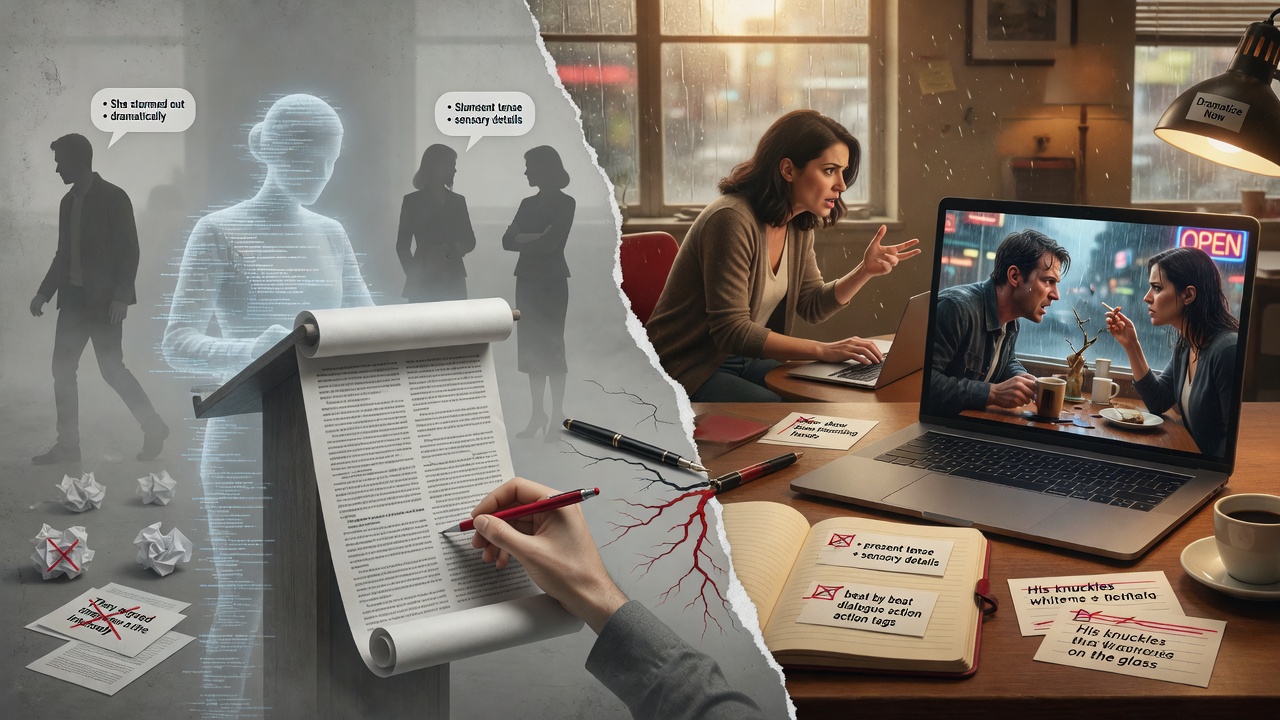
Why AI Summarizes Instead of Dramatizes (The Root Cause)
Here's the uncomfortable truth: AI models are trained on the entire internet plus enormous libraries of text, and the vast majority of that text is expository prose — articles, summaries, reports, Wikipedia entries, book reviews, plot synopses. When you ask an AI to write "the scene where Maya confronts her father," its default mode is to do exactly what all that training data does: describe what happened, compress time, and explain the emotional stakes rather than enact them. The model is essentially writing a very sophisticated summary of a scene that doesn't quite exist yet.
This isn't a bug in the obvious sense. For many tasks, summary is exactly what you want. Ask an AI to describe your protagonist's backstory and you'll get something clean and useful. But ask it to write Chapter 12, and there's a strong gravitational pull toward the same compression. Paragraphs show up that read like "Over the next hour, they argued about the money, and eventually Maya stormed out, feeling betrayed." That's not a scene. That's a recap of a scene.
The AI isn't being lazy. It's doing what it does best: processing and condensing information. Your job is to force it out of that mode entirely.
The technical reason this happens involves how language models predict tokens. They're optimizing for coherent, flowing prose that matches what they've seen. And what they've seen most is prose that moves quickly, covers ground efficiently, and tells the reader the outcome. Scene-level dramatization — staying locked in a single moment, letting dialogue breathe, rendering sensation in real time — is statistically rarer in the training corpus. So you have to work against the model's natural inclination every time you want a genuine scene.
Understanding this root cause changes how you prompt. You're not asking the AI to "write better." You're asking it to override a deeply ingrained tendency toward efficiency. That requires specific, structural constraints in your prompt — which is exactly what the rest of this guide covers. If you're just starting to write a book with AI, building these habits early will save you enormous revision time later.
How to Recognize Summary Creep in Your AI Draft
Summary creep is sneaky. It doesn't always announce itself as "this is a summary." Sometimes it disguises itself as a perfectly reasonable paragraph. You need to train your eye to catch the specific signatures.
The Elapsed Time Tell
The clearest signal is compressed time. Phrases like "for the next few minutes," "after a long silence," "as the evening wore on," or "eventually" are almost always summary in disguise. Real scene-time moves beat by beat — one action, one reaction, one line of dialogue, then the next. When time jumps, you've left the scene.
Emotion Without Sensation
Watch for sentences that name an emotion without grounding it in the body or the physical world. "She felt devastated" is summary. "Her hands stopped moving. She set the letter on the counter and didn't pick it up again" is scene. The AI almost always defaults to naming emotions directly, because that's what most prose in its training data does. You want it to enact the emotional state through behavior and sensation instead.
Dialogue Summaries Instead of Dialogue
This one's particularly brutal to read once you spot it. The AI writes things like: "He explained that he had been lying about the inheritance for years, and she tried to stay calm but couldn't." That's summarized dialogue. An actual scene would have him saying specific words, her face doing something specific, and the air in the room changing. Run your Filter Word Finder over an AI draft sometime — the filter words cluster around exactly these summary passages, because summary and filtering tend to travel together.
The Outcome Lead
Another signature: the AI tells you the result before dramatizing the path to it. "The argument ended badly, with Tomás refusing to apologize and leaving without a word." Now there's no reason for the argument scene — you already know how it ends. Real scene construction withholds the outcome and makes the reader earn it moment by moment. If your AI draft keeps front-loading outcomes, you're looking at summary masquerading as narration.
A quick pass with the Manuscript Cleanup Report can surface some of these patterns automatically, but the real skill is reading for them yourself. Once you start seeing summary creep, you see it everywhere — and you also start understanding exactly what kind of prompts prevent it.
Scene-Mode Prompts: Forcing AI into the Present Tense of Story
The single most effective thing you can do is tell the AI explicitly that it is writing a scene, not describing one. That sounds obvious but most writers skip it. They write "write the scene where…" and assume the model understands what scene construction actually requires. It doesn't, by default. You need to build the constraints directly into the prompt.
The core components of a strong scene-mode prompt are: a specific opening moment (not a situation — a moment), a constraint against summarizing or compressing time, explicit instruction to render dialogue and sensation in real time, and a defined endpoint so the model doesn't start summarizing its way toward a resolution. Here's what that looks like in practice:
Write a scene (not a summary) in which Detective Reyes knocks on apartment 4B and the door opens to reveal her estranged sister. Begin at the exact moment the door swings open — do not summarize anything that happened before this moment. Stay in continuous present-tense story time: every beat of dialogue must be written out in full, no paraphrasing. Render Reyes's physical sensations — what she sees, what she smells, the feeling of her own hands. Do not compress time or skip ahead. End the scene at the moment Reyes decides whether to step inside or not — do not resolve that decision. Third person limited POV, past tense prose.
Notice the prompt does several things at once: it names a specific sensory anchor (the door swinging open), it explicitly prohibits summarizing, it instructs on dialogue rendering, it assigns an emotional/sensory task, and it defines a hard stop before resolution. That last part is critical. Without a defined end point, the AI will rush toward resolution and start summarizing the emotional fallout — because that's how it closes a loop efficiently.
You should also try giving the AI a "camera" metaphor. Models respond surprisingly well to cinematographic framing because it's well-represented in their training data.
Treat this scene like a film camera that cannot cut away. The camera is locked on Marcus and Delia at the kitchen table for the duration of this scene — it cannot skip forward in time, cannot summarize what they feel, can only show what it would actually see and hear in real time. Marcus has just found the plane ticket in her coat pocket. Write the scene from this moment until he stands up from the table. Every line of dialogue must be spoken out loud on the page. No internal summary of emotions — show his reactions through physical behavior only.
This works because it reframes the AI's task as recording rather than narrating. Recording implies completeness and continuity. Narrating implies selection and compression. The camera constraint forces the model into a different relationship with time. For genre-specific applications, the same logic applies whether you're writing a romance novel with AI or handling high-stakes confrontations in a thriller — the camera metaphor scales.
The 'No Elapsed Time' Constraint for Locking AI to a Single Moment
The "no elapsed time" constraint is probably the single most powerful tool in your scene-mode toolkit. It's exactly what it sounds like: you tell the model it is not allowed to advance the clock. Everything that happens in the output must happen in continuous real time from the established starting point.
This forces something remarkable. The AI can no longer fall back on its default mode of "and then, and then, and then" compressed narration. It has to find other ways to fill the scene — which means it reaches for the tools that actually create drama: specific dialogue, physical behavior, observed detail, sensory texture. The constraint functions like removing a crutch. Suddenly the model has to walk differently.
Write a 600-word scene starting at the exact moment Priya sits down across from her editor at the restaurant. CONSTRAINT: No elapsed time. The scene covers only what happens in the first three minutes of their meeting — do not skip forward, do not compress, do not summarize. If you feel the urge to write "after a pause" or "eventually" or "minutes later," stop and instead write what fills that pause. Every line of dialogue spoken by either character must appear in full. Priya is trying to hide that she knows the manuscript is being dropped. Write in close third person, past tense. Do not tell the reader what Priya is feeling — only what she does with her hands, her face, her voice.
The instruction "if you feel the urge to write 'after a pause' — stop and instead write what fills that pause" is particularly useful because it anticipates the AI's escape routes and closes them. You're essentially saying: I know how you'll try to cheat, and I'm blocking that move in advance.
One thing worth knowing: different models handle this constraint differently. Some will honor it tightly for a paragraph and then drift back toward summary. Others stay locked in much longer. If you're deciding which model to use for a scene-heavy chapter, it's worth checking out comparisons of the best AI models for writing to understand where each one breaks under constraint. Also, if your story has any structural complexity — flashbacks, dual timelines, jumping between character POVs — you'll face additional challenges with time that the no-elapsed-time constraint alone won't solve. The guide on Which AI Model Handles Nonlinear Timelines Best goes deep on exactly that.
For scenes that need to cover more ground — a full argument, a seduction, a negotiation — you can stack the constraint across multiple prompts. Write the first three minutes in one pass, then continue from the last line of output in the next pass, with the same constraint applied again. This is slower than asking for a full scene in one shot, but the resulting prose is dramatically better. It also keeps character consistency higher, because the model is working with more specific context each time rather than abstracting from a character summary.
Fixing Existing Summary Passages with a Dramatization Pass
You've already got a draft. It's full of summary creep. Now what?
The good news is that a dedicated dramatization pass is faster than rewriting from scratch, and it's something AI is actually quite good at once you frame the task correctly. The key is isolating each summary passage and treating it as raw material — not as prose to be polished, but as a blueprint for a scene that needs to be constructed.
Here's the workflow. First, read your draft and mark every paragraph that contains compressed time, named emotions, summarized dialogue, or outcome-first narration. Don't try to fix as you go — just flag. Then take each flagged passage as a separate task. Paste the summary passage into your AI tool followed by this kind of prompt:
The following paragraph is a summary of a scene that should be dramatized in full. Expand this into a scene of 400-600 words. Do not keep any summary language. Every emotional beat implied in the summary must be enacted through dialogue, physical behavior, or sensory detail — not stated directly. If the summary says "they argued," write the actual argument. If it says "she felt relieved," show the relief through her body and voice. Begin the scene at the first moment described and end it at the last moment described. No compression, no elapsed time jumps, no explaining what characters feel.

[Paste summary paragraph here]
This framing works because it repositions the existing text as a story treatment rather than finished prose. The model stops trying to preserve your original language and instead uses it as a scene spec. The results aren't always perfect on the first pass, but they're almost always dramatically more scenically present than what you started with.
After your dramatization pass, run the Cliché & Overused Phrase Finder on the expanded scenes. Expansion tends to generate a certain category of melodramatic cliché — trembling hands, racing hearts, voices barely above a whisper — because those are the high-frequency sensation words in the training data. You'll want to catch those and replace them with more specific, character-specific physical behavior.
For a structured approach to the full revision sequence, The Five-Pass Revision Order for AI-Assisted Novels places the dramatization pass in context with all the other revision work your manuscript needs. And if you're concerned about editing a book with AI more broadly — line-level issues, pacing, structural problems — there's a full framework for that too. The dramatization pass is one layer of a larger editorial stack, not a standalone fix.
One final thing that makes the whole process easier: if you build your scene requirements into your story bible from the start — noting which scenes carry heavy emotional weight, which moments must play out in real time — you'll generate fewer summary-heavy drafts in the first place. Prevention is faster than repair. Set the expectation in your project context that scenes are scenes, not summaries, and the model will surprise you with how much it can honor that when the instruction is clear and specific.
Pick the worst summary passage in your current draft — the one you've been skimming past because it feels thin — paste it into your AI tool with the dramatization prompt above, and see what one focused pass produces. That's your proof of concept. Everything else in this guide scales from there.