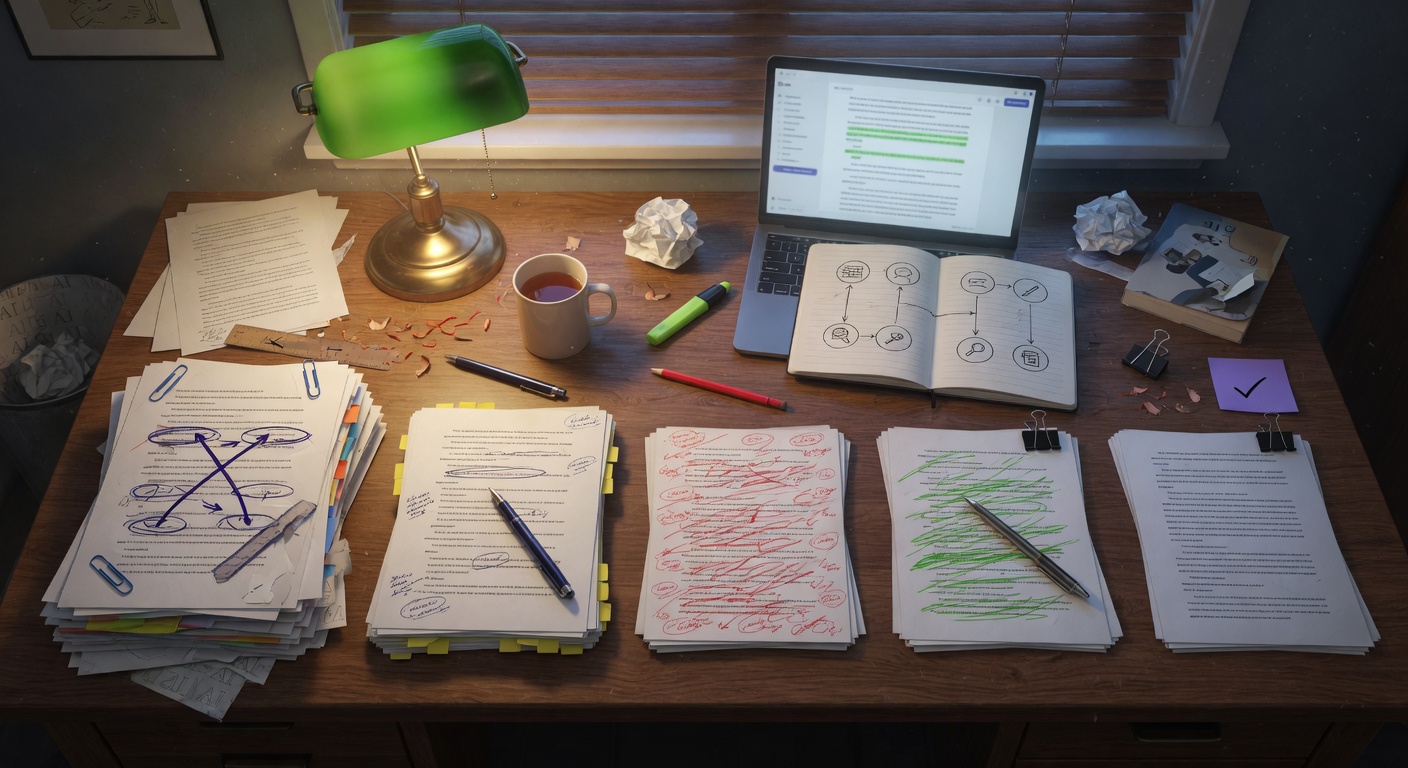
AI drafts arrive fast—and messy in predictable ways. Characters change eye color, subplots vanish, and every emotional beat gets labeled instead of dramatized. The fix is not "run Grammarly and publish." It is a fixed revision order so each pass has one job.
Pass 1: Story spine (do not touch sentences yet)
Read only chapter summaries or your outline column. Ask: does the protagonist want something clear on page one? Does each chapter change the situation? Are there scenes that repeat the same beat (two arguments about trust, two tavern reveals)?
Mark structural cuts in the margin. If a chapter exists only because the model needed word count, delete or merge it before you polish a single line.
Pass 2: Continuity and character bible
Build a one-page bible: names, ages, speech tics, who knows what when. Walk the manuscript with that sheet. AI models forget constraints between sessions—this pass catches "Sarah's brother Tom" becoming "Sarah's cousin Tom" in chapter fourteen.
Use a name variant checker if you suspect spelling drift. Flag timeline errors (a "three-day journey" that takes one paragraph).
Pass 3: Scene purpose and pacing
Every scene needs: goal, conflict, outcome. Highlight scenes where characters meet, exchange information, and leave without friction—those are summary disguised as scene. Either add opposition or collapse them into a transition.
Check chapter endings. AI loves symmetrical closure ("She slept, wondering what tomorrow would bring"). End on action, decision, or reversal when possible.
Pass 4: Voice and dialogue
Read dialogue aloud. If every character sounds like the same polite assistant, assign each a constraint: one never uses contractions, one interrupts, one deflects with humor. Replace half your dialogue tags with action beats.
Run a filter word scan on narration only. Cut "felt," "seemed," and "very" clusters—the fastest way to make AI prose feel human-edited.
Pass 5: Line-level polish and proof
Now run readability, adverb, and passive-voice tools. Fix typos and repeated words. Compare your opening chapter to your climax—energy should rise, not flatten.
Rule of thumb: if you are fixing plot and commas in the same sitting, you will redo work. Separate passes save weeks.
When to involve humans
After pass 3, a beta reader or developmental editor sees story problems you normalized. After pass 5, a copy editor catches grammar you missed. AI gets you to "real draft" faster; humans still matter for quality.
Entangled Text's diff-based editor is built for passes 4–5: generate a revision prompt, review each change, accept or reject. See how to edit a book with AI for the workflow inside the app.
What “done” looks like after each pass
Writers skip passes because the draft already looks like a book. AI drafts always look like a book. Use exit criteria instead of vibes:
- Pass 1 done when you can state the protagonist’s want in one sentence and every chapter either advances it or you have a reason it exists (breather, clue, relationship cost).
- Pass 2 done when names, ages, who-knows-what, and geography match a one-page bible. If you find a contradiction, fix the bible the same day you fix the prose.
- Pass 3 done when no scene is “two people talk, then leave.” Goal, friction, outcome — or cut it.
- Pass 4 done when you can identify speakers from dialogue with names removed. If you cannot, assign speech constraints and regenerate only the talky scenes.
- Pass 5 done when a read-aloud of chapter one and the climax does not snag on filter stacks (“she realized she felt”) or identical sentence lengths.
Map the passes to Story Studio
In Entangled Text, pass 1 happens on the outline and chapter list in Write — merge, retitle, delete — before you spend pool on polish. Pass 2 is the story bible / continuity tools plus a name check. Passes 4–5 are scoped diffs: prompt “rewrite only the argument in this chapter; keep plot beats.” Regenerating a whole chapter because one paragraph failed is how you spend a month of allowance on work you will throw away.
After pass 3, send a beta-reader link from Ship. Do not ask betas to hunt typos you have not cleaned; they will. After pass 5, run manuscript cleanup, then export from Ship. KDP formatting is a later problem — see the KDP upload checklist.
A weekend plan if the draft is already “finished”
- Saturday morning: spine only. Print or paste chapter titles + one-line summaries. Cut or merge before noon.
- Saturday afternoon: bible walk of names and secrets. Do not line-edit.
- Sunday morning: scene purpose on the worst three chapters (the ones you dread rereading).
- Sunday afternoon: voice pass on dialogue in those three chapters only. Stop. Resume pass 5 on Monday with tools, not willpower.
If you try all five passes in one sitting, you will rewrite the same paragraph for plot and then for commas, then change the plot again. Separate passes are slower on day one and faster by week two.