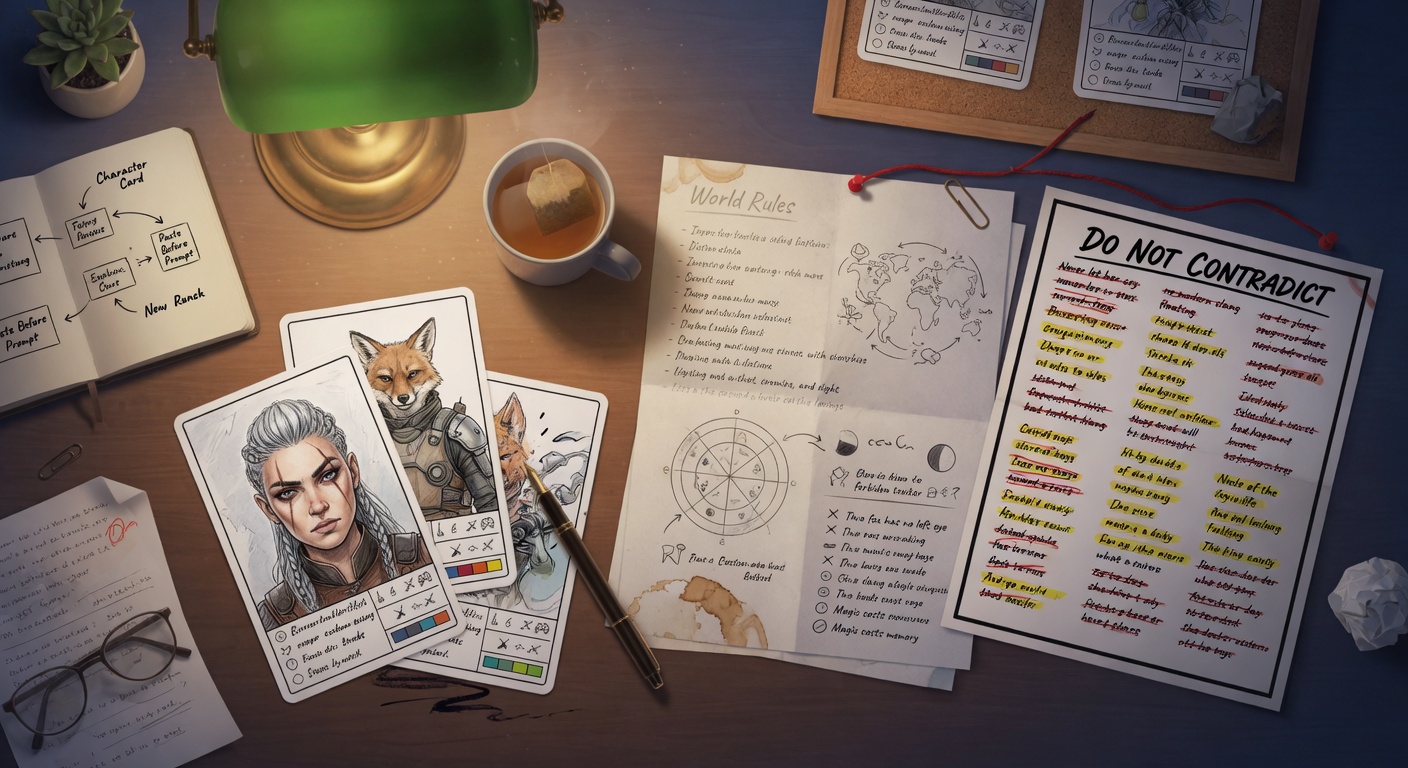
Large language models do not remember your novel. They predict the next token from what is in the prompt right now. A story bible is not worldbuilding cosplay—it is the minimum context you re-inject so chapter forty matches chapter four.
Keep it short and scannable
Target 800–1,200 words total for a mid-length novel. Longer bibles get truncated or ignored. Use bullets, not prose essays.
Character cards (3–5 lines each)
- Name + role — "Mira Voss, protagonist, disgraced cartographer"
- Want / fear — "Wants redemption; fears being forgotten"
- Voice — "Short sentences, avoids metaphors, swears when stressed"
- Secrets — "Forged the map that caused the border war"
World rules (hard constraints)
List facts the model must not violate: magic costs blood; FTL takes three weeks; the king is alive until act three. AI will invent convenient exceptions unless you forbid them explicitly.
Timeline anchor
One paragraph: where we are in the story when generating. "Day 12 of the expedition. Mira knows about the forged map; Jalen does not."
Paste strategy
Put the bible in system context or the first user message every session. In Entangled Text, use project story settings so it travels with each chapter job—do not rely on chat history.
STORY BIBLE (do not contradict):
[paste cards + rules]

CURRENT CHAPTER: 14 — "The Flood Gate"
SCENE GOAL: Mira confesses to Jalen; he refuses to believe her.
POV: Mira, close third, past tense.
DO NOT: introduce new named characters; resolve the confession in this scene.

Write the scene (~1,400 words).
After generation, diff against the bible manually for the first few chapters until you trust the model.
Update the bible when the story changes
When a secret is revealed, move it from "Secrets" to "Known facts." Stale bibles cause more drift than no bible at all.
Related: character consistency workflow and the free series bible worksheet tool.
A compact bible you can actually paste
Here is a shape that survives context windows. Copy it, delete unused lines, keep it under ~1,000 words:
- Header — Title, genre, POV, tense, heat/violence level, “do not contradict” in one line.
- Cast — Three to eight cards. If a name is not on a card, the model should not invent them a last name.
- Rules — Magic, tech, law, money. Phrase as prohibitions: cannot resurrect; cannot read minds; FTL is three weeks.
- Clock — Story day, who knows which secret, what the last chapter just changed.
- Voice — Two sample sentences of narration you will accept. Models imitate the nearest prose in the prompt; give them a target.
What does not belong in the paste: lore essays, family trees, maps in prose, or chapter-by-chapter recaps of the whole book. Summarize “where we are now.” History that is not load-bearing this scene is noise.
Common bible failures
- The bible grew — You appended every new idea. The model then ignores the middle. Trim weekly. Move spent secrets to a “known facts” line, not a second essay.
- The bible is fiction — Pretty worldbuilding that does not constrain scenes. If a rule never causes a problem, delete it or give it a cost.
- The bible fights the outline — Outline says the king dies in chapter 12; bible still says he is alive “until act three.” Pick one source of truth before you generate.
- You stopped pasting it — Chat history is not memory. In Entangled Text, keep the bible in project story settings so every chapter job carries it. Do not rely on “the model remembers from yesterday.”
Series vs single-book bibles
For a series, split: a series sheet (rules, recurring cast, timeline of prior books) and a this-book sheet (current want, current secrets, current geography). Paste both, series first, book second. If the book sheet contradicts the series sheet, the book sheet wins for this generation — then update the series sheet after you accept the chapter.
Before you generate chapter one of book two, walk proper nouns. A series bible worksheet is enough; you do not need a wiki. If you are mid-draft in Story Studio, lock chapters you have already revised so a later generation does not “helpfully” rename a secondary character.