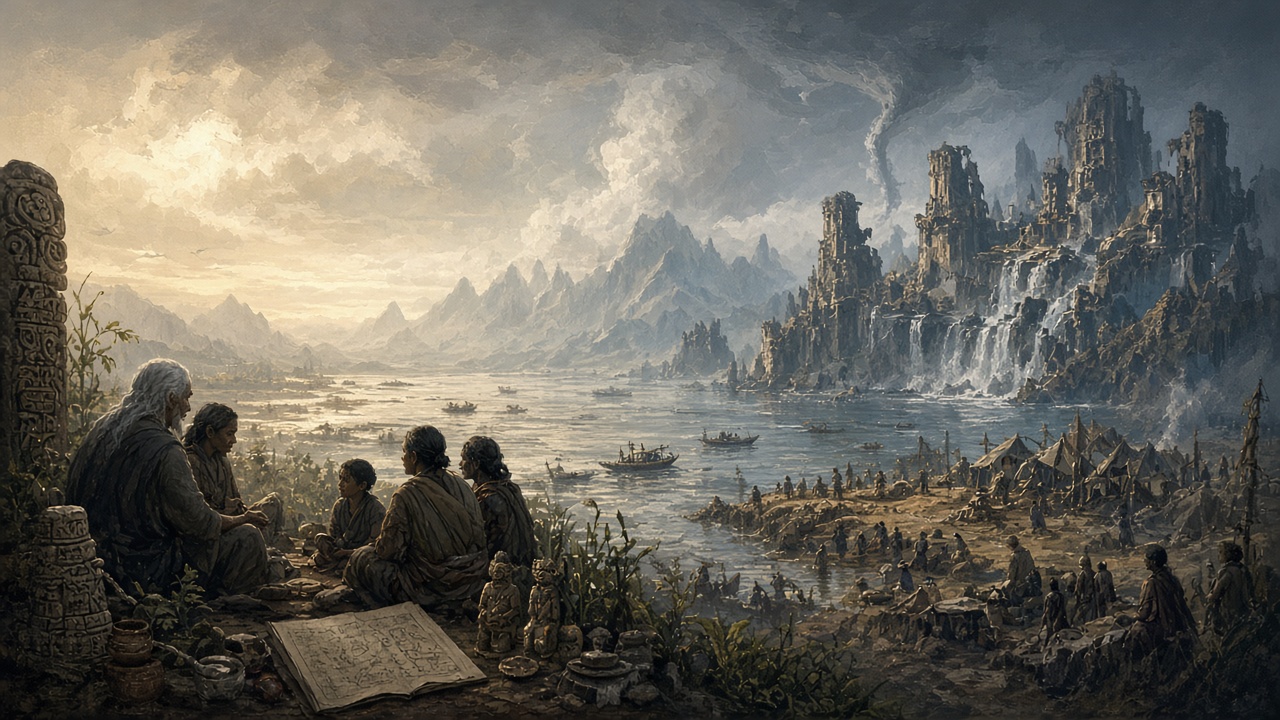
Disaster as Trivia vs. Disaster as DNA
Ask most AI models to build a fantasy world with a history of famine, and you'll get a single paragraph buried in the backstory: "Two hundred years ago, the Long Famine killed thousands." Then everyone moves on. The famine becomes a fact characters might mention once, like a Wikipedia footnote, instead of something that shaped how people eat, marry, worship, and insult each other. That's because AI tends to treat disasters the way a textbook does — as an event with a start and end date — rather than the way an anthropologist does, as a force that keeps rippling through a culture long after the actual crisis ends. A real famine doesn't just kill people. It changes what foods carry shame, which professions become suspect, who the culture blames when things go wrong again, and what jokes you're not allowed to tell at dinner. If you're trying to write a book with AI that feels lived-in rather than lore-dumped, you need to stop asking the model to describe the disaster and start asking it to trace the disaster's descendants — the habits, taboos, and social structures it left behind. This guide walks through a method for doing exactly that, working backward from the catastrophe itself to the textures of daily life two or three generations later.
A disaster that only appears in exposition is backstory. A disaster that shows up in slang, recipes, and who you're allowed to marry is worldbuilding.
Step One: Pick a Disaster With a Mechanism
Before you prompt anything, get specific about how your disaster actually works. "Bad weather" or "a terrible war" gives the AI nothing to extrapolate from. "The Long Drought" is better, but still thin unless you define its mechanism — the actual physical or magical logic of how it unfolded. Compare these two setups:
- Weak: A magical blight destroyed the crops a century ago.
- Strong: A blight caused by an unraveling ley line made all grain crops within forty miles of the old capital sterile for eleven years, but only grain touched by iron tools — so wooden-plowed fields survived while iron-plowed estates failed completely.
The second version already implies winners and losers. Whoever still used wooden plows — probably poorer, more traditional farmers — survived while wealthier estates with iron tools collapsed. That single mechanical detail is doing worldbuilding work before you've written a single scene. This is the same instinct behind good fantasy worldbuilding: specificity up front saves you from generic output later, and it works whether you're building magic systems or ecological catastrophes. Here's a prompt that forces this kind of specificity instead of letting the AI default to vague "bad times" language:
I'm designing a climate disaster for my fantasy world called the Ashfall Winters — a volcanic event that darkened the sky for seven years. Help me define its mechanism with concrete rules: What specifically failed first (crops, livestock, trade routes)? What regions were hit hardest vs. spared, and why — geography, altitude, proximity to coast? Was there a resource that became suddenly valuable because it circumvented the disaster (stored grain, greenhouse technology, a specific hardy crop)? Give me 5-6 concrete mechanical facts, not vague atmosphere. I want facts I can use to derive who gained power and who lost it.
This works because it demands causality, not mood. You're asking for facts with winners and losers baked in, which is exactly the raw material you need for the next step.
Step Two: Trace Who Gained Power, Who Got Scapegoated
Once you have a mechanism, the next move is asking the AI to run that mechanism forward through a social lens, not just a historical one. Most disaster worldbuilding stops at "there was a war over resources afterward." You want more granularity than that — specifically, you want to know which existing social fault lines the disaster widened, and which new ones it created. Think about real history for a second. The Black Death didn't just kill a third of Europe — it also broke feudal labor structures because suddenly peasants could demand wages, it triggered massacres of Jewish communities who got scapegoated as poisoners, and it shifted religious authority because the Church couldn't explain or stop the deaths. One mechanism, three completely different second-order effects on power, blame, and belief. Push your AI toward this kind of multi-threaded consequence instead of a single tidy outcome:
Given the Ashfall Winters mechanism we defined (wooden-plow farmers survived, iron-plow estates failed, greenhouse-grown "ember root" became the only reliable food source), trace three separate second-order effects:
1. Who gained political or economic power during the crisis that didn't have it before, and how did they consolidate that power once the crisis ended?
2. Who became a scapegoat — a group blamed for causing or worsening the disaster — even if the blame was scientifically unfounded? Give me the accusation's internal logic, even though it's wrong.
3. What previously respected profession or social role became suspect or low-status because of its association with the disaster?
Answer each as a short scenario with specific names of groups, not abstractions like "the poor" or "the elite."
Notice the prompt explicitly asks for "internal logic, even though it's wrong." That's deliberate — scapegoating always has a twisted rationale behind it, and if you skip that step the AI will just give you "people were scared and blamed outsiders," which is true of literally every disaster in history and therefore useless to your specific story. You want the specific accusation: greenhouse growers were hoarding warmth-magic, so they must have caused the ash cloud to create a monopoly. That's a detail you can build a subplot around. This is also where it helps to keep a running story bible that AI models actually follow, because these second-order effects need to stay consistent across every chapter and every character who references them. Without a central reference document, you'll get contradictory versions of "who got blamed for the Ashfall" depending on which chat session you asked.
Step Three: Turn Fallout Into Texture
This is the step most writers skip, and it's the one that actually makes a disaster feel like lived history instead of an encyclopedia entry. Power shifts and scapegoats are structural. Texture is sensory — it's what characters eat, what they won't say out loud, what children chant while jumping rope, what word makes an old woman's face go hard. Once you know the mechanism and the social fallout, ask the AI to generate the small, specific cultural debris the disaster would leave behind:
Based on the Ashfall Winters and the fact that ember root became the only reliable food while traditional grain farming was associated with the failed iron-plow estates, generate:
- Three food customs or substitutions that persisted for generations after the crisis ended (even once grain farming recovered)
- Two marriage or courtship taboos connected to greenhouse-growing families vs. traditional farming families
- A children's rhyme or game that references the disaster obliquely, the way "Ring Around the Rosie" is rumored to reference plague
- A slur or insult that grew out of the greenhouse-grower scapegoating, including what it literally means and why it stings
- One religious or seasonal ritual that emerged specifically because of the seven dark years
Make these feel like things that outlived their original meaning — characters using them without fully remembering why.
That last instruction — "things that outlived their original meaning" — is the key to making this feel authentic rather than like a history lesson. Real cultural residue gets detached from its cause over time. Nobody doing "bless you" after a sneeze is thinking about the plague. You want your ember-root wedding custom or your children's chant to feel exactly that unmoored, so when a character finally explains its origin to an outsider (or to the reader), it lands as revelation rather than exposition. This kind of texture is also where genre-specific tools can help you go deeper. If you're writing something with a strong historical backbone, historical fiction with AI tools are built around exactly this instinct — grounding invented custom in plausible cause and effect. And if your disaster has a horror angle (a blight that's still slightly active, a famine god who still wants tribute), the same backward-design logic is core to how you'd approach horror with AI, where dread lives in ritual and avoidance, not jump scares.
Step Four: Stress-Test Your Characters' Assumptions
Here's where most manuscripts quietly fall apart. You do all this rich worldbuilding work up front, generate taboos and slurs and rituals — and then three chapters later, a character casually does something that violates the disaster's logic without anyone noticing. A noble family serves wheat bread at a wedding feast like it's nothing, even though wheat farming is supposed to carry generational shame. A soldier swears by a god whose temple should have been destroyed in the famine riots. These aren't big dramatic contradictions — they're small continuity leaks, and they're exactly the kind of thing sharp readers catch. The fix is to treat your disaster's logic like a constraint system, the same way you'd treat a magic system. Good fantasy magic systems work because the limitations are consistent; your disaster's social fallout needs the same rigor. Once you've drafted a scene, go back and ask the AI to audit it specifically for logic violations:
Here's a scene from Chapter 9 where Lady Ambrette hosts a harvest feast for visiting dignitaries [paste scene]. Based on our established world rules — wheat farming carries shame from its association with the failed iron-plow estates, ember root is considered humble "survivor's food" that upper classes avoid eating in public, and the word "plowtouched" is a slur for descendants of iron-plow families — check this scene for any detail that contradicts those rules. Flag anything a careful reader would notice as inconsistent, including food served, casual dialogue, and any character's unremarked assumptions about status or custom.
This is essentially a targeted version of what a character consistency check does for personality and voice, except you're applying it to cultural logic instead. Run this kind of audit during your five-pass revision, specifically during the pass focused on worldbuilding and continuity rather than prose quality — trying to catch logic violations and line-edit typos in the same pass means you'll do both badly. It's worth doing this stress test with secondary characters especially, since protagonists usually get more authorial attention. The merchant who shows up for one scene, the dignitary's bored teenage son, the innkeeper — these are the characters most likely to casually break your disaster's rules because nobody's watching them closely. Ask the AI to specifically inventory every background character's unremarked assumptions, not just your leads.
Scaling This Across a Series
If you're writing more than one book in this world, the disaster's cultural fallout needs to evolve, not stay frozen. A taboo that's ironclad in Book One, set thirty years after the crisis, might be eroding by Book Three, set three generations later, as the direct witnesses die off and the ritual becomes performative rather than sincere. That evolution is itself a great source of generational conflict — grandparents who take the famine taboos seriously clashing with grandchildren who think they're superstition. Track this in a Series Bible Template with a dedicated timeline for "cultural fallout decay" — noting which taboos are still sincerely held, which are becoming ironic or performative, and which have died out entirely by each book's timeframe. This is also a natural place to log your disaster's mechanism facts so every book stays consistent, the same way you'd use an AI book outline to keep plot threads straight across volumes. If your story involves multiple cultures that experienced the same disaster differently — say, a coastal region spared the worst of it versus an inland region devastated — that's a rich vein for class or political tension in a science fiction with AI setting too, not just fantasy. Resource collapse, climate migration, and generational trauma translate directly into sci-fi frameworks: a terraforming failure or an orbital famine works on exactly the same backward-design logic as a magical blight. One more practical note: this method produces a lot of generated material — mechanism facts, scapegoat logic, taboos, slurs, rituals, decay timelines. Before you commit to a full draft built on all of it, it's worth understanding how to budget AI drafting for a full novel, since this kind of iterative, multi-pass worldbuilding prompting adds up across a long project differently than straightforward scene drafting does.
The Takeaway
Don't ask your AI to describe a disaster. Ask it to age one. Define the mechanism first — what specifically failed and who was spared by accident of geography or tools. Then trace power, blame, and shifted status. Then harvest the small stuff: the rhyme, the slur, the wedding custom nobody remembers the origin of. Finally, audit your actual chapters against that logic before you consider the worldbuilding done. A disaster that's still shaping your characters' table manners and insults three generations later isn't backstory anymore — it's just how the world works, which is exactly how it should feel.