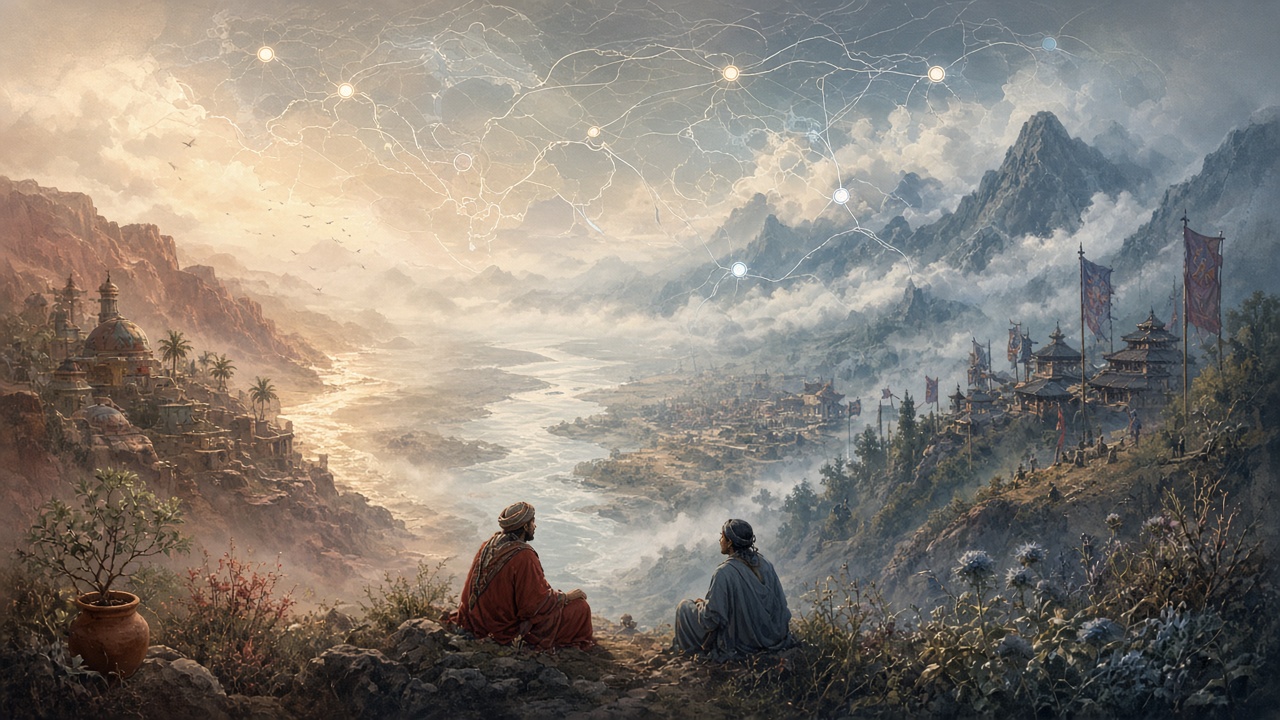
Why AI Defaults to "Culture Ends at the Border"
Ask an AI model to describe two neighboring nations and you'll get two tidy paragraphs. Nation A eats this, worships that, speaks this language. Nation B is the photo negative. Somewhere between them is an invisible seam where, apparently, culture just... stops. People on one side never intermarry with people on the other. Nobody smuggles anything. Nobody's grandmother speaks a mash-up dialect nobody has a name for. This happens because the model is pattern-matching against how most reference material describes nations: as discrete units with flags, capitals, and Wikipedia infoboxes. Borders in that training data are usually described as legal lines, not lived spaces. So when you ask for "a border town," you often get a town with a wall down the middle and two totally separate societies politely not touching each other — which is almost never how real border zones work. Real border zones are messy, mixed, contested, and full of people who belong to both sides and neither. If you've spent time trying to write a book with AI set in occupied territory, a contested frontier, or a port city built on trade, you've probably hit this flattening effect. The fix isn't a better one-line prompt. It's a method — a way of forcing the model to generate friction instead of symmetry.
A border isn't a line. It's a zone with its own economy, its own slang, and its own rules that neither side fully controls.
Mapping the Friction Points First
Before you write a single scene, build a friction map. This is a short reference document — four or five categories where the two cultures visibly rub against each other — that you feed into every prompt afterward. Skipping this step is why AI-generated border zones feel like set dressing instead of living places.
Language creep
Real border populations don't speak two clean languages. They speak a blend, and the blend isn't symmetrical — one language usually bleeds into the other more than vice versa, depending on who has economic or military power. Ask the AI to generate this bleed explicitly: loanwords for contraband goods, slang terms border guards use that civilians don't, insults that only make sense in the mixed dialect.
Contraband goods
Every border has a black-market shopping list, and that list tells you everything about what each side lacks. If one country bans religious texts and the other bans certain medicines, the smuggling routes reveal the actual power asymmetry better than any exposition dump.
Intermarriage law
Who's allowed to marry across the line, under what legal fiction, with what children's citizenship status? This single detail generates enormous plot texture — inheritance disputes, custody battles, kids who hold two passports and belong to no army.
Dual-loyalty holidays
Look for the one holiday both sides technically celebrate but for entirely different, sometimes opposite reasons. A harvest festival that's a liberation day on one side and a day of mourning on the other, observed in the same town square, is a scene generator all by itself.
I'm building a border zone between two nations for my novel: the Kestrel Republic (industrial, currency-strong, controls the river trade) and the Ossa Marches (agrarian, currency-weak, controls the mountain passes). Generate a friction map with five categories: (1) three specific loanwords or slang terms that have crossed from Kestrel into Ossa speech and three that crossed the other way, with a note on WHY each one crossed that direction; (2) a list of six contraband goods smuggled across this border, three each direction, tied to what each side legally restricts; (3) the actual legal status of cross-border marriage — is it recognized, semi-recognized, or void, and what happens to children's citizenship; (4) one shared holiday that means something different on each side, including how it's actually celebrated in the border town itself, not in either capital.
This works because it forces specificity in four directions at once, and it makes you articulate power asymmetry (currency strength, trade control) before any character shows up. Swap in your own nation names and the two things each side actually controls — resources, terrain, trade routes — and the model will generate friction that's logically load-bearing rather than decorative.
Prompting for Asymmetry, Not Balance
Here's the trap: once you ask for "two cultures blending," the AI often tries to be fair. It'll give you 50/50 blending, mutual respect, a nice diplomatic equilibrium. Real contact zones are almost never balanced. One side's language becomes the trade language. One side's currency becomes the de facto currency even on the other side of the line. One side's citizens code-switch fluently while the other side's citizens barely bother learning ten words, because they don't have to.
You need to explicitly assign power before asking for the cultural texture, or the model will average everything into blandness.
In the border town of Vessy Crossing, the Kestrel Republic has the economic and military upper hand — their currency is used for all transactions, their language is required for any official paperwork, and their border guards outnumber the Marches' militia five to one. Given this power imbalance, show me: (1) how Ossa Marches merchants speak when selling to Kestrel customers versus when they're alone with each other — give me actual sample dialogue lines in both registers; (2) which side's slang has become "cool" or aspirational for teenagers on the other side, and why; (3) a pricing scene at the town market where the same goat cheese is priced differently depending on who's buying, and the vendor's unspoken reasoning; (4) who code-switches fluently and who doesn't bother, and what that says about who's forced to adapt versus who can afford not to.
This prompt is good because it makes the asymmetry do narrative work — pricing, slang prestige, and code-switching are all downstream effects of who holds power, and once you have concrete examples you can drop straight into dialogue. When you get the response, push further: ask what happens when the power balance shifts (a war ends, a trade deal collapses) and how fast the slang and pricing patterns would flip. That reversal is often a better plot engine than the steady state.
If you're working in a fantasy or historical setting, this is also where fantasy worldbuilding tools and historical fiction with AI workflows tend to break down — the model wants to give both invented empires equal narrative weight. Naming which side has the upper hand, and forcing every generated detail to flow from that imbalance, is the actual fix.
Generating a "Border Generation" Character
Once you have the friction map and the power asymmetry, you need a character who lives inside the contradiction — not a diplomat who visits the border, but someone born into it. I call this a border generation character: someone who belongs fully to neither side, who code-switches by reflex, and whose daily friction reveals the zone's actual rules better than any worldbuilding paragraph could.
The mistake most writers make is generating this character the same way they'd generate any protagonist — name, appearance, goal, flaw. That produces a character who happens to live near a border but doesn't actually embody it. You want to prompt for the specific frictions of dual belonging: which documents they carry, which language they dream in, which holiday they don't know how to feel about.
Create a protagonist who is a "border generation" character in Vessy Crossing: her mother is Ossa Marches, her father Kestrel Republic, born in the crossing itself. Don't give me a generic backstory — instead, walk me through one full day of her life and show me the friction points: what identity papers does she carry and what happens when a checkpoint guard doesn't believe her paperwork matches her face; what language she counts money in versus what language she dreams in; a moment where she's accused of being a spy by BOTH sides in the same week for opposite reasons; and one specific family object (food, clothing, tool) that exists only because her parents' two cultures collided, and what it means differently to each side of her family.
This works because "walk me through one day" forces concrete, sensory detail instead of a personality summary, and asking for accusations from both sides simultaneously captures the real bind of border-generation identity — never fully trusted by either camp. That checkpoint scene alone is usually strong enough to become your opening hook; if your first page is dragging, this is a good pairing with a look at Opening Hooks for AI Drafts: Fix the First Page Fast.
Once you like the character, run them through the character consistency checker before drafting a full manuscript — border-generation characters are exactly the type that AI models drift on over a long draft, sliding them toward "fully belongs to Side A" by chapter twelve because that's the cleaner narrative default. Catching that drift early saves you a much bigger fix during edit a book with AI passes later.
Turning Border Tension Into Plot Engines
A well-built border zone shouldn't just be atmosphere. It should generate conflict automatically, scene after scene, without you having to manufacture drama from nothing. Three mechanisms do most of the work: smuggling economies, identity papers, and loyalty tests.
Smuggling as an economic engine
Smuggling isn't just a heist subplot — it's a pressure valve that reveals what each side actually lacks and fears. Prompt for the full supply chain, not just the goods.
Design a smuggling economy for the border between Kestrel Republic and Ossa Marches. Give me: the three most valuable contraband items and why each side wants them; the actual route goods take (which checkpoints, which bribed officials, which decoy cargo); who profits at each link in the chain, including at least one person who profits from BOTH sides without either side knowing; and one recent event (new law, price crash, war scare) that just disrupted this economy and forced everyone to find a new route or partner in the last month.
The "profits from both sides without either side knowing" detail is the important part — that's your double-agent character seed, and the "disrupted in the last month" detail gives you a plot that's already in motion rather than a static backdrop.
Identity papers as recurring obstacle
Papers are the perfect built-in conflict engine because they force a scene every single time your character needs to cross, prove something, or hide. Rather than inventing a new obstacle every chapter, build the papers system once and let it generate friction repeatedly — a technique worth locking into your How to Build a Story Bible That AI Models Actually Follow so the AI doesn't quietly simplify the bureaucracy in later chapters.
Loyalty tests
The sharpest border-zone plots force characters to prove loyalty to one side in a way that costs them something with the other side — turning in a smuggler who's also a cousin, translating a document that will be used against people who raised them. These moments work because they can't be resolved cleanly; someone always loses something real.
If you're outlining a full manuscript around this structure, an AI book outline built specifically around escalating loyalty tests will hold together better than a generic three-act shape — each act can correspond to a tightening of border control that raises the stakes of the next test. The Three-Act Beat Sheet and Series Bible Template are worth combining here if this border zone is going to recur across multiple books.
Putting It Into a Full Draft
Border zones reward slow layering more than any other setting type. Build the friction map first, assign power asymmetry second, generate your border-generation character third, and only then start drafting scenes — if you try to skip straight to prose, the model will quietly flatten the zone back into two clean halves within a few chapters, because that's the statistically safer pattern it keeps defaulting to.
Whichever genre you're working in — historical fiction with AI, science fiction with AI for an occupied colony world, or fantasy worldbuilding for a contested magical frontier — the same four-step method holds. And when you get to revision, check your border-zone chapters specifically during the consistency pass of The Five-Pass Revision Order for AI-Assisted Novels: look for any scene where the model quietly resolved the asymmetry, let a character speak too cleanly in one language, or let a loyalty test end without cost. Those are the seams where the AI reverted to its default. Catch them, push back in, and your border zone stays as messy and alive on page three hundred as it was on page one.