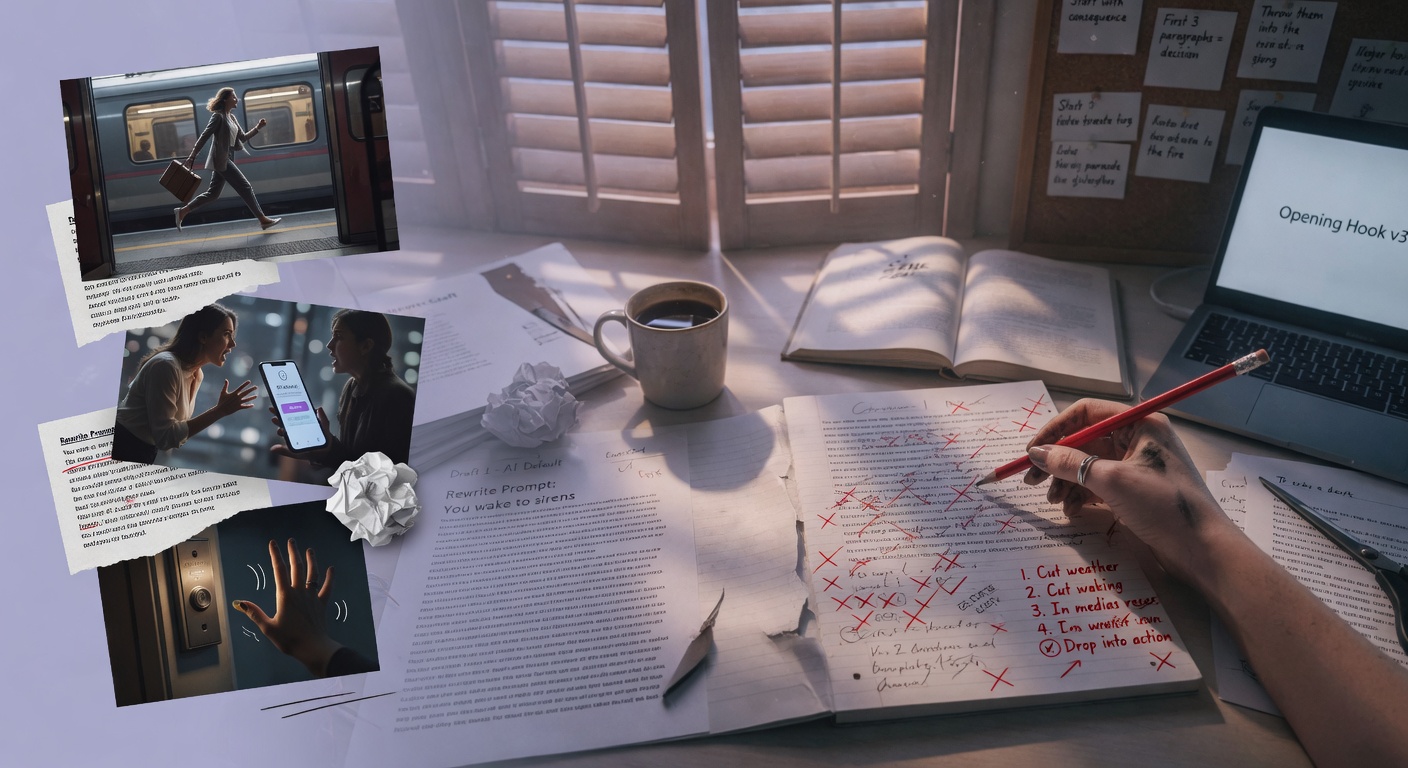
The most expensive paragraph in your book is the first one. AI models open with travel, dreams, or protagonist waking up because training data is full of amateur openings. Assume your generated chapter one starts wrong.
Hook types that work
- Disruption — something changes before we know the character's name
- Voice — a narrator with attitude about something specific
- Mystery — a concrete odd detail, not vague foreboding
- Conflict — argument, chase, bad news delivered on-page
Rewrite checklist (first 250 words)
- Delete weather unless it threatens someone
- Delete mirror descriptions of appearance
- Replace "Little did she know" with dramatized irony later
- Name one want or fear by word 150
- End the first page on a question or action
Use the opening hook analyzer on your first page— it flags passive starts and filter-heavy openings.
Rewrite only the first 400 words. Start in medias res: Marcus is already on the ledge, rope fraying, city guard shouting below. No waking up, no weather essay. Establish he is stealing the reliquary for his sister's ransom. Past tense, close third. Keep existing chapter plot for the rest unchanged.When to regenerate vs edit
If the opening is generic but the rest works, rewrite 300 words by hand or targeted prompt—cheaper than regenerating the whole chapter. If the entire chapter is setup with no scene goal, cut the chapter.
Bad first lines (and what they are hiding)
- Weather — Usually hiding that you do not know the scene goal. Start with the goal under threat.
- Waking up — Hiding that the interesting day has not started. Skip to the event that makes this day different.
- Name + appearance in a mirror — Hiding that you are worldbuilding the body instead of the want. Give the want; appearance can wait.
- Prologue in a different POV — Sometimes earned in epic fantasy; often a delay. If the prologue’s only job is lore, fold one concrete image into chapter one and cut the rest.
Write three alternate first sentences for the same chapter — disruption, voice, conflict — and pick the one that makes page two obligatory. Do not keep the first sentence the model happened to emit.
Page two still has a job
A great hook with a second page of backstory is still a failed opening. By word 400 the reader should know whose head they are in, what is at risk in this scene, and why they cannot leave. If you need history, dramatize one fact (a scar, a letter, a debt), do not summarize a childhood.
KDP sample length is short. Query agents (if you go that route) often stop at page one. Treat the first 250–400 words as a product, not a warmup. Run the opening hook analyzer after you rewrite, not before — it will flag the AI defaults you already know about. Then read the page aloud. If you would skip it in a bookstore, readers will too.
When the rest of chapter one is the problem
If the first page is sharp and pages 3–20 are travel, packing, and “she thought about her life,” you do not have an opening problem. You have a chapter that starts the book too early. Cut to the first scene that changes the situation. Move the packing to a later flash if you truly need it. AI drafts love to generate the day before the plot; you are allowed to throw that day away.
Hook vs first chapter
The hook is the first page. The first chapter still needs a complete scene: goal, friction, outcome, and a reason to turn the page. AI often nails a flashy first paragraph and then coasts into summary. If the opening analyzer is happy and you are still bored at word 800, the scene goal is missing. Rewrite the scene, not the first sentence again.
For dual timeline or multiple POV, the first page should still belong to one mind. Opening on a chorus of voices teaches the reader that they do not need to attach. Attach first; braid later.