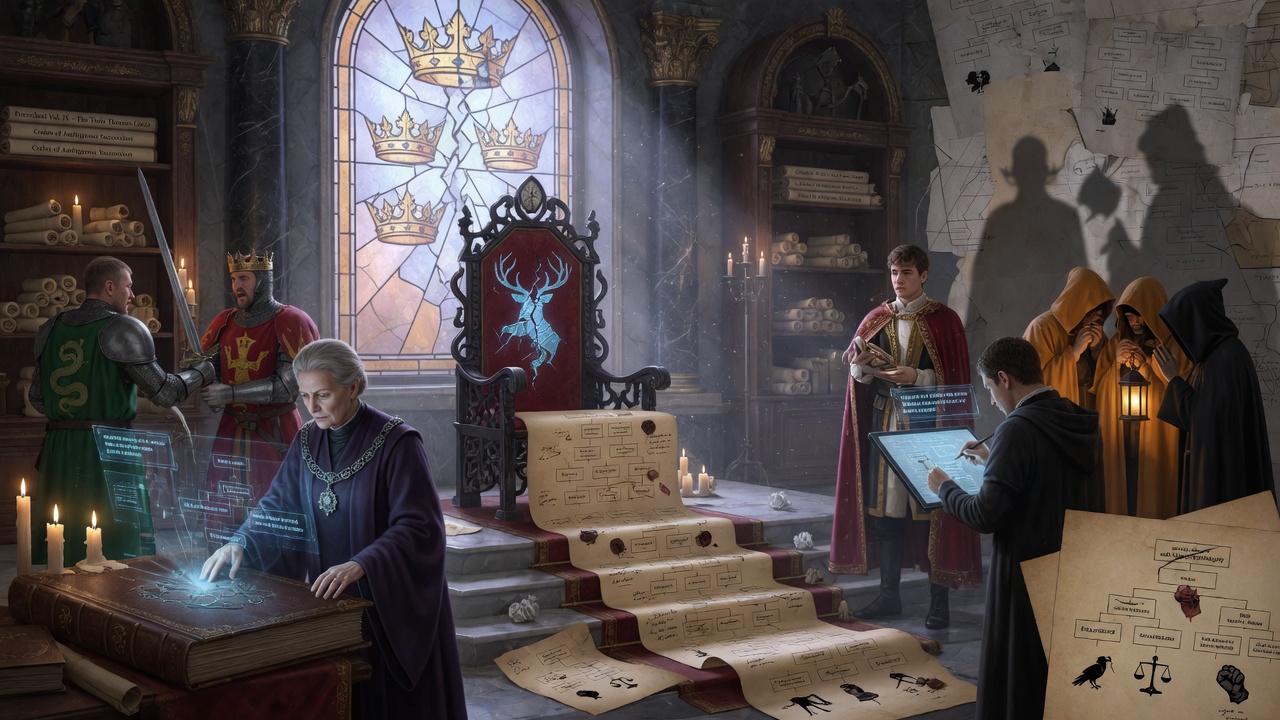
Why succession law is your fastest source of political stakes
Most fantasy and political fiction treats succession as a fact rather than a system. The king dies, the eldest son takes the throne, everyone bows, roll credits on the coronation. That's not a plot. That's a wikipedia entry.
Real succession crises come from ambiguity built into the rules themselves. Does the crown pass through the eldest child regardless of gender, or does it favor sons? What happens if the heir is a minor — does a regent rule, and who appoints them? Can a legitimized bastard inherit if there's no other blood claimant? These aren't background trivia. They're the load-bearing walls of your plot. Every unclear clause in a succession law is a future war waiting for the right corpse to trigger it.
This is why I tell writers to design their line of succession the way a constitutional lawyer would — not the way a Wikipedia summary of medieval history would. You want gaps. You want contradictions between old customary law and newer written statute. You want a council whose approval is "traditionally required" but never legally defined. That vagueness is your engine. It's what turns a death in chapter three into six factions maneuvering by chapter five, instead of you having to explain the politics through a tedious council-room lecture.
A succession crisis isn't a fight over a chair. It's a fight over whose interpretation of the rules wins — and interpretation is where character and faction come alive.
If you're building this into a fantasy world from scratch, this pairs well with a broader worldbuilding pass — the fantasy worldbuilding approach works nicely alongside a dedicated legal-systems session, since inheritance law tends to tangle with land rights, religious authority, and military command structures anyway.
Prompting AI to draft a succession system with a built-in exploitable ambiguity
Don't ask an AI model to "invent a line of succession." That gets you a Wikipedia paraphrase — primogeniture, agnatic-cognatic whatever, done in four sentences, no seams to pull on. You need to ask for the seams directly.
The trick is requesting the law and a documented history of how it's been interpreted differently over time. Legal systems that have been argued about for generations always have precedent that contradicts itself somewhere. That contradiction is your gap.
Draft the succession law for the Kingdom of Aurelin, a monarchy roughly 300 years old. Give me: (1) the formal written statute on inheritance of the throne, (2) at least one customary/unwritten tradition that has historically been treated as equally binding, and (3) a specific historical incident, at least 80 years ago, where these two sources conflicted and were resolved in a way that satisfied no one legally, only politically. I want the resolution to have created a precedent that could be read two contradictory ways. Then explain, from a legal-scholar's point of view, why a clever claimant today could use that precedent to argue for their own legitimacy even though they wouldn't be the 'obvious' heir under strict primogeniture.
This works because it forces the model to generate the ambiguity as a documented historical fact rather than a vague rule you'll have to justify later. You get something that feels like it survived three centuries of actual arguing, not something invented five minutes ago to serve your plot. Push for the precedent — that's the part writers skip, and it's the part that makes the exploit feel earned instead of convenient.
Once you have a draft you like, this is exactly the kind of foundational material to lock into your story bible so every later scene — court dialogue, background characters, footnotes in a letter — stays consistent with the specific wording of the law rather than a looser gist of it. Succession disputes live and die on exact phrasing; "the eldest legitimate child" and "the eldest legitimate son" are two different plots.
Push for the loophole a lawyer would actually find
A second pass helps here. Ask the AI to play devil's advocate against its own law:
Here is the succession law and precedent we just drafted for Aurelin [paste it]. Now act as a hostile court advocate hired by a claimant with a weak but not laughable position. Find the single strongest technical argument they could make to contest the "obvious" heir's claim, using only the law and precedent as written — no new information. Be specific about which words in the statute are doing the work, and note what a rebuttal lawyer for the obvious heir would say back.
This gives you both sides of an actual legal argument you can dramatize in court scenes, letters, or a tense hallway conversation — instead of characters just asserting "I have the better claim" and the reader having to trust them.
Generating rival claimants with genuinely defensible claims
The cartoon usurper — twirling mustache, transparently evil, wants the throne because power — is death to a political plot. Readers need to be able to imagine a version of the story where the "wrong" claimant wins and it wouldn't feel unjust. That's what makes the crisis a crisis instead of a checklist of villain behaviors to defeat.
Ask the AI for claimants built from the ambiguity you already established, each with a real argument, real constituency, and a real cost to their victory.
Using the succession law and the historical precedent we established for Aurelin, generate three rival claimants to the throne after King Ossian's sudden death with no named heir confirmed by the council. For each claimant give me: their exact blood or legal relationship to Ossian, the specific clause or precedent they'd invoke, which existing factions (military, merchant guilds, religious orders, foreign powers) would rationally back them and why it serves that faction's interests, and one legitimate practical objection to their claim that isn't just "the other guy has a better one." Make sure at least one claimant has the technically strongest legal case but the weakest political support, and at least one has strong political support but a shakier legal case.
That last instruction is the important one. Legal strength and political strength should not line up neatly. That mismatch is where your actual plot lives — the character with the better paperwork loses, or wins and can't hold the throne without the army that never wanted them. Every reader who's watched real politics knows this feels true.
Run each claimant through a quick gut-check afterward. If you can swap their name for "the villain" without losing anything, they're not done yet. Ask the AI to give you their private, honest justification — the thing they tell themselves at night, not their public speech — and check whether it survives contact with actual sympathy.
Write two paragraphs in first person from Lady Ferrant's point of view — one of our rival claimants — explaining privately, to no audience but herself, why she believes she deserves the throne more than the council's preferred candidate. She should not be lying to herself. She should sound like someone who has genuinely convinced herself using real facts, even if a neutral observer would find her reasoning self-serving.
If you're managing several claimants, extended families, and title chains across a series, the Series Bible Template is worth setting up early — succession plots multiply names fast, and a Proper Noun Extractor pass on your draft will catch when you've accidentally given two different cousins the same surname three books apart.
Stress-testing the vacancy: mapping the first 72 hours of a power gap
Here's where most drafts get lazy. The king dies, and somehow every faction in the realm reacts on the same timeline, at the same pace, as if they'd all read the same script. In reality, a power vacuum moves at different speeds for different people. The general nearest the capital moves in hours. The distant border lord doesn't even hear the news for a week, and by the time he does, he's making decisions based on outdated information.
Ask the AI to map this out as a timeline, faction by faction, not as a single narrative.
King Ossian dies at dawn with no confirmed heir. Map the first 72 hours across these five factions: the Palace Guard, the Merchant Council, the Temple of Ashara, House Ferrant (a border house with its own claimant), and the neighboring kingdom of Veslir. For each faction, tell me: when they realistically learn the news given travel/communication speeds in this world, what their first concrete action is (not their goal — their literal first move), what they're most afraid another faction will do first, and one action that would look reasonable to them but reckless or hostile to an outside observer. Keep it grounded in logistics, not just intentions.
The instruction to separate "first concrete action" from "goal" matters enormously. Factions in weak drafts announce their goals ("we shall seize the capital!") instead of doing the mundane, telling thing an organization actually does first — recalling messengers, quietly moving grain stores, doubling the guard on a specific gate. Those small logistical details are what make a political crisis feel inhabited rather than narrated.
This kind of scene mapping also sets you up for strong aftermath scenes — the quiet, tense hours after the death is announced but before anyone's committed to open conflict are often more gripping than the eventual battle, precisely because everyone's reacting to incomplete information.
Once you have the 72-hour map, feed it back through a consistency pass. This is a good moment to run a character consistency check on your major players — it's easy to have the Merchant Council's spokesperson act shrewdly calculating in the vacancy scene and then suspiciously naive two chapters later once the plot needs them to be.
Feeding succession lore into scenes through disputes and rituals, not history lessons
You've now got a detailed legal system, defensible rival claimants, and a faction-by-faction timeline. The temptation is to explain all of it. Resist that. Nobody wants a character to sit down and recite the statute out loud so the reader can follow along — that's the history-lesson dialogue that kills momentum in political fiction faster than almost anything else.
Instead, let the lore surface through friction. A ritual gets performed incorrectly and someone objects. A claimant's herald uses a specific title that implies a legal position without saying so directly. A coronation is delayed on a technicality that two characters argue about in five lines, not fifty. The reader absorbs the rule from watching people fight over it, the same way you learn a card game's rules by watching someone get called out for cheating.
Write a scene: the Temple of Ashara is preparing the coronation rite for the council's preferred candidate, Prince Rowan. House Ferrant's herald arrives uninvited and publicly objects to one specific part of the ritual — the anointing must traditionally be performed by the eldest surviving sibling of the deceased monarch, and Ferrant's claimant IS that sibling, not the Temple's chosen officiant. Write this as a tense confrontation in the middle of the ceremony, using action and dialogue only — no narrator explanation of the succession law. The audience should be able to infer the legal stakes entirely from what the characters say and do in the moment.
Notice the instruction banning narrator explanation. That constraint does the real work — it forces the scene to dramatize the rule instead of stating it. If a reader needs a footnote to understand why the objection matters, revise the scene, not the footnote. The tension itself should carry the legal information.
Write a short dialogue exchange (under 300 words) between two minor court officials gossiping in a hallway before the coronation. Through their gossip — not exposition, actual petty gossip with opinions and bias — reveal that there's historical precedent for delaying a coronation if a rival claimant formally lodges an objection with the Temple within three days of the monarch's death, and that House Ferrant did exactly that yesterday. Neither character should explain this clearly for the reader's benefit; they should talk like people who already know it and are more interested in what it means for their own careers.
This second prompt is useful for delivering pure information load without a scene of real consequence — hallway gossip is a classic, cheap delivery mechanism, and readers accept it because gossiping characters are allowed to be a little redundant and biased in a way your protagonists aren't.
When you move into revision, treat succession-lore consistency as its own dedicated pass. The Five-Pass Revision Order for AI-Assisted Novels is built for exactly this kind of layered check — you're not just checking prose quality, you're checking whether the rules you invented in outline stayed consistent through fifteen chapters of drafting, where it's easy for an AI (or you) to accidentally have a character invoke the wrong clause.
Bringing it together in your draft
None of this works if the succession system lives only in your outline notes and never touches the actual prose. The law needs to leak into small things — the way a servant addresses a claimant differently after news breaks, the specific object (a signet, a sash, a particular sword) that everyone understands confers legitimacy even though no one says so aloud. If you're working from an AI book outline, build a checkpoint into it specifically for "which faction learns what, and when" so the vacancy timeline you mapped earlier actually surfaces on the page instead of staying a background document only you know about.
If you're writing this inside a longer political fantasy and worried about drift across a long draft, Entangled Text's approach to persistent world state — detailed in the Entangled Text documentation — is built partly for exactly this problem, keeping legal and genealogical facts consistent across hundreds of pages without you re-explaining them to the model every session. And if you're weighing which model handles this kind of dense, rule-bound worldbuilding best, the comparison in best AI models for writing is worth a look before you commit a whole manuscript to one.
The practical takeaway: before you draft a single succession scene, write down the exact wording of your law, one documented precedent that contradicts it, and three claimants whose arguments you could defend in a debate. If you can't argue for your "wrong" claimant convincingly for two full minutes, the ambiguity isn't sharp enough yet — go back and dull-proof it before you write the crisis, not after.