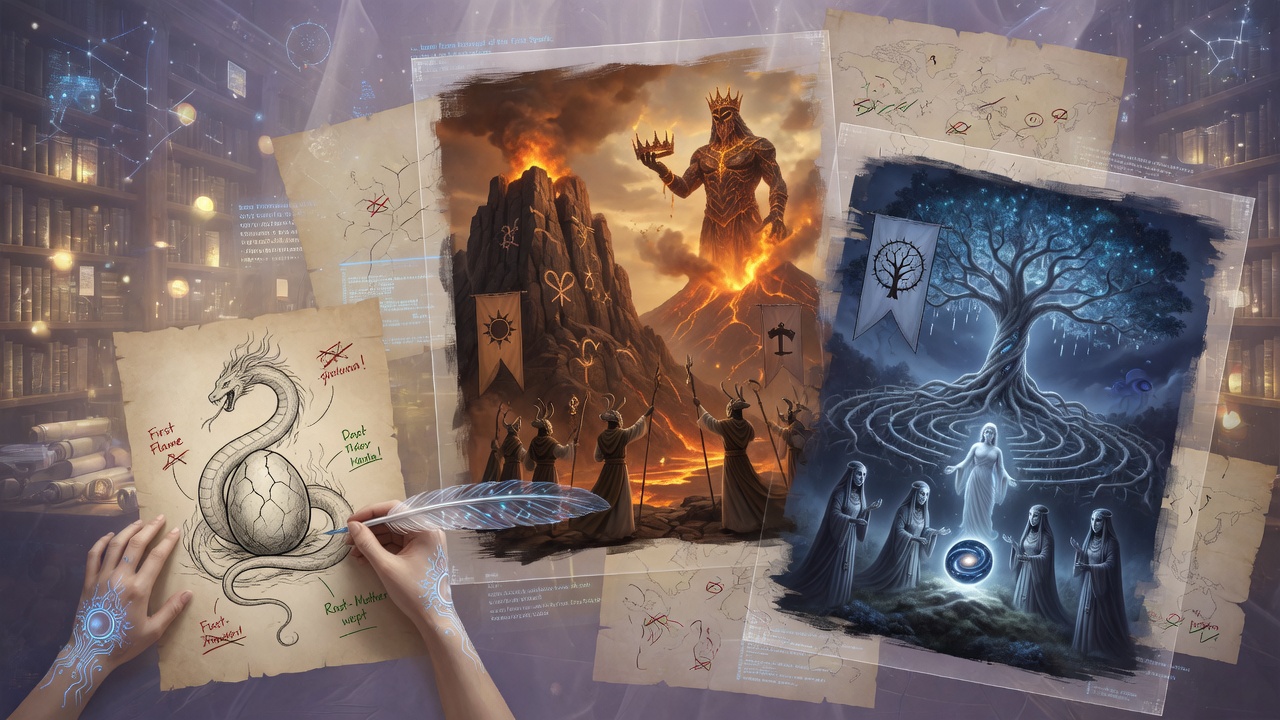
How to Use AI to Build a World's Competing Origin Myths
Why Competing Myths Do More Worldbuilding Work Than Official History
Official history is a list of events. Competing myths are a map of who wants what and why. The moment your world has two factions arguing about whether the gods created the first humans or abandoned them, you've told the reader something about power, grievance, and identity that three pages of timeline could never touch. That's not an accident — it's how mythology actually functions in human cultures, and it's one of the most underused tools in speculative fiction worldbuilding.
Most writers build one canonical origin for their world. The gods made the land from a titan's corpse, full stop. But real societies have never worked that way. The Romans absorbed Greek myths and rewrote them. Indigenous nations on the same river delta had radically different stories about where the river came from. The story a culture tells about its own beginning always reveals what that culture is afraid of, what it wants to protect, and who it wants to exclude. When you give your factions competing myths, you're doing the same thing — encoding belief, bias, and political hunger into the bones of your world's history.
A myth isn't a lie a culture tells. It's the deepest truth a culture believes about itself — and its enemies believe something completely different.
This is where AI becomes genuinely useful. You can prompt it to generate the same cosmological event through three incompatible ideological lenses in an afternoon. What would take weeks of careful historical research and creative rewriting — building internally consistent but mutually contradictory origin accounts — becomes a rapid generative process you can then shape, contradict, and weaponize for narrative tension. If you're already trying to write a book with AI, origin myth generation might be the single highest-leverage worldbuilding session you run.
The contradictions themselves become plot. If the merchant guild believes trade routes were blessed by the river goddess at the world's founding, and the mountain clans believe those same routes were stolen from their ancestors by a cursed king, then every tariff dispute is also a theological argument. Every trade negotiation carries the weight of competing cosmologies. You don't have to explain this to the reader — you just let the characters argue, and the worldbuilding leaks through.
How to Prompt AI for the Same Event Across Three Ideological Lenses
The core technique is simple: pick one event, then ask AI to retell it three times, each time from a different ideological or cultural position. The key is specificity. A vague prompt gets you vague myth. You need to tell the AI what each faction values, what they fear, and what narrative shape their culture typically uses to tell sacred stories.
Start by anchoring the shared facts — the things all versions agree happened, even if they interpret them differently. Maybe a great fire consumed the old city. Maybe a god went silent. Maybe the first king died without naming an heir. This shared skeleton is what makes the contradictions meaningful. Three stories about completely different events aren't competing myths; they're just three stories. The tension comes from everyone insisting their interpretation of the same moment is the true one.
Here's a prompt structure that works well for this:
I'm building a fictional world where three factions share a common historical event: a cataclysm called the Sundering, in which a great city fell and the gods went silent. I need you to generate three separate origin myths retelling the Sundering — one for each faction below. Each myth should feel internally consistent, use the oral or written tradition typical of that culture, and encode that faction's core values and biases WITHOUT being obvious about it.

Faction 1 — The Ash Clergy: Priestly, hierarchical, believe the gods are testing humanity. Their sacred texts use formal invocation and passive construction ("It was decreed," "The heavens were closed"). They would never portray the gods as absent; instead, the gods are watchfully silent.

Faction 2 — The Ironborn Compact: Merchant-engineers, secular, believe civilization is self-made. Their records use precise dates, named individuals, and economic causality. They would frame the Sundering as a failure of poor resource management and political incompetence — not divine will.

Faction 3 — The Rootless (nomadic refugees): Oral tradition, distrust of cities and temples, believe the Sundering was a punishment for arrogance. Their stories use repetition, call-and-response structure, and always end with a moral warning. The gods in their version act suddenly and without mercy.

Generate each myth at 200-300 words. Keep them contradictory but internally coherent.
Why this works: you're giving the AI three different epistemological frameworks — religious, secular, and oral-folk — and each one naturally produces different causal explanations for the same event. The Ash Clergy's gods didn't abandon anyone; they're just waiting. The Ironborn Compact doesn't even think gods were involved. The Rootless think the gods acted, and acted violently. None of them are lying. All of them are right from inside their own worldview.
The thing to tweak: swap out the structural instructions (invocation, dates, repetition) based on your actual cultures. Those prose-level details are where myths stop feeling like Wikipedia summaries and start feeling like something a character might actually recite at a funeral or a treaty signing. You can also ask the AI to generate a fourth myth — a deliberately corrupted or politically motivated version created by a specific ruler to justify a land grab. That's when things get interesting. For deeper guidance on managing these world details systematically, see How to Build a Story Bible That AI Models Actually Follow.
Using Mythic Contradiction to Encode Faction Values and Bias
Here's something worth sitting with: the distortions in each myth are more informative than the accurate parts. When the Ash Clergy's version of the Sundering never mentions economic collapse — only divine will — that silence tells you exactly what they don't want their congregation thinking about. When the Ironborn Compact's version names three failed administrators but doesn't mention the temple district burning first, that's not ignorance. That's politics.
Once you have your three base myths, prompt the AI to analyze the contradictions explicitly. This is a different kind of prompt — not generative, but analytical:
Here are three competing myths about the Sundering from my fictional world [paste myths].

Analyze the contradictions between them at three levels:
1. Factual contradictions — events that directly conflict (e.g., who acted first, which location was destroyed)
2. Causal contradictions — different explanations for WHY the event happened
3. Moral contradictions — who is blamed, who is heroized, what lesson is drawn

Then suggest: what does each faction's myth reveal about what they're AFRAID of in the present day? What would they need to suppress or deny in order to maintain their version of events?
This analytical pass is where your faction politics crystallize. You're not just building backstory — you're discovering what your factions have at stake right now. If the Rootless myth would be politically explosive if it became widely read (because it implies the current capital city is built on cursed ground), then suddenly you have a plot engine. Someone finds the old text. Someone wants it destroyed. Someone wants it weaponized.
Faction values embedded in myth also give you a low-effort way to characterize new figures quickly. A general who quotes the Ash Clergy's version of the Sundering while defending a siege is telling you everything about his theology, his political allegiances, and his moral framework in one breath. You don't need a backstory chapter. The myth does the work. This is closely related to the craft problem of Fantasy Magic Systems: Constraints AI Will Respect — in both cases, the underlying rules of your world only feel real when characters have genuine skin in the game about what those rules mean.
Stress-Testing Your Myths: Where AI Reveals Internal Inconsistency
AI is excellent at generating myth. It's less reliable at maintaining internal consistency across a complex mythological system — especially once you've generated a dozen fragments over multiple sessions. A god who was described as voiceless in the Ash Clergy myth might casually speak in a later fragment you generated when you forgot to re-specify. A date that anchors the Ironborn Compact's timeline might contradict a dynasty length you established elsewhere. These aren't catastrophic problems, but they compound fast.
The good news: you can use AI to catch these problems too. After you've built up several myth fragments, feed them back in as a batch and ask for a contradiction audit:
Here are six myth fragments from my fictional world — three oral traditions and three written religious texts [paste all six].

I need you to flag any internal inconsistencies within each myth, and any cross-myth contradictions that seem UNINTENTIONAL (rather than representing genuine faction disagreement). Specifically look for:
— Timeline contradictions (dates, generational gaps, sequence of events)
— Character/deity contradictions (powers, names, presence or absence in a scene)
— Geographical contradictions (locations of events)
— Tonal inconsistencies within a single myth that suggest two different authorial voices

Don't try to resolve the contradictions — just map them clearly so I can decide which to fix and which to keep as intentional unreliable history.
That last line matters. You want intentional contradictions to survive — those are the good ones, the ones that create faction tension. You only want to catch the accidental ones where you simply forgot what you'd established. Tools like the Proper Noun Extractor can help you keep your deity names, place names, and mythic figures consistent across documents before you even run this kind of audit. The Character Name Variant Detector is similarly useful when gods acquire epithets across multiple myth fragments and start looking like different characters.
One specific thing AI will almost always catch: timeline math. If your founding myth implies the city was built 400 years before the Sundering, but your religious calendar puts the Sundering at Year 200, something is wrong. Humans skim past this. AI, when asked to look, usually catches it immediately. That's a genuinely useful mechanical function — it's doing the same work a close continuity editor would do, and it's why knowing how to edit a book with AI is as valuable as using it to draft.
Planting Myth Fragments in Prose Without Stopping the Story
The graveyard of worldbuilding is the infodump. You've done all this incredible work generating three competing myths with layered contradiction and political subtext, and then you stop your story cold to have a character explain all of it to another character who should already know it. Readers feel the gears grinding. The story stops being a story and starts being a lecture.
The solution is myth fragmentation — you never deliver a myth whole. You scatter shards of it across scenes, and you let the reader's brain assemble them. A priest mutters the opening line of the Ash Clergy's founding prayer under his breath when he sees the Ironborn Compact's engineers drilling into the old city wall. A nomadic child draws the Rootless symbol for "cursed ground" in the dirt near the capital gates. Neither scene stops to explain mythology. Both scenes do enormous mythological work.
Prompt AI to help you find these insertion points:
Here is a scene from my novel [paste scene — ideally 300-600 words]. The scene involves [brief description of what's happening].

Here are three myth fragments from my world that are relevant to this scene's location/event/characters [paste relevant myth fragments].

Suggest five ways to embed references to these myths into this scene WITHOUT pausing the narrative. Each suggestion should:
— Fit naturally into character action, dialogue, or internal thought
— Reveal something about that character's cultural allegiance through WHICH myth they reference
— Not exceed 1-3 sentences of added text
— Create a question in the reader's mind rather than answering one

Rank them by how much tension they add to the existing scene.
This prompt is doing something subtle: it asks the AI to rank by tension, which pushes it away from decorative worldbuilding toward functional storytelling. A myth fragment that raises a question — why does the engineer spit when he passes the temple door? — is infinitely more useful than one that simply demonstrates you've done your research.
The craft principle here is the same one that governs Opening Hooks for AI Drafts: Fix the First Page Fast — readers will follow you anywhere if they feel something is being withheld, something they're about to understand. Myth fragments work as micro-hooks threaded through your middle chapters. Each one is a tiny promise: this world has a history, and it matters, and you're going to find out why.
As you're doing all this, keep your myth documents organized somewhere your AI sessions can access them reliably. The Series Bible Template is built exactly for this — housing faction-specific mythology alongside character notes and plot structure so nothing drifts. If you're working on a long project with multiple sessions, the guides on How to Use Role-Framing Prompts to Unlock AI Craft Modes will help you maintain consistent authorial voice across myth-generating sessions that might otherwise produce tonally inconsistent material.
For broader AI fiction writing techniques as you build out this world, the AI fiction writing guide covers the full toolkit — from first draft through revision. And if you're using a dedicated platform for all of this rather than a general chat interface, the fantasy worldbuilding tool on Entangled Text is designed to hold exactly this kind of layered, multi-faction world detail in one place.
Here's the most practical thing you can do right now: pick one event in your world that two factions would have strong feelings about — a founding, a betrayal, a cataclysm, a migration. Write three sentences describing the bare historical facts, stripped of interpretation. Then run the three-lens prompt above. Don't try to reconcile the myths the AI generates. Read the contradictions carefully and ask yourself which one your protagonist believes — and whether they've ever questioned it. That question is your next chapter.
Try it yourself
Write your own book with AI — free, no credit card required.
Free · No credit card