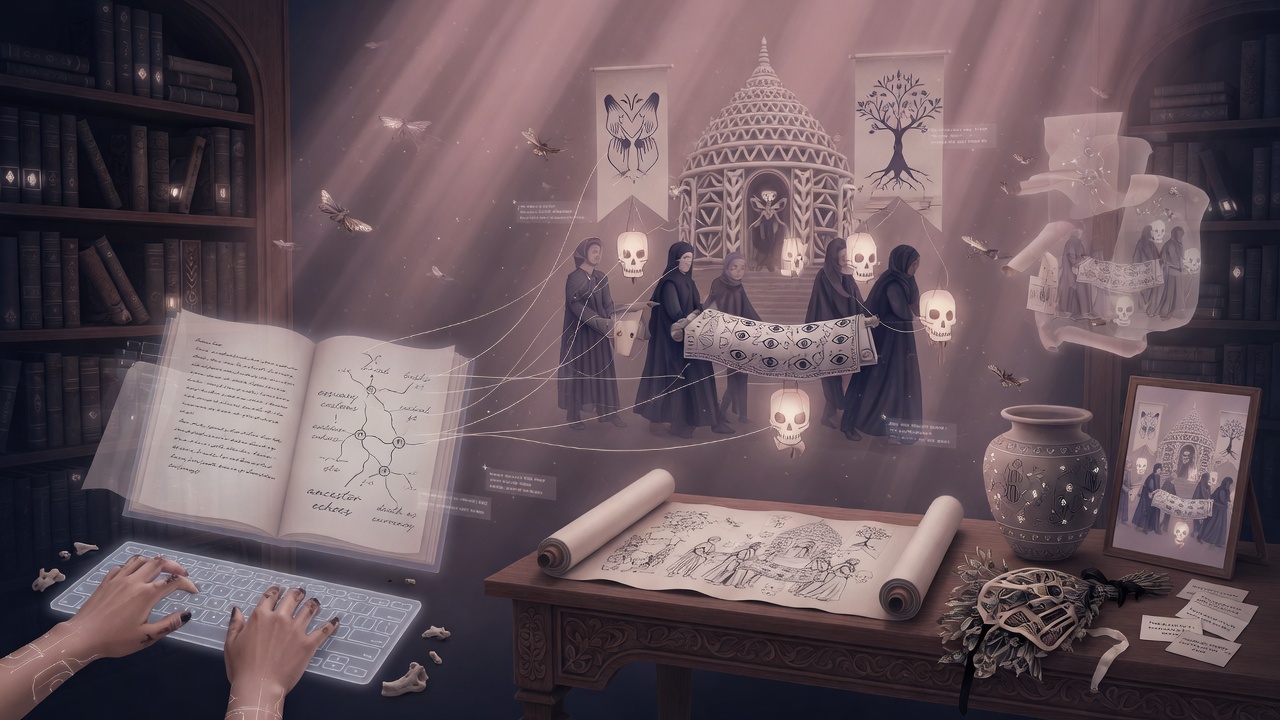
Every culture you've ever found convincing — whether in a novel, a film, or a game — had a coherent relationship with death underneath it. You might not have noticed it consciously, but it was there. The way characters spoke about the dead. Whether the corpse was sacred or dangerous. Whether grief was performed loudly or swallowed whole. These details don't just add flavor. They reveal what a people actually believe about time, the body, the soul, justice, and what makes a life worth living.
Building this from scratch is one of worldbuilding's hardest tasks. Death customs connect to everything — economics, law, gender roles, architecture, art, agriculture, inheritance. Get them wrong (or leave them vague) and your culture feels like a movie set: convincing from the front, empty behind the facade. AI, used well, can help you build the whole building. But only if you prompt it correctly — which means starting from belief, not behavior.
Why Death Customs Are the Fastest Path to a Believable Culture
Here's the thing about death: every human society has to answer the same questions. What happens after we die? What do we owe the dead? What does the corpse mean — is it the person, or just the shell? Who has authority over death rites, and what happens when that authority is challenged? The answers a culture gives to these questions ripple outward into literally every domain of life.
A culture that believes the dead can intervene in the affairs of the living will have ancestor shrines in every home — which means architecture, which means domestic economy, which means who controls the household. A culture that believes the soul's destination depends on the quality of the funeral will have a funerary economy with priests, undertakers, specialist craftspeople, and an entire shadow market for those who can't afford the good death. A culture that treats the corpse as polluting will have spatial rules about where death can happen, who can touch the body, and what those people are allowed to do afterward.
This is why death customs are the fastest worldbuilding path. One coherent belief system fans out into dozens of concrete details without you having to invent each one separately. You're not adding flavor — you're generating structure.
The goal isn't to describe how a culture handles death. It's to understand what they believe death is — and then let the behavior follow logically.
The Four Axes: Prompting AI to Define a Culture's Core Death Logic
Before you ask AI for rituals or customs, you need to establish the underlying logic. I think of this as four axes, and your culture sits somewhere on each one. The AI can help you explore each axis — but you have to ask about them separately and deliberately, or you'll get generic fantasy funeral tropes.
Axis 1: The afterlife's geography and accessibility. Is there an afterlife? Is it a destination, a state, or a cycle? Can the living reach it? Can the dead return?
Axis 2: The body's meaning after death. Is the corpse the person, a dangerous remnant, a neutral object, or a sacred vessel? This single question determines more funeral behavior than almost anything else.
Axis 3: The relationship between the living and the dead. Do the dead retain agency? Can they bless or curse? Do the living have obligations to them, and if so, for how long?
Axis 4: Who controls death? Is death authority held by priests, by family, by the state, by a specialist caste? What happens when those authorities conflict?
Here's a prompt that establishes all four axes at once for a specific culture:
I'm building a culture called the Verath, who live in a cold, mountainous region and have a polytheist religion with no single death god — death is considered a natural process with no divine steward. Help me develop their core death logic across four dimensions: (1) what they believe happens to the self after death, (2) what the corpse means to them — sacred, dangerous, neutral, or something else — (3) what obligations if any the living have to the dead, and how long those obligations last, and (4) who holds authority over death rites and what legitimizes that authority. Make these answers internally consistent with each other and with a culture that has no underworld mythology and values practical self-sufficiency. Give me 3-4 sentences on each dimension.This works because you've given the AI real constraints — the climate, the theology, the cultural value — and asked for consistency explicitly. Without those constraints, you'll get generic fantasy death lore. After you get the response, push back on anything that feels borrowed. Ask: "The obligation to the dead lasting three years feels arbitrary — what's the logic behind that number for a culture that values practicality?" Make the AI defend its choices. That's when the interesting stuff emerges.
From Belief to Behavior: Prompting Rituals, Mourning Rules, and Taboos
Once you have the core logic, behavior follows. But "what are their funeral customs" is still too broad — you'll get a list of vaguely medieval practices that feel copied from a D&D sourcebook. You need to prompt for behavior at specific moments: the moment of death, the preparation of the body, the funeral itself, the mourning period, the anniversaries, and what happens when someone dies badly (in violence, alone, or without family present).
The edge cases are where a culture's real beliefs show up. Ask about those specifically.
Based on the Verath death logic we established — no death god, corpse treated as neutral matter to be returned to the mountain, three-year obligation period, authority held by the eldest surviving sibling — generate specific mourning behaviors and taboos. I want: what mourners are forbidden to do during the three-year period, what physical markers they wear or carry, what the correct behavior is at the moment of death (what do you say, what do you touch), and what happens when someone dies alone with no family present to perform the rites. The culture values stoicism and practicality, so grief should be expressed in structured, functional ways rather than openly emotional ones. Avoid generic fantasy tropes like candle-lighting or spirit-guiding.The instruction to avoid candle-lighting and spirit-guiding isn't snark — it's genuinely useful. AI has been trained on enormous amounts of fantasy writing and it will default to familiar patterns. Naming what you don't want is as important as naming what you do.
After you get mourning behaviors, ask for the taboos specifically. Taboos are often more revealing than the rituals themselves, because they tell you what the culture is afraid of. A culture terrified of dying alone will have elaborate social structures to prevent it. A culture that considers it shameful to weep in public will have private grief practices that compensate — small, personal rituals performed in darkness. These are the details that make a character feel like they come from somewhere real.
Building the Funerary Economy
Death is always an industry. Somewhere, someone is being paid. This is one of the most overlooked aspects of worldbuilding, and one where AI can do heavy lifting if you frame the prompt correctly.
Think about what a culture's death beliefs require physically. If you need the body preserved, you need embalmers, preservatives, cold storage, or magic. If you need elaborate grave goods, you need craftspeople who specialize in objects that will be buried rather than used. If you need priests to guide the soul, you need an institution that trains and pays them. All of this costs money — which means some people can afford a good death and some people can't. That gap is where your story can live.
The Verath treat the corpse as neutral matter that must be returned to the mountain through exposure and bone-collection over three years. Based on this, help me develop the funerary economy: what specialists exist (and what are they called), what materials or objects are required at each stage of the process, what the minimum cost of a proper death is for an average family, and what a wealthy family's death looks like compared to a poor family's. Then give me one specific way that economic inequality around death rites creates resentment or conflict in this society — something concrete, not abstract.That last instruction — "one specific way that economic inequality creates resentment" — is crucial. You're not just building lore. You're building plot. The AI might tell you that poor families can't afford the bone-collectors who do the final mountain internment, so they bury the bones themselves in unmarked locations, which is technically permitted but socially stigmatized. Now you have class conflict, shame, and a reason for a character to lie about how their grandmother was buried. That's a story.
How Death Customs Create Conflict: Prompting Institutional and Class Friction
A death system with no friction isn't a real system — it's a museum exhibit. Real institutions compete for authority. Families clash with priests. The state tries to regulate what families consider private. New religious movements challenge old ones. Immigrants bring death practices that the host culture finds incomprehensible or threatening. These conflicts don't need to be your main plot, but they need to exist in the background, because they're what makes a world feel like it has history.
Ask the AI to generate structural conflicts explicitly — not just "what are some tensions" but specific institutional fault lines.
The Verath have a death system where authority over funerary rites is held by the eldest surviving sibling, and the state has no formal role in death practices. Now introduce three sources of institutional conflict: (1) a scenario where the sibling authority system breaks down (who inherits the role when siblings predecease each other, or in cases of estrangement), (2) a tension between the traditional sibling-authority system and an emerging class of professional bone-collectors who argue they should have legal standing over death rites, and (3) what happens when a Verath person dies in a foreign city with no family present and no bone-collectors available. For each, give me the specific argument each side makes — not who's right, but how each side frames their position in terms the culture would find legitimate.The "how each side frames their position" instruction prevents the AI from giving you a neutral summary and forces it to generate actual rhetoric — the kind of language characters would actually use. A bone-collector arguing for professional authority wouldn't say "we deserve legal standing." They'd say something like "the mountain doesn't care about your bloodline, only about whether the rites were performed correctly." That's a line a character can say.
Class conflict around death is particularly generative for fiction because it touches the most emotionally raw moments in people's lives. A character who watched their mother get a shameful burial because the family couldn't afford the specialist isn't just poor — they carry a specific wound, a specific shame, a specific anger. That's characterization that comes directly from your worldbuilding.
Stress-Testing Coherence: Using AI to Find the Cracks in Your Death System
Once you have a death system you like, you need to break it. Not because it's wrong, but because finding the cracks tells you where your story is. Every belief system has edge cases it struggles with, questions it can't fully answer, and situations where its internal logic produces outcomes that feel unfair or monstrous. A religion that promises the soul's peace is contingent on proper burial has to answer for mass death — for plagues, for floods, for battlefields where the bodies can't be recovered. What does it do with that? How does it cope?
Ask the AI to stress-test explicitly:
Here is the Verath death system: [paste your developed system]. Now stress-test it by identifying three scenarios where the internal logic breaks down or produces outcomes the culture would find deeply troubling. I want: (1) a mass-death scenario (plague, avalanche, war) where the three-year bone-collection process becomes impossible to perform at scale, (2) a theological edge case — a situation where following the rules produces an outcome that seems cosmically unjust by the culture's own values, and (3) an interpersonal scenario within a single family where two people following the rules correctly still end up in irreconcilable conflict. For each, tell me what the dominant cultural response is AND what a dissenting minority might argue.The mass-death scenario almost always produces the most interesting material. If proper burial requires a three-year process and a thousand people die in an avalanche, something has to give. Either the culture develops emergency protocols, or it decides those people are cosmically lost, or it decides the rules can be suspended under certain conditions — which means someone has the authority to suspend them, which means a power structure. Any of these is a story.
The theological edge case is where religion gets interesting. A culture where the quality of your death rites determines your afterlife fate will eventually confront the fact that a good person who dies alone gets a worse fate than a corrupt person with a large family. How does the theology handle that? Does it have a mercy clause? Does it pretend the problem doesn't exist? Does it produce a heretical sect that argues the mountain cares about character, not ceremony? Heresies are worldbuilding gold, and they grow naturally out of stress-testing.
The most believable worldbuilding detail isn't the one you invented deliberately — it's the one that emerged inevitably from the logic you already established.
Letting Death Customs Colonize the Rest of Your World
After stress-testing, take stock of what you have. You should have a core belief system, a set of behaviors and taboos, a funerary economy, a set of institutional conflicts, and a few theological fault lines. Now the question is: what does this do to everything else?
Death customs leave fingerprints on art (what gets depicted and how), architecture (where death is allowed to happen, how the dead are housed), law (inheritance, rights of the dead, criminal law around body-handling), language (what words exist or are avoided), and daily domestic life (how homes are arranged around the possibility of death within them). You don't have to develop all of these — but running a quick prompt asking the AI to trace one or two of these connections will catch details that make your world feel inhabited rather than designed.
Ask something like: "Given everything we've established about the Verath relationship with death, what would their domestic architecture look like — specifically, how would home design account for the possibility of dying at home, and what rooms or features would exist specifically because of their funerary practices?" You'll get something specific and usable in a scene. A character describing their childhood home as having a bone-room — the cold back room where the family's dead rested during their first year — tells you more about that culture in six words than three paragraphs of exposition.
That's the practical takeaway here. Once you've built the death system through the prompting sequence above — axes, behaviors, economy, conflicts, stress-tests — run a final prompt asking AI to generate five specific, concrete details that would appear in a scene set in an ordinary home, on an ordinary day, that trace back to the death customs you've built. Not rituals. Not lore. Details. The object on the shelf. The thing the child is not allowed to touch. The phrase the grandmother uses when someone sneezes. Those details are what readers feel as authenticity, even when they can't name why.