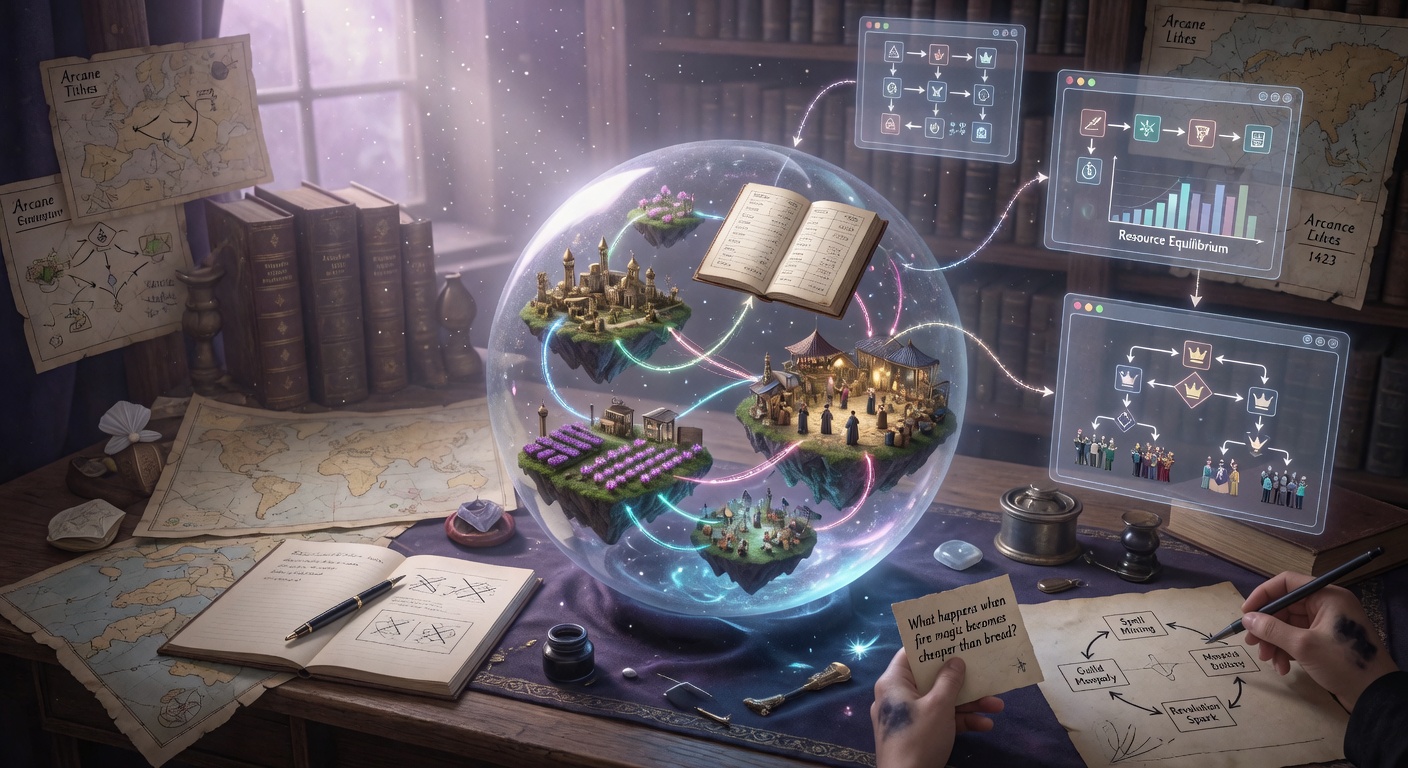
Why Magic Systems Need an Economy (Not Just Rules)
Most magic systems fail the same way. The author invents fascinating rules — magic costs blood, or requires spoken words in a dead language, or only works at night — and then never asks the obvious follow-up question: so what does society look like because of this?
Think about fire. Fire isn't just a tool. It's warmth, cooked food, light in the dark, a weapon, a signal. When humans got reliable access to fire, it restructured everything: where we slept, how we organized labor, what we ate, who held authority. Your magic is fire. It restructures everything. If you've built a world where some people can conjure clean water from thin air and you haven't thought through what that does to farmers, merchants, colonial ambitions, and the price of land near rivers — you haven't finished your magic system. You've just written its first chapter.
This is where internal economics comes in. Not economics as in spreadsheets and GDP, but economics as in: who has access to the thing, who controls it, who gets excluded, and what will people do to change their position? That's the engine of every interesting story.
The good news is that AI is genuinely excellent at this particular kind of thinking. Give it your magic's rules and ask it to follow the consequences downstream, and it will generate implications faster than any solo brainstorming session. Not because AI is smarter than you — it isn't — but because it doesn't get attached to your original vision. It just follows the logic wherever it goes. That's exactly what you need when stress-testing a system you've been building for months and have stopped seeing clearly.
Prompting AI to Identify Resource Scarcity in Your Magic
Every magic system has at least one scarce resource, even if you haven't named it yet. Scarcity is what gives magic its weight. If anyone can do it, anytime, without cost — you don't have magic, you have a setting detail. Scarcity is the thing that makes magic matter economically and socially.
The scarcity might be obvious: only one in a thousand people are born with the gift. Or it might be hidden inside your rules: magic works fine, but the reagents it requires only grow in one mountain range. Or it might be temporal: magic users burn out after ten years of heavy use, creating a constant churn of aging practitioners and hungry apprentices.
Your first job is to find all the scarcities in your system — including the ones you didn't intend. AI is useful here because you can dump your rules into a prompt and ask it to go hunting.
I'm building a magic system for a secondary world fantasy novel. Here are the rules as I have them so far:

- Magic is called Threadwork. Practitioners (called Threaders) can manipulate physical reality by "pulling" invisible threads that connect all matter.
- Threadwork requires concentration and physical stillness — you can't cast while moving.
- The ability is genetic but recessive. Two non-Threader parents can produce a Threader child if both carry the gene.
- Extended use causes "thread-blindness," a temporary loss of the ability that gets longer and more frequent with age. A 50-year-old Threader might be blind for six months out of every year.
- There is no known way to restore thread-sight once it begins declining.

Please identify every form of scarcity embedded in this system — not just the obvious ones. Include scarcities I might not have considered, like time-based scarcity, knowledge scarcity, or scarcity created by the physical requirements of casting. For each one, explain what economic or social pressure it would create.
This works because you're not asking the AI to invent your world — you're asking it to audit what you've already built. The specificity of your rules matters enormously here. Vague input produces vague output. Notice that the prompt includes the detail about physical stillness and the age-related decline. Those two details alone will generate implications most writers miss: Threaders can't defend themselves while casting, which means they need bodyguards, which creates a whole economic relationship. Older Threaders lose productive years, which means their services become scarcer and potentially more expensive right as their physical decline makes them safer to employ in non-combat roles.
After you get the initial list, push further. Ask: "Which of these scarcities creates the most exploitable power asymmetry?" That's where your class structures live.
Building Class Structures and Power Imbalances from Magic's Limits
Here's the thing about magic and class: whoever controls access to magic controls everything else. This isn't a cynical take — it's just what history tells us about any transformative technology. The people who controlled the printing press, the railroad, the shipping lane — they built institutions to protect that control, and those institutions outlasted the original advantage by centuries.
Your magic system will do the same thing. The question is how. And the answer depends entirely on what the limits are.
A magic that's genetic creates aristocracy almost automatically — bloodlines become literal power, inheritance becomes a political weapon, and families will do monstrous things to keep the gene in their line. A magic that requires years of specialized training creates a different structure: a guild or priesthood, gatekeeping through education, class mobility that's theoretically possible but practically brutal. A magic that requires expensive reagents creates mercantile power — the traders who control the supply chain hold the real leverage, not the practitioners themselves.
You can get AI to map these structures for you in a way that feels organic to your specific system, not like a generic fantasy trope transplanted from somewhere else.
Using the Threadwork magic system I described earlier, help me build the social class structure of a city-state that has had Threaders in its population for roughly 400 years. I want the class structure to emerge logically from the magic's specific limits — especially the genetic recessiveness, the physical stillness requirement during casting, and the age-related decline.

Please give me:
1. At least four distinct social classes or factions whose position is directly tied to Threadwork's economics
2. The specific tension point between each adjacent class (what do they want from each other, what do they resent about each other)
3. One institution (a law, a guild, a religious practice, a marriage custom) that exists specifically because of Threadwork's limits and that most citizens would consider completely normal and reasonable, even though an outsider would find it troubling

Don't give me generic fantasy social structures. I want these to feel like they grew from THIS magic system specifically.
The third request in that prompt — the institution that seems normal but is actually troubling — is the most important one. That's where your world stops feeling like a backdrop and starts feeling lived-in. It's also where your most interesting moral conflicts live. A law that mandates genetic testing before marriage looks different from inside a culture that's had it for two hundred years than it does from your protagonist's outside perspective.
When you get the response, look for the place where two classes need each other but resent that need. That's almost always where your plot wants to start.
Using AI to Find Plot-Breaking Loopholes Before Your Readers Do
Readers are adversarial. Not because they're trying to ruin your book — they love your book — but because engaged readers instinctively test systems. They ask: why didn't the hero just do X? They catch the moment in chapter seventeen where your magic's rules would have solved the problem you spent three chapters on.
Your job is to find those loopholes first and either close them or — and this is often better — build them into the story intentionally. A loophole that a clever character discovers is a plot. A loophole that readers discover before your characters is an immersion-breaking frustration.
AI is ruthless at this. Give it your magic rules and the outline of a key conflict, and ask it to attack the problem from every angle. It has no investment in your story's outcome. It will find the cheap solutions immediately.
I need you to think like a reader who is actively trying to poke holes in my magic system. Here is the key conflict in my novel's second act:

My protagonist, a mid-level Threader named Sable, needs to stop a corrupt magistrate from signing a document that will legally transfer ownership of the city's water supply to a private merchant guild. She has three days. She can use Threadwork, but she is being watched, has no political allies, and cannot be seen to act against the magistrate directly without triggering a law that makes her magic use forfeit to the state.

Here are the Threadwork rules: [paste full rules]

Please identify every way Sable's Threadwork abilities could theoretically solve this problem in under an hour — the "obvious" solutions a reader might think of. For each one, explain what would need to be true about the world or the magic for that solution to NOT work. I'll use this to either close the loophole in my rules or make sure I've established the relevant constraint on the page before this scene.
What you're doing here is using AI as a stress-tester, not a co-author. The solutions it suggests are probably things you've already thought of and dismissed — but seeing them written out forces you to articulate why they don't work. That articulation is the thing you need to put on the page. A constraint that exists in your head but not in your manuscript is invisible to your readers. They'll use the loophole.
This process also occasionally reveals that a loophole isn't actually a problem — it's a story. If AI immediately suggests a solution that's elegant and in-character, ask yourself why your protagonist isn't using it. If the answer is "because then I don't have a second act," that's a plotting problem, not a magic problem.
Prompt Templates: From Raw Magic Concept to Economic Worldbuilding
These are the prompts I return to most often when developing a magic system's economics from scratch. They're designed to be used in sequence, though you can drop in at any stage depending on where you are in your process.
Stage 1: The Economic Audit
Here is my magic system in its current form: [describe your magic's rules, costs, and limitations]

Please run an economic audit on it. Specifically:
- What are all the forms of scarcity embedded in these rules? (Include hidden scarcities like time, knowledge, physical safety, and age.)
- What naturally occurring monopolies could form around this magic?
- What would this magic do to existing pre-magic economic relationships — trade, labor, land value, inheritance?
- What new professions would exist in a world with this magic that don't exist in ours?
- What old professions would become obsolete or radically transformed?

Don't worry about narrative yet. I just want to understand the full economic shape of what I've built.
Use this before you've committed to any social structures. It's a discovery tool. The "new professions" question consistently produces the most useful material — those jobs are where your secondary characters and subplot texture live.
Stage 2: The Inequality Engine
Based on the magic system I described [paste or reference previous description], help me understand how inequality would calcify over time.

Assume this magic has existed in my world for [X] generations. Walk me through how initial advantages compound. Who gets richer while doing less? Who works harder for diminishing returns? What does the middle of this society look like — the people who have some access to magic's benefits but not full access?

I'm specifically interested in the mechanisms of inequality, not just the outcome. What are the specific rules, customs, or economic structures that make it hard for people at the bottom to move up, even if individual talent would theoretically allow it? Make these mechanisms feel specific to my magic's rules, not generic.
The phrase "mechanisms of inequality" does a lot of work in this prompt. It pushes AI away from describing outcomes (the rich are rich, the poor are poor) toward describing process — and process is what you can dramatize in scenes.
Stage 3: The Exchange Rate Problem
Every magic system creates an exchange problem: what is magical ability worth, in concrete terms, compared to other forms of value? This question sounds abstract until you're writing the scene where your Threader protagonist negotiates payment for her services and you realize you have no idea what the going rate is or who sets it.
My magic system [paste rules] exists in a pre-industrial economy roughly equivalent to [your chosen analogue — late medieval Europe, Song Dynasty China, Ottoman Empire, etc.].

Help me figure out the exchange economics:
- What would a skilled Threader realistically charge for common uses of their ability? (Give me at least five concrete examples of services with rough pricing relative to average skilled-labor wages.)
- Who would be in a position to negotiate those rates, and who would have to accept whatever they're offered?
- What would prevent Threaders from simply pricing themselves into monopoly control of the economy? (What counterweights exist or would naturally develop?)
- Is there a black market for Threadwork, and if so, what specifically would be traded on it that the legitimate market won't accommodate?

I want to be able to write a negotiation scene between my protagonist and a merchant client and have the economic logic feel completely solid underneath it.
The last line of that prompt is the key. You're not worldbuilding for its own sake — you're worldbuilding to write a specific kind of scene with confidence. Keeping that concrete goal in the prompt helps AI stay grounded in the practical rather than drifting into abstract theorizing.
The best magic economies don't feel invented. They feel discovered — like the author just followed the logic and wrote down what they found. AI can help you follow that logic faster and further than you'd go alone, but only if you give it specific rules to work with. Vague magic produces vague economics. The more precisely you define your constraints, the more surprising and useful the downstream implications become.
One last thing worth knowing: the economic implications AI generates will sometimes contradict the story you've already planned. That's not a failure — that's the process working. When the logic of your magic system argues against your plot, you have a real choice to make: adjust the magic, adjust the plot, or find the even more interesting story that lives inside the contradiction. Those contradictions, honestly, are where the best worldbuilding decisions come from.
Start with the Stage 1 audit on whatever magic system you're currently building, even if you think you know it well. Run it tonight, before your next writing session. I'd bet there's at least one scarcity in your rules that you haven't followed all the way to its social consequences yet — and that consequence is probably a better story than the one you currently have planned.