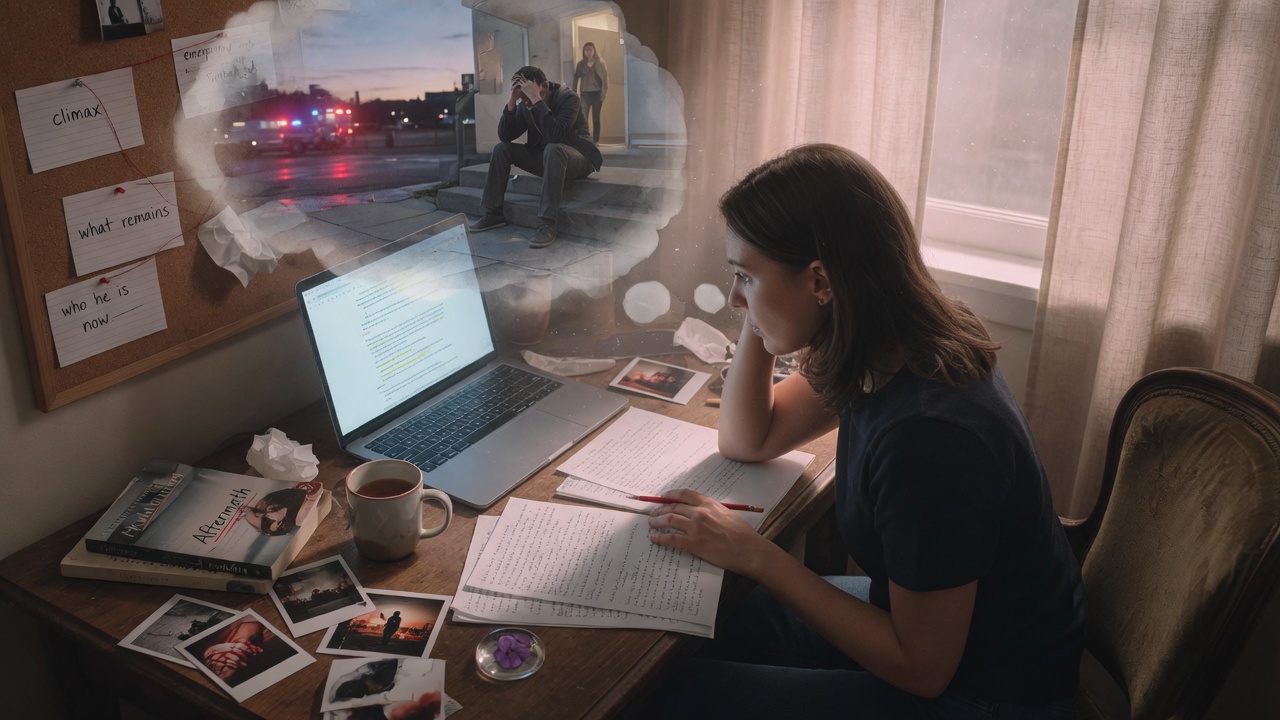
Every writer has done it. You finish the big scene — the fight, the confession, the funeral — and your beta reader (or your own gut) says "the next chapter drags." So you cut it. You jump straight to the next plot beat, and the book gets tighter, faster, more "commercial." Except something's missing, and it takes a few chapters before you figure out what: nobody in this story ever seems affected by anything that happens to them.
That's the cost of treating aftermath scenes as filler. They're not filler. They're where readers metabolize what just happened, and where you get to plant the next fuse without anyone noticing you struck the match. AI is genuinely useful here — but only if you stop asking it to write "a quiet scene where they process their feelings," because that instruction produces exactly the kind of soft, static, cuttable prose that got aftermath scenes their bad reputation in the first place.
Why Aftermath Scenes Get Cut in Revision (And What's Lost When They Are)
Aftermath scenes get slashed because they're usually written as emotional rest stops. Character sits. Character reflects. Character maybe cries, or stares at a wall, or pours a drink. Nothing changes. No new information enters the scene, no decision gets made, and the plot doesn't so much as twitch. It reads like padding because, structurally, it is padding — a scene that only processes the past instead of also building the future.
But when you cut those scenes entirely, you lose three things readers actually care about: emotional credibility (people who shrug off trauma feel like sociopaths or cardboard), pacing rhythm (nonstop escalation without release is exhausting, not thrilling), and — this is the one writers forget — the quiet space where a reader forms their own theory about what happens next. A well-built aftermath scene doesn't just let the reader breathe. It gives them something to worry about while they do.
The fix isn't "write longer aftermath scenes" or "write shorter ones." It's writing aftermath scenes with a job. If you've worked through an AI book outline for your manuscript, you already know every chapter is supposed to earn its place — aftermath scenes are no exception, they just earn it differently than action scenes do.
The Three-Beat Aftermath Formula: Residue, Reckoning, Redirect
Here's the structure I give AI every time I need a post-event scene to actually pull weight: Residue, Reckoning, Redirect. Three beats, and none of them are optional.
- Residue — the physical, sensory leftover of the event. Ringing ears, shaking hands, blood drying stiff on a sleeve, the smell of smoke still in someone's hair. This grounds the scene in the body before it goes anywhere near the mind.
- Reckoning — the emotional or moral confrontation with what happened. Not a summary of feelings — a specific reaction to a specific detail. This is where character voice does the heaviest lifting.
- Redirect — the turn. A decision, a question, a new piece of information, a wrong assumption forming. This is the beat most AI drafts skip entirely, because "redirect" requires the model to think about your plot, not just your prose.
Most AI-generated aftermath scenes give you Residue and Reckoning and just... stop. They land on the emotional beat and treat it as the ending, because emotionally resonant prose reads like a satisfying stopping point even when it isn't one. Your job is to force the Redirect explicitly, every time.
Write the scene immediately after Mara kills the man who murdered her brother. She expected relief. She doesn't feel it. Structure the scene in three beats: (1) Residue — the immediate physical aftermath of the violence, what her body is doing, what she notices in the room she didn't notice during the fight. (2) Reckoning — her specific emotional response to the body, not generic guilt, something tied to a detail from earlier in the book (she once swore she'd feel nothing). (3) Redirect — she finds something on the body or hears something that reopens the mystery of who hired him, ending the scene with a new question, not a resolved one. Keep it under 500 words. Do not have her cry. Do not have her say out loud what she's learned.
This works because it names the trap and routes around it in the same breath — "do not have her say out loud what she's learned" preempts the model's instinct to summarize the theme. Swap in your own event and constraint (a breakup instead of a killing, a magic-system backfire instead of a fight) and the formula holds.
If you're building this into a longer project, it's worth mapping which of your chapters are pure Reckoning scenes and flagging them for a Redirect pass — a Scene Planning Worksheet is a fast way to see the pattern across a whole draft instead of chapter by chapter.
Prompting AI to Plant a New Question Inside a "Calm" Scene
The single highest-leverage move in an aftermath scene is planting a new tension while the reader thinks they're resting. This is a magic trick, and like all magic tricks, it works because attention is pointed somewhere else. The reader is watching your character grieve, or rage, or bandage a wound — and three lines later, they realize they're now worried about something they weren't worried about before.
AI won't do this unprompted. Left alone, it will resolve the scene's emotional arc and consider its job done. You have to specifically ask for a seed — something small, planted without fanfare, that pays off later.
Rewrite this aftermath scene [paste scene] so that somewhere in the middle third, without calling attention to it, plant a small detail that will become important later: the ally who helped in the fight has a fresh bruise that doesn't match the fight they just survived. Don't have any character comment on it. Don't foreshadow it with narration like "she'd remember that later." Just let it exist in the scene the way real inconsistent details exist — mentioned once, in passing, folded into a physical description.
Notice the explicit ban on narrative hand-holding — "don't foreshadow it with narration." AI models are trained on a lot of prose that telegraphs its own cleverness, and without that instruction you'll get a version of the detail with a spotlight on it. You want the opposite: a detail a first-time reader skims past and a re-reader catches immediately.
This technique pairs well with whatever tension is already live in your subplot. If you're working in romance, this is often where you plant the seed of the next misunderstanding right after the emotional high of a reconciliation — worth cross-referencing against the Romance Beat Sheet: Where AI Drafts Usually Break guide, since aftermath scenes are one of the most common break points in AI-drafted romance specifically because the model wants to let the couple be happy and stay happy.
In fantasy, the planted detail is often systemic rather than personal — a cost of magic that didn't show up the way it should have. If your magic has rules, make sure the aftermath scene respects them; see Fantasy Magic Systems: Constraints AI Will Respect for how to keep AI from quietly softening the price your character just paid.
Calibrating the Decompression Ratio: How Much Rest Before Readers Disengage
There's no universal formula for how long an aftermath scene should run, but there is a useful ratio to think in: for every unit of intensity in the preceding scene, you get roughly a proportional — not equal — unit of decompression before tension needs to reassert itself. A street fight earns a paragraph of quiet. A character's death earns a scene, maybe a chapter. A wedding-day betrayal earns more than either, because betrayal has a longer emotional half-life than physical danger.
The mistake I see most often isn't scenes that are too short — it's scenes that are the right length but flat all the way through, with no rising or falling inside the rest itself. Even a "calm" scene needs its own micro-shape: it should decompress fastest at the start (when the reader most needs the relief) and start tightening again before it ends (so the transition to the next scene doesn't feel like a jump cut).
Here is my draft aftermath scene [paste scene]. It's currently one flat register the whole way through — sad, sad, sad, then it just ends. Rewrite it so the first third is the most decompressed, slowest-paced part of the scene (short sentences, physical detail, minimal dialogue). The middle third should introduce one piece of unresolved business — a phone left unanswered, a decision she's been avoiding — that starts to reintroduce tension. The final third should end on a small but specific unresolved action, not a summary line, so the chapter break doesn't feel abrupt when the reader turns the page into a higher-tension scene.
This kind of pacing instruction is exactly the sort of thing generic "make it better" prompts never surface, because pacing is invisible until you name it. If you're not sure whether your own instinct about scene length is calibrated correctly, it's worth running a chapter through a second pass specifically to check — the Five-Pass Revision Order for AI-Assisted Novels treats pacing as its own dedicated pass rather than something you catch incidentally while checking grammar, which is exactly why it catches problems a single "polish this" prompt misses.
One more calibration tool: chapter position. An aftermath scene that ends a chapter needs a different ratio than one buried mid-chapter, because a chapter ending is doing double duty — closing the emotional beat and opening curiosity for the next chapter. Run your chapter endings through the Chapter Ending Hook Checker if you're not sure your "quiet" ending is actually pulling readers forward or just letting them close the book.
Editing Pass: Stripping AI's Habit of Stating the Emotional Lesson Outright
Here's the tell that gives away an unedited AI aftermath scene faster than anything else: a sentence near the end that names the theme out loud. "She realized that trust, once broken, could never be fully repaired." "In that moment, he understood that revenge had cost him more than it had given." These sentences aren't wrong, exactly — they're just the kind of thing a competent high schooler writes when asked to explain what a scene "means," and readers don't need a scene explained to them if you wrote the scene well.
This habit comes from how these models are trained: enormous amounts of text that explains itself, summarizes itself, wraps up with a moral. Fiction that trusts the reader is actually a minority pattern in the training data compared to essays, summaries, and simplified narrative. So you have to edit it out by hand, every time, or prompt against it explicitly before you even get to editing.
Go through this scene [paste scene] and find every sentence where the narration directly states what the character has learned, realized, or now understands emotionally — the "she realized that..." or "in that moment he knew..." construction, even in disguised form. For each one, either cut it entirely and trust the preceding action/dialogue to carry the meaning, or replace it with a small physical action or piece of dialogue that implies the same realization without naming it. Show me the before and after for each change so I can choose.
Asking for before-and-after pairs matters here — it stops the model from just deleting the line and leaving a gap, and it gives you veto power over cuts that might actually need to stay (sometimes a character stating their own realization out loud is honest characterization, not lazy narration — the test is whether it's the narrator editorializing or the character speaking in their own voice).
This is also a good moment to check whether the emotional lesson is getting stated through punctuation as much as through explicit sentences — AI has a habit of using em-dashes and short fragmented sentences to signal "this is the emotional part" in a way that can feel mechanical once you notice it. If that rhythm is creeping into every aftermath scene identically, the How to Control AI's Punctuation Habits to Match Your Authorial Voice guide is worth a read alongside this one.
Once you've stripped the stated lessons, read the scene one more time and ask a blunter question: if I deleted this scene entirely, what would the reader not know, and what would they not be worried about? If the answer is "nothing," you haven't fixed the scene — you've just made the filler prettier. Go back to the Redirect beat and make sure it's actually doing something.
Bringing It Into Your Draft
Aftermath scenes are one of the clearest places where the difference between "AI wrote my book" and "I used AI to write my book" shows up on the page. The formula — Residue, Reckoning, Redirect — gives you a checklist. The planted-question prompt gives you a mechanism. The decompression ratio gives you a pacing target. And the editing pass gives you permission to cut the sentence that explains the scene's own meaning, because your reader was never going to need it explained.
If you want to stress-test this across a whole manuscript rather than scene by scene, feed a batch of your quietest chapters through a edit a book with AI pass specifically flagged for "scenes with no plot movement," and see how many come back marked. That number tells you more about your draft's pacing health than any beta reader comment ever will. And if you're earlier in the process and still shaping the book, it's worth building this three-beat structure into your story bible as a standing instruction — so every aftermath scene AI drafts for you starts with Redirect already expected, instead of something you have to remember to ask for one scene at a time.