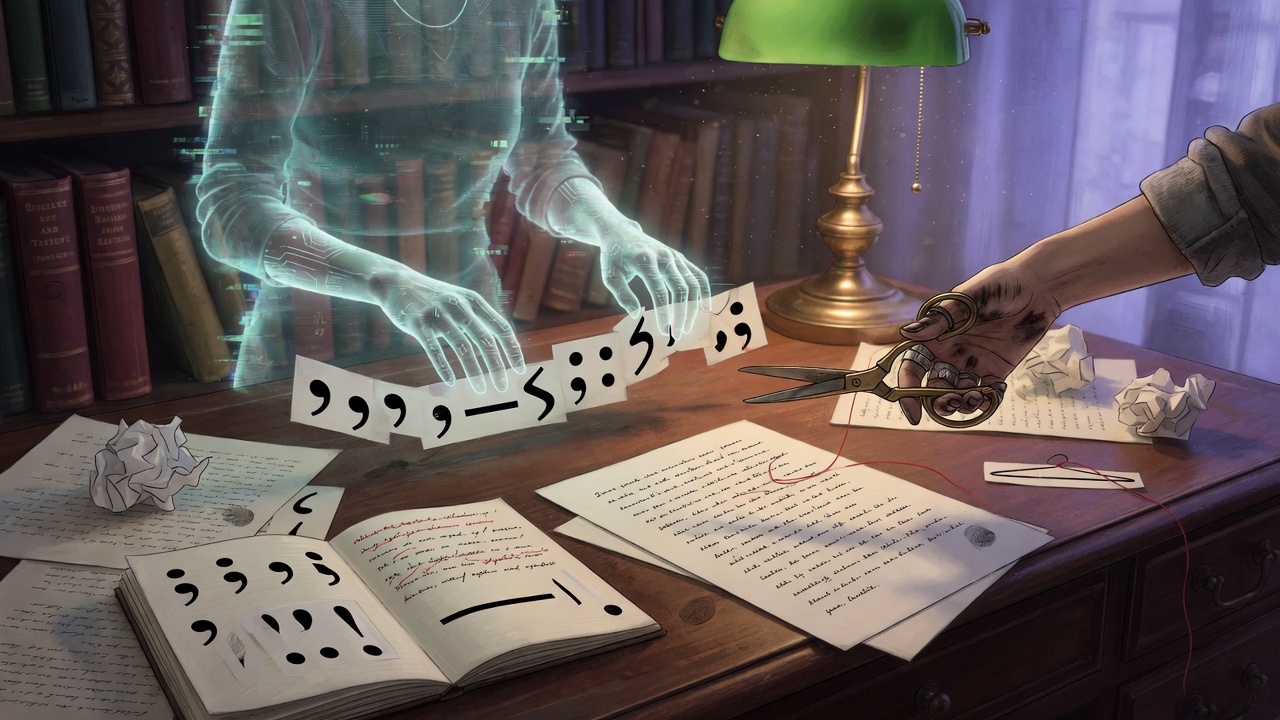
Every writer has a punctuation habit they don't know they have. Maybe you chain three short sentences before letting one run long. Maybe you comma-splice when a character is panicking, like the sentence itself forgot how to breathe. Maybe you almost never use semicolons, and when you do, it's a tell — a moment where the narrator gets a little formal, a little distant. This is your punctuation signature, and it's doing more work in your prose than most people realize. AI, left to its own devices, doesn't know it exists. It defaults to a kind of punctuation Esperanto: even commas, predictable periods, an em-dash sprinkled in whenever it wants a dramatic pause. Clean. Correct. And utterly generic.
This guide is about treating punctuation the way you'd treat dialogue tags or sentence length — as a stylistic choice you can name, document, and hand to an AI model as an actual instruction set, not a vague vibe.
Why Punctuation Is a Voice Fingerprint Most Writers Never Audit
Ask a writer to describe their voice and they'll talk about word choice, tone, maybe pacing. Almost nobody mentions punctuation. But read two authors side by side — say, Cormac McCarthy and Zadie Smith — and the punctuation alone tells you who's who before you've registered a single word. McCarthy strips out quotation marks and most commas, letting sentences run together like weather. Smith stacks clauses with semicolons and dashes, building sentences that spiral and self-correct mid-thought. That's not decoration. That's the architecture of how each of them thinks on the page.
Punctuation controls rhythm, and rhythm is most of what readers experience as "voice" even when they can't articulate why. A sentence broken by a dash reads as interruption — a thought crashing into itself. A comma splice reads as breathlessness or intimacy, rules ignored because the moment matters more than the grammar. A fragment. A dead stop. These are all rhythm decisions, and they're exactly the kind of thing generic AI output smooths over in favor of textbook-correct sentences.
The problem shows up most obviously when you try to write a book with AI across many chapters. Individual scenes might read fine, but string them together and the prose starts to feel like it was written by someone impersonating you rather than actually being you. Readers can't always name what's off. They just sense the voice went slightly beige.
Punctuation isn't grammar's leftover housekeeping — it's the rhythm section of your prose. Get the rhythm wrong and the voice reads like a cover band, technically playing the right notes but never quite landing the groove.
Reverse-Engineering Your Own Punctuation Signature from Past Work
Before you can teach an AI your punctuation habits, you have to actually know what they are. Most writers have never looked. This is the diagnostic step, and it's worth doing properly rather than trusting your gut, because your gut is usually wrong about your own habits — we tend to remember the punctuation we admire in other writers, not the punctuation we actually use.
Pull three or four passages from your best previous work — polished, finished, the stuff you're proud of — ideally including a mix of dialogue, action, and interior reflection. Then look for patterns in five places specifically:
- Em-dash frequency and function. Do you use dashes to interrupt dialogue, to insert an aside, or both? How many per page, roughly?
- Sentence fragments. Do you drop them in for emphasis? Only in tense scenes, or scattered throughout?
- Comma splices. Are you a stickler who never breaks the rule, or do you splice deliberately when a character's thoughts are running hot?
- Semicolon usage. Rare and formal, or a genuine rhythm tool you reach for often?
- Paragraph-ending punctuation. Do your paragraphs tend to land on short punchy sentences, or trail off with a longer one?
This is tedious by hand, which is exactly why it's worth running your own manuscript through something built for pattern-spotting. The Sentence Rhythm Report will show you your actual sentence-length variance and punctuation density rather than your remembered impression of it, and the Word Frequency Finder can surface habitual connector words and filler phrases that tend to travel alongside certain punctuation habits — writers who lean on "but" and "and" as sentence-openers, for instance, usually also lean on fragments.
Once you've got the pattern, write it down in plain language. Not "I use em-dashes sometimes" but "I use one em-dash per 150-200 words, almost always to interrupt dialogue rather than narration, and I never use double dashes in the same sentence." Specificity here is the entire game. Vague instructions produce vague compliance.
Writing a Punctuation Ruleset Prompt AI Will Actually Follow
Most style prompts fail because they describe punctuation in adjectives — "punchy," "literary," "clipped" — instead of rules. AI models are pattern-matchers, and adjectives are exactly the kind of soft target they'll interpret however's most statistically common, which is to say generically. What actually works is closer to a technical specification: named punctuation marks, frequency guidance, and explicit contrast cases (what you do want vs. what you don't).
Think of this ruleset as an extension of your story bible — not something that lives in your head, but a document the model can reference every session, the same way it references character names and magic system rules.
Apply this punctuation style to everything you draft for me, treating it as a hard constraint, not a suggestion:


1. EM-DASHES: Use no more than one em-dash per paragraph. Reserve them exclusively for interrupted dialogue or a sudden physical action breaking a thought — never for adding an explanatory aside (that's what a comma or period is for).

2. FRAGMENTS: Allow sentence fragments only in high-tension scenes (danger, confrontation, grief). Two to three words max. Example of the register I want: "She ran. Didn't look back. Couldn't."

3. COMMA SPLICES: Permit deliberate comma splices only in first-person interior monologue, and only when a character's thoughts are accelerating emotionally. Do not use comma splices in third-person narration or dialogue tags.

4. SEMICOLONS: Do not use semicolons at all. If a sentence feels like it needs one, break it into two sentences instead.

5. DEFAULT SENTENCE: When in doubt, favor a plain declarative sentence over a compound one joined with "and" or "but." I'd rather have three short sentences than one smooth long one.


Before drafting the next scene, confirm you understand these five rules by restating them in your own words.
Notice that last line. Asking the model to restate the rules back to you isn't busywork — it's a check that catches misreadings before they contaminate 2,000 words of prose. If it restates rule 3 as "use comma splices for emphasis" instead of specifically tying it to first-person interior monologue, you know to correct it now rather than during revision.
Here's a second version for a writer whose signature runs the opposite direction — dense, semicolon-heavy, almost Victorian in its clause-stacking:
My prose style relies heavily on subordinate clauses and semicolons rather than short punchy sentences. When drafting, follow these constraints:


- Average sentence length should run 22-30 words, not 8-12. Resist the urge to break long sentences into short ones for "readability."

- Use semicolons to join two independent but related clauses at least once every 200 words — this is a defining feature of my voice, not an occasional flourish.

- Avoid sentence fragments entirely, even in action scenes. My tension comes from long sentences with tight internal control, not short bursts.

- Em-dashes are permitted for parenthetical asides (setting off a clause mid-sentence), used two to three times per page, but never for dialogue interruption — for that, use an ellipsis instead.

- Do not simplify or "clean up" run-on-adjacent sentences. If a sentence has three clauses connected by semicolons and conjunctions, leave it intact.
The point of showing you two opposite rulesets is this: there's no universal "good" punctuation rhythm the AI is hiding from you and needs to be begged for. There's only your rhythm, made explicit. If you're unsure which model handles this kind of granular instruction-following best, the comparisons in best AI models for writing are worth a look before you invest hours refining a ruleset a particular model can't actually hold onto.
Stress-Testing the Ruleset Across Dialogue, Action, and Introspection
A punctuation ruleset that works in one mode of scene often collapses in another. Dialogue-heavy scenes tempt AI toward comma splices and dashes because that's how humans "sound" chatty in training data. Action scenes tempt it toward fragments, sometimes too many, turning your tense chase scene into a strobe light of two-word sentences. Introspection tempts it toward long, hedging compound sentences stitched together with "and" and "but," because reflective prose in the training corpus skews literary-adjacent and over-punctuated.
So don't just test your ruleset on one paragraph and call it done. Run it through all three modes deliberately, in the same session, so you can compare directly.
Using the punctuation ruleset established above, draft the same beat three ways so I can check consistency:


1. DIALOGUE: A tense exchange between Mira and her sister Kess, where Kess finally admits she read Mira's letters without asking.

2. ACTION: Mira running down a fire escape during an earthquake, trying not to drop the box of letters.

3. INTROSPECTION: Mira, an hour later, sitting on a curb, thinking about whether she can forgive Kess.


After each version, list which specific punctuation rules you applied and where, so I can verify against the ruleset before we continue.
That last instruction — listing which rules were applied where — turns the AI into an auditor of its own output, which is far more useful than just asking "does this match my style?" A model will almost always say yes to that question regardless of accuracy. Asking it to show its work catches the drift instead of papering over it.
When you spot a mismatch — say, the action scene used three em-dashes in one paragraph, violating your one-per-paragraph rule — don't just fix that instance. Feed the correction back as reinforcement: "You used three em-dashes in the action passage; the rule allows one per paragraph. Rewrite that passage, and going forward flag when you're tempted to break this rule so we can discuss it instead of defaulting to it."
This stress-testing step pairs naturally with the kind of structural checks you'd already be doing if you're working from an AI book outline — you're essentially building a parallel outline, except for rhythm instead of plot. If you write romance, this matters even more in high-emotion beats; the punctuation stress points in a confession scene or a first-kiss scene are exactly where drift tends to strike, which is worth cross-referencing against the pacing issues covered in the Romance Beat Sheet: Where AI Drafts Usually Break guide. LitRPG and fantasy writers face a parallel issue in stat blocks and magic-system exposition, where AI tends to default to clean, semicolon-stacked technical prose regardless of your established voice — something worth testing explicitly if you're using an LitRPG writing tool for system-heavy chapters.
Catching Punctuation Drift in Long Multi-Chapter Drafts
Here's the uncomfortable truth: even a well-written ruleset degrades over a long draft. Context windows fill up, earlier instructions get diluted by hundreds of pages of subsequent prose, and by chapter fifteen the model has quietly reverted to its factory-default comma habits. This isn't a failure on your part — it's just how these models work. The fix isn't writing a better prompt once. It's building drift-checking into your revision routine.
The most efficient place to do this is during a dedicated pass rather than scattered throughout drafting. If you're following The Five-Pass Revision Order for AI-Assisted Novels, punctuation rhythm fits naturally into the line-level pass, after you've locked plot and character but before you're polishing individual word choices. Trying to fix rhythm and plot logic in the same pass means you'll miss both.
Here are three passages from chapters 2, 9, and 17 of my manuscript. Compare their punctuation patterns against the ruleset we established (one em-dash per paragraph max, fragments only in high-tension moments, no semicolons, comma splices restricted to first-person interior monologue). Identify specifically where later chapters have drifted from earlier ones — not just "this is inconsistent" but exact sentence-level examples with the rule that's being broken. Then rewrite the drifted passages to match the chapter 2 baseline.
Doing this comparison across widely spaced chapters (not adjacent ones) is deliberate — drift is gradual, so chapters 2 and 3 will look nearly identical while chapters 2 and 17 reveal the slow creep back toward generic prose. This is also where a style sheet built from your AI draft earns its keep: log the actual punctuation rules alongside your name spellings and timeline notes, so drift-checking becomes a five-minute reference task instead of a re-negotiation with the model every time.
It's also worth running raw metrics periodically rather than relying purely on prompted comparisons. Readability Scores won't tell you about em-dash placement directly, but a sudden shift in average sentence length or syllable density between chapters is often the numerical shadow of punctuation drift — long compound sentences creeping in usually means your fragments and hard stops have quietly disappeared. Combine that with a fresh Sentence Rhythm Report run on the full manuscript, chapter by chapter, and you'll see the drift as a graph, not just a feeling.
If you're working with a human editor or beta readers afterward, flag this explicitly rather than assuming they'll catch it as "just" an inconsistency note. The Beta Reader Workflow for AI-Assisted Manuscripts is worth adapting to specifically ask readers whether any chapters felt "flatter" or "more formal" than others — that's often punctuation drift wearing a different name. And before anything goes to KDP, a final punctuation consistency check belongs on your list right alongside formatting checks in the KDP Upload Checklist After an AI-Assisted First Draft, since inconsistent rhythm is one of those things readers flag in reviews without ever naming the actual cause.
None of this requires you to become a grammarian. It requires you to notice what you already do, write it down like a rule rather than a feeling, and check the AI's work against it the way you'd check continuity or timeline errors. Start small: pull one finished chapter you're proud of, count your em-dashes and fragments by hand, write four bullet points describing what you found, and hand those four bullets to the model before your next drafting session. That's the whole method, scaled down to something you can do in twenty minutes before you write a single new word.