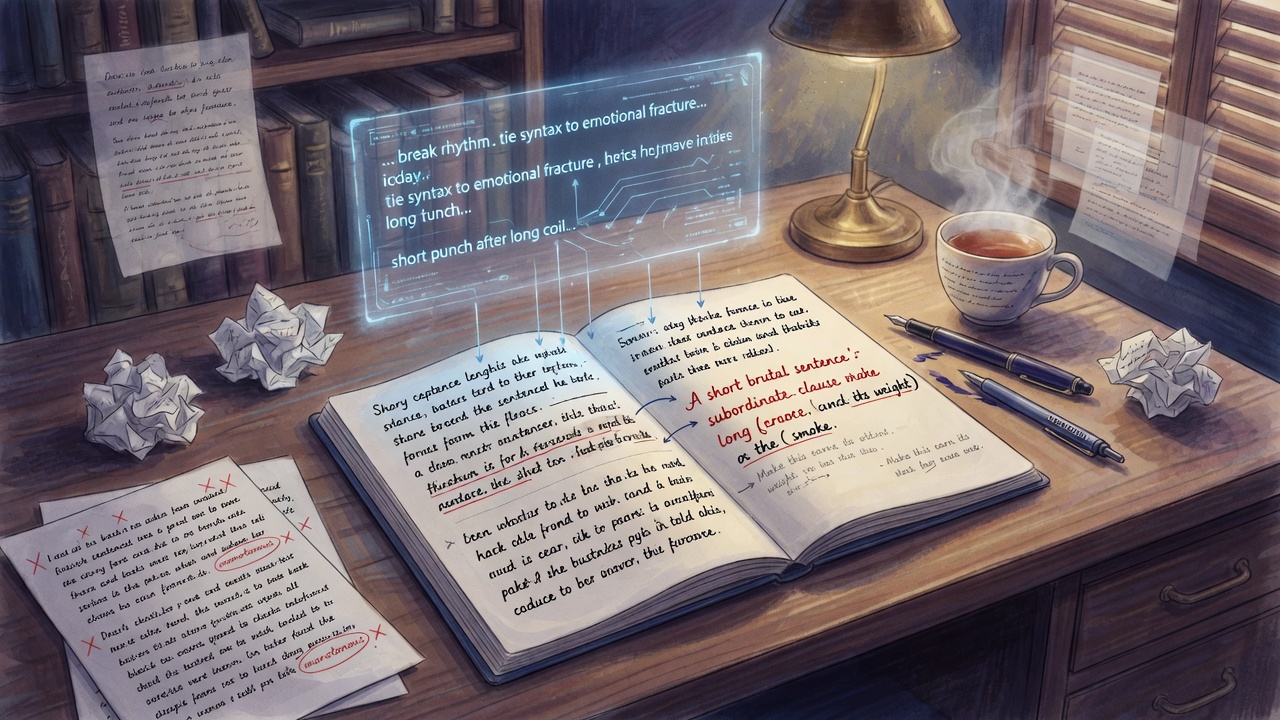
How to Use AI to Write Prose That Earns Its Complexity
Why AI Defaults to Uniform Sentence Complexity (And What It Costs You)
Here's something worth noticing the next time you read a raw AI draft: the sentences are almost the same length. Not identical, but rhythmically interchangeable. A medium-length declarative sentence. Another one. Maybe a slightly longer one with a subordinate clause. Repeat for thirty pages. It's the prose equivalent of a metronome — technically keeping time, but utterly devoid of music.
This isn't a bug exactly. It's a consequence of how large language models are trained. They've absorbed enormous amounts of competent, serviceable writing — blog posts, web articles, mid-tier fiction — and they've learned to produce something that reads as "correct." Correct, in that context, means avoiding both extremes: no bewildering run-ons, no choppy fragments. The result is prose that occupies the comfortable middle ground of syntactic blandness.
For fiction, this is a serious problem. Sentence rhythm isn't decoration. It's meaning. A three-word sentence after a paragraph of dense subordinate clauses hits like a physical thing. A long, winding sentence that delays its main verb — that keeps the reader suspended, slightly off-balance, waiting — enacts the very disorientation the character is feeling. When everything sounds the same, readers don't register the emotional peaks. They just feel vaguely tired.
Syntactic uniformity is the prose equivalent of a flat EQ. Technically clean. Emotionally inert.
This is one of the core challenges when you write a book with AI: the model will do what you ask, but left to its own defaults it reaches for the mean. And the mean, in prose craft, is rarely where the interesting work happens. The good news is that this is a trainable behavior. You can prompt the AI away from its comfortable middle ground — but only if you understand what you're actually asking for and why.
If you've already worked through the basics and you're in revision, check out the guide on how to edit a book with AI — but come back here first, because what we're discussing is more fundamental than editing. It's about building syntactic awareness into the generation process itself.
The Principle of Earned Complexity: Matching Syntax to Cognitive Load
Earned complexity is the idea that a sentence's structural difficulty should map onto what the reader is being asked to process emotionally and intellectually. A long, intricate sentence isn't inherently better than a short one. It's only better when the complexity of the syntax mirrors the complexity of the moment.
Think about when a character understands something enormous — really absorbs it, all its implications unfolding in real time. That moment might want a sentence that does the same thing: that starts in one place and arrives somewhere else, that holds multiple ideas in suspension before resolving them. The syntax performs the cognition. The reader experiences understanding the way the character does.
Contrast that with a character running. Or panicking. Or making a split-second choice under pressure. Short sentences. Maybe fragments. The syntax strips away everything that isn't the immediate action because that's exactly what's happening in the character's nervous system — the extraneous is gone, only the essential remains.
The mistake most writers make — and that AI makes by default — is applying the same syntactic register to both moments. The AI will write your character's profound realization in the same medium-complexity sentences it uses for the grocery run. The Sentence Rhythm Report can show you, visually, where your draft has flatlined. But before you use tools to diagnose the problem, you need to understand the underlying principle well enough to direct the AI toward the right solution.
Here's a useful diagnostic question to ask about any passage: what is this moment asking the reader to feel, and how much should it cost them? Some moments should be easy to receive — clean, clear, fast. Others should work the reader a little. Make them earn the meaning by moving through syntax that's slightly effortful. That effort, when it's calibrated right, becomes pleasure.
This principle connects to broader craft concerns around character interiority. If you've noticed that your AI drafts tend to flatten not just sentence rhythm but also character desire, the guide on Why AI Writes Every Character Wanting the Same Thing addresses the deeper pattern underneath both problems.
Prompting for Simplicity First: Stripping Sentences to Their Load-Bearing Structure
Before you can teach the AI to escalate complexity meaningfully, you need to teach it to simplify ruthlessly. Most writers skip this step. They go straight to asking for "better prose" or "more literary writing" and end up with AI-generated sentences that are ornate but hollow — complexity as decoration, which is exactly what we're trying to avoid.
Start by asking the AI to identify the load-bearing structure of a sentence: the subject, the verb, the core object or complement. Everything else is furniture. Furniture is only good when the room is solid.
Here is a passage from my novel. I want you to strip every sentence down to its grammatical core — subject, verb, essential object only. Remove all subordinate clauses, participial phrases, adverbs, and qualifiers. Don't try to preserve meaning elegantly. I want the skeleton, not the skin. Then, in a separate paragraph, tell me which sentences lost almost nothing important when stripped, and which ones collapsed entirely because the complexity was structural to the meaning.

[Paste your passage here]
Why this works: it forces both you and the AI to audit what's actually doing load-bearing work. When a sentence collapses on stripping — when the meaning genuinely lives in the clause structure — that's a signal the complexity was earned. When a sentence strips down to something just as complete and clear, the complexity was probably decorative. You can then make deliberate choices about what to restore and why.
A related move: ask the AI to rewrite a passage using only simple sentences (subject-verb-object, no subordination) as a baseline draft. Not as the final version — as a canvas. Once you see the ideas laid bare, you can make conscious choices about which ones need more structural weight.
Rewrite this scene using nothing but simple declarative sentences. No subordinate clauses. No participial phrases. No compound predicates joined by "and" unless absolutely necessary. Prioritize clarity and directness over everything. This is a diagnostic draft, not a final one — I want to see what the scene looks like when all complexity is removed.

The scene: [paste your scene]
POV character: Marcus, 40s, former surgeon, emotionally controlled, accustomed to suppressing fear under pressure
Emotional situation: He's just been told his daughter is missing. He's alone in the kitchen. He hasn't reacted visibly yet.
Notice the specificity about character and emotional situation. That's not incidental — without it, the AI will strip the sentences but lose the emotional subtext entirely. The simplicity you're asking for isn't blankness. It's precision. The Readability Scores tool can tell you the quantitative complexity of what you've generated, which is useful for calibrating how far you've actually stripped things down.
Escalating Complexity as a Deliberate Craft Move: Four Prompt Patterns
Once you've established the simple baseline, complexity becomes something you add with intention. Here are four specific patterns for prompting the AI to build it in the right way.
Pattern 1: The Cognitive Unfolding Sentence
Use this when a character is working something out in real time — when the thought itself is the drama. The sentence structure should delay resolution, hold multiple possibilities in tension, then arrive somewhere.
Write a single long sentence — between 60 and 90 words — in which Elena, a forensic accountant, realizes mid-thought that her client has been lying to her for three years. The sentence should begin with something she's confident about, move through a series of subordinate clauses that each introduce a small doubt, and only arrive at the realization at the very end. The syntax should enact the process of figuring it out, not announce the conclusion. Use no exclamation points. Her voice is analytical, dry, quietly devastated.The key instruction here is "the syntax should enact the process." That's the principle made operational. After you get the output, check whether the sentence actually delays resolution or whether it just announces the realization and then adds qualifiers after. If it's the latter, tell the AI to restructure so the main clause comes last.
Pattern 2: Staccato Pressure
Action sequences, panic, confrontation — these want short sentences and often fragments. The AI will resist fragments because they feel "incorrect." You have to explicitly grant permission and explain the craft logic.
Ask for "syntactic pressure" — a term that tends to communicate the right idea to most models. Pair it with a strict word count per sentence, which forces the AI to cut rather than accumulate. The Word Frequency Finder can help you check afterward whether filler words crept back in.
Pattern 3: The Weighted Pause
This is one of the most powerful and underused tools in fiction prose: a very short sentence, usually three to seven words, dropped after a long one. The short sentence lands differently because of what came before it. The contrast creates emphasis that no amount of italics or exclamation points can replicate.
When prompting for this, specify the structural contrast explicitly. Don't just ask for "varied sentence lengths." Ask for a pattern: long, long, short. Or long, short. Give the AI the architecture and let it fill the bricks.
Pattern 4: The Subordination Ladder
For moments of accumulated grief, nostalgia, complex moral reasoning — anything where the character is holding multiple truths at once — ask the AI to build a sentence where each clause depends on the previous one. Not just "a complex sentence" but a specific structural shape: a ladder, where each rung adds weight.
This pairs well with How to Build a Story Bible That AI Models Actually Follow, because once you've developed a character's syntactic voice — the shapes their interior monologue tends to take — you can add that to your story bible as a style note. "Marcus's interiority favors subordination ladders when suppressing emotion; short declaratives when acting." That kind of specificity makes AI outputs far more consistent across a long manuscript.
Building a Complexity Contrast Edit into Your AI Revision Pass
All of the prompting techniques above are most powerful when they're part of a structured revision workflow rather than ad-hoc fixes. Here's how to build a complexity contrast edit — a specific pass dedicated entirely to syntactic register — into your process.
The goal of this pass is not to make your prose more complicated. It's to make the complexity meaningful by creating contrast. High points feel higher when they follow something simple. Difficult sentences feel earned when they arrive after a stretch of clarity. You're not adding ornament; you're engineering rhythm.
Start by reading your chapter aloud and marking three kinds of moments: (1) places where the prose felt flat, where nothing landed; (2) places where you stumbled over syntax without getting a payoff; (3) places where the rhythm felt right. This is your map. Category 1 is often where you need more contrast — something simpler before or after a key moment. Category 2 is where complexity was decorative rather than earned. Category 3 tells you what your instincts already know.
Then run a targeted AI revision prompt on each category 1 and category 2 passage:
I'm doing a syntactic revision pass on this passage. Here's what I need:

1. Identify any sentence that is more complex than its emotional content justifies. Rewrite it with simpler syntax, preserving all meaning.
2. Identify any moment where the prose is uniformly simple but the character is experiencing something cognitively or emotionally complex. Suggest one sentence — just one — that escalates the syntax to match the moment.
3. Check the final 2-3 sentences of the passage. Does the passage end with appropriate syntactic weight — heavier for resolution, lighter for open tension? Adjust if not.

Do not rewrite the entire passage. Make surgical changes only.

Passage:
[paste passage]

Context: This is chapter 7 of a literary thriller. POV is third-person close. The character, Diane, has just read a letter from her estranged father. She's sitting at her kitchen table. The scene should feel suspended, unresolved.
The instruction "surgical changes only" is doing a lot of work here. Without it, AI models have a tendency to rewrite everything, often smoothing away the interesting choices you already made. You want the model to act as a copy editor with craft awareness, not a ghostwriter starting fresh.
This kind of targeted revision pass fits naturally into the framework laid out in The Five-Pass Revision Order for AI-Assisted Novels, where syntactic refinement typically belongs in a later pass, after structure and character are locked. If you try to fix sentence rhythm before you've stabilized the scene's purpose, you're polishing prose that might need to be cut anyway.
When you're ready to take your manuscript further — into beta readers, formatting, or publication — the Beta Reader Workflow for AI-Assisted Manuscripts is worth reading alongside the KDP Upload Checklist After an AI-Assisted First Draft. Syntactic complexity is something beta readers will feel before they can name it. "Some parts felt slow" often means the prose was uniformly complex where it should have simplified. "Certain scenes didn't land" sometimes means the key moment arrived in exactly the same syntactic register as everything around it.
One practical habit worth building: keep a short document of what I'd call syntactic anchors for each POV character — two or three sentences from your manuscript that exemplify the right complexity register for that character's calm state, stressed state, and reflective state. When you start a new AI generation session, paste these anchors into your prompt. The model will calibrate its sentence structures against them far more reliably than if you describe the style abstractly. Pair this with the character consistency tools available in Entangled Text and you'll find the outputs drifting far less across a long project.
The goal isn't sentences that sound literary. It's sentences that do something sentences of a different structure couldn't do.
Syntactic complexity in fiction is a form of argument — an implicit claim that this moment, this thought, this feeling is worth more of the reader's cognitive attention. Make sure you're only making that claim when you mean it. The best thing you can do this week is pick a single chapter, run the strip-to-skeleton exercise on three consecutive paragraphs, and see what survives. The sentences that collapse are your starting points. Build them back up with intention, and the prose that emerges will have earned everything it asks of your reader.
Try it yourself
Write your own book with AI — free, no credit card required.
Free · No credit card