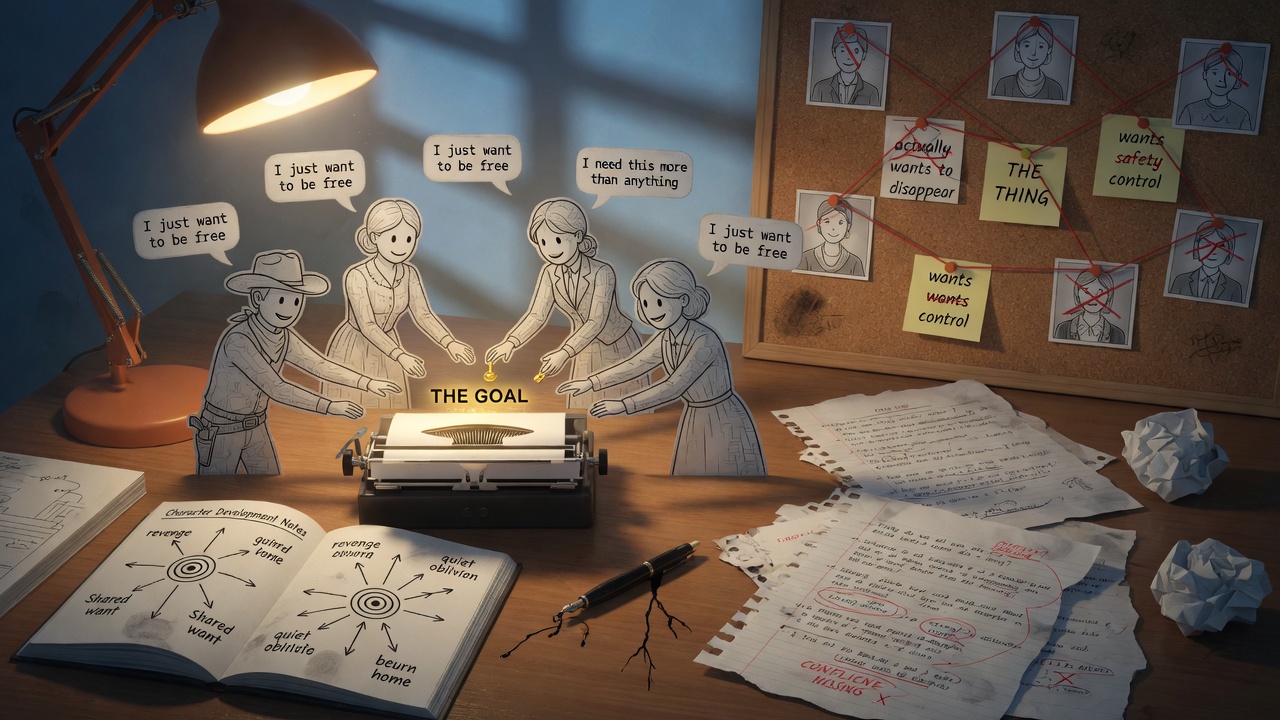
Here's something that will ruin you for bad fiction once you notice it: every character in a scene is trying to accomplish the same thing. The detective and the suspect both want the truth to come out. The estranged siblings both want reconciliation. The rival politicians both want what's best for the city. Everyone is rowing in the same direction, and the scene has all the tension of a group hug.
This is what AI does by default, and it happens so consistently that I've started calling it the convergence problem. Understanding why it happens is the first step to fixing it — because once you see the mechanism, you can work against it deliberately.
The Convergence Problem: Why AI Defaults to Unified Desire
Language models are trained on enormous amounts of human text, and a significant chunk of that text is expository, cooperative, or explanatory in nature. Instructions, articles, summaries, polite emails. Even the fiction in the training data skews toward resolved conflict — completed stories where things worked out. The model has a statistical lean toward harmony, toward characters who ultimately share a frame of reference.
But there's something more structural happening too. When you prompt an AI to "write a scene where two characters discuss X," the model interprets the topic as the organizing principle. Both characters are now oriented toward X. Their dialogue becomes a joint exploration of X rather than a collision of incompatible needs that happen to be occurring in the same room.
Drama isn't two people talking about the same thing. It's two people in the same conversation who each desperately need it to end differently.
The AI doesn't intuitively grasp this distinction. It reaches for what linguists call cooperative discourse — the conversational norm where participants work together to build shared meaning. Real dramatic scenes are fundamentally uncooperative. Characters are pursuing separate agendas. They're using the same words to mean different things. They're answering questions that weren't asked because answering the actual question would be dangerous.
There's also the matter of what I call desire flattening — where a character's want gets reduced to the thematic concern of the scene rather than something rooted in their specific psychology. A jealous wife doesn't just "want honesty." She wants her husband to say the words that will let her stop imagining things. That's a much more specific, much more volatile desire, and it's completely different from what the husband wants, which might be to get through this conversation without detonating his marriage before he's figured out what he actually feels.
How to Spot Single-Goal Flattening in Your Draft
The symptoms are subtle enough that they hide behind competent prose. You can have well-written sentences, plausible character voices, and a scene that still has no friction because everyone secretly wants the same outcome.
Read your scene and ask this diagnostic question for each character: What would they need to conceal, deflect, or avoid in this conversation? If a character has nothing to hide and nothing to protect, they have no cross-purpose desire. They're just a participant in a shared discussion, not a person with their own imperatives.
Other red flags to watch for:
- Everyone agrees on what the scene is "about." If your detective and your witness are both operating as if the conversation is a truth-finding exercise, you've lost the witness's counter-agenda.
- Characters take turns making their points without derailing each other. Real competing desires produce interruptions, non-sequiturs, and subject changes that are actually covert redirections.
- Emotional beats resolve cleanly. When Character A says something vulnerable, Character B receives it warmly and the scene moves forward. No one is threatened by what the other person just revealed.
- The scene ends with both characters in roughly the same place they'd want to be. Genuine cross-purpose drama almost always ends with at least one character having failed to get what they came for — or getting something they didn't know they were asking for.
Here's a quick revision test: cover the dialogue tags and read only what the characters say. Can you tell which lines belong to which character based purely on what they're trying to accomplish? If the lines are basically interchangeable — if Character A could plausibly say what Character B is saying — you have a convergence problem.
The Competing Wants Framework: Prompting Characters at Cross-Purposes
The fix isn't complicated, but it requires you to do a bit of work before you prompt. You need to establish, explicitly and separately, what each character in the scene is trying to achieve — and those goals need to be incompatible, not just different.
Different goals can coexist peacefully. Incompatible goals create drama. The mother who wants her son to stay for dinner and the son who wants to leave have different goals. The mother who needs her son to stay so she can tell him she's sick — but can't say that directly because she doesn't want to be a burden — and the son who needs to leave because staying one more hour will mean admitting he's been lying about his life in the city: those are incompatible goals disguised as a mundane argument about dinner plans. That's a scene.
Before you write a single prompt, build what I call a desire map for your scene:
- Surface want: What does this character appear to want from the conversation?
- Real want: What do they actually need, underneath the surface want?
- Fear: What outcome would be catastrophic for them?
- Strategy: What tactic are they using to pursue their real want while protecting against their fear?
When those four elements are defined for each character, and when the characters' fears point at each other's real wants, you have the architecture for genuine dramatic friction. Then you hand that architecture to the AI and ask it to dramatize it — not to invent it.
This is the key insight about working with AI on character-driven scenes: the model is excellent at dramatizing a conflict you've already specified. It's poor at discovering a conflict you haven't. Your job is to design the collision. The AI's job is to write the crash.
Prompt Examples: Building Desire Conflict at the Scene Level
Generic prompts produce convergence. Specific prompts produce collision. Here's the difference in practice.
Write a scene between Maya, a hospice nurse, and her patient Frank, a retired contractor in his late 70s.

Maya's surface want: to complete Frank's end-of-life paperwork and discuss his pain management preferences.
Maya's real want: to get Frank to acknowledge he's dying so she can actually help him, because patients in denial suffer more in the final days.
Maya's fear: that Frank will die still believing she failed him by not being warmer, more personal.
Maya's strategy: professional distance as armor — she keeps steering toward medical facts when the conversation threatens to become real.

Frank's surface want: to be polite and cooperative, to not be difficult.
Frank's real want: to have one honest conversation about what his life meant, because there's no one else left who knew him when he was young.
Frank's fear: that this nurse, like everyone else, sees only an old sick man and not the person he was.
Frank's strategy: he keeps making small jokes, testing whether she'll laugh, because people who laugh with him are people who see him.

Write 400–500 words. Third-person limited, Maya's POV. The paperwork should be present and real — they keep returning to it — but it should feel like a battleground, not a task.
Why this works: the fear/strategy mapping creates genuine cross-purpose behavior. Maya's clinical distance is exactly what prevents Frank from getting what he needs. Frank's jokes are exactly what threatens Maya's professional composure. They're not working against each other on purpose — they're each doing the thing that protects them, and those things happen to collide. That's the texture of real drama. Tweak the fears to shift who has more power in the scene; make Frank's fear darker or Maya's more specific to change the emotional register.
Write a scene at a kitchen table. Characters: Dani (31, recently back home after losing her job in another city) and her father Hector (58, has been running the family's struggling hardware store alone for two years).

Hector's real want: for Dani to offer to help with the store — not because he'll ask, but because he needs to know she sees what he's carrying.
Hector's fear: if he asks directly and she says no, he'll have lost something he can't name. So he won't ask.
Hector's strategy: talking about the store in a way that makes the situation visible without making the request explicit. He mentions details — the broken shelving unit, the supplier who raised prices, a regular customer who died — as if he's just making conversation.

Dani's real want: to be welcomed back without conditions, to be the daughter again before she became the disappointment.
Dani's fear: that coming home means surrendering the version of herself she was trying to build elsewhere.
Dani's strategy: she keeps redirecting toward the future, toward her plans, because sitting still in this kitchen feels like giving up.

They're talking about whether to order more mulch for the spring display. Write the scene in 500 words. Let the mulch conversation carry all of it. Do not let either character say anything true directly.
The last instruction — "do not let either character say anything true directly" — is doing significant work here. It prevents the AI's convergence instinct from resolving the tension prematurely by having someone just come out with it. Real scenes in this emotional register operate entirely through indirection. You can adjust the final instruction to "allow one character to break, but not the other" if you need the scene to move toward partial revelation.
Revision Pass: Using AI to Audit and Redistribute Character Motivation
You don't only use AI at the drafting stage. One of the most useful things you can do with a scene you've already written — whether the AI wrote it or you did — is ask the model to analyze the desire distribution and tell you where it's collapsed.
I'm going to paste a scene below. Read it and then answer these questions for each named character:

1. What does this character appear to want from the conversation?
2. What is this character afraid of in this scene?
3. At what moments does this character's behavior seem inconsistent with a person pursuing a distinct goal?
4. Are there any points where two characters seem to want the same thing at the same time? List them.
5. On a scale of 1–5, how much does each character's presence in the scene create friction for the other characters?

Be specific. Quote the lines where you see convergence or inconsistency. I'm not looking for praise — I want to find the flat spots.

[PASTE SCENE HERE]
This prompt works because it gives the AI an analytical task rather than a creative one. You're using the model's pattern-recognition strengths instead of asking it to improvise. The instruction to quote specific lines forces the analysis to stay grounded in the actual text rather than drifting into generalities. The "scale of 1–5" question sounds a bit blunt, but in practice it surfaces which characters have been reduced to props.
After you get the audit back, you have two options. You can revise manually — which is often the right call, because now you know exactly where the dead spots are. Or you can prompt a targeted rewrite of the flat sections:
In the scene I showed you, you identified that Renata's motivation collapses in the middle section — she starts behaving as if she shares Marco's goal of getting the truth out, when her actual goal is to keep the family together even if that means burying the truth.

Rewrite just lines 14 through 23 of that scene. Keep Marco's lines identical. Rewrite only Renata's dialogue and physical actions so that she is consistently protecting the family story, even while appearing to cooperate. She should seem agreeable on the surface while actually redirecting every time Marco gets close to the thing she doesn't want said.

Do not add new information or characters. Stay in the same location and timeframe.
The constraint to keep Marco's lines identical is essential. It prevents the AI from solving the problem by changing both characters, which would just generate a new scene. You want a surgical fix to the motivation collapse, not a rewrite that loses what was already working.
The practical takeaway here is simpler than it might seem after all of this: before you prompt any scene involving two or more characters, write two sentences — one for each character — that complete this template: "[Character] will do anything in this scene to [real want], and the thing they're most afraid of is [fear]." If those two sentences point at each other — if Character A's real want is exactly Character B's fear — you're ready to write. If they don't conflict, redesign the wants before you touch the prompt. The AI will faithfully dramatize whatever collision you set up. What it won't do is invent one for you.