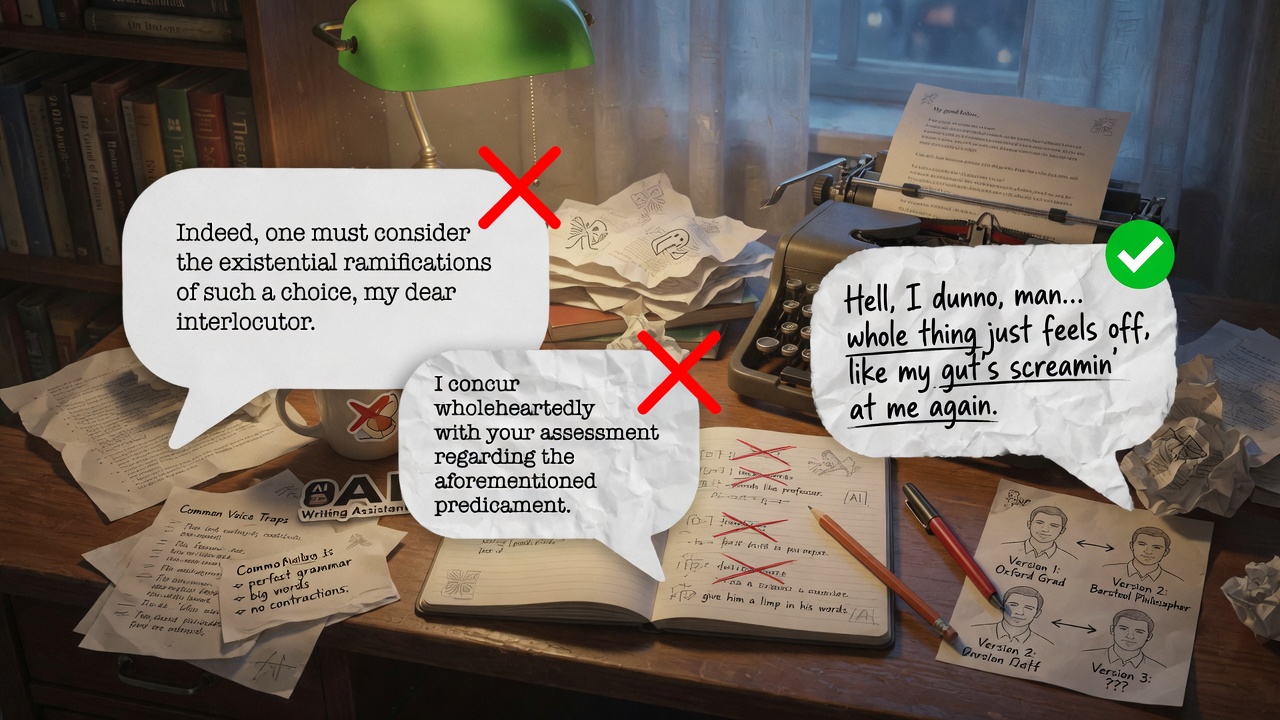
Every character in your AI-assisted manuscript is suspiciously well-spoken. The seven-year-old articulates her fears with quiet precision. The mechanic from rural Georgia explains his worldview in complete, balanced sentences. The exhausted single mother responds to conflict with measured, emotionally intelligent observations. They all sound like they've had therapy and read widely. They sound, if you're being honest, a little like the AI itself.
This isn't a flaw in your prompting instincts. It's baked into how large language models are trained. The overwhelming weight of that training data skews toward educated, edited, standard-register prose — articles, books, essays, forum posts from people who write well. The model's default "person speaking" is essentially a thoughtful adult with a college education and good emotional vocabulary. That person bleeds into every character unless you actively fight it.
The fix isn't complicated, but it requires a shift in how you think about character voice before you prompt. You can't just say "make her sound uneducated" — that produces either offensive caricature or surface-level quirks that wear off after two exchanges. What you need is to encode the actual cognitive and linguistic architecture of how a specific person processes and communicates the world.
The Educated Default: Why AI Writes Everyone Like a Thoughtful Adult
The problem runs deeper than vocabulary. When AI flattens character voices, it's not just swapping in the wrong words — it's applying the same thinking structure to every speaker. Educated adult cognition tends to be: linear, cause-and-effect driven, emotionally self-aware, comfortable with abstraction, and capable of holding two competing ideas at once without collapsing into contradiction.
A child doesn't think that way. Neither does someone in acute emotional shock, or a person who grew up in an environment where direct emotional labeling was rare or discouraged, or an elderly man whose speech patterns calcified decades ago around idioms nobody uses anymore. Each of those people doesn't just choose different words — they arrive at utterances differently. Their sentences have different shapes because their cognition has different shapes.
The AI's educated default isn't about vocabulary. It's about giving every character the same internal processing style — and then dressing it up in superficial dialect markers.
You'll often see this disguised as dialect. The AI will give a Southern character "y'all" and "fixin' to," or give a working-class character a dropped g on gerunds, and call it a day. But strip those markers away and the underlying sentence logic is identical to every other character. The clause structure is the same. The emotional insight is the same. The way the character handles uncertainty or conflict is the same. That's the real flatness — and surface dialect won't fix it.
Mapping the Problem: How to Spot Vocal Homogeneity Across Your Cast
Before you can fix the problem, you need to see it clearly. The best diagnostic tool is brutal and simple: take a passage of dialogue involving three or more of your characters, strip out the speaker tags, and read it cold. Can you tell who's speaking? Not from context clues in the plot — from the voice alone?
If the answer is mostly no, you have vocal homogeneity. But go further. Look for these specific symptoms:
- Complete sentences from everyone. Real speech is fragmentary, interrupted, abandoned mid-thought. If every character finishes their sentences cleanly, the AI is editorializing.
- Emotional meta-commentary. Characters who explicitly name their feelings ("I feel like you don't trust me") rather than expressing them obliquely or not at all. Many people — especially men in certain cultural contexts, or people under stress — don't have ready access to that vocabulary.
- Balanced clauses. "On the one hand... but on the other hand..." constructions, or sentences that concede a point before making their own. This is educated rhetorical structure. A teenager in a fight doesn't argue like a debate team member.
- Vocabulary ceiling breaches. A character who, three scenes ago, didn't know what "pensive" meant suddenly uses "reticent" correctly in dialogue.
- Conflict resolution via articulation. Characters who solve interpersonal problems by clearly explaining their needs and listening to others'. This is the AI's therapeutic ideal, not how most people actually fight.
Make yourself a character voice sheet — even a rough one. For each major character, jot down their education level, what kind of environment they grew up in, what topics they're actually fluent discussing versus where they'd struggle, and what they do when they can't find the right word. That last one matters enormously.
Cognitive Anchoring: Prompting from How a Character Thinks, Not Just How They Talk
Here's the reframe that changes everything: instead of telling the AI how your character speaks, tell it how your character thinks.
Speech is downstream of cognition. If you encode the cognitive constraints accurately, the speech patterns follow more naturally — and they stay consistent across longer passages because they're rooted in something structural, not just a list of verbal tics.
Cognitive anchors to consider for any character:
- Abstraction tolerance. Can this person comfortably discuss feelings, ideas, or hypotheticals? Or do they ground everything in concrete, physical, immediate reality? A man who grew up fixing engines thinks about betrayal differently than a woman who grew up in a house full of books.
- Emotional vocabulary access. Some people have rich, precise emotional language. Others have a much smaller set: angry, sad, fine, whatever. When a character with limited emotional vocabulary needs to express something complex, they'll either go silent, get physical, displace onto something external ("I'm just tired"), or reach for an approximate word that's slightly wrong.
- Sentence-building strategy. Does this person think ahead to the end of their sentence before they start speaking, or do they build as they go and sometimes get lost? Do they use filler while processing ("I mean," "like," "you know")? Do they abandon constructions and start over?
- Reference pool. What cultural, professional, or personal library does this character draw metaphors from? A carpenter reaches for carpentry. A former athlete reaches for sport. A deeply religious person reaches for scripture. The AI defaults to a wide, educated general reference pool — you need to narrow it.
Give the AI a constraint, not a style note. "She speaks simply" is a style note. "She doesn't have language for what she's feeling and so she talks about the physical world instead" is a constraint — and it generates speech that stays true across multiple scenes.
Prompt Techniques: Encoding Vocabulary Ceilings, Syntax Habits, and Speech Gaps
Now the practical part. The prompts that actually work are specific, restrictive, and structural. You're not asking the AI to perform a voice — you're giving it a set of rules to stay inside.
Here's a prompt for a character with limited formal education and emotional avoidance:
Write dialogue for Dale, a 52-year-old auto mechanic from rural Kentucky who left school at 16. His vocabulary is concrete and practical — he has no problem naming engine parts, weather, distances, dollar amounts. He has almost no vocabulary for emotions and avoids direct emotional statements entirely. When he's upset, he talks about tasks or logistics. His sentences are short. He uses "reckon" and "ain't" naturally but not constantly. He never uses psychological language ("boundaries," "processing," "feeling heard"). He interrupts himself sometimes and doesn't always finish the thought. He shows affection through offers of practical help, not words.

Scene: Dale's adult daughter tells him she's moving across the country. Write his response — about 6-8 lines of dialogue.
Why this works: it gives the AI a positive vocabulary domain (mechanical, physical, practical) AND a negative constraint (no emotional/psychological language). The behavioral translation — affection through practical offers — gives it somewhere to put the emotion without naming it. You'll get Dale reaching for something concrete when he's overwhelmed, which is character voice emerging from cognitive architecture rather than dialect performance.
For a young child, cognitive anchors matter even more than vocabulary:
Write dialogue for Maya, age 7. Her sentences are short and often loosely connected with "and then" or "because" even when the logic doesn't quite hold. She doesn't understand abstract concepts like fairness as principles — she understands them as specific incidents that happened to her. She jumps between topics when she hits something she can't process. She asks literal questions about things adults consider rhetorical. She has full emotional experience but her vocabulary for it is limited to: scared, mad, sad, happy, weird-feeling, it hurts. She doesn't moderate her emotional expression for social context.

Scene: Maya is asking her mother why her grandmother doesn't recognize her anymore. Write the dialogue — Maya's side only, 5-6 exchanges.
The key move here is "loosely connected with 'and then' or 'because' even when the logic doesn't quite hold." That's not a style note — it's a description of how seven-year-olds actually build causal reasoning. The AI will apply it structurally, not just as decoration.
For a character with high intelligence but non-standard education — say, someone who is very smart but grew up without access to standard academic frameworks:
Write dialogue for Terrence, 34, who grew up in foster care and is largely self-educated through reading whatever he could find — lots of genre fiction, some history, technical manuals, internet forums. He's genuinely intelligent and perceptive, but his reference points are idiosyncratic and his formal register is inconsistent. He'll use a sophisticated word correctly and then, in the same breath, use a grammatical construction that marks him as outside formal education. He doesn't use therapy-speak or corporate language. He's observational and dry. When he doesn't have the right word, he invents a description rather than reaching for the proper term ("that thing where someone acts helpful but it costs you something").

Scene: Terrence is explaining to a friend why he doesn't trust a mutual acquaintance. 8-10 lines of dialogue.
That parenthetical — "that thing where someone acts helpful but it costs you something" — is doing enormous work. You're showing the AI exactly what a vocabulary gap looks like when someone is intelligent: they describe around it rather than reaching for a word they don't own.
Testing and Iterating: A Three-Character Dialogue Stress Test to Lock in Distinct Voices
Once you've developed cognitive anchors for your main cast, you need to test them under pressure. The best test is a scene where three distinctly different characters have to discuss the same topic — ideally something emotionally or conceptually complex — and you check whether their different processing styles are actually producing different speech.
The prompt structure for this test:
Write a scene with three characters discussing whether to sell the family house after their mother's death.

Character constraints:
- Ruth, 58, retired schoolteacher: emotionally articulate, tends to frame everything as a lesson or principle, long sentences, uses full emotional vocabulary freely, slightly professorial even in grief
- Danny, 51, contractor: practical, talks in terms of money and logistics, uncomfortable with open grief, responds to emotional statements with problem-solving, short sentences, slight deflection when things get too raw
- Cass, 29, youngest sibling who was closest to the mother: fragmented speech when emotional, trails off, interrupts herself, asks questions she doesn't actually want answered, her sentences get shorter and less grammatical under stress

Write 15-20 exchanges. Keep each character inside their cognitive style — Ruth should sound nothing like Danny should sound nothing like Cass. Show their different relationships to the same grief through HOW they speak, not just WHAT they say.
After you get the output, apply the strip-the-tags test again. If you can still tell who's speaking without the names, the voices are working. If Ruth starts using Danny's clipped pragmatism, or Danny starts reaching for emotional abstractions, the AI drifted — and you now know which character's constraints you need to strengthen.
Iteration usually means tightening the negative constraints. The positive side (what vocabulary a character has access to) is easier for the AI to maintain. The negative side (what vocabulary they don't have, what cognitive moves they can't make) degrades faster over a long scene. If Danny starts getting too emotionally sophisticated three pages in, add to his constraint: "He never asks how someone feels. He asks what they're going to do about it."
One more iteration trick: after you get a draft you're mostly happy with, ask the AI to flag anywhere it felt it had to "reach" outside a character's established voice to make the dialogue work. It won't always catch this reliably, but it will sometimes surface moments where the plot forced a character to articulate something they shouldn't be able to articulate — and those are the moments worth rewriting by hand.
The educated default isn't going away on its own. The AI will keep pulling every character toward that polished, emotionally aware center unless you build structural fences around each voice. The work is in the character briefs — not in asking for dialect, not in appending "make this sound less educated" to a prompt, but in encoding the actual cognitive architecture before you write a single line of scene.
Start with your character who currently sounds most like everyone else. Write out their abstraction tolerance, their emotional vocabulary ceiling, what they do when they hit a concept they can't name, and what their three main reference domains are. Put that in a brief of eight to ten sentences. Then run that brief as a header on every prompt that involves them for the next chapter, and watch what happens to the voice.