How to Use AI to Write Group Scenes Where Every Voice Is Distinct
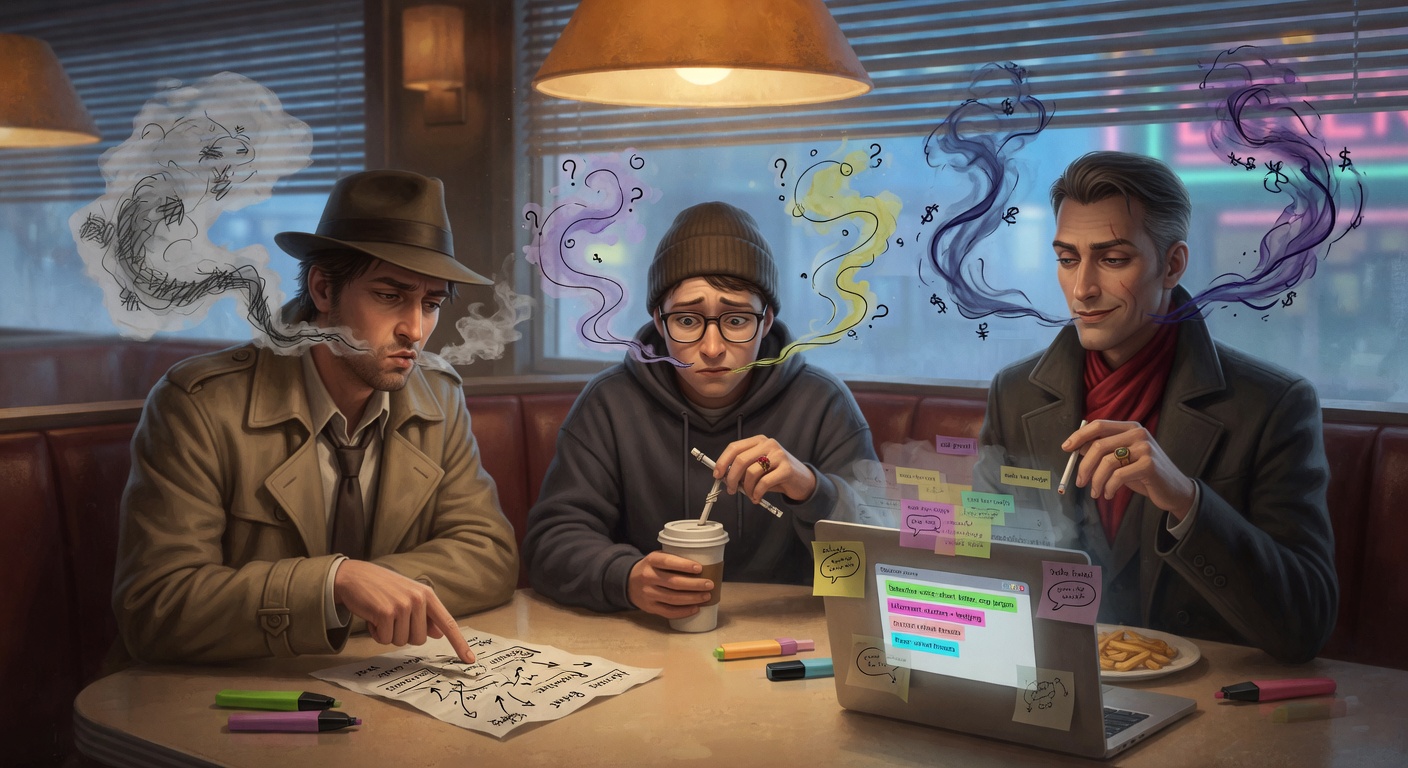
Group scenes are where AI-assisted fiction goes to die. You've got four characters sitting around a table — the cynical detective, the nervous informant, the idealistic rookie, the morally grey fixer — and somehow, by the third exchange, they all sound like the same moderately-articulate person having a conversation with themselves. Every line is a clean, complete thought. Every character is equally witty. Nobody interrupts, nobody fumbles, nobody talks past anyone else.
This isn't a mystery. It's a predictable failure mode, and once you understand why it happens, you can actually fix it.
Why AI Collapses Character Voices in Group Scenes
Here's the core problem: AI language models are trained to produce coherent, fluent text. That's their whole thing. And coherent, fluent text is the enemy of distinct character voice. Real people are incoherent. They're repetitive. They talk in half-sentences and non-sequiturs. They have verbal tics that are mildly annoying. They answer questions with different questions, or don't answer at all.
When you ask an AI to write dialogue for four characters at once, it has to juggle coherence across all four simultaneously. Under that cognitive load — and yes, models do have something functionally similar to cognitive load — the path of least resistance is to flatten everyone toward a neutral, articulate mean. The detective stops sounding like a detective. The nervous informant stops stumbling. Everyone starts using full sentences and making clean points.
There's a second problem: context window dilution. In a long ensemble scene, each character's specific voice instructions get diluted by everything else in the prompt — the setting, the plot information, the other characters' descriptions. By the time the model is generating the fourth character's third line, it's working from a very faint impression of who that person is supposed to be.
The solution isn't to write better prompts for the scene itself. It's to do significant work before you ever ask for a scene draft — work that gives the AI compressed, specific, memorable information about each voice.
Building a Voice Fingerprint Card for Each Character Before You Prompt
A Voice Fingerprint Card is a short, dense character profile built specifically for dialogue generation. It's different from a general character bio, which usually describes backstory, appearance, and motivation. A Voice Fingerprint Card describes how someone talks — the mechanics of their speech, not the content of their soul.
For each character, you want to nail down five things:
- Sentence structure preference: Long and winding with subordinate clauses, or clipped and declarative? Do they trail off? Do they over-explain?
- Vocabulary register: Formal, technical, slangy, dated, hyper-specific to a field or subculture?
- Deflection or engagement style: Do they answer questions directly, or do they redirect, minimize, or answer with a story?
- A signature verbal behavior: One specific, slightly odd habit — they always return to a particular metaphor, they repeat the last word someone said before responding, they never use contractions.
- What they never say: This is underused. Specifying that a character would never offer unprompted reassurance, or would never use passive voice, creates negative space that's incredibly useful.
Here's what a Voice Fingerprint Card might look like in practice, for a character named Renata:
Renata speaks in short declarative bursts, three to six words each. She asks questions instead of making statements when she's nervous. She uses the word "fine" sarcastically and often. She never explains her reasoning unless pressed twice. She does not soften bad news. She refers to abstract concepts by giving them proper names ("the Thing with the Brennan account," "your little plan"). She would never say "I understand how you feel."
Write one of these for every character in your ensemble before you touch a scene prompt. It takes maybe ten minutes per character. It's the single highest-leverage thing you can do.
Once they're written, paste all your Voice Fingerprint Cards into a single block at the top of your scene prompt. They become the anchor for everything that follows.
The Anchor-and-Contrast Method for Multi-Character Dialogue Drafts
The Anchor-and-Contrast Method is a prompting approach that works by giving the AI two jobs at once: stay true to each character's individual fingerprint (anchoring), and actively make each character's voice diverge from the others (contrast).
Most writers only ask for the first part. They describe each character and ask for a scene. The AI produces something technically consistent but monotonous, because nothing in the prompt told it to actively differentiate. Adding the contrast instruction changes the output significantly.
The method has three components:
1. Lead with the fingerprint block
Paste all your Voice Fingerprint Cards first, before any scene description. Label them clearly. This front-loads the most important information before the model gets distracted by plot.
2. Give an explicit contrast instruction
After the fingerprint block, add a single sentence that tells the AI its job is differentiation. Something like: "In this scene, the contrast between these four voices should be immediately obvious — a reader should be able to identify who is speaking from the dialogue alone, without dialogue tags." This isn't fluff. It actually changes what the model optimizes for.
3. Assign a specific dramatic function to each character in this scene
Not their general personality — what they're trying to do in this specific scene. Renata is trying to end the conversation. Marcus is trying to get someone to commit to something they don't want to commit to. Yusuf is trying to figure out who's lying. Della is trying not to be noticed. These micro-objectives give each character a reason to talk differently, which is more generative than personality descriptions alone.
Personality describes who someone is. Dramatic objective describes what they want right now. Dialogue lives in the gap between the two.
When you combine the fingerprint block, the contrast instruction, and the scene-specific objectives, you're giving the AI a complete enough picture that it doesn't have to guess. And when the AI doesn't have to guess, it doesn't default to averaging.
Prompt Examples: From Flat Ensemble to Differentiated Group Scene
Here are two prompts for the same scene — one that produces flat ensemble dialogue and one that doesn't.
The weak version:
Write a tense scene where four characters — Detective Holt, the informant Tony, rookie officer Priya, and fixer named Clare — discuss what to do about a missing evidence file. Each character has a different perspective on the situation.This prompt will get you four characters who all discuss the situation with equal articulateness and roughly similar sentence lengths. "Different perspective" isn't a voice instruction — it's a content instruction.
Now here's a prompt that uses the Anchor-and-Contrast Method:
Voice Fingerprint Cards:

DETECTIVE HOLT: Speaks in long, exhausted sentences that circle back on themselves. Uses "allegedly" and "supposedly" constantly, even in private. Never addresses anyone by name — he says "you" even when three people are in the room. He does not make jokes. He would never admit uncertainty directly; instead he asks procedural questions as a way of stalling.

TONY (informant): Talks too fast. Starts sentences he doesn't finish. Refers to himself in the third person when scared ("Tony doesn't know anything about that"). Uses a lot of filler — "you know," "like," "whatever." He deflects with humor that doesn't land. He never volunteers information; everything gets dragged out of him.

PRIYA (rookie): Formal and over-precise, like she's writing a report out loud. She completes her sentences. She references protocol and procedure when she's uncomfortable. She asks clarifying questions. She's the only one who uses full names. She would never swear.

CLARE (fixer): Economy of language. She speaks in half-sentences and lets silence do work. She watches before she talks. When she finally says something, it lands. She uses physical action as punctuation — she picks something up, she moves across the room. She asks questions she already knows the answer to.

Scene: The four of them are in a back office. A manila folder that should contain surveillance photos is empty. Nobody knows who took them — or everyone does. Holt has been sitting with this information for twenty minutes before anyone else arrived.

Scene-specific objectives: Holt wants to figure out if Clare took the photos without letting her know he suspects her. Tony wants to leave. Priya wants someone to file a formal report. Clare wants to assess how much Holt knows.

IMPORTANT: Write this scene so a reader can identify who is speaking from the dialogue alone. The contrast between voices should be stark. 400-500 words of dialogue, minimal narration.
This prompt works because it gives the AI everything it needs to make active choices. The Voice Fingerprint Cards give it texture. The scene-specific objectives give it subtext. The explicit contrast instruction tells it what success looks like. Notice how Clare's fingerprint includes physical behavior — that bleeds into the minimal narration and makes her feel present even when she's not talking.
One more, for a different kind of ensemble — a family dinner scene:
Voice Fingerprint Cards:

GRANDMA RUTH: Redirects every conversation back to food, health, or someone she knew in 1987. Speaks with authority she hasn't earned on the topic at hand. Uses "in my day" unironically. She asks questions that are actually criticisms: "You're wearing that?" She never acknowledges she's been contradicted.

MARCUS (her adult son, 52): Performs calm. Extremely long sentences full of qualifications and hedges. "I think what Mom might be trying to say, and correct me if I'm wrong, is..." He talks about his feelings in the third person: "A person might find that hurtful." He does not finish arguments; he smooths them over incompletely.

DEVORAH (Marcus's wife): Precise and dry. Short sentences. Extremely specific word choices — she'll use "contemptuous" where someone else would say "mean." She notices things and names them, which makes everyone uncomfortable. She laughs at the wrong moments. She would never cushion a direct observation.

JAYLEN (their 19-year-old): Almost entirely in questions and one-word answers. When pushed, he speaks in run-on sentences with no punctuation energy — just a flat stream of words. He refers to everything as "that thing" or "this whole thing." He checks his phone in his responses: partial answers, trailing off.

Scene: Thanksgiving dinner, first course. Devorah has just made a comment about the cost of Ruth's assisted living facility — not maliciously, but it lands badly. Everyone at the table heard it.

Scene-specific objectives: Ruth wants to make Devorah feel guilty without appearing wounded. Marcus wants no one to fight. Devorah wants to clarify what she actually meant, but not apologize. Jaylen wants to know if he can leave the table yet.

Write 300-400 words of dialogue. Reader should be able to remove all dialogue tags and still know exactly who is speaking.
The "remove all dialogue tags" instruction at the end is worth keeping in your toolkit. It reframes the task in a way that the model finds useful — it's a concrete quality bar rather than an abstract aspiration.
How to Run a Voice Attribution Test on AI-Generated Group Dialogue
Once you have a draft, you need to test whether the differentiation actually worked. The Voice Attribution Test takes about five minutes and tells you exactly where voices are collapsing.
Here's the process:
- Copy the dialogue from your draft and strip out all dialogue tags and action beats. Just the spoken words, attributed to nothing.
- Read through it. For each line, ask: could I put this in any other character's mouth without it feeling wrong?
- Mark every line where the answer is "yes" or "maybe." Those are your collapse points.
Then take your marked lines back to the AI with a targeted revision prompt:
Here are three lines from the dialogue I'm revising. Each one is currently too generic — it could belong to any of the four characters. Using the voice fingerprints below [paste fingerprints], rewrite each line twice: once as it would actually come out of [Character A]'s mouth, and once as [Character B] would say it. Make the contrast between the two versions obvious.

Lines to revise:
1. "We need to figure out who took those photos."
2. "This is getting complicated."
3. "Maybe we should call someone."
This prompt is doing something specific: it's asking the AI to demonstrate contrast rather than just produce it. Seeing the same content expressed through two different voices back-to-back teaches you what the fingerprint actually sounds like in practice, and gives you concrete options to drop into your scene.
When you run this test regularly, you start to notice patterns in your own prompt writing. You'll see that certain voice fingerprints you write are doing real work — Devorah's "extremely specific word choices" was a strong instruction — and others are too vague to generate anything distinctive. "Speaks thoughtfully" is useless. "Answers a question by asking what the questioner means by their key term" is not.
The goal isn't to hand the AI full creative control over your characters. It's to compress your understanding of each voice into a form the AI can actually act on, and then check its work.
The practical thing to do right now: take your most recent ensemble scene — or one you've been avoiding writing — and draft Voice Fingerprint Cards for every character before you write a single word of the scene itself. Use the five-part structure: sentence preference, vocabulary register, deflection style, one signature verbal behavior, and one thing they'd never say. Keep each card under 100 words. Then write the scene prompt with the cards at the top, add the contrast instruction, and add a specific dramatic objective for each character in that scene.
The difference between that and just describing your characters in a prompt is the difference between giving a musician sheet music and telling them to "play something sad." Specificity is the whole game.
Try it yourself
Write your own book with AI — free, no credit card required.
Free · No credit card