How to Prompt AI to Write Subtext-Heavy Dialogue
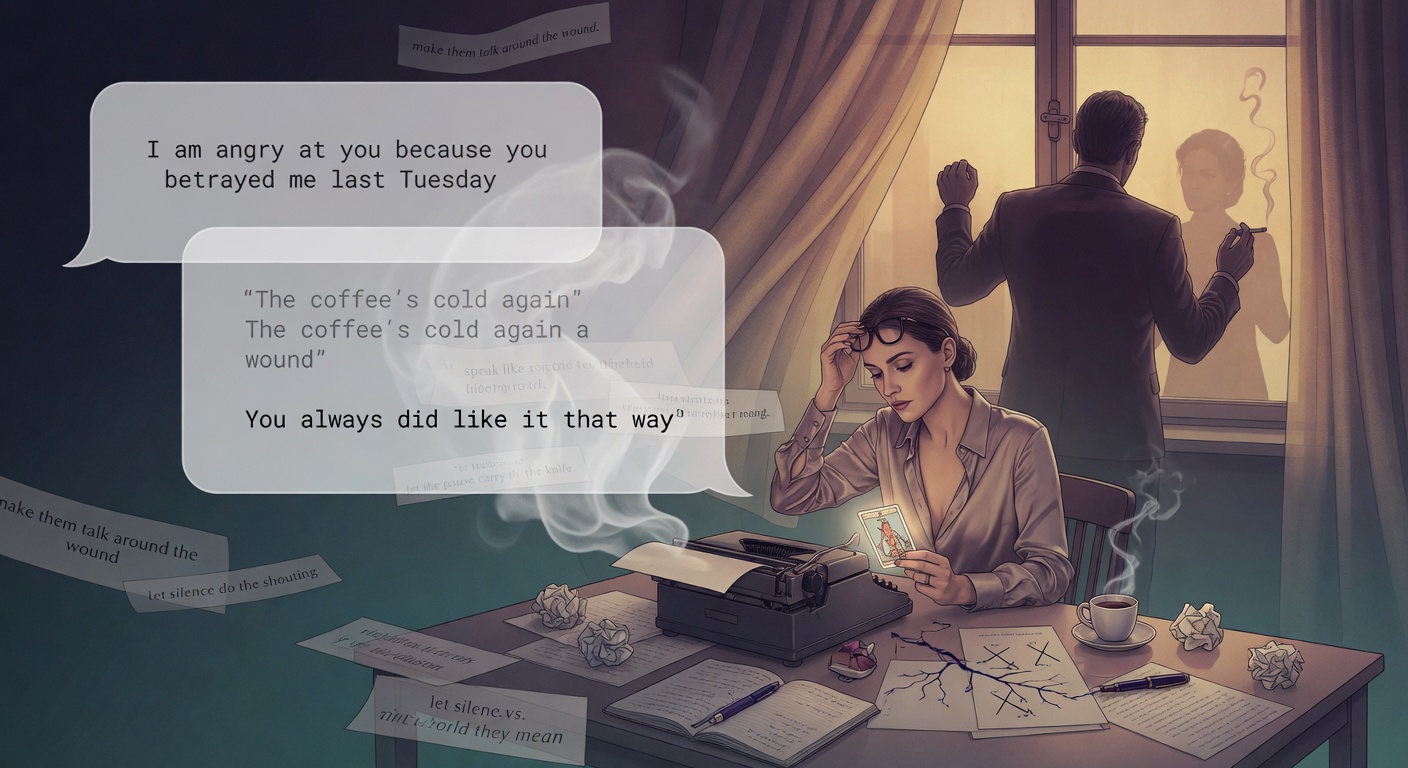
Subtext is the hardest thing to teach a human writer. It's even harder to get from an AI. Left to its own devices, the AI will have your characters announce their feelings like they're reading from a therapy intake form. "I'm angry at you because you never listen." "I still love her, even though she hurt me." Direct. Clear. Completely lifeless.
The good news: AI can write genuinely layered, indirect dialogue — the kind where a conversation about who forgot to buy milk is actually about a marriage falling apart. You just have to build the subtext into the prompt before the AI writes a single word.
Why AI Default Dialogue Is Too On-the-Nose (and How to Spot It)
Here's what AI does naturally. You ask it to write a scene where two estranged brothers reunite at their father's funeral. It gives you something like: "I haven't forgiven you for leaving," Marcus said. "I had to leave," David replied. "You never understood what this family did to me."
That's not dialogue. That's two characters summarizing the story for people who weren't paying attention.
The tell-tale signs of on-the-nose AI dialogue are easy to spot once you know what you're looking for. Characters name their emotions directly ("I feel betrayed"). They explain their motivations out loud ("The reason I'm doing this is..."). Every exchange resolves cleanly, with both parties understanding each other by the end. Nobody deflects, nobody lies, nobody talks about the weather when they mean something else entirely.
This happens because AI is optimized for clarity. Its training rewards coherent, comprehensible output. Subtext is, by definition, a form of strategic communicative ambiguity — and ambiguity looks like a bug to a language model unless you specifically instruct it otherwise.
AI doesn't default to subtext because subtext requires the model to simultaneously hold what a character is saying AND what they refuse to say. You have to make that refusal explicit in your prompt.
The Three Layers of Subtext AI Can Be Trained to Target
Before you can prompt for subtext, you need to know what you're actually asking for. I find it useful to think about subtext in three distinct layers, because you can instruct AI to work on any one of them — or all three at once.
Layer 1: Emotional Subtext
This is the most common type. A character feels something — jealousy, grief, desire, shame — but expresses something adjacent instead. The grieving mother who keeps criticizing her daughter's outfit at the funeral rather than crying. The ex-boyfriend who talks about his new apartment with just a little too much enthusiasm. You instruct AI for this layer by specifying the hidden emotion AND giving it a decoy topic for the character to focus on instead.
Layer 2: Power Subtext
Every conversation has a power dynamic. Someone is maneuvering, testing, withdrawing, or asserting. Power subtext lives in interruptions, in who changes the subject, in who asks questions they already know the answers to. Think of a boss who keeps complimenting an employee's "commitment" in a meeting where she's about to be passed over for promotion. The compliment is the threat. You instruct AI for this layer by giving it the power objective of each character — what they're trying to win or protect — separately from what they're saying.
Layer 3: Relational Subtext
This is about history. The specific weight two characters carry into a room together. When a father says "you look thin" to his adult daughter, that line means something completely different depending on whether he's a man who withheld food as punishment or a man who has spent thirty years worrying she doesn't eat enough. Relational subtext is the whole unsaid backstory bleeding through ordinary words. You instruct AI for this layer by front-loading the relationship history, not just the current scene goal.
Prompt Architecture: Giving AI the Emotional Agenda Before the Scene
Most writers prompt AI the way they'd describe a scene to a stranger: "Write a conversation between a husband and wife who are having marriage problems." That's a disaster waiting to happen. The AI fills the vacuum with whatever "marriage problems dialogue" looks like in aggregate — which is every clichéd argument you've ever seen in a mediocre movie.
The architecture that actually works has four components, and you give them to the AI in this order:
1. The hidden agenda. What does each character actually want from this conversation that they will not say out loud? Not their surface want (to talk about the vacation plans) but their real want (to find out if the other person still wants to be married).
2. The avoidance strategy. What topic or object or task are they using to avoid the real thing? The more specific, the better. "They're discussing what to do with a broken fence post" beats "they're talking about mundane household things."
3. The emotional temperature of each character. Not "sad" — that's too broad. "He's been running on adrenaline for three days and is starting to crash." "She made a decision two weeks ago that she hasn't told him yet and feels the relief of it constantly, like a stone she's already put down."
4. What must NOT be said. This is the most important instruction and the one writers almost always leave out. Tell the AI explicitly: this character will never use the word "love" in this scene. This character will not admit she knows about the money. The moment AI understands what's forbidden, it starts working with indirection.
The constraint is the subtext. When you tell AI what a character refuses to say, you're teaching it where the pressure in the scene actually lives.
Four Prompt Examples That Generate Genuinely Indirect Dialogue
Here are prompts I've actually used or developed through iteration. Copy them, gut them, rebuild them for your own scenes.
Write a scene of dialogue between two women, Renata (58) and her daughter Simone (31), set in Renata's kitchen the morning after Simone has told her she's not having children. Neither of them refers to that conversation directly. Renata focuses entirely on making coffee — the grinding, the exact temperature, the cups she's chosen. Simone is watching her mother's back.

Hidden agenda: Renata is grieving. She will not show Simone this grief because she believes it would be manipulative. She is trying to perform normalcy as an act of love. Simone is waiting to be told it's okay. She needs permission she suspects her mother will never give.

Renata must not say anything explicitly about grandchildren, disappointment, or the future. She must not cry or show visible emotion. Instead, she talks about small things with slightly too much care — the coffee, a plant on the windowsill, a neighbor. Simone gives short answers.

Tone: quiet, careful, like two people handling something fragile. The scene should end without resolution.
Why this works: the avoidance object (the coffee ritual) gives the AI a concrete behavioral anchor for Renata's emotional displacement. The explicit instruction that Renata's performed normalcy is an act of love stops the AI from making her cold — it understands her motivation even while she hides it. The forbidden content list is tight and specific. Tweak: swap in any emotionally loaded domestic task — folding laundry, watering plants — and the dynamic shifts slightly each time.
Write a 300-word dialogue between two former business partners, Glenn and Yusuf, meeting for lunch eighteen months after their company failed and Glenn lost most of his savings. Glenn initiated the lunch. Yusuf doesn't know why Glenn asked to meet.

Glenn's hidden agenda: He wants an apology. He will not ask for one. He's hoping Yusuf will offer it voluntarily, and is running a kind of internal test — if Yusuf doesn't bring it up, Glenn will have his answer about who Yusuf is.

Yusuf's hidden agenda: He's done his grieving and moved on. He is genuinely glad to see Glenn. He thinks the lunch is about reconnecting, maybe even working together again. He has no idea Glenn is still this angry.

They talk about their current lives, the restaurant, an industry news story they both know. Glenn is pleasant. Too pleasant — there's a flatness under it that a perceptive reader should sense. Yusuf is warm and expansive.

Do not have either character mention the company, the money, or what happened. The word "sorry" must not appear.
Why this works: giving the AI mismatched hidden agendas is incredibly generative — Yusuf's oblivious warmth makes Glenn's controlled pleasantness much more charged. The AI understands one character is testing the other, which creates natural dramatic irony. Tweak: you can flip the dynamic so Yusuf does know he owes an apology but is hoping Glenn won't bring it up — completely different scene from the same surface conversation.
Dialogue scene. A detective, Cara, is interviewing a suspect, Owen, about a theft at his workplace. Cara already knows Owen did it — she has evidence she hasn't revealed yet. Owen doesn't know she knows.

Cara's power objective: She wants Owen to feel safe enough to make a mistake. She is friendly, almost deferential. She keeps asking about his coworkers, his opinion on things, making him feel like an expert. She never asks him directly about the theft.

Owen's objective: He wants to seem cooperative without saying anything incriminating. He's practiced what he'd say. He's more nervous than he expected.

Write the dialogue as a cat playing with something it has already caught. Cara should seem slightly bored, or interested in something other than what Owen thinks she's interested in. She should ask about a specific coworker named Dennis three separate times, in three different ways, as if she keeps forgetting she already asked — but she hasn't forgotten.

No direct accusation. No mention of evidence. Owen never lies explicitly — he just never quite tells the truth.
Why this works: "a cat playing with something it has already caught" is the kind of specific tonal instruction AI responds to better than abstract adjectives like "tense" or "suspenseful." The repeated-question-about-Dennis technique gives the AI a specific behavioral pattern to execute, which produces something that feels choreographed and deliberate rather than random. Tweak: change what Cara already knows versus what she's still uncertain about — ambiguity in her knowledge changes the whole texture of her performance.
Write a scene where a 17-year-old, Maya, is saying goodbye to her father at the airport. He is moving to another country for work. They both know this is likely permanent, though neither will say so. Maya is furious at him. She has decided to be loving instead of furious, because she wants this to be a good memory. That decision is costing her something.

The father talks too much. He gives advice about small things — her phone plan, a good mechanic she should use, a recipe she asked about once three years ago that he wrote down and is giving to her now on a piece of paper. He is filling the time.

Maya accepts everything he says. She agrees with everything. She does not tell him she's angry. She asks no questions about when she'll see him again.

Constraints: no crying, no hugs described in the text, no character says "I love you" or "I'll miss you." The recipe note should appear as a physical object in the scene but its contents don't matter. The last line must be Maya's and must be about something completely ordinary.
Why this works: the instruction that Maya "has decided to be loving instead of furious, and that decision is costing her something" gives the AI a character who is actively performing an emotion rather than simply feeling it — that gap is where subtext lives. The recipe as a physical object is a concrete displacement for everything the father can't say. The final line constraint forces the scene to end in the key of the whole thing: ordinary surface, enormous weight underneath.
Editing AI Subtext: When to Amplify, When to Bury It Deeper
Even with detailed prompts, AI will occasionally surface the subtext — have a character almost say it, or write a line that's so loaded it collapses under its own weight. Your editing job is calibration.
Amplify when: the subtext is present but too easy to miss. If you read the scene and feel nothing pulling beneath the surface, the AI has written polite conversation rather than charged conversation. Go back into the prompt and tighten the forbidden list, or add a specific behavioral tell — he keeps rearranging the cutlery; she checks her phone twice but doesn't look at it. Concrete physical behavior carries subtext better than word choice.
Bury it deeper when: the dialogue is doing too much work. If a line reads like a metaphor for the relationship rather than something a human would actually say — "Some doors, once closed, can't be reopened, you know" — that's AI trying to wink at the reader. Cut it, or replace it with something more mundane. Real subtext doesn't explain itself. Add to your prompt: "No line should be interpretable as a metaphor for their relationship. All dialogue must sound like something a real person would say in this specific situation."
The other editing move worth knowing: sometimes the AI writes a good subtextual exchange in the middle of a scene but brackets it with on-the-nose lines at the start and end. It's warming up and then wrapping up, essentially. Delete the first and last exchanges more often than you think you should. Subtextual scenes almost always start too early and end too late.
The subtext is rarely in the best line of dialogue. It's in the line before it, or the silence after it that you have to put into stage direction.
One last thing worth doing: once you've generated a scene you mostly like, paste it back to the AI with this specific instruction — "Identify every moment in this scene where a character is close to saying what they really mean. Rewrite those moments so the character retreats further from it, using action or deflection instead." That single follow-up prompt has fixed more AI dialogue for me than any amount of re-prompting from scratch.
Try it yourself
Write your own book with AI — free, no credit card required.
Free · No credit card