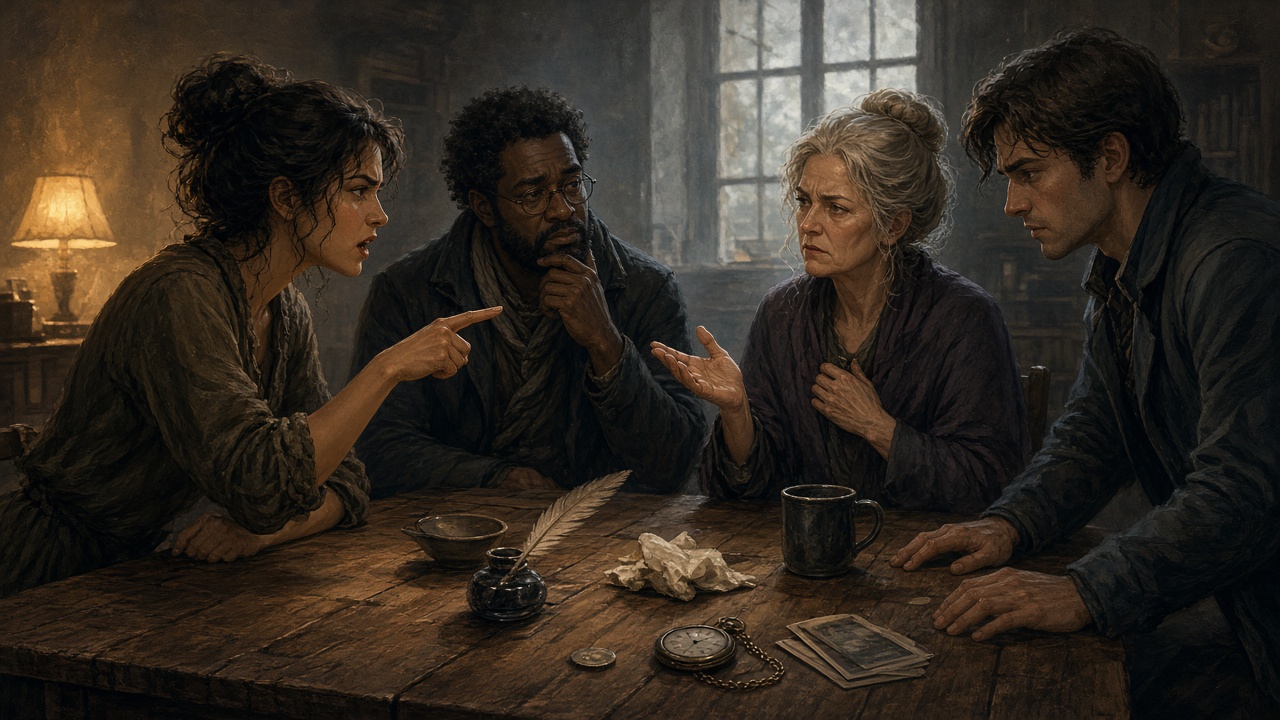
Why AI Defaults to One "Debate Mode" for Every Character
Open any AI-drafted argument scene and you'll notice something strange: everyone fights the same way. Character A makes a point. Character B counters it. Character A rebuts the counter. It reads like a debate club transcript with different names pasted on top. The tension is there on paper, but it doesn't feel human, because real people don't argue like lawyers building a case. They argue like themselves. This happens because language models are trained to produce coherent, logical exchanges. Coherence is the model's default value, and conflict scenes get treated as information-trading rather than emotion-leaking. Nobody in real life responds to "you never listen to me" with a calm, structured rebuttal. They cry, they change the subject, they walk out, they explain themselves for four uninterrupted paragraphs nobody asked for. AI doesn't know to do that unless you tell it to. The fix isn't better dialogue prompting in the generic sense. It's giving each character a fixed, nameable conflict-response pattern — a habit their brain falls into under pressure — and then holding the AI to that pattern scene after scene, no matter how high the stakes climb. Once you do that, arguments stop sounding interchangeable and start sounding like specific people who've been fighting this way their whole lives.
Mapping Characters to Conflict Archetypes
Before you write a single argument scene, decide how each major character handles conflict when they're cornered. Not what they believe — how they behave when belief meets resistance. I use five reliable archetypes, borrowed loosely from conflict psychology but bent toward fiction's needs:
- The Deflector — turns questions into jokes, changes the subject, redirects blame outward. Rarely answers directly.
- The Escalator — meets any resistance with more intensity. Raises stakes, raises volume, makes threats they may not mean.
- The Withdrawer — goes quiet, shuts doors (literally or emotionally), agrees just to end the conversation, then acts out the disagreement later instead of voicing it.
- The Over-Explainer — buries the real issue under context, justification, and backstory. Talks past the point where anyone's still listening.
- The Placater — apologizes first, absorbs blame that isn't theirs, tries to smooth the moment even when they're the one who's right.
Assign one archetype per major character and write it into your story bible next to their other traits. This single addition does more for dialogue variety than any amount of "make the dialogue more distinct" prompting, because it gives the model a mechanical rule to follow instead of a vague aesthetic goal.
Here are four characters from my manuscript. For each one, I'm assigning a fixed conflict-response style that should show up any time they're in an argument or disagreement, regardless of the topic:

- MARA (escalator): raises her voice, brings up past grievances, makes the conflict bigger than the original issue within three lines of dialogue.
- DESH (withdrawer): goes monosyllabic, physically disengages (turns away, busies his hands), agrees out loud to end it while clearly not agreeing internally.
- YUSEF (over-explainer): responds to any accusation with a long justification that includes irrelevant context, rarely lets the other person interrupt.
- PIA (placater): apologizes even when not at fault, minimizes her own needs, tries to find a compromise before anyone else has finished their point.

Write a scene where Mara confronts Yusef about missing the deadline. Keep both characters locked to their conflict style even as the argument gets more personal. Do not let Yusef become defensive in an escalator way — he stays in over-explainer mode even when cornered.
This works because it front-loads the constraint before the model starts drafting. You're not correcting bad output after the fact — you're defining the physics of the scene up front. If you're using an AI book outline to plan chapters, it's worth noting each character's conflict style right there in the outline notes for every scene tagged as confrontation, so you don't have to re-explain it chapter after chapter.
Keeping the Style Consistent as Stakes Rise
Here's where most writers lose the thread. You establish that Desh withdraws under pressure in chapter three, and it works — quiet, clipped, cold. Then in chapter eighteen, when the stakes are life-or-death, the AI suddenly writes Desh screaming and throwing furniture, because "high stakes" reads to the model as "more dramatic dialogue" rather than "the same pattern turned up louder." The trick is to describe escalation as amplitude within the pattern, not a switch to a different pattern. A withdrawer under mild stress goes quiet. A withdrawer under extreme stress doesn't become an escalator — he goes silent for longer, leaves the room entirely, stops answering texts for days. The behavior intensifies without changing shape.
Desh is a withdrawer in conflict — he goes quiet, disengages physically, and agrees just to end conversations rather than stating his real objection. I need a scene where he and Mara are arguing about whether to tell the police what they found, and this time the stakes are much higher than earlier scenes (someone could go to prison based on their choice).

Do NOT have Desh become loud, aggressive, or confrontational just because the stakes are higher — that would break his established pattern. Instead, show his withdrawal escalating in its own register: longer silences, shorter answers, him leaving the room mid-sentence, maybe not speaking to Mara again until the next morning. The intensity should come from how far he withdraws, not from him switching to a different conflict style.
Explicitly naming the failure mode you want to avoid — "do NOT have him become loud" — matters more than it should. Models are pattern-completion engines, and "high stakes argument" is a pattern strongly associated with raised voices in most training data. You have to override that association directly, every time stakes jump, at least until the pattern is well-established across enough scenes that the model can infer it from context alone.
This is also where a character consistency pass earns its keep — run it specifically looking for conflict-style drift, not just physical description or backstory errors. It's a different kind of consistency than most consistency tools check for by default, so you may need to prompt it directly with the archetype list above.
Contrast Prompts: Pairing Mismatched Styles for Friction
The real payoff of this method shows up when you deliberately mismatch styles. Two escalators arguing just get louder together — which can work, but it's a known shape, and it resolves the same way every time (someone breaks or someone wins). The far more interesting friction comes from styles that can't actually engage each other. Picture an escalator arguing with a withdrawer. The escalator needs resistance to push against, and the withdrawer refuses to give it. That's not a fight, that's a wall meeting a wave — and it's genuinely uncomfortable to read, in the best way, because neither character gets the confrontation they need. The escalator ends up screaming into silence. The withdrawer ends up trapped by someone who won't let the silence end the conversation.
Write a kitchen-table argument between Mara (escalator — raises voice, drags up old grievances, wants a visible resolution) and Desh (withdrawer — goes quiet, physically disengages, will say "fine" or "okay" just to end it without meaning it).

The core mismatch: Mara needs Desh to fight back or she can't feel like anything's been resolved. Desh needs Mara to stop so he can regain control of himself. Neither gets what they need. End the scene with Mara saying something she regrets specifically because Desh's silence made her feel unheard, and Desh leaving the room — not as a dramatic exit, just quietly, mid-argument, in a way that infuriates Mara more than anything he could have said.
Notice that prompt doesn't just name the styles — it names what each character needs from the exchange and states plainly that neither gets it. That's the actual mechanism of good mismatched conflict, and spelling it out for the AI produces sharper scenes than simply requesting "tension" or "conflict." You can build entire subplots around style mismatches: an over-explainer paired with a placater will produce excruciating, funny scenes where one person won't stop talking and the other keeps apologizing for interrupting a fight they didn't start. A deflector paired with another deflector might mean two people who like each other never actually resolve anything for half the book, which — depending on your genre — might be exactly the slow burn you want. If you're building tension in a romance novel with AI, mismatched conflict styles are often a better engine for will-they-won't-they tension than external plot obstacles, and the Romance Beat Sheet: Where AI Drafts Usually Break covers other places this kind of emotional mismatch tends to get flattened by default AI drafting.
Mismatched conflict styles don't need a winner. The friction comes from two people trying to have completely different conversations at the same time, using the same words.
This same principle transfers well outside romance too. In a thriller with AI, an escalator interrogator paired with a placater suspect creates instant unease — the placater keeps agreeing with accusations that aren't even true yet, which reads as guilt even when it isn't. In LitRPG writing, a party of adventurers with clashing conflict styles under pressure (a guild leader who over-explains strategy while a rogue withdraws mid-briefing) makes party dynamics feel lived-in rather than like exposition delivery vehicles.
The Editing Pass: No Two Characters Resolve Conflict the Same Way Twice
Once the draft exists, run a dedicated pass — separate from grammar, separate from plot logic — that checks one thing only: does every argument in the manuscript end differently, in a way that reflects who these specific people are? This matters because even with archetypes assigned, AI drafts tend to converge on a small number of resolution shapes: someone apologizes, someone storms off, someone has a realization mid-argument and softens. If you don't check for this specifically, you'll find that your escalator, your withdrawer, and your placater all end their respective conflicts the exact same way — with a hug, or a "you're right," or a slammed door — regardless of their supposedly different styles.
Go through the attached chapter and list every scene containing an argument or interpersonal conflict. For each one, tell me: (1) which character's established conflict style is present, (2) how the scene resolves — does it end in agreement, avoidance, unresolved tension, someone caving, someone doubling down, etc. — and (3) whether that resolution pattern has already appeared in an earlier scene with a different character pair.

Flag any resolution that repeats a pattern already used twice or more, and suggest an alternative ending for that scene that stays true to the character's conflict style but produces a different outcome than the repeated pattern.
This is a genuinely different kind of check than most editing passes cover, which is why it deserves its own slot rather than getting folded into a general consistency sweep. If you're following The Five-Pass Revision Order for AI-Assisted Novels, this conflict-resolution audit fits naturally into the pass focused on character and voice, after you've locked structure but before you're polishing line-level prose. Doing it too early wastes effort on scenes that might get cut; doing it too late means you're rewriting dialogue you've already grown attached to.
It's also worth checking your dialogue mechanically here — a Dialogue Tag Analyzer can surface whether you're describing the same physical action (crossing arms, sighing, looking away) for multiple characters during conflict, which often signals that the underlying style differentiation isn't actually reaching the prose even if the plot beats differ. Similarly, the Dialogue vs Narration Ratio tool can flag whether your over-explainer scenes are actually longer on the page than your withdrawer scenes — if they're not, the pacing isn't reflecting the style you assigned, even if the content technically matches.
Building This Into Your Process From the Start
The earlier you assign conflict styles, the less repair work you'll do later. If you're still in the planning stage, add a "conflict style" field to every character entry when you first write a book with AI, right alongside voice notes and physical description. It costs you one sentence per character and saves you an entire revision pass. For genre-specific applications: in fantasy worldbuilding, conflict styles interact powerfully with power dynamics — a withdrawer who happens to be the most powerful mage in the room reads very differently than a withdrawer who's powerless, and it's worth prompting the AI to account for that when the Fantasy Magic Systems: Constraints AI Will Respect guide's rules about power limits intersect with character behavior. In mystery novel with AI projects, giving your suspects distinct conflict styles during interrogation scenes does double duty as misdirection — a placater who caves immediately under questioning reads as guilty even when they're not, which is a great way to build false leads that feel earned rather than arbitrary. And if you're revising an opening hook, a sharply drawn conflict style on page one is one of the fastest ways to make a character memorable before you've had time to establish much else about them.
If you're managing this across a long project with a tight budget, note that these prompts don't need your most expensive model tier to work well — the constraint is doing most of the labor, not raw model capability — so this technique fits comfortably into the kind of approach covered in How to Budget AI Drafting for a Full Novel. And when you get to outside readers, ask your beta reader workflow to flag any argument scene where they couldn't tell who was talking without the dialogue tags — that's usually the clearest signal that a conflict style didn't survive the draft.
Start with just two characters and one scene. Assign them opposing conflict styles, write the prompt naming what each one needs and won't get, then read it out loud. If you can tell who's speaking without checking the name on the line, the method's working — and you can scale it to the rest of your cast from there.