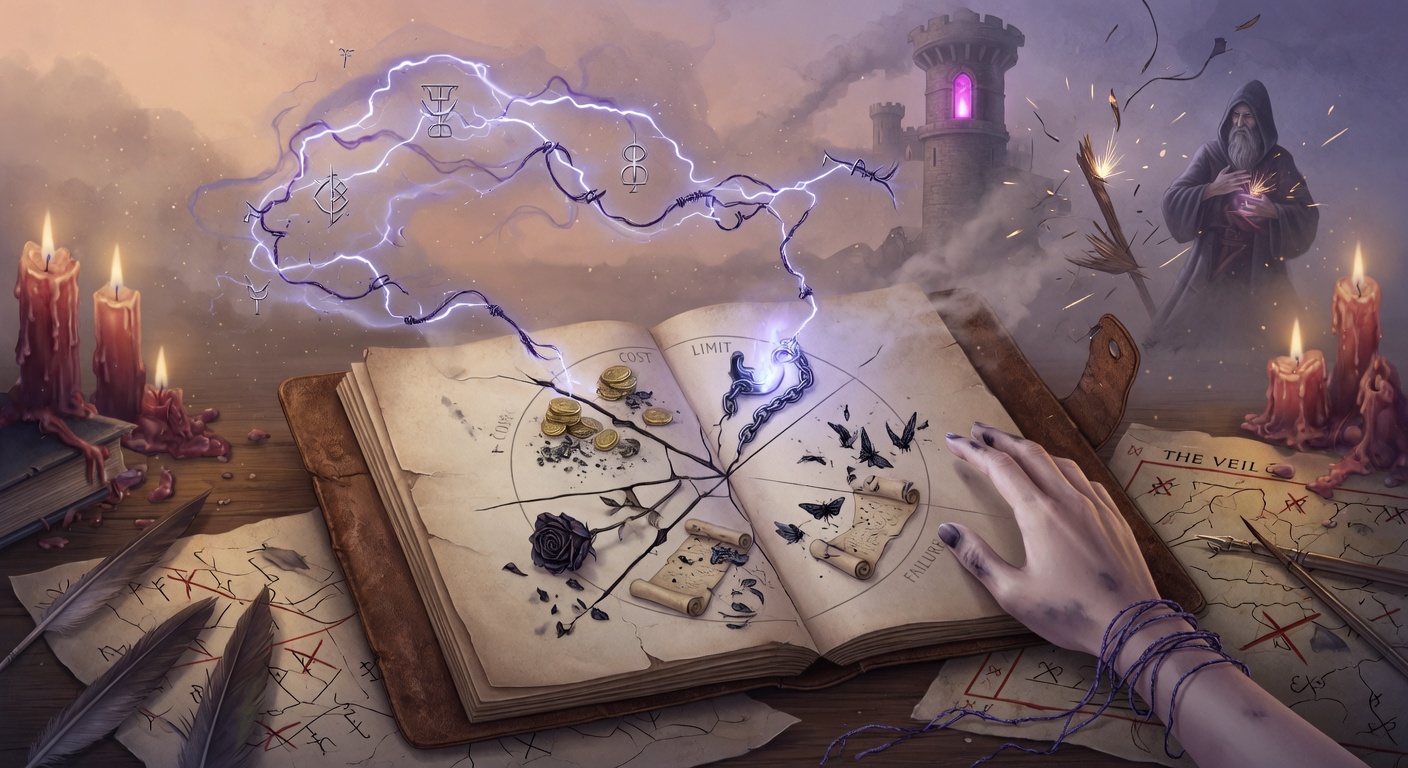
Soft magic is beautiful in the hands of a human who knows when not to use it. AI treats every soft system as a vending machine for plot fixes. Give the model hard constraints early.
Three questions before chapter one
- Who can use magic and who cannot?
- What does magic cost (energy, years, memories, social status)?
- What can magic not do under any circumstances?
Write answers in a "NEVER" list: "Magic cannot resurrect the dead." "Magic cannot see the future." Models need prohibitions spelled out.
Spell scenes need failure modes
Every magical set piece should include: attempt, complication, partial success or setback. Prompt for the complication explicitly—AI defaults to flawless casting.
Magic rules: Thread-weaving pulls heat from the caster's blood. Maximum three threads at once. Thread-weaving cannot cut iron.

Scene: Elara tries to seal the breach. The iron frame resists. She must choose between burning herself out or letting the village flood. POV Elara. Show physical cost. No new magic types.Consistency across chapters
Maintain a spell log: name, user, cost paid, outcome. Review before each generation session. If a rule changed in revision, update the bible the same day.
Tools: fantasy worldbuilding in Entangled Text, proper noun extractor for place-name drift.
Cost accounting (or the magic will inflate)
Write the cost in units a scene can show: heat from blood, a day of fever, a memory of a name, a social debt. Vague “exhaustion” is not a cost; the model will ignore it. After each magical set piece, add one line to the spell log: who paid, how much, what is now harder. If the next chapter the caster is fresh, you broke the system.
Soft magic (unexplained wonder) can stay soft if the protagonist cannot use it as a tool. The moment your hero can request a miracle, you have a hard system with unwritten rules — and AI will write the missing rules as plot coupons. Either forbid protagonist-cast miracles or define the three questions above.
Magic should create plot, not delete it
A good constraint makes the clever plan expensive. A bad constraint is a lock the next chapter picks with a new spell. When you outline, mark which obstacles are mundane (locked gate, political no, distance) and which are magical. If every obstacle is magical, every solution will be too. Mix them.
Prompt for failure on purpose in climactic scenes. “She succeeds but loses X” is more interesting than “the spell holds.” Put the loss in the outline beat so the model cannot “helpfully” restore it two paragraphs later.
Glossary discipline
Cap invented terms. Five named schools of magic is a book; fifteen is a wiki the model will misspell. Keep a proper-noun list and scan for drift (Aether / Ether / Aither). In Story Studio, put the NEVER list and the cost units in story settings so they travel with each chapter job. Update them the same day a rule changes in revision.
If you are writing progression / LitRPG, the system is the plot. Stats, ranks, and cooldowns belong in the bible as numbers, not flavor. AI will invent a new rank to escalate. Freeze the rank table before chapter one and tell the model “no new ranks in this scene.”
When to break your own rules
Once — at most — and it should cost more than any previous use. If the climax is “the prohibition was a rumor,” readers will assume every future rule is fake. Better: the caster pays a permanent price (a sense, a relationship, a legal exile) that the rest of the book has to live with. Put that price in the outline before you generate the scene, or the model will restore the caster to full power in the denouement “to be satisfying.”
After a rule-break chapter, update the NEVER list. Yesterday’s prohibition is today’s exception with a scar. Continuity is the magic system; the spells are just the visible part.