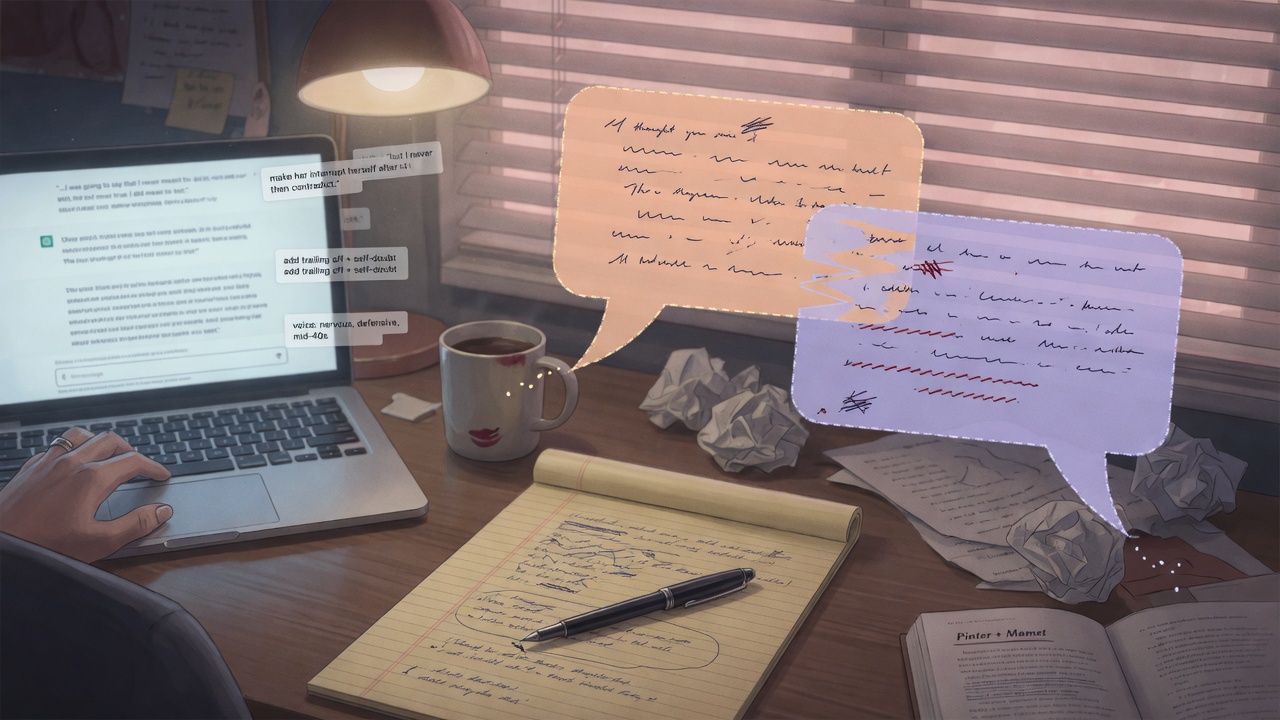
Real speech is broken. People cut themselves off mid-thought, back up and try again, start a sentence they don't know how to finish. They say "I just think that—" and then swallow whatever they were about to say because they've suddenly realized they don't want to say it. They contradict themselves in the span of eight words. They trail off when the emotion gets too heavy to carry forward.
AI, by default, does none of this. Ask an AI to write a character confessing something difficult and you'll usually get a clean, fully-formed confession with proper subject-verb agreement and a concluding thought. It's technically competent and emotionally false. The kind of dialogue that makes readers think "no one actually talks like this."
The good news: you can fix it. Not by hand-editing every line after the fact (though sometimes that's right), but by prompting differently from the start. This guide is about how to do that — how to get AI to write the fractured, self-censoring, looping quality of real speech under pressure.
Why AI Defaults to Complete Sentences (And What That Costs You)
Language models are trained on text, and most text — published novels, articles, transcribed interviews, edited scripts — has been cleaned up. The stammers got removed. The false starts got smoothed over. The training data rewards coherence, so the model has learned that coherent output is good output. When you ask it to write dialogue without specific guidance, it writes the dialogue that would survive a copy-editor: grammatically complete, logically ordered, emotionally legible.
The cost is enormous. Interrupted dialogue isn't just a stylistic quirk — it's one of the primary ways fiction conveys interiority without exposition. When a character starts to say "I never told you about the night she—" and stops, the reader leans in. They do the interpretive work. They feel the weight of the unsaid thing. That pause, that cutoff, does more emotional work than three paragraphs of internal monologue explaining the character's complicated feelings about whatever happened that night.
When you write a book with AI, this defaults-to-coherence problem shows up constantly in dialogue-heavy scenes. The AI gives you the conversation as it would look in a transcript of a very calm, very articulate therapy session. Everyone finishes their thoughts. No one interrupts anyone. Conflict resolves in clear argumentative beats. It reads like a debate, not a fight.
The solution isn't to ask AI to "make dialogue more realistic." That prompt is too vague — the model will add a few "ums" and call it done. You need to give it specific mechanical instructions about what broken speech actually looks like, and you need to tie those mechanics to the emotional state driving the speech. That's what the rest of this guide covers.
The Mechanics of Self-Interruption: Trails, Pivots, and Swallowed Words
Before you can prompt for fractured speech, you need a vocabulary for the different ways speech fractures. Not all interruptions are the same, and knowing which type you need helps you write a precise prompt instead of a vague one.
The Trail-Off
The character runs out of words, or courage, or both. The sentence doesn't reach its destination. In prose, you mark this with an em dash or ellipsis — the ellipsis for fading, the em dash for a harder stop. "I just thought if we tried, maybe we could—" is different from "I just thought if we tried, maybe we could…" The em dash feels cut short; the ellipsis feels like something dissolving. Use them deliberately.
The Pivot
The character starts one sentence and hijacks themselves into another. "He was — look, I don't want to talk about Marcus, okay?" They began with a statement about Marcus and veered into an emotional exit. This is what people do when they realize, mid-sentence, that they're about to say something true they weren't planning to say.
The Self-Correction
The character contradicts themselves in real time. "She was fine with it. She was — she wasn't fine with it, she just said she was." The backtrack reveals more than the original statement. This is the mechanism behind some of the most revealing character moments in fiction.
The Abandoned Clause
The character starts a subordinate clause and forgets, or refuses, to complete it. "If I'd known what he was going to—" Full stop. This leaves the conditional hanging, which puts the reader in the position of completing it. They imagine the worst, which is usually more effective than anything you'd write explicitly.
When you're using a tool like the Dialogue Tag Analyzer to review a scene, these interruptions can also clarify which tags to keep and which to cut — a broken line often carries its own emotional signal and doesn't need "she said, her voice trembling" after it.
Prompting for Pressure States: Fear, Grief, Rage, and Concealment
The emotional state driving a character shapes the specific way their speech breaks. Fear-speech is different from grief-speech is different from rage-speech. If your prompt doesn't name the pressure state and describe what it's doing to this specific character in this specific moment, the AI will apply generic "emotional" markers — the generic trembling voice, the generic dramatic pause.
Fear tends to produce rapid pivots and abandoned thoughts. The frightened character starts sentences they don't finish because completing them would mean fully articulating the thing they're afraid of. They may also produce runaway sentences — connecting clause to clause with "and" because they don't want to reach a period and have to face what they've said.
Grief trails off. Grief starts sentences that are too heavy to carry to the end. It also circles back — the grieving character returns to the same phrase or image the way you return to a bruise you keep accidentally pressing. Grief-speech has a recursive, looping quality.
Rage interrupts itself with acceleration. The angry character overrides their own words with more intense words, abandons polite framings mid-sentence when the polite framing isn't adequate. "I'm just — this is — you know what, no. You don't get to—" The interruptions are violent in the sense that each one cuts off something that wasn't strong enough.
Concealment produces the most interesting speech patterns. A character who is hiding something interrupts themselves not from emotion but from calculation. They start a sentence, realize it's revealing too much, and redirect. This produces a distinctive over-corrected quality — the pivots are too smooth, the new sentences a little too confident, like someone who has practiced being evasive.
When you build out a character's voice in a story bible that AI models will actually follow, it's worth documenting not just how a character speaks normally, but how their speech degrades under each pressure state. That's the kind of specificity that generates consistent, character-true output across a whole manuscript.
Four Prompt Templates With Before-and-After Examples
These aren't generic starting points — they're the kind of prompts you'd actually type when you're in the middle of a scene and need something specific. Adapt the details; keep the structural logic.
Prompt 1: The Grief Trail-Off
Write a scene where Maren, 40s, is trying to tell her daughter where she buried the dog. She keeps starting sentences she can't finish. She's not crying — she's past crying, she's just empty — but she can't get through the full directions without abandoning the sentence halfway when the memory gets too specific. Use ellipses for the trail-offs, not stage directions. Let the incomplete sentences do the emotional work. Don't explain what she's feeling.Why this works: you've named the character, the emotional state, the specific task (giving directions), and the specific interruption type (trail-off). You've also told it to use punctuation instead of stage directions and explicitly forbidden emotional explanation — which stops the AI from writing "she said, her voice heavy with sorrow" after every line. The instruction "let the incomplete sentences do the emotional work" is a craft principle that, when stated directly, the model usually follows.
Prompt 2: The Concealment Pivot
Write a dialogue exchange, 8-10 lines, between a detective named Osei and a witness named Claire. Claire knows more than she's saying. She should start two or three sentences that would reveal too much, then pivot mid-sentence to something safer — the pivot should feel almost smooth, like she's practiced this, but not quite smooth enough. Osei notices but doesn't call it out directly. Write Claire's lines with em dashes at the pivot points. No internal monologue. No narration explaining what Claire is concealing.The em dash instruction is crucial here. Left to its own devices, the AI will write "she paused before answering" — the narrator telling you about the break rather than the break itself occurring in the dialogue. Specifying punctuation forces the fractured quality into the text itself. The line count (8-10) also matters: it stops the AI from writing a sprawling scene when you need a tight, pressurized exchange.
Prompt 3: Rage That Overrides Itself
Write a monologue from a character named Dara who has just found out her business partner filed the bankruptcy without telling her. She starts speaking calmly and gets progressively less able to finish her sentences — not because she's dissolving into tears, but because she keeps finding more accurate words for what she means and overriding the previous attempt. Show her upgrading the intensity of her language mid-sentence. Use em dashes where she cuts off her own words. The speech should feel like she's fighting to stay controlled and losing, sentence by sentence.The phrase "upgrading the intensity" is doing real work here. It tells the model specifically what kind of self-interruption to produce: not the trailing fade-out of grief, but the escalating override of rage. "Losing sentence by sentence" gives the model a structural arc for the monologue — controlled at the start, barely hanging on at the end.
Prompt 4: Fear That Runs On
Write a scene where a teenager named Theo is explaining to his older sister what he saw at the warehouse. He's scared. His speech should be run-on sentences connected by "and" — he doesn't want to reach a period because reaching a period means the sentence is finished and he has to confront what he's described. But occasionally he'll start a specific detail and abandon it with an em dash when the detail is too real. Keep the narration minimal. Let the syntax itself show that he's frightened.This prompt teaches the AI a specific linguistic mechanism: the avoidance of sentence-final punctuation as a fear response. "Let the syntax itself show" is the key phrase — you're asking the model to do character work through sentence structure rather than through narration or description. That's a sophisticated instruction, and stating it explicitly usually produces output that honors it.
Editing the Output: When to Keep the Fragment and When to Complete It
Even with detailed prompts, you'll need to edit. That's not a failure — that's the workflow. The AI gets you 70% of the way to the right scene fast; you close the gap. The editing question for interrupted dialogue is specific: which breaks to keep, which to complete, and which to move.
Keep the fragment when the interruption is doing interpretive work — when the reader's imagination in the gap is more powerful than anything you'd write. "If you'd told me what she was going to—" Stop there. The reader fills it in. They're now complicit in the scene.
Complete the fragment when the break is obscuring necessary information rather than creating productive mystery. Not every interruption needs to be a revelation. If a character is giving instructions or establishing a plot point, fragmenting the speech can just make the scene confusing. Confusion is not the same as tension.
Move the fragment when it's happening in the wrong place in the speech. AI sometimes puts the interruption at the end of a long fully-formed sentence — "She had thought about it for years and had decided that the only thing she could do was—" — when the break would land harder earlier: "She had thought about — look. The only thing she could do was leave." The same content, with the break placed where it reveals the effort of thinking rather than just stopping at the end.
When you're working through a full manuscript and want a systematic approach, the Five-Pass Revision Order for AI-Assisted Novels gives you a structure for when to address dialogue specifically (it's usually not pass one — you want to have the overall shape right before you tune voice).
The Dialogue vs Narration Ratio tool is useful here too. Scenes with heavy interrupted dialogue often read as more dialogue-dense than they actually are, because the white space created by fragments gives the eye less text to process. Check the actual ratio before you decide to pad it with more narration — you may not need it.
One thing worth saying about over-editing: there's a temptation to clean interrupted dialogue up once you see it on the page. It looks strange. It doesn't match the tidiness of the surrounding prose. Resist this reflex. Read it aloud. If the fragment lands — if it creates the small sharp silence it's supposed to create — leave it. The strangeness is the point.
If you're working on a genre where dialogue rhythms matter in specific ways — a romance novel with AI where interrupted confessions drive the central tension, or LitRPG writing where character voice has to stay consistent across system-speak and emotional moments — these same prompting techniques apply, they just need calibration to the genre's conventions. Romance readers, for instance, tend to tolerate and even love the abandoned confession; they're genre-trained to feel the charge of the unsaid thing. That's an opportunity worth using.
Once your dialogue scenes are working and you're moving toward publication, the Beta Reader Workflow for AI-Assisted Manuscripts has guidance on how to specifically ask beta readers to flag dialogue that feels unnatural — which is one of the most useful feedback categories you can collect, and one that readers are generally good at identifying even when they can't articulate why.
The most actionable thing you can do right now: take a dialogue scene you've already drafted — AI-generated or not — find the moment of highest emotional pressure, and rewrite one character's speech using only em dashes and ellipses to mark where the words fail them. No stage directions. No "she trailed off." Just the punctuation and the silence it creates. Read it aloud against the original. That comparison will teach you more about interrupted dialogue than any amount of theory.