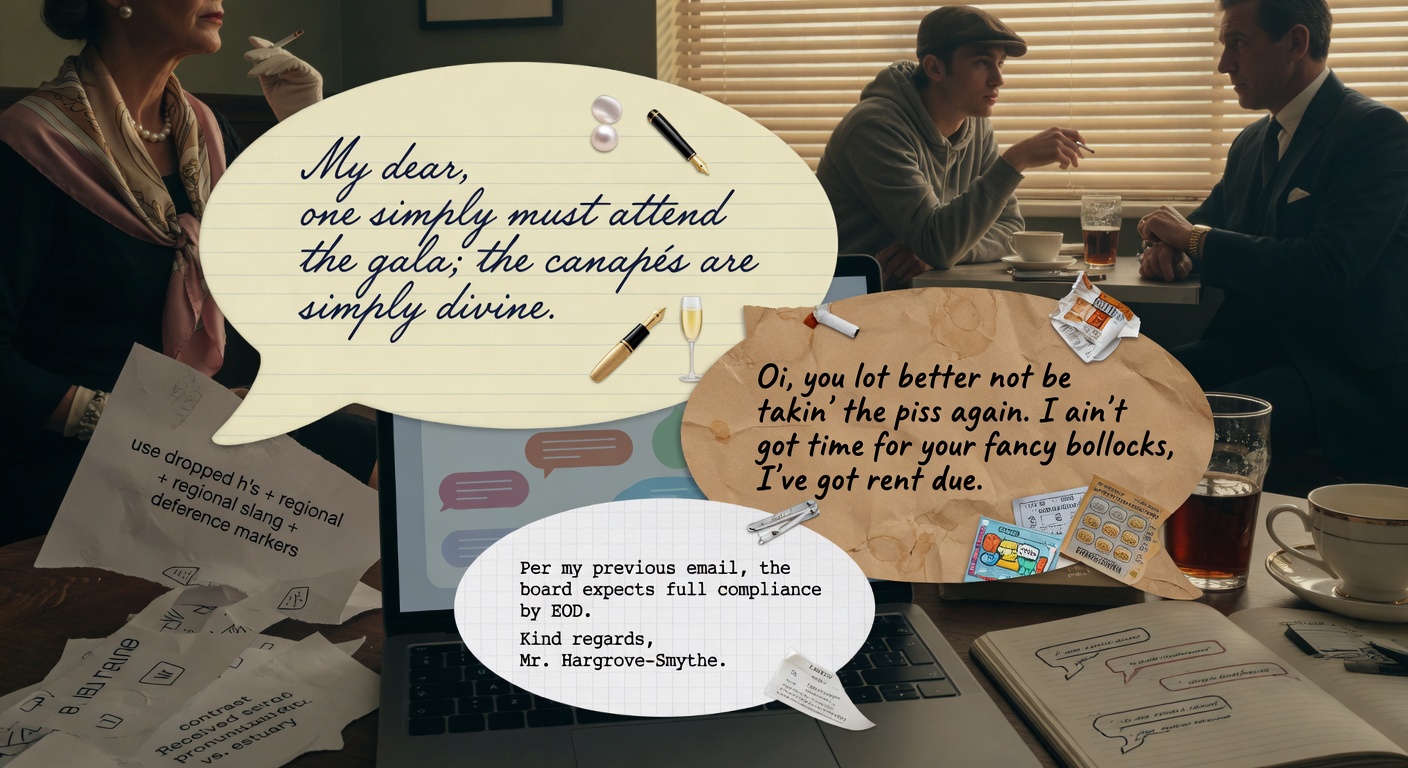
How to Use AI to Write Dialogue That Reveals Class and Status
Class is one of the hardest things to write convincingly, and it's even harder to prompt for. Most AI-generated dialogue defaults to a kind of educated, vaguely professional middle register — everyone sounds like they went to the same decent university and attended the same conflict resolution workshops. Your aristocratic villain sounds like your dockworker protagonist sounds like your corporate lawyer antagonist. The words are different but the music is the same.
This guide is about fixing that. Specifically, it's about teaching you how to prompt so that social class, education, and power emerge organically through speech — the way a character interrupts, the length of their sentences, what they never bother to explain because they assume everyone already knows it. Not through descriptions like "he spoke with working-class bluntness" or "her finishing school diction was impeccable." Through the actual words on the page.
Why Class Signals in Dialogue Are Harder Than They Look
When we hear someone speak in real life, we're picking up on dozens of simultaneous signals: vocabulary range, sentence complexity, how often they hedge, whether they wait to be addressed, how they handle disagreement. Fiction has to replicate that through text alone, which means writers have to make deliberate choices that feel unconscious. That's already a high bar.
AI makes it harder because large language models are trained on text that skews heavily toward educated, written, standard English. They can produce dialect if you push hard, but their default "neutral" is not actually neutral — it's a specific class register dressed up as universal. When you ask for a scene between a factory foreman and a company executive without further guidance, you're likely to get two people who both speak in complete, grammatically tidy sentences, both listen generously, and both use words like "perspective" and "concern."
The goal isn't to write caricature. It's to write the thousand small choices — in vocabulary, sentence rhythm, and conversational behavior — that reveal where someone came from and what they've learned to expect from the world.
The other trap is that class in dialogue isn't just about education or accent. It's about power expectation. Someone who grew up wealthy doesn't just have a bigger vocabulary — they've learned that they will be listened to, that their questions will be answered, that they can take up space in a conversation. Someone who grew up poor may have an equally rich internal life and an equally sophisticated understanding of the world, but they've learned different conversational survival strategies. Those learned behaviors are where the real texture lives.
The Four Levers: Vocabulary, Syntax, Deference, and Floor Control
Before you can prompt effectively, you need a mental model of what you're actually trying to create. I think of class signaling in dialogue as four distinct levers, and you can adjust them independently.
Vocabulary
Vocabulary is the obvious one, but it's more nuanced than just "uses big words vs. small words." It's about domain. An electrician may have a highly technical vocabulary around wiring and load calculations but use plain language everywhere else. A literature professor may drop Latin phrases casually but struggle with "torque." Class-specific vocabulary includes not just complexity but register: formal vs. colloquial, technical vs. general, and crucially — whether a character uses the correct terminology or a folk approximation of it. "The doctor said it's my heart valve" vs. "The cardiologist flagged mitral regurgitation."
Syntax
Syntax — sentence structure — is where a lot of writers stop thinking consciously, which is a mistake. Longer, embedded clauses ("the proposal, which had been circulating since March, finally reached the committee") signal formal education and comfort with delayed gratification in communication. Shorter, additive structures ("We got the proposal. March, I think. Finally went to committee.") signal a different relationship to information — more oral, more immediate, less invested in demonstrating coherence. Neither is better. They're different tools and different worlds.
Deference
Deference is about who apologizes, who qualifies their opinions, who asks permission to speak versus who just speaks. "I don't know if this is relevant, but—" is a deferential opener. "Here's what I think" is not. High-status characters often make assertions; lower-status characters often frame assertions as questions or possibilities. Watch for hedging language: "might," "perhaps," "I could be wrong," "just a thought." These markers aren't random — they're learned behaviors from years of having your statements challenged or dismissed.
Floor Control
Floor control is the most powerful lever and the one AI handles worst by default. It's about who controls the direction and pace of a conversation. High-status characters change the subject when they're done with it. They interrupt without apologizing. They ask questions and expect answers but don't answer questions they find beneath them. They use silence as a weapon. Low-status characters often answer questions they weren't technically asked, because not answering feels dangerous. They redirect carefully. They wait for permission to exit a conversation.
When you prompt, you can specify these four levers separately. "Make Character A use hedging language and answer questions she wasn't asked" will get you something much more specific and useful than "make her sound working class."
Prompt Strategies for Writing Up, Down, and Across the Power Gap
The power relationship between characters in a scene changes what you need to specify. Writing "up" (a low-status character speaking to a high-status one), "down" (the reverse), and "across" (two characters from different classes but with roughly equivalent situational power) each require different prompting emphases.
Writing Up
When your lower-status character is speaking to someone with power over them, focus your prompt on the strategies of the less powerful: indirection, the management of disagreement, the careful calibration of how much to reveal. Don't just say "she's nervous." Specify the conversational behaviors that nervousness or strategic caution produces. Does she answer the question slightly differently from how it was asked, buying time? Does she use "we" when she means "I" to distribute responsibility? Does she volunteer information that wasn't requested in an attempt to seem cooperative?
Writing Down
High-status characters speaking to lower-status ones are often the harder half to write without making them cartoonishly villainous. The key is specificity about how power manifests, not just that it does. Real high-status condescension is often polite on the surface — it's in the assumptions. The character who explains something the other person already knows. The character who uses someone's first name without being invited to. The character who ends a conversation by walking away rather than by any mutual signal of closure.
Writing Across
Cross-class conversations where both characters have situational power (a wealthy patient in a doctor's appointment with a working-class specialist, say, or a famous artist being interviewed by an Ivy League journalist) are richest because the tension comes from competing claims to status. Prompt explicitly for this: "Character A has institutional authority but suspects Character B's social background outranks hers, and she's recalibrating mid-conversation."
The most interesting class moments in dialogue happen when the social script breaks down — when someone behaves as if they have more status than the situation grants them, or when someone with obvious power suddenly defers.
Sample Prompts and Before/After Scene Comparisons
Here's where theory becomes practice. These are prompts you can copy directly or adapt — each one is designed to activate the levers we've been discussing.
Write a scene where Nora, a 50-year-old hospital administrator from a working-class background who has worked her way into a management role, meets with Dr. Callum Ashe, a surgeon in his 40s who grew up wealthy and attended private school. They're discussing a staffing complaint. Nora has institutional authority over this meeting — she called it — but Dr. Ashe is used to being deferred to by hospital staff and doesn't quite accept that she outranks him here.

For Dr. Ashe: He should speak in unhurried, complete sentences. He answers questions with questions. He uses "we" and "the team" when deflecting responsibility. He doesn't hedge his opinions. He changes the subject when he's finished with something, without signaling the change.

For Nora: She's precise and prepared — she's learned to be bulletproof in meetings. She uses formal language slightly more than feels natural to her, because she learned early that she has to. She pauses before responding to him in ways she doesn't pause with others. When he deflects, she returns to the original question — once, firmly.

No dialogue tags beyond "said." Show the power negotiation through the conversation itself.
This works because it separates the characters' class backgrounds from their current institutional roles, creating friction. The specific behaviors (answers questions with questions, returns to original question once and firmly) give the AI concrete micro-behaviors rather than abstract vibes. The instruction about dialogue tags forces the power dynamics to live in the speech itself.
Write a conversation between Marcus, a 28-year-old who grew up in a small rural town and now works as a skilled tradesman, and his college-educated younger sister Dana, who now works in urban policy. They're at their parents' kitchen table. Marcus is explaining why he voted against a ballot measure Dana worked on. He's not stupid and he's not angry — he had specific reasons. Dana is trying not to be condescending but keeps failing.

Marcus should: use concrete, specific examples to make his points (names of actual roads, actual businesses, what actually happened to them). Speak in shorter bursts. Be dry, not heated. Not use the policy vocabulary Dana uses.

Dana should: accidentally use jargon ("implementation timeline," "stakeholder input") and then correct herself, which makes it worse. Ask him questions that reveal she's expecting a particular answer. Treat a pause as an invitation to explain rather than as him thinking.

This is not a scene where one of them is right. Let the conversation end without resolution.
The key instruction here is "this is not a scene where one of them is right." AI tends to construct dialogue toward resolution. Telling it explicitly to deny that resolution keeps the class tension unresolved, which is almost always more true to life. The detail about Dana correcting her own jargon is doing a lot — it shows class self-consciousness, which is its own form of condescension.
Rewrite the following dialogue exchange so that the class and education difference between the two characters is legible only through how they speak — not through any authorial commentary, not through dialect spelling, not through one character being rude. Focus on: sentence length and complexity, what each character assumes the other already knows, who asks questions and who makes statements, and who controls when the subject changes.

[paste your existing dialogue here]
This revision prompt is one I use constantly. The instruction "not through dialect spelling" is important — AI defaults to phonetic approximations of accent when you ask for class markers, which usually reads as mockery. Forbidding that forces it toward the structural and behavioral signals that actually work on the page.
Common AI Failures (and How to Course-Correct Them)
Even with good prompts, AI will make predictable mistakes when you're working in this territory. Knowing what to watch for saves a lot of revision time.
The Equalization Drift
This is the most common failure. Mid-scene, the speech patterns you carefully specified start to blur — both characters begin sounding increasingly similar, usually converging toward the AI's default educated-middle register. It happens especially in longer scenes where the model has drifted from the initial instructions.
Fix it by adding a mid-prompt reminder: "Remember that Character A speaks in short, additive sentences and makes assertions, while Character B uses embedded clauses and hedges her opinions. Do not let these patterns drift." Or generate in shorter chunks and re-specify at each new exchange.
Signaling Through Description, Not Speech
You ask for class to emerge through dialogue. You get dialogue with narration sandwiched between: "His tone carried the casual authority of someone who'd never been told no" or "She chose her words with the careful precision of someone who'd learned to translate herself." These might be fine in a finished scene, but they're the AI doing the work you wanted the dialogue itself to do.
Add to your prompt: "Do not use narration or dialogue tags to signal class or power. The speech itself must do this work. No sentences like 'he spoke with the ease of someone accustomed to being heard.'"
The Rude-Smart Fallacy
AI frequently encodes high status as rudeness and low status as simplicity. The powerful character becomes dismissive or cold; the less powerful character speaks in shorter, simpler sentences because the AI has associated vocabulary range with class. Both assumptions flatten your characters.
Counter this explicitly: "The lower-status character should not speak simply — he is observant and precise. He just uses a different domain vocabulary and doesn't perform his intelligence the way the other character does." And for the powerful character: "She is not rude or cold. Her power shows in her assumptions, not her tone."
False Resolution
AI really wants to end scenes with mutual understanding or at least a clear emotional beat. Class tension specifically tends to get resolved in ways that feel false — the wealthy character has a moment of insight, the working-class character is validated, everyone feels seen. Real class friction doesn't usually resolve cleanly in a single conversation.
Specify your ending: "The scene ends when Dr. Ashe leaves. There is no resolution. Nora doesn't feel good about how it went. Neither does he, but for different reasons." Give the AI the ending you want so it doesn't invent a warmer one.
The single most useful thing you can do before your next scene is to pick one of the four levers — vocabulary, syntax, deference, or floor control — and write a prompt that specifies it in concrete behavioral terms for both characters. Not "she speaks with authority" but "she changes the subject when she's done with it, without signaling the transition." Try it on a scene you've already written, using the revision prompt above. You'll see immediately where the defaults were, and once you see them, you can't unsee them.
Try it yourself
Write your own book with AI — free, no credit card required.
Free · No credit card