How to Use AI to Write Dialogue Where Characters Talk Past Each Other
Most dialogue in AI-generated fiction is technically correct and dramatically dead. Two characters exchange information, respond to each other's points, reach small understandings, and move the scene forward. It reads like a transcript of two reasonable people having a conversation. Which is exactly the problem — almost no meaningful fictional conversation works that way.
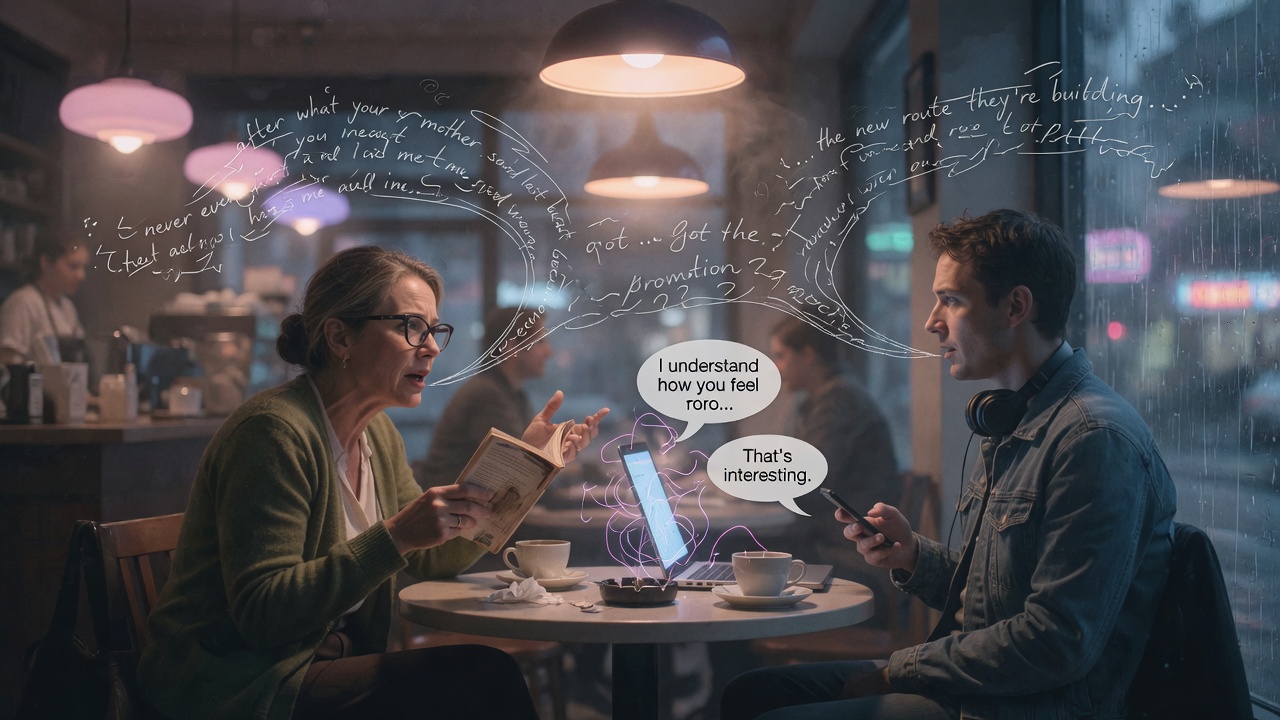
The best scenes in literary and genre fiction alike are full of people who are not really talking to each other. A mother asking about her son's job when she means "are you okay." A detective repeating the same question three different ways while the suspect answers a question nobody asked. Two ex-lovers discussing logistics when every word is actually about whether there's still something there. That structural misalignment — characters pursuing different agendas in the same exchange — is where subtext lives. And it's one of the hardest things to get AI to write well, because everything about how language models are trained pushes them toward coherence.
This guide is about fixing that. You'll find a framework for defining character agendas before you prompt, specific techniques for locking misalignment into your instructions, and detailed prompt examples you can copy and adapt right now. If you're already using an AI fiction writing guide to shape your drafts, these prompting patterns slot in at the scene level, any time a conversation needs to carry more weight than it's currently pulling.
Why AI Defaults to Conversational Coherence (and Why That Kills Drama)
Language models learn from text. And most text — Reddit threads, news articles, Q&A forums, even most published novels — models cooperative communication. When you say something, the other person responds to what you said. Misunderstandings get corrected. Points get acknowledged. This is how language is supposed to work, so it's what AI replicates by default.
The result is dialogue that feels like a script for a corporate training video. Character A raises concern. Character B validates concern. They negotiate. They reach resolution. Scene ends. Nobody's heart is breaking. Nobody is lying to themselves. Nobody is using the word "fine" to mean its precise opposite.
The problem isn't that AI writes bad dialogue. It's that AI writes resolved dialogue — and resolution is the enemy of dramatic tension.
When you ask an AI to write a tense conversation between two characters, it will usually add tension through content: one character says something mean, or reveals a secret, or raises their voice. The structure of the conversation — how each line relates to the previous one — remains cooperative. That's the default you need to break.
Understanding this is half the battle. The other half is learning to give the model explicit structural instructions that override its coherence instinct. The best AI models for writing can absolutely produce cross-purpose dialogue — they just need to be told, very specifically, what that looks like.
The Dual-Agenda Framework: Giving Each Character a Hidden Conversational Goal
Before you write a single word of your prompt, you need to know two things about each character in the scene: what they're ostensibly talking about, and what they're actually trying to accomplish. These are never the same thing in a scene worth reading.
The ostensible topic is the surface conversation — dinner plans, a business proposal, whether the car needs to go in for service. The hidden conversational goal is what each character is really doing: seeking reassurance, establishing dominance, punishing the other person, stalling for time, testing loyalty, trying to get out of having to say something directly.
Write these down before you prompt. I mean literally write them down in your prompt, as a setup block the model can reference. Something like:
- Character A's surface topic: Asking whether Marcus will be at the holiday dinner
- Character A's hidden goal: To get her son to admit he's cut off contact with his father without having to ask directly, because asking directly would mean acknowledging the divorce is real
- Character B's surface topic: Giving a non-answer about the dinner
- Character B's hidden goal: To get through this call without his mother realizing he's in the same city as his father right now
Now both characters have a reason to talk past each other. They're not being obtuse for the sake of it — they each have something real they're protecting. That specificity is what makes cross-purpose dialogue feel like subtext rather than confusion.
This framework pairs well with the work you'd do in a story bible that AI models actually follow — if your character profiles include hidden wants and conversational defense mechanisms, you can pull from them directly when you're setting up a scene prompt.
Prompting Techniques: How to Lock In Misalignment Without Breaking Realism
Once you have your dual-agenda setup, the prompt itself needs to do several specific things. Generic instructions like "write a tense conversation" or "add subtext" will not get you there. You need to constrain the structure explicitly.
Name the Misalignment Mechanism
Tell the model which of the following patterns you want the scene to use. Each creates a different flavor of cross-purpose:
- Topic hijacking: One character keeps steering the conversation back to their own concern, ignoring the emotional register of what the other just said
- False agreement: A character says yes to the surface question while meaning no to the underlying one
- Strategic deflection: Every time one character approaches the real subject, the other asks a clarifying question that resets the surface topic
- Parallel monologue: Both characters are essentially making speeches at each other, with each line a response to what they wish the other had said, not what they actually said
Prohibit Resolution Explicitly
Add a line like: "Do not let the characters reach any understanding or acknowledgment of the real subject. The scene ends without resolution. Neither character should feel they've been heard." This sounds harsh, but without it the model will almost always sneak in a moment where one character's eyes soften or they say something that lands. That moment kills the scene.
Assign Specific Avoidance Behaviors
Give each character a word or category they must never directly use, even though everything in the scene circles it. If the real subject is the affair, neither character is allowed to say "affair," "cheating," "that night," or any synonym. This forces the model to work obliquely, which is where the interesting language lives.
Control the Response Pattern Line by Line
For shorter exchanges, you can actually specify the structural pattern: "Character A asks a question. Character B responds to a different question they'd prefer to have been asked. Character A responds to Character B's answer as if it were the answer they wanted. Repeat for six exchanges." This level of instruction sounds mechanical, but the output rarely reads that way — the model fills the pattern with natural language and specific detail.
If you're using the Dialogue vs Narration Ratio tool to check your scene balance, scenes built on this kind of cross-purpose dialogue tend to need very little narration — the structure carries the weight that action beats would otherwise handle.
Prompt Examples: From Family Dinner to Interrogation Scene
Here are four prompts you can copy, adapt, and use today. Each targets a different genre context and misalignment mechanism.
Family Scene: The Phone Call
Write a 400-word phone call scene between a 62-year-old mother (Carol) and her adult son (Daniel, 34). The surface conversation is about whether Daniel will attend Christmas dinner this year.

Carol's hidden goal: To get Daniel to voluntarily mention whether his father is in his life, without Carol having to admit she's been tracking her ex-husband's social media. She is terrified of seeming pathetic.

Daniel's hidden goal: To end the call before his mother realizes he had lunch with his father yesterday. He feels guilty and overcompensates with cheerfulness.

Misalignment mechanism: FALSE AGREEMENT. Daniel agrees to surface requests while evading the emotional subtext. Carol accepts the surface answers while ignoring the emotional subtext.

Rules:
- Neither character uses the word "Dad," "your father," or any variation
- Do not include any moment where Carol or Daniel feels understood
- End the call before anything real is said
- Use Carol's habit of asking follow-up questions as a deflection tool
- Dialogue should feel warm on the surface, strangled underneath
Why it works: The "false agreement" label gives the model a structural pattern. The word prohibition forces oblique language. The instruction about Carol's habit of asking follow-up questions gives her a specific behavioral tic that creates deflection without the model having to invent a generic avoidance move.
Interrogation Scene: The Repeat Question
Write an interrogation scene, 500 words, between Detective Yara Osei and a suspect named Finn Calloway who she knows is lying but can't prove it yet.

Yara's hidden goal: She doesn't actually care where Finn was Thursday night — she already knows. She's asking about Thursday to watch how he constructs a lie, so she can identify his "tell" before she asks about Friday, which is what actually matters.

Finn's hidden goal: He's worried about Thursday because he thinks that's the night she cares about. He's giving her an airtight alibi for Thursday with so much detail that he's not noticing how little she's reacted to any of it.

Misalignment mechanism: PARALLEL OBSESSION. Each character believes the other is focused on what they themselves are focused on.

Rules:
- Yara never mentions Friday. Not once.
- Finn volunteers more and more detail about Thursday, unprompted
- Yara's questions become shorter and more open-ended as Finn becomes more elaborate
- Include two moments where Yara could correct Finn's assumption and chooses not to
- No internal monologue — we infer everything from behavior and word choice
Why it works: "Parallel obsession" creates two self-contained dramatic ironies running simultaneously. The rule about Yara's questions getting shorter as Finn's answers get longer is a concrete structural instruction that most models will follow if given explicitly. The prohibition on internal monologue forces the subtext to live in the dialogue itself.
Romance Scene: The Moving Boxes
Write a 350-word scene between two people (Priya and Lena) who dated for two years and broke up three months ago. They are meeting to exchange the last of their belongings. The surface conversation is entirely practical — who owns which book, whether the plant goes with Priya.

Priya's hidden goal: To find out, without asking, whether Lena is seeing someone. Every question she asks about an object is actually a test to see how quickly Lena wants this finished.

Lena's hidden goal: To leave with her dignity intact. She keeps the conversation functional because she doesn't trust herself to stay calm if it becomes personal.

Misalignment mechanism: TOPIC HIJACKING. Priya keeps finding ways to extend the conversation through objects. Lena keeps closing each object-question as quickly as possible.

Rules:
- No character says what they mean
- Each exchange about an object should carry a different emotional weight for each woman
- End the scene before the last box is decided — let it hang unresolved
- One piece of dialogue must be interpretable two completely different ways depending on who's speaking it
Why it works: The "one line interpretable two ways" instruction produces the kind of dialogue that readers underline. It forces the model to find language that genuinely operates on two levels simultaneously, which is the craft goal of the whole scene. If you're writing a romance novel with AI, scenes like this one are what separate emotionally resonant breakup moments from plot-functional ones. The Romance Beat Sheet: Where AI Drafts Usually Break covers similar territory — emotional beats that AI tends to flatten unless you prompt for specific structural complexity.
Editing the Output: Where AI Lets Characters Accidentally Understand Each Other
Even with tight prompting, AI outputs from these kinds of scenes tend to fail in the same predictable places. Knowing where to look makes the editing pass much faster. You can read more about building a systematic revision process in The Five-Pass Revision Order for AI-Assisted Novels, but here are the specific failure modes to hunt in cross-purpose dialogue.
The Empathetic Pause
Look for moments where one character's response begins with a beat of acknowledgment — "She was quiet for a moment," or "He nodded slowly" — before they redirect. These beats are the model's default way of signaling that a character has registered the emotional content of the previous line. In cross-purpose dialogue, that registration is death. Cut them, or replace them with a behavior that indicates the character heard the words but chose a different subject anyway.
The Accidental Resolution Line
Scan the last five lines of any AI-generated dialogue scene for phrases like "I know," "I understand," "Maybe you're right," or any variant of "I hear you." These are the model's trained instinct to close emotional loops. They're almost always wrong for cross-purpose scenes. The Dialogue Tag Analyzer can help you spot dialogue tags that signal emotional resolution — "she admitted," "he finally said," "she relented" — which often appear right before these accidental resolution moments.
The Symmetry Problem
AI tends to give both characters equal emotional intelligence in a scene. Real cross-purpose dialogue is often asymmetrical — one person is more aware of what's really happening than the other, or more willing to not-say it, or better at using the surface topic as a weapon. If both characters sound equally evasive and equally emotionally sophisticated, the scene reads as a stylistic exercise rather than a dramatic one. Go back in and deliberately make one character cruder, more obvious, more needy — let the asymmetry create its own tension.
Over-explained Subtext in Action Beats
The model frequently adds action beats that explain the subtext it should be hiding: "She asked about the plant, but what she really wanted to know was—" or "He answered her question, though not the one she'd meant to ask." Cut every single one of these. The Filter Word Finder won't catch these exactly, but they often cluster around filter constructions — "she realized," "he noticed," "she understood." If the subtext is working, the reader does not need a tour guide.
Once you've done this editing pass, run your scene against your character consistency checks — it's surprisingly easy to accidentally make a character more self-aware during the revision process than they were designed to be, especially if the original draft was doing some of the hidden-goal work for them.
Cross-purpose dialogue is one of those craft elements that separates publishable fiction from competent fiction. It requires you to hold two complete, internally logical character agendas in your head simultaneously and make sure they never quite touch. AI can do the drafting work once you've done the architectural work — which means your job is to define the agendas before you prompt, not after.
Start with a scene you've already written that feels flat. Identify the two hidden goals. Write them into a setup block. Add one specific misalignment mechanism and one explicit prohibition. That's a five-minute revision to your prompt that will change what the model produces more than any other instruction you could give it. The rest is editing — and now you know exactly where to look.
Try it yourself
Write your own book with AI — free, no credit card required.
Free · No credit card