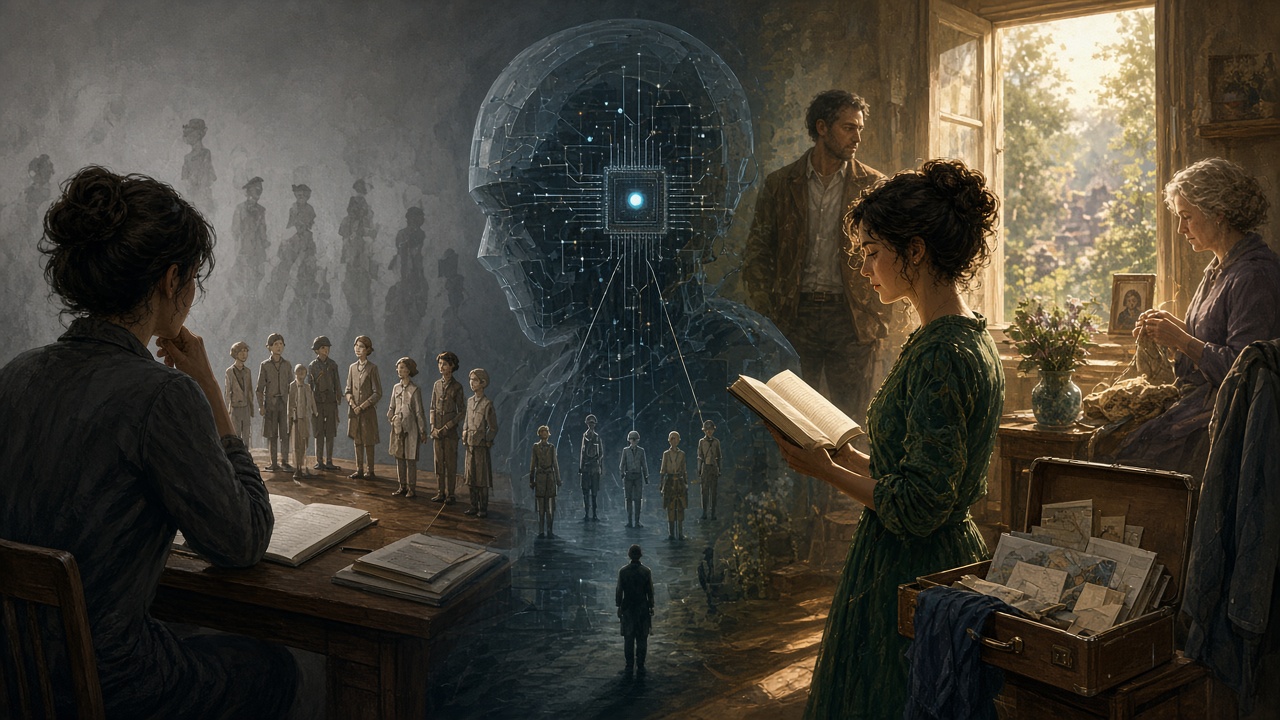
The tell: characters who blink into existence
Read any AI-drafted chapter with a barista, a coworker, a nosy neighbor, or a best friend who shows up to deliver one piece of information, and you'll notice something odd if you look closely. They have no weight before the scene starts and no residue after it ends. The barmaid pours the drink, says the line that nudges the plot forward, and then the narrative moves on as if she powers down the second the protagonist leaves the room. This is different from a minor character being minor. Plenty of real one-scene characters in good fiction feel alive — you sense they have somewhere to be, a life that predates the page. The AI version doesn't do this. It writes secondary characters as reactive props: entities that activate on cue, speak only what's plot-relevant, and vanish without a trace of implied existence. No one ever seems to have been doing something before you walked in. No one ever seems annoyed that you interrupted it. Once you start noticing this pattern, you can't unsee it. The sheriff's deputy who exists solely to confirm the body was found at 6 a.m. The protagonist's sister who calls only to deliver exposition about their mother's illness. The love interest's roommate who appears for exactly one scene of comic relief and never gets mentioned again, not even in passing. These characters aren't badly written in the sentence-level sense — the dialogue tags work, the prose is clean. They're badly written in the ontological sense. The AI hasn't imagined a person. It's generated a function wearing a name.Why this happens: the model drafts needs, not a cast
AI models write secondary characters this way because they're solving a local problem, not simulating a world. When you prompt a scene, the model is predicting what needs to happen next for the protagonist's arc, the immediate conflict, the information the reader needs. It is not, by default, holding a mental roster of every character in your story and asking "what would this person be doing right now if the camera weren't on them?" Think about how the model actually generates a scene. It's pattern-matching against the narrative function you've implied — "character who delivers bad news," "character who provides comic relief," "character who blocks the protagonist's goal" — and it fills that function efficiently. Efficiently is the key word. There's no cost, in the model's prediction, to a character having no offstage life. There's only cost to the character not serving the scene's purpose. So it optimizes for exactly what you asked for and nothing more, because nothing more wasn't requested. This is a direct extension of a problem familiar to anyone who's tried to write a book with AI at any length: the model defaults to the shortest path that satisfies the immediate prompt. Full cast simulation — tracking twelve characters' independent timelines, grudges, errands, and routines across three hundred pages — is a much harder and much less efficient thing to do than "write the next scene so it accomplishes X." Unless you explicitly build continuity scaffolding, the model will quietly drop it every time, because dropping it is cheaper.A character who only exists when useful isn't a character. They're a mechanism the plot is wearing as a disguise.This is also why the problem tends to get worse, not better, as your draft gets longer. Early chapters sometimes get lucky — the model has more context, more of your voice to imitate. By chapter twenty, especially across separate sessions or a patchy story bible, the model has often lost track of who these people even are outside the function you first assigned them.
The fix: write an offstage life brief before you draft the scene
Here's the single highest-leverage fix I've found, and it takes about five minutes per character. Before you draft any scene featuring a recurring secondary character, write a one-paragraph offstage life brief — not for your protagonist, who the model already treats as a continuous person because the whole story orbits them, but specifically for the people who only get scattered appearances. The brief should answer four things: what this character wants that has nothing to do with your protagonist, what they're doing in the hours they're not on page, one ongoing problem or irritation in their life, and one habit or routine that's theirs alone. None of this needs to appear explicitly in the scene. Its entire job is to change what the model predicts is plausible for this person to say, notice, or do.Prompt Example
Before we draft the next scene, here's a brief on Marisol, the dockworker who appears in chapters 4, 9, and 15. She's been covering extra shifts because her brother owes money to someone she won't name. She's teaching herself Portuguese from a library app during her lunch breaks because she's planning to leave for Lisbon the moment she's saved enough. She resents that the protagonist gets to treat the dock as a temporary inconvenience when it's her whole life. She has a habit of cracking her knuckles one at a time when she's deciding whether to trust someone. None of this needs to come up directly — just keep it in mind as her internal weather when you write her dialogue in the next scene.
Prompt Example
Write a short offstage life paragraph for each of these four recurring secondary characters in my mystery novel: Denny (the protagonist's landlord), Officer Reyes (recurring police contact), Thuy (protagonist's ex-coworker turned reluctant informant), and Pastor Hale (runs the shelter where the second body was found). For each, give me: one want unrelated to the main plot, one ongoing minor conflict in their life, one routine or habit, and one thing they privately think about the protagonist that the protagonist doesn't know.
Auditing a draft for props pretending to be people
If you already have a draft, you don't need to guess which characters have this problem — you can have the AI find them for you. This is a distinct, narrower task than general developmental feedback, so ask for it specifically rather than folding it into a broad edit pass.Prompt Example
Read through this manuscript and make a list of every secondary character who appears in more than one scene. For each one, tell me: do they ever initiate an action or line of dialogue that ISN'T a direct response to the protagonist or the immediate plot need? Do they ever reference something happening in their life that isn't related to the main story? Do they show any sign of a routine, opinion, or agenda that exists independent of the scene they're in? Flag anyone who scores zero on all three — those are the characters currently functioning as props rather than people.
Prompt Example
Go through every scene featuring Theo (the protagonist's brother) and check: does he ever speak first, ask a question unprompted, or object to something without being directly challenged first? Or does every line of his dialogue exist only as a response to someone else's line? I want a scene-by-scene breakdown, and for any scene where he's purely reactive, suggest one small unprompted line or action that would show he has his own train of thought running underneath the conversation.
Seeding the unexplained detail
The deepest fix isn't an audit, though. It's a drafting habit: deliberately seeding small, unexplained offstage details that you never resolve. A grudge nobody mentions again. An errand referenced once and never followed up. A habit that has no narrative function at all. This matters because unexplained specificity is what reads as continuity. If a character's every detail serves the plot, the reader's unconscious math concludes the character exists only for the plot. But if a character mentions, offhand, that they can't make it Thursday because they're driving their cousin to a custody hearing — and that custody hearing never comes up again — the reader's brain does something interesting. It assumes a whole life it was never shown. One unresolved thread implies a hundred you didn't bother to mention.Prompt Example
In this scene, the protagonist stops by Gail's shop to ask about the missing necklace. Before you get to that conversation, give Gail one small, specific, unexplained detail of her own life — something she mentions or does that has nothing to do with the necklace or the plot, and that we never need to follow up on later. Make it concrete and slightly odd, not generic ("I'm tired" is generic; something with texture is better).
Where this shows up differently by genre
The symptom looks slightly different depending on what you're writing, so it's worth tuning your approach rather than applying one fix everywhere.- In romance novel with AI projects, the usual casualty is the best friend or sibling who exists purely to hear the protagonist process their feelings about the love interest. Give that friend their own romantic subplot fragment, even an unresolved one — check the Romance Beat Sheet: Where AI Drafts Usually Break for where supporting-cast flatness tends to compound other structural issues.
- In thriller with AI drafts, handlers, informants, and partner characters often read as walking exposition dispensers. An offstage brief that gives them a competing loyalty or a reason to withhold information fixes two problems at once — flatness and predictability.
- In historical fiction with AI, servants and background townsfolk are especially prone to prop-status because the model treats them as scenery rather than people with their own stakes in the historical moment.
- In horror with AI and YA novel with AI projects, the friend-group ensemble often collapses into a single undifferentiated unit that all reacts to danger identically — offstage briefs are the fastest way to separate them into distinct people with different fears and different things to lose.