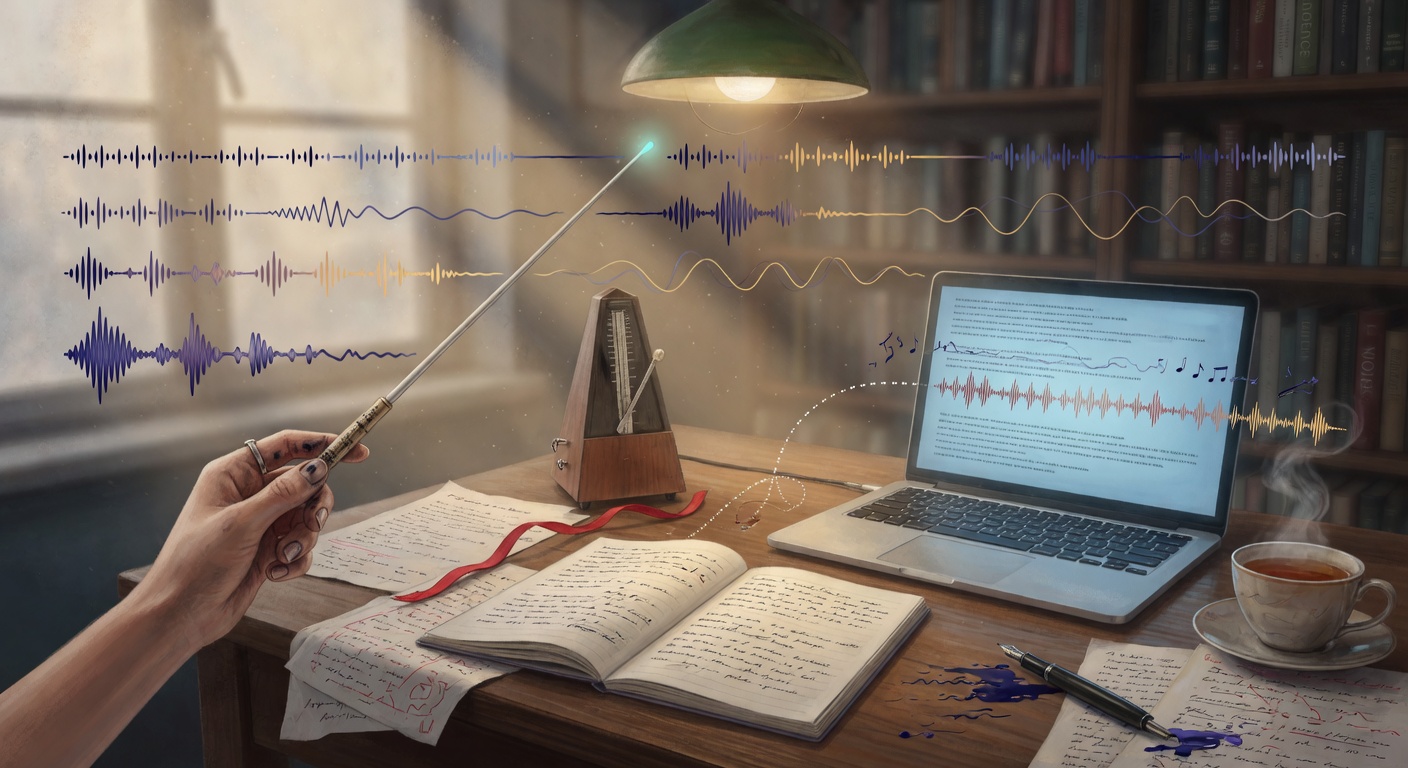
How to Train AI to Imitate Your Sentence Rhythm
Most writers who feel frustrated with AI-generated prose can't quite name what's wrong with it. The word choices are fine. The plot logic holds. But something feels off, like listening to a cover band that knows all the notes but plays at the wrong tempo. That something is almost always sentence rhythm.
Rhythm is the most personal element of any writer's voice — more personal than vocabulary, more personal than thematic obsessions, more personal even than dialogue style. It lives in the architecture of your sentences: where you place your commas, whether you favor long rolling clauses or short declarative punches, how you use fragments, where you breathe. Two writers can describe the same rainy street and the prose will feel completely different based on nothing more than syntactic patterning. Cormac McCarthy and Joan Didion could both write a sentence about exhaustion and you'd know which was which from the shape alone.
The good news is that rhythm isn't mysterious — it's measurable. And once you can measure it, you can teach it.
Why Sentence Rhythm Is the Hardest Part of Voice to Transfer to AI
When writers try to get AI to match their style, they usually reach for surface-level descriptors. "Write in a dark, literary tone." "Use sparse prose." "Sound like Hemingway." These instructions describe the feeling of a style, not its mechanics. The AI makes educated guesses based on pattern associations, and those guesses are inconsistent.
The problem is that rhythm operates below the level of conscious description. You don't think "I'm going to use a three-beat short sentence here followed by a long subordinate clause" — you just write it, because it sounds right to you. That instinct was built through years of reading and drafting. It's baked into your syntactic muscle memory.
AI can't absorb your rhythm through description. It needs to see the actual patterns, named and quantified, before it can reproduce them reliably.
Generic style prompts also fail because they conflate tone with structure. "Sparse prose" tells the AI about word economy, but it says nothing about whether your short sentences cluster in threes before a long one, or whether you habitually end paragraphs with a fragment. Those are different rhythms that can both feel "sparse." Without that level of specificity, the AI defaults to a kind of averaged spareness — technically correct, distinctively nobody's.
The fix is treating rhythm like code: find the actual patterns, express them as rules, then feed those rules back explicitly. It takes an upfront investment of maybe an hour, but after that, you have a rhythm profile you can paste into any prompt.
How to Analyze Your Own Prose for Rhythmic Patterns (With AI Help)
Pull three to five paragraphs from your own fiction — ideally from different projects or different years, so you're capturing consistent habits rather than a phase. Choose passages you wrote without any AI assistance. Paste them into a single document.
Now use AI as your analyst. You're not asking it to write anything yet. You're asking it to describe what it observes. The prompt below is the one I use, and it's specific enough to get genuinely useful output rather than vague compliments about your "lyrical style."
I'm going to paste five paragraphs of my fiction writing. Don't evaluate the quality or content. Instead, analyze the sentence rhythm with clinical precision. I want you to note:

1. Average sentence length in words (rough count)
2. The ratio of short sentences (under 10 words) to long sentences (over 25 words)
3. Where I tend to use fragments — at the start of paragraphs, ends, mid-paragraph?
4. Comma placement habits — do I front-load subordinate clauses, stack them mid-sentence, or trail them at the end?
5. Do I use em-dashes, and if so, how — as parentheticals, as dramatic breaks, as sentence-enders?
6. What's my most common sentence structure? (e.g., simple declarative, compound with coordinating conjunction, complex with embedded clause)
7. Is there a rhythmic pattern at the paragraph level — e.g., do paragraphs tend to start long and compress, or build to a long final sentence?

Here are the paragraphs: [PASTE YOUR PROSE HERE]
The reason this works is that you're forcing the AI to describe mechanics rather than impressions. You'll get back something like: "Sentences cluster around 12–18 words, with short sentences (5–8 words) appearing at the end of most paragraphs like a closing beat. Front-loaded participial phrases are frequent. Em-dashes are used almost exclusively as mid-sentence breaks, not sentence-enders." That's usable information. "Evocative and precise" is not.
Do this analysis on all three to five samples, then look for what's consistent across them. Patterns that appear in all your samples aren't accidents — they're your syntactic fingerprint. An observation that only shows up in one sample might be mood-dependent or genre-dependent, not a core rhythm habit.
It also helps to read one of your passages aloud while tapping your finger on your leg. You'll feel the beats. Then read an AI-generated draft aloud and feel where the rhythm stops matching. Your body often detects the mismatch before your brain can name it.
Building a Rhythm Profile: Turning Your Patterns into Prompt Instructions
Once you have your analysis, you need to translate it into a format that travels well — something you can paste into the beginning of a prompt and that an AI can actually follow. This is your rhythm profile, and it should be written as rules, not descriptions.
Bad rhythm profile: "My prose has a rhythmic, literary feel with varied sentence length and emotional precision."
Good rhythm profile: "Sentences average 14 words. Short sentences (under 8 words) appear at the end of paragraphs as a closing beat — almost never at the start. Fragments are acceptable mid-paragraph for emotional emphasis. Compound sentences use 'and' or 'but' as connectors; semicolons are rare. Em-dashes appear as mid-sentence breaks to interrupt or qualify, not as sentence-enders. Paragraphs often begin with a longer orienting sentence, compress through the middle, then close with something short."
See the difference? The second version gives the AI something to execute. It's a checklist it can work against.
A rhythm profile is not a description of your style. It's a set of structural rules that, when followed, produce the feel of your style as a side effect.
Here's how to build yours. Take the observations from your analysis and rewrite each one as an instruction. Use phrases like "sentences should," "avoid," "fragments are acceptable when," "paragraphs typically." You're writing a style guide for a very literal-minded collaborator who needs explicit rules rather than implied taste.
Keep the profile under 200 words. If it's longer, you're over-specifying and the AI will start losing track of constraints. Prioritize the patterns that felt most distinctive or that you observed most consistently. Five sharp rules beat fifteen vague ones.
Save this profile somewhere easily accessible — a notes app, a text snippet tool, the top of your project document. You'll be pasting it often.
Prompt Examples: Feeding Your Rhythm Profile Back into AI Drafts
Here's where the work pays off. Once you have a rhythm profile, you inject it at the start of any drafting prompt. The profile comes first; the scene instructions come second. Think of it like tuning an instrument before you play it.
Follow this sentence rhythm profile exactly when drafting:
- Sentences average 13–16 words. Short sentences (under 8 words) close paragraphs, not open them.
- Fragments are acceptable for emotional beats or physical sensation moments.
- Compound sentences connect with "and" or "but" — avoid semicolons.
- Em-dashes appear mid-sentence as interruptions or qualifiers (never at the end).
- Paragraphs start with a longer orienting sentence, compress in the middle, end short.
- No more than one subordinate clause per sentence. Keep clauses sequential, not nested.

Now write a scene: Maya is walking home at 2am after a fight with her sister. She passes the diner where they used to eat after school. Third person close POV. 300 words.
This works because the profile primes the AI's output constraints before the scene instructions engage its content generation. When both arrive in the same prompt, the AI tries to satisfy both simultaneously. The rhythm profile shapes the sentence-by-sentence decisions while the scene instructions govern what those sentences are actually saying.
You'll also want a version for revision work — when you have AI-generated prose that's structurally sound but rhythmically off, and you want to rework it without rewriting from scratch:
Here's a paragraph I need you to revise for rhythm only — don't change the events, POV, or any specific words I've used unless rhythm requires it.

My rhythm rules:
- Short sentences (under 8 words) should only appear at the end of a paragraph or as an isolated emotional beat.
- Avoid stacking two long sentences back-to-back. Break them up or compress one.
- If there's a semicolon, replace it with a period or restructure.
- The paragraph should feel like it breathes — accelerate through the middle, land hard at the end.

Here's the paragraph: [PASTE PARAGRAPH]
Notice the instruction "don't change any specific words I've used unless rhythm requires it" — this protects your content decisions while giving the AI permission to restructure. Without that guardrail, it'll start paraphrasing your sentences and you'll lose other elements of your voice in the process.
One more: when you want to give the AI a sample of your prose as a live example rather than a rule list, because sometimes showing works better than telling:
Read this passage carefully. Pay attention to the sentence length, where fragments appear, the punctuation habits, and the paragraph structure:

[PASTE 150–200 WORDS OF YOUR OWN PROSE]

Now write a new scene in the same sentence rhythm — not the same tone or content, just the same structural patterns. The scene: Detective Rena Marsh enters an apartment she's never visited before, knowing the person who lived there died three days ago. Third person close. 250 words.
This is useful when your rhythm profile feels too abstract or when you want to cross-check it. If the AI nails the rhythm from the example but drifts when using only the rule list, your rules may be incomplete — go back and add whatever the example was demonstrating that you hadn't captured in words.
Stress-Testing Your Rhythm Profile Across Different Scene Types
A rhythm profile that only works for quiet introspective scenes isn't a real profile — it's a mood-specific instruction set. Real voice holds across different emotional registers. The way you write an action sequence is still recognizably you, even if the sentences get shorter and the pace accelerates. Your profile needs to account for that.
Run your rhythm profile against at least three different scene types and compare the output to your own prose in those same modes. Try: an action or chase scene, a tense dialogue exchange, and a reflective interior monologue. These are the three scenes that most stress-test rhythm because they pull in different directions — action wants compression, dialogue wants rhythm to live in the white space between lines, and interiority wants expansion.
If the AI's action scene output feels too long and undulating when you read it aloud, your profile probably needs a conditional rule: something like "in fast-paced or physical sequences, default sentence length drops to 8–12 words and fragments increase." That's not a different voice — it's how your voice adapts to pace. Most writers' rhythms do shift under different scene pressures, and your profile should reflect that.
Dialogue is trickier, because speech rhythms are partly character-specific and partly how you render the prose lines around the dialogue. Pay attention to your attribution sentences and action beats — the "she said, crossing her arms" constructions. Those are almost entirely rhythmic signals, and they're easy to miss in a high-level analysis. If your attribution lines tend to be brief and declarative while the AI keeps writing elaborate ones, add it as an explicit rule.
The goal isn't perfect mimicry every time. It's a baseline close enough that your editing work becomes refinement rather than reconstruction.
When the AI drifts — and it will, especially in longer drafts — the fastest fix is to paste a few lines of your own prose immediately before the section you want it to continue, then remind it of the profile. Fresh context resets the rhythm calibration without you having to rewrite from scratch.
The single most valuable thing you can do right now is run that analysis prompt on 300 words of your own prose before you do anything else. Not because you need a perfect rhythm profile immediately, but because the process of reading the analysis will teach you things about your own writing you've never consciously noticed. Writers who've done this often describe it as suddenly being able to see the code underneath the surface of their prose — and once you can see it, you can teach it.
Start there. One passage, one analysis, one draft rule list. You can refine it as you go.
Try it yourself
Write your own book with AI — free, no credit card required.
Free · No credit card