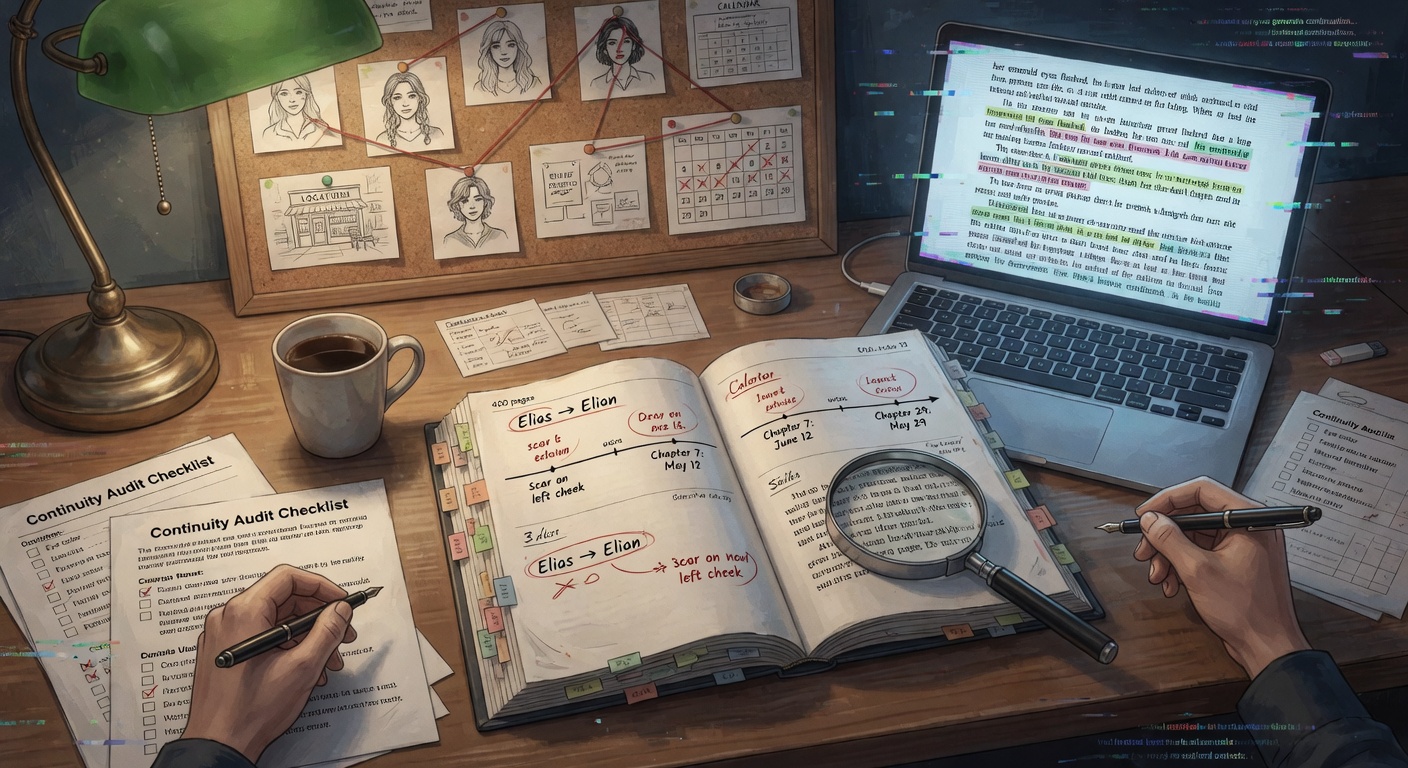
Finishing a full AI-assisted draft feels genuinely good. You've got 80,000 words, a complete story, and that specific relief of having something rather than nothing. Then you read chapter fourteen and the detective's eyes are brown. In chapter two they were green. In chapter nine someone called them "those grey eyes." You didn't write any of those lines consciously. The AI did, and it was just... guessing each time.
This is the most common complaint I hear from writers using AI drafting tools, and it's not random bad luck. It's structural. Once you understand why AI introduces continuity problems, catching them stops feeling like an exhausting hunt and starts feeling like a checklist you run once, systematically, before anyone else sees the manuscript.
Why AI Drafts Break Continuity in Predictable Ways
AI language models don't hold your story in memory the way you do. Every generation is, at some level, a fresh prediction based on whatever context fits in the window. Your protagonist's scar — the one you mentioned in chapter one and referenced twice in chapter three — might fall entirely outside the model's active context by chapter twelve. So the AI does what it always does when uncertain: it invents something plausible. A different scar. Or no scar. Or a scar on the other cheek.
Character detail drift is the most common artifact of this. Physical descriptions, speech patterns, names of minor characters, backstory details mentioned in passing — these erode over a long draft. The gruff uncle who "never touched a drop" in the backstory flashback somehow orders a whiskey in chapter twenty-two.
Timeline inconsistencies come from a different failure mode. AI is bad at implicit arithmetic. If a character says she left her hometown "sixteen years ago" and she's thirty-two in the story's present, she left at sixteen. But two chapters later, the AI might write a flashback where she's "barely thirteen when she packed her bags." It's not lying. It just didn't do the math.
Object and setting contradictions are subtler but just as disorienting to readers. The gun gets tucked into a jacket pocket, then a holster, then a glove compartment — all in the same evening with no explanation. The farmhouse kitchen has a wood-burning stove in one scene, a gas range in the next. These feel like sloppy writing even when the prose itself is strong.
The good news: all three failure types are predictable, which means they're auditable. You don't need to read the manuscript hoping to spot errors. You can build a system that makes errors surface themselves.
Building Your Continuity Tracking Sheet Before You Edit
Do this before you start your editing passes, not during. If you try to build your tracking sheet while also reading critically, you'll miss things. Your brain can't do both at once.
Open a spreadsheet — Google Sheets, Airtable, a plain Excel file, whatever you'll actually use. Create four tabs: Characters, Timeline, Objects & Settings, and Flags.
The Characters Tab
For every named character, log: physical description (eyes, hair, height, distinguishing marks), age, key backstory facts that get stated in the text, habitual speech patterns or verbal tics, and their relationship to every other named character. You're not writing character bibles here — just what the text actually claims, with chapter references. "Blue eyes — Ch. 1, p. 4" is enough.
The Timeline Tab
This one requires you to anchor the story. Find your clearest time reference — a date, a seasonal marker, an event — and build outward. Log each scene's approximate position in story-time, any stated durations ("three days later," "the following spring"), and any character ages mentioned. You'll use this to catch the arithmetic errors.
The Objects & Settings Tab
Only track objects that appear more than once or that matter to plot. The letter someone carries. The specific car. The layout of the main house. For settings, note details that get described with specificity — a broken step, a particular view from a window, the color of the walls.
The Flags Tab
Leave this blank for now. It's where you'll dump every potential inconsistency you find during the audit, with a chapter reference and a note about what's contradicted. Keeping flags separate from your tracking data means you're not constantly second-guessing your source-of-truth entries.
Populating this sheet takes a few hours for a novel-length draft. It's not glamorous. It is, however, the thing that makes everything else faster.
The Three-Pass Audit: Characters, Timeline, and Physical World
Three separate passes. Not one pass trying to catch everything. Your attention degrades when it's spread too thin, and continuity errors are exactly the kind of thing that slips past tired eyes.
Pass One: Characters
Read through the draft with only your Characters tab open. Every time a character is described, speaks, or has a backstory detail mentioned — check it. Don't trust your memory; check the sheet. When you find a contradiction, drop it in the Flags tab with the chapter, the specific text, and what it contradicts. Don't fix it yet. Just flag.
Pay special attention to minor characters who appear in early chapters and then resurface much later. A neighbor mentioned in chapter two who reappears in chapter nineteen is almost guaranteed to have drifted. The AI regenerated her from scratch with only the character name as a hook.
Pass Two: Timeline
This pass is about arithmetic and sequence. Go through your Timeline tab and verify every stated duration, every age, every reference to how long ago something happened. Read scenes involving flashbacks with particular suspicion — AI often loses track of which tense it's working in, temporally speaking, and slips details from one era into another.
A useful trick: write out your story's timeline on a single piece of paper before this pass. A simple horizontal line with events marked. When the text says something happened "two weeks before" something else, physically verify it on your line. This catches errors that are easy to rationalize away when you're reading sequentially.
Pass Three: Physical World
Objects and settings. Walk through your Objects & Settings tab and trace every significant item through the story. This is where you catch the gun that teleports, the door that opens outward in one scene and inward in another, the scar that migrates from the left hand to the right.
Settings deserve special attention in scenes involving movement. AI is genuinely bad at spatial consistency — characters exit through doors that weren't established, cross rooms in ways that don't match the described layout, look out windows that face the wrong direction. These errors rarely break plot logic, but they break the reader's spatial imagination of the scene.
Each pass should take you through the full manuscript. Three complete reads sounds like a lot, but each one goes faster than you think because you're only looking for one category of problem. You're not trying to fix prose. You're running a verification check.
Prompts to Make AI Flag Its Own Continuity Errors
Here's the part most writers skip, and they shouldn't. The same AI that introduced continuity errors can help you find them — if you ask in the right way. The trick is giving it a specific, bounded task with context rather than a vague request to "check for consistency."
These prompts work best when you feed the AI a chapter or a cluster of related scenes, not the entire manuscript at once.
Below are three scenes from my novel that all involve the character Marcus Hale. Please read them carefully and flag any inconsistencies in his physical description, speech patterns, or stated backstory. List each potential inconsistency with a quote from each conflicting passage.

[Paste Scene A]
[Paste Scene B]
[Paste Scene C]
This works because you're giving the AI a contained comparison task with a specific character as the anchor. The more scenes you paste, the higher the chance of context overflow, so keep it to three or four scenes maximum. Tweak it by swapping character names or asking specifically about one attribute — "only flag inconsistencies in how Marcus talks about his time in the army."
I'm going to give you a timeline of events from my novel as I understand them, followed by a scene. Tell me if anything in the scene contradicts the timeline, especially character ages, how long ago events happened, or the sequence of events.

Timeline:
- Story present: late autumn, protagonist Elena is 34
- Elena's mother died 8 years ago (Elena was 26)
- Elena left her hometown at age 19 to go to university
- The accident happened 3 years before story present

Scene: [paste scene]
This works because you've done the math yourself and handed it to the AI as ground truth. You're not asking it to construct the timeline — you're asking it to verify the scene against a timeline you've already established. Tweak this by adding more anchor events as you work through the manuscript.
Here is a description of a key setting from my novel — the Harrow farmhouse — as I established it in chapter two. Following that is a scene from chapter sixteen that takes place in the same farmhouse. Check the chapter sixteen scene against the chapter two description. Flag anything that contradicts or is incompatible with the established layout, decor, or physical details of the farmhouse.

Chapter two description: [paste]

Chapter sixteen scene: [paste]
Setting verification is where this approach shines. Physical spaces are hard to hold in your head but easy to compare in text. Adjust this prompt for any recurring location — a character's car, a workplace, a frequently-visited bar. The more specific your chapter two description, the more precisely the AI can check against it.
I'm auditing my novel for continuity errors introduced during AI-assisted drafting. Below is a list of established facts about the character Diane Osei. After the list, I'll paste five scenes involving Diane from different parts of the manuscript. Your job is to identify any moment where the scenes contradict the established facts, and quote the specific line that creates the contradiction.

Established facts about Diane:
- 41 years old, born in Accra, moved to London at age 12
- Has a younger brother named Kwame who she's estranged from
- Never learned to drive — always takes the Tube or taxis
- Has a habit of touching her left earlobe when she's nervous
- Speaks with a slight Ghanaian accent that emerges more strongly when she's angry

[Paste scenes]
The character fact-list format is especially useful because you're forcing the AI to work against a specific, enumerated document rather than trying to synthesize consistency across prose. Notice the level of detail — the earlobe habit, the accent behavior. Those are the kinds of details that drift in AI drafts, and those are exactly the kinds of details that make characters feel real to readers.
Handing a Clean Draft to Beta Readers with a Continuity Brief
Once you've run the three passes and used AI to cross-check your flagged sections, you'll have a draft with resolved contradictions and a completed tracking sheet. Most writers stop here and send the manuscript. Do one more thing first.
Write a continuity brief for your beta readers. One page, maybe two. It contains the core facts your readers need to flag any remaining errors you might have missed: protagonist's physical description, key backstory dates, the names and basic relationships of your supporting cast, and any setting details that are load-bearing (meaning, important to atmosphere or plot).
This isn't to hand-hold your betas. It's to align them. When a reader has your brief in front of them, they can catch the detail you glossed over in your three passes because you'd been staring at the manuscript for weeks. They become a verification layer, not just a subjective response machine.
Ask your betas explicitly: "If you notice anything in the text that contradicts this brief, note the chapter and quote the line." That specific ask converts casual readers into useful editors for this specific problem.
Your continuity brief also protects you in another way. It forces you to articulate your canonical facts clearly — and sometimes, writing the brief reveals inconsistencies you didn't catch during the audit. If you find yourself uncertain about what the brief should say, that uncertainty is a flag pointing directly at something you need to go back and resolve before the manuscript goes out.
A clean handoff to beta readers isn't about impressing them with polish. It's about making their attention useful. Give them the right tools and they'll catch what you missed. Give them a muddy draft and they'll spend their notes telling you things you already know are wrong.
The single most useful thing you can do right now: before you start your next AI-assisted chapter, open a new tab and start your tracking sheet. Don't wait until the draft is done. Log the details as you go — eye color, stated ages, the description of the apartment — and your continuity audit at the end becomes a verification exercise instead of an archaeological dig. Twenty minutes of tracking now is three hours of hunting later that you simply won't have to do.