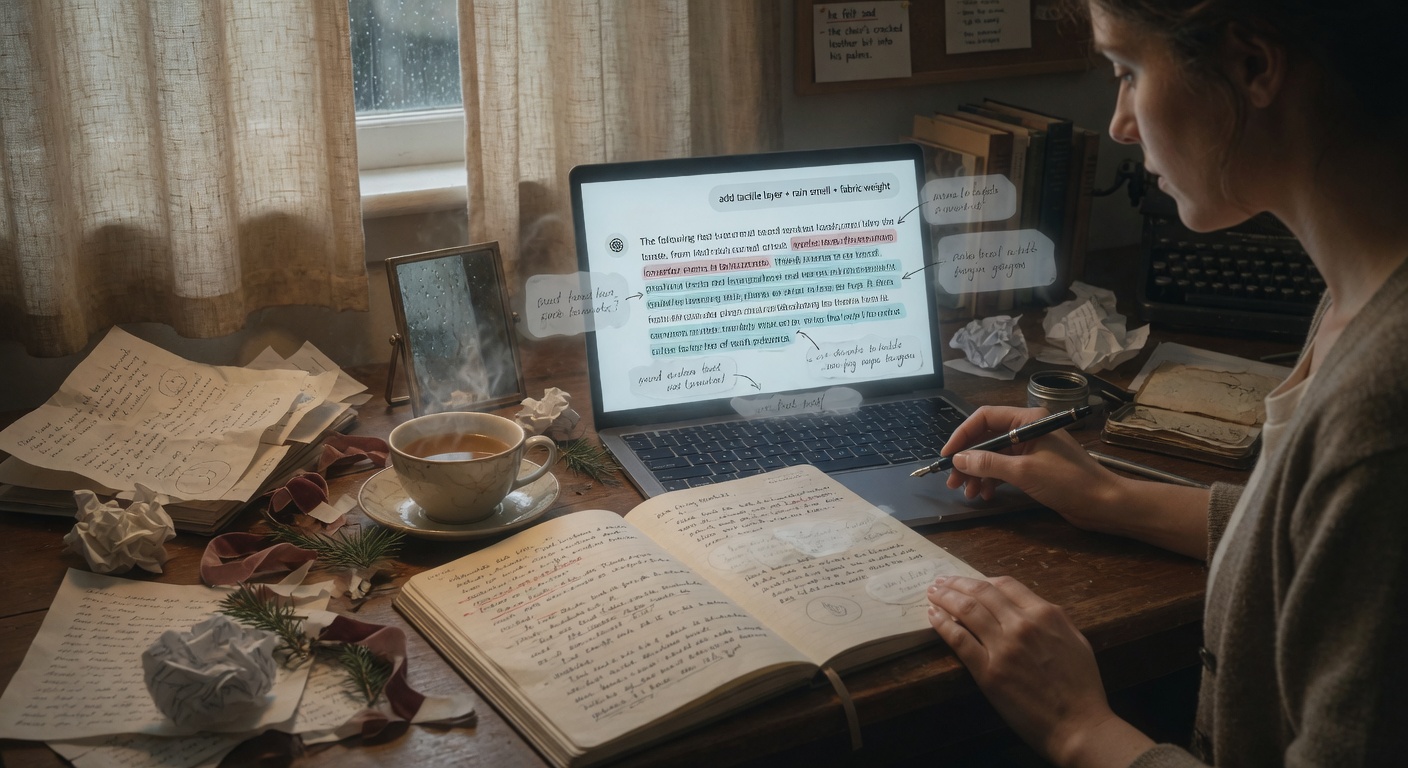
Flat scenes are sneaky. You can read a passage back and find nothing technically wrong with it — the dialogue lands, the plot moves, the character wants something. But it still feels like watching the action through smudged glass. The reader is present but not inside. They're getting information about a scene rather than living in it.
Nine times out of ten, the culprit is sensory debt: the gap between the sensory richness a scene promises and what it actually delivers on the page. Your protagonist walks into a diner at 2am, but we only know it's a diner because you told us so. We don't smell burnt coffee and the ghost of someone's cigarette break. We don't feel the sticky vinyl under her thighs or hear the cook's radio leaking a song she hates. The scene is technically present but sensorially bankrupt.
The good news is that AI is genuinely excellent at diagnosing this kind of debt — and with the right prompts, it can help you repay it scene by scene without tipping into purple prose territory. Here's how to make that work.
What Is Sensory Debt and Why It Makes Scenes Feel Distant
Most writers, especially early in a draft, default to two senses: sight and sound. We describe what things look like and what people say. Occasionally smell shows up for a funeral or a bakery. Touch and taste are almost orphaned — pulled out only for dramatic moments like a first kiss or a poisoning.
That default pattern creates a scene that functions more like a screenplay direction than lived experience. Screenplays can get away with this because the camera and sound design fill in the rest. Prose can't outsource to a production team. The words on the page are the entire sensory world.
Sensory debt isn't about adding more description. It's about noticing which senses are carrying the full weight of a scene and which ones have gone silent.
The "debt" framing is useful because it reframes the problem. You're not failing at description — you've borrowed atmospheric weight from senses you haven't paid back. A scene set in a kitchen might be heavily visual but owe the reader smell, temperature, and the specific texture of flour-dusted hands. Paying that debt isn't decoration; it's the difference between a scene your reader remembers and one they slide past.
Different scenes naturally emphasize different senses, and that's fine. A tense courtroom scene might lean on sound and sight — voices, body language, the squeak of a chair. But even there, tiny touches of smell (the lawyer's cologne, the particular staleness of recycled air) or physical sensation (how tight the protagonist's jaw is, the hard wood of the gallery bench) anchor the reader bodily in the space. Absence of those anchors is the debt.
How to Prompt AI to Audit a Scene for Sensory Imbalance
Before you can fix sensory debt, you need to know exactly where it lives. This is where AI earns its keep, because doing this audit manually means you're reading your own prose — and you wrote it, so your brain autocompletes the sensory gaps. You already smell the kitchen in your head. AI doesn't. It only knows what's on the page.
The most useful audit prompt asks the AI to act as a sensory accountant. Give it your scene and ask it to tally, sense by sense, what's actually present versus absent. Be specific about what you want back — not a general "how can I improve this," but a structured breakdown.
I'm going to paste a scene from my literary thriller. I want you to audit it for sensory debt. Go through each of the five senses — sight, sound, smell, touch/physical sensation, and taste — and tell me:

1. What specific sensory details are currently present (quote the relevant phrases)
2. Which senses are underrepresented or completely absent
3. What the scene's setting and emotional tone SUGGEST should be present but isn't (e.g., if there's a character eating, taste should probably be there)

Do not rewrite anything yet. Just give me the diagnosis. Here's the scene:

[paste scene]
That "do not rewrite anything yet" instruction is crucial. Without it, the AI will jump straight to fixing and you'll lose the diagnostic step — which is where the actual insight lives. You want to understand the debt before you start repaying it.
The audit usually surfaces something surprising. Writers almost always discover they've written entire pages that are heavily visual with zero physical sensation — the POV character might as well be floating two inches above the action. Or there's sound in the dialogue but the ambient soundscape of the scene has gone completely quiet. Once you see it itemized, it's hard to unsee.
For longer scenes, you can also ask the AI to flag where in the scene the sensory coverage drops off. Often the first paragraph is reasonably grounded and then the scene goes "sense-blind" once dialogue or action picks up.
Repayment Prompts: Adding Specific Senses Without Overwriting
This is where most writers either undershoot (add nothing meaningful) or overshoot (suddenly every noun has three adjectives and the scene reads like a scented candle catalog). The key is targeted, surgical prompting — you're not asking the AI to enrich the whole scene, you're asking it to weave in one specific sensory register at a time.
Work sense by sense. If the audit reveals that touch and smell are in debt, do two separate passes. Trying to add both at once usually produces clumping — all the new sensory details pile up in the same paragraph instead of distributing naturally through the scene.
Here's a scene from my novel. The audit identified that physical sensation (touch, temperature, bodily awareness) is almost completely absent. My POV character is Maya, a 34-year-old surgeon who runs cold emotionally but is physically hyperaware of her environment — it's how she processes stress.

I want you to suggest 4-6 specific moments in this scene where I could add physical/tactile sensation. For each suggestion:
- Quote the exact line where you'd add it
- Write the actual new sentence or phrase (not a description of what to write)
- Keep it brief — one sentence max per addition
- Match Maya's clipped, observational voice. She notices things like a diagnostician, not a poet.

Do not add any smell or sound details — just touch and physical sensation.

Here's the scene: [paste scene]
Notice what that prompt does: it gives the AI character context (who is experiencing the sensation), voice context (clipped, observational), and a hard constraint (one sense only, brief additions). The character context is the most important part. Sensory details land differently depending on who's noticing them. A grieving mother feels the cold differently than a soldier trying to stay alert. Without that grounding, the AI defaults to generic sensory description — damp air, rough texture, bitter taste — which reads as decoration rather than character.
For smell specifically, which is the most emotionally powerful and most frequently neglected sense, this prompt structure works well:
My scene takes place in my protagonist's childhood home, which she's returning to for the first time in eleven years. She has a complicated, mostly painful relationship with her mother, who is now ill.

The scene currently has no smell details at all. I want to add smell in a way that does double work — it grounds the physical space AND reflects the emotional undercurrent of the reunion (grief, resentment, something unresolved).

Suggest 3 smell details for this scene. Each one should:
- Be specific and unexpected (not "the smell of her mother's perfume" or "something cooking")
- Be something that would actually exist in this space
- Connect to the emotional texture of the scene without being heavy-handed
- Be written as a complete sentence I could drop into the prose

Setting details: 1970s ranch house in rural Ohio, late November, the mother has been ill for months and the house has been somewhat neglected.
That "do double work" instruction is something I use constantly. It stops the AI from generating sensory filler and pushes it toward details that carry thematic or emotional weight. The best sensory details in fiction aren't there to prove the writer can describe things — they're there because they mean something to the character or the scene's subtext.
Anchoring Sensory Details to Character Emotion and POV
Here's where sensory revision can go wrong even with good prompts: the new details are technically accurate but feel pasted in, like someone added a nature documentary voiceover to your scene. The diner smells like burnt coffee and vinyl, yes, but it's reported rather than experienced. The character is still watching from outside.
The fix is to route every sensory detail through the POV character's emotional state. This isn't always done explicitly — sometimes it's just about which details the character notices and how they register them. A character who's terrified will notice different things than a character who's bored or in love. The selection and framing of sensory detail is itself characterization.
What your character notices tells us who they are. What they fail to notice tells us what they're avoiding.
When prompting for this, give the AI access to the character's emotional interior. Not just "she's nervous" but the specific flavor of that nervousness — is she dissociating, is she hypervigilant, is she trying to focus on small things to avoid thinking about the big thing?
I'm revising a scene where my character Daniel is waiting in a hospital corridor to hear whether his father survived surgery. He's not a crier. He deals with stress by going very still and practical — he notices procedural details, makes mental lists, focuses on anything concrete.

Here's the scene. Right now it's very internal and thought-heavy. I want to add sensory grounding, but the sensory details need to feel like how DANIEL specifically would experience waiting — through his coping mechanism of hyper-noticing small concrete things.

Suggest 5 sensory details to weave into this scene. Each one should:
- Feel like something Daniel would actively focus on as a way of not thinking about his father
- Be from the physical environment of a hospital corridor (specific, not generic)
- Vary across the senses (don't give me 5 visual details)
- Be written in third-person limited, past tense, matching this voice: [paste 2-3 sentences from the scene as a voice sample]

Scene: [paste scene]
The voice sample instruction at the end matters more than it might seem. AI is good at generating sensory details but has a tendency to slightly shift register — adding a lyricism or a flatness that doesn't quite match what you've built. Giving it actual sentences from your prose as a calibration sample produces much tighter matches.
Before-and-After Workflow: A Full Scene Revision Example
Theory is useful. Watching it work on actual prose is better. Here's the workflow compressed into a practical sequence you can run on any flat scene.
Step 1: Run the Sensory Audit
Paste your scene with the audit prompt from Section 2. Get the diagnosis. Don't skip this step even if you think you know what's missing — the audit usually reveals something you didn't expect.
Step 2: Prioritize Two or Three Senses in Debt
You don't need to fix everything at once. Look at the audit and pick the two or three senses that are most absent AND most relevant to this scene's emotional purpose. A quiet grief scene probably needs touch and smell more than taste. A confrontation scene in a bar might need ambient sound and physical sensation more than smell.
Step 3: Run Separate Repayment Passes
One sense at a time. Use the targeted prompts from Section 3, always including character context and voice sample. Get suggestions, not rewrites. Review each suggestion and only keep what genuinely fits — AI will sometimes generate details that are technically correct but tonally off or too on-the-nose.
Step 4: Integrate Manually
This step is yours. Take the suggestions you've accepted and weave them in yourself, adjusting the syntax so they breathe naturally into your existing sentences. Don't just paste them in as-is — you'll be able to feel where they're sitting awkwardly. This is also where you make sure the new details are distributed through the scene rather than clumped at the beginning.
Step 5: The Rhythm Check
Read the revised scene aloud. Sensory overload has a distinct sound — you'll hear your prose slowing down, becoming thick. If you've added too much, you'll feel it before you can analytically identify it. Cut anything that stops the rhythm rather than deepening it. A detail that draws attention to itself usually doesn't belong.
As a rough calibration: in a 500-word scene, you're probably looking to add somewhere between 4 and 10 sensory details across the senses you've identified as in debt. Fewer and you haven't really moved the needle. More and you're likely tipping into overwriting. That range gives you something concrete to aim at during revision.
The final practical note: keep a running sensory audit as a document for your whole manuscript. As you go scene by scene, note which senses you tend to neglect. Most writers have consistent blind spots — I know mine is ambient sound, which I almost never include naturally. Knowing your pattern means you can catch it earlier, sometimes even in the first draft, before the debt accumulates into something that makes every scene feel slightly distant from the reader.
Run your most recently drafted scene through the audit prompt tonight. You'll almost certainly find at least one sense that's been completely silent. That's your starting point.