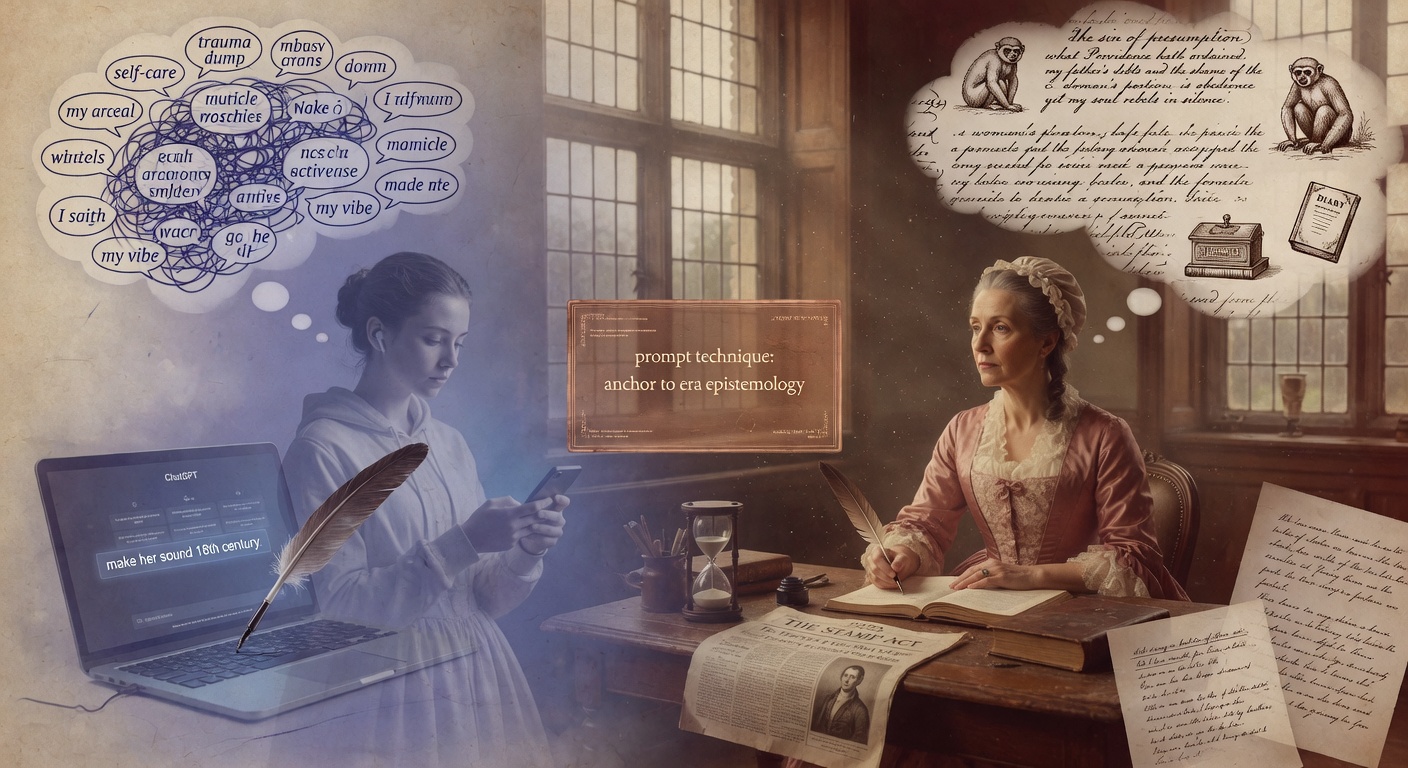
How to Use AI to Write Characters Who Think in a Different Era
There's a specific failure mode that haunts historical fiction written with AI help, and once you see it, you can't unsee it. The year is 1347. The Black Death is moving through a Florentine merchant's village. He watches his daughter sicken. And his internal monologue reads like a man in grief therapy — layered, self-aware, full of emotional language that assumes psychology as a framework for understanding the self. He processes. He reflects on his patterns. He wonders what this loss means for him as a person.
That merchant didn't think like that. He didn't have the concept of "the self" as a discrete psychological entity. He probably thought in terms of God's will, humoral imbalance, sin and punishment, fate — not because he was less intelligent, but because those were the cognitive tools his culture gave him. When AI renders his interiority in contemporary psychological language, it doesn't just feel slightly off. It hollows out the entire point of historical fiction, which is to genuinely inhabit a different way of being human.
The good news: this is a fixable problem, and fixing it makes AI an extraordinarily useful collaborator for historical fiction.
Why AI Defaults to Modern Consciousness (And What It Costs Your Historical Fiction)
AI models are trained predominantly on contemporary text. Even when they've ingested historical literature, the sheer volume of modern writing shapes their default register. Ask an AI to write a character's thoughts without specific instruction, and it will reach for the nearest available template — which is roughly the inner life of a 21st-century, English-speaking, psychologically literate person. The character will notice their own emotions, name them, and implicitly believe that understanding those emotions is a meaningful goal.
This matters more than it might seem. Cognitive style — the way a character organizes cause and effect, assigns meaning, understands their own agency — is the invisible architecture of interiority. A Roman soldier in 60 AD doesn't have a continuous, bounded self the way a modern reader does. His sense of identity is far more porous, communal, enmeshed with family honor and divine favor. An 18th-century woman in Boston doesn't privately interrogate her marriage the way a contemporary character might; she likely experiences her constraints as natural order, and her interior rebellion (if it exists) will be encoded in religious or domestic language, not therapeutic.
When AI flattens all of this into modern consciousness, you lose the strangeness that makes historical fiction feel true. And strangeness is the whole point — not alienation, but the productive disorientation of encountering a genuinely different mind.
The goal isn't to make your historical character sound old-fashioned. It's to make them think in ways that are structurally different from how we think now.
Mapping the Cognitive Fingerprint of an Era: Research Inputs That Change AI Output
Before you can prompt AI effectively, you need to know what you're asking for. This requires some research — but it's a specific kind of research, not just "what happened in 1450." You're looking for the cognitive fingerprint of an era: the underlying assumptions people made about causation, selfhood, time, the body, God, fate, and social hierarchy.
Here's what to look for, and where to find it:
- Primary sources in translation. Diaries, letters, court records, sermons, and personal accounts. Not to mine for facts, but to absorb how people structured their thoughts. How do they explain misfortune? Do they look inward or outward? What's the ratio of religious to practical reasoning?
- Historians of mentality. The Annales school — historians like Philippe Ariès and Georges Duby — specifically studied how ordinary people understood life and death across history. Ariès's The Hour of Our Death is invaluable for any period before 1900.
- Medical and philosophical texts of the period. What people believed about the body and the mind tells you everything about how they experienced being inside one. Galenic humors, Calvinist predestination, 19th-century nervous theory — each creates a completely different model of why a person feels what they feel.
- The concept of interiority itself. Charles Taylor's Sources of the Self traces the historical development of inwardness. Not light reading, but essential for understanding what "inner life" even meant across different centuries.
Once you have a feel for the period's cognitive landscape, you can feed it directly into your prompts. The more specific your research input, the more specific the AI output. Vague instructions produce vague period flavor. Specific intellectual frameworks produce specific thinking.
Prompting Techniques to Shift Internal Monologue Away from 21st-Century Psychology
There are several concrete techniques that work reliably. I use most of them in combination rather than relying on any single approach.
Specify the explanatory framework, not just the emotion
Don't just tell AI what the character feels. Tell it how the character explains that feeling to themselves — and crucially, what intellectual framework they'd reach for. "She feels grief" produces modern grief. "She experiences grief as a humoral imbalance, an excess of black bile that her physician has warned is dangerous to the liver, and she prays to regulate it rather than to express it" produces something different.
Prohibit specific modern concepts explicitly
This sounds blunt, but it works. Tell AI directly: Do not use the concepts of self-esteem, emotional processing, trauma, personal growth, or identity in this character's internal voice. Modern psychological vocabulary sneaks in even when you don't ask for it, because it's so deeply embedded in AI's training. Naming what you don't want is just as important as naming what you do.
Give the character their era's vocabulary for inner states
A medieval person experiencing anxiety might call it fear of God's judgment, or a troubled conscience, or physical symptoms interpreted as signs. A Victorian experiencing depression might understand it as neurasthenia, a fashionable affliction of sensitive constitutions, tinged with ambivalent pride. Giving AI the period-appropriate vocabulary for emotional states forces it to think inside those frames rather than translating them into modern equivalents.
Anchor the character's sense of causation
How does your character understand why things happen? Divine will? Fate? The movements of planets? The logic of social hierarchy? The laws of nature as understood by Enlightenment science? Causation is the skeleton of thought. Change the causation model, and the entire structure of interior monologue changes with it.
Use a reference text as a style anchor
Paste a short excerpt from a genuine primary source — a few sentences from a period diary or letter — into your prompt and ask AI to model the character's interiority on that sentence structure and reasoning style. This is one of the most effective techniques I've found. AI is excellent at pattern-matching from examples.
Four Prompt Examples: From Medieval Fatalism to Victorian Self-Examination
Here are four prompts you can adapt directly. Each one targets a different era and cognitive mode.
Medieval Fatalism (14th Century)
Write a passage of internal monologue for Thomas, a 14th-century English wool merchant, as he learns his business partner has died of plague. Thomas is not a deeply learned man but is conventionally religious. His interiority should reflect medieval Catholic fatalism: he does not interrogate his own emotional responses or seek to understand them as psychological states. Instead, he interprets events as God's will operating through natural causes, feels the death primarily as a rupture in social and economic bonds rather than personal loss, and his private response involves calculation of spiritual obligation (prayers, masses owed) alongside practical concern. Do not use any language of emotional processing, self-reflection, or personal growth. Avoid the word "feel" as a mental verb. The character's inner voice should read as if thought and duty are nearly indistinguishable.
The key move here is the instruction that "thought and duty are nearly indistinguishable." This targets the specific cognitive feature of medieval consciousness where personal response and social/religious obligation aren't separate categories. Tweak the religious specifics — Orthodox, Muslim, Jewish — for different medieval contexts.
Early Modern Calvinist (17th-Century Puritan, New England)
Write internal monologue for Mercy, a 35-year-old Puritan woman in 1680s Massachusetts, as she discovers her teenage son has been meeting secretly with a young woman from a neighboring family she distrusts. Mercy's interiority should be shaped by Calvinist theology: she understands her own impulses — including her anger and suspicion — as potential evidence of sin in herself, not just in her son. She practices a constant, wary self-examination, but NOT in the modern therapeutic sense; she is searching for signs of God's grace or its absence, not for psychological insight. Her thoughts move in a pattern of observation → spiritual interpretation → self-indictment → resolution toward prayer. She would not trust her own emotional conclusions. Use the language of conscience, sin, grace, and covenantal obligation. The sentence structure should feel restrained, even when the emotion beneath is intense.
The observation-interpretation-indictment-prayer pattern gives AI a concrete thought sequence to follow. That's more useful than abstract descriptions of Puritan psychology. Adjust the theological tradition — Anglican, dissenting, Catholic — to shift the flavor significantly.
18th-Century Enlightenment Rationalism
Write internal monologue for Antoine, a 40-year-old French lawyer in 1778, as he attends a dinner where a philosophe makes arguments he finds deeply persuasive but socially dangerous. Antoine's interiority should reflect Enlightenment rationalism as a lived cognitive style: he genuinely believes that reason is the correct instrument for evaluating all claims, including his own discomfort. His self-examination is NOT emotional — it's epistemological. He asks himself whether his resistance to the philosophe's ideas is rational or merely habitual, and he distrusts the latter. He's also acutely aware of social performance and the gap between public and private reasoning, which he experiences as a practical tension rather than existential anxiety. Avoid introspection about feelings; replace it with introspection about the quality of his reasoning. Reference period concepts: opinion vs. reason, prejudice as intellectual failure, sensibilité as a specifically 18th-century category distinct from modern emotion.
The "epistemological rather than emotional" instruction is doing the heavy lifting. Enlightenment characters examine the validity of their thoughts, not the depth of their feelings. That's a genuinely different cognitive mode, and naming it gives AI something to work with.
Victorian Self-Examination (Late 19th Century)
Write internal monologue for Eleanor, a 28-year-old unmarried English woman in 1883, as she reads a letter informing her that the position she applied for (as a governess) has been filled by someone else. Eleanor is educated, reads widely, and is privately aware of the injustice of her situation — but she has no vocabulary for feminist grievance as a legitimate public category. Her interiority should reflect Victorian nervous theory: she experiences her frustration as a physical sensation she must manage carefully lest it damage her nerves or her health. She is also performing self-examination in a specifically Victorian mode — not Calvinist conscience-searching, but something closer to character cultivation, asking whether her disappointment reveals a flaw in her discipline or resignation. She has likely read Ruskin and Eliot; she thinks in terms of duty, character, and the moral meaning of small acts. Do not make her a secret modern feminist. Make her someone who genuinely believes in Victorian ideals of womanhood while chafing under them in ways she cannot fully name.
The last instruction — "do not make her a secret modern feminist" — is critical. AI has a tendency to give historical women a fully-formed contemporary feminist consciousness as a kind of compensatory move. Resist this. The tragedy (and richness) of Eleanor's character is that she chafes under constraints she also partly believes in. That's what historical specificity looks like.
Calibrating the Balance: Period Authenticity Without Alienating Readers
There's a real tension here, and it's worth being honest about it. A fully period-authentic interiority can become opaque to modern readers if you push it too hard. If your medieval merchant's thoughts are entirely organized around masses owed and humoral imbalance, readers may feel no point of entry.
The solution isn't to sneak in modern psychology through the back door. It's to find the human constants that exist across eras — love, fear, ambition, shame — and render them through period-appropriate cognitive frameworks. The merchant can grieve genuinely and deeply while understanding that grief through a medieval lens. The emotion is recognizable; the interpretive architecture around it is not.
Modern readers don't need a character to think like them. They need a character whose inner life makes sense on its own terms — and whose different terms reveal something.
A few calibration techniques that help:
- Use the narrator's perspective as a bridge. In third-person narration, the narrative voice can quietly translate for readers even when the character's interiority stays historically grounded. The character thinks in humors; the narrator's framing makes the emotion visible.
- Let action carry what interiority doesn't explain. Historical characters don't need to understand their own grief for readers to see it. Sometimes the most period-authentic move is to show a character who simply acts — who prays, who works, who doesn't examine — and let the reader experience the interiority that way.
- Ask AI to flag where it's cheating. This sounds odd, but it works. Add to your prompt: After drafting this passage, note any places where you defaulted to contemporary psychological language or modern interiority, and suggest a period-appropriate alternative. AI is reasonably good at this meta-analysis when asked explicitly.
The other thing worth saying: you don't need to get every nuance of medieval cognition exactly right to write good historical fiction. You need to get it directionally right — to move the character's inner life meaningfully away from the contemporary default. Even a 60% shift in that direction produces fiction that feels genuinely inhabited rather than costumed.
Start with your next scene that requires a character's internal monologue. Pick one specific cognitive feature of their era — their model of causation, their relationship to self-examination, their vocabulary for emotional states — and build a prompt around that single feature. One concrete constraint produces more period-authentic prose than a dozen vague instructions to "sound historical." Write the scene, compare it to what an unconstrained AI would produce, and you'll immediately see what specificity buys you.
Try it yourself
Write your own book with AI — free, no credit card required.
Free · No credit card