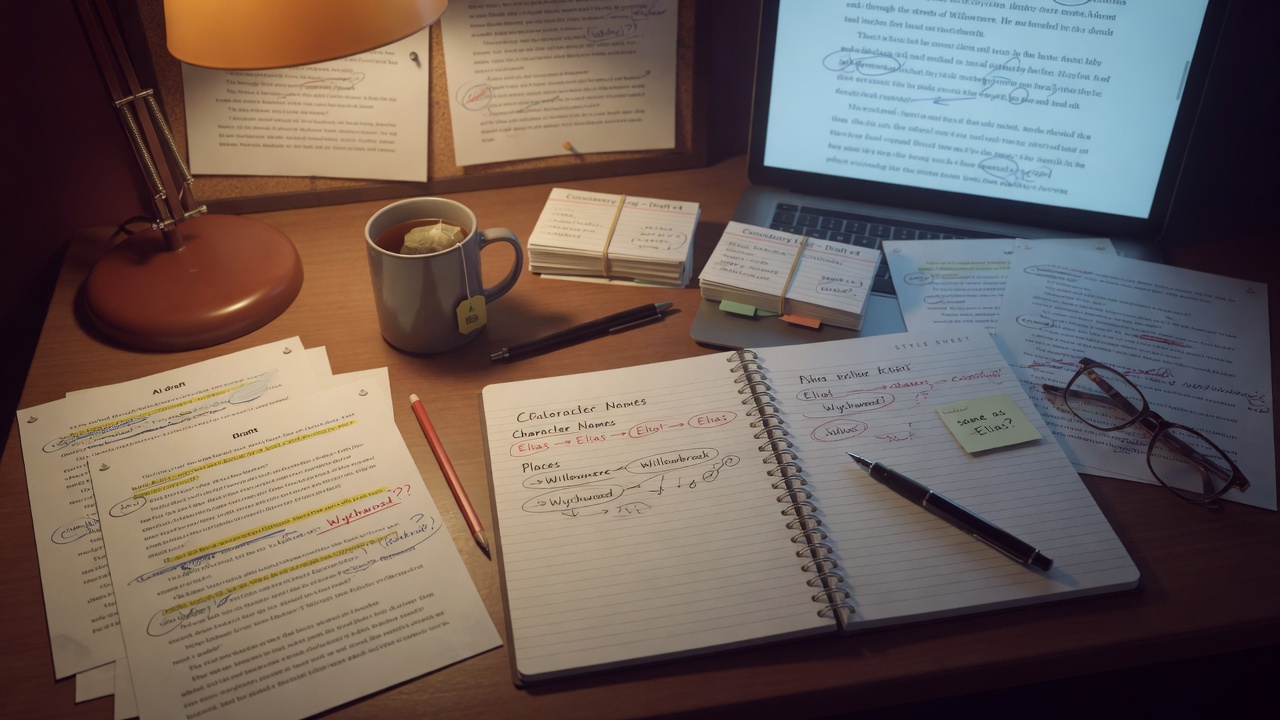
Somewhere around chapter twelve, your antagonist's home town changes its name. Not dramatically — it goes from "Ashford" to "Ashforde" — and you don't notice because you were reading for plot, not spelling. Then in chapter nineteen it flips back. Your beta reader notices. Your copyeditor definitely notices, and charges you for the privilege of flagging forty more instances just like it.
This is the single most predictable failure mode of AI-drafted manuscripts, and almost nobody catches it before it's expensive to fix. The good news is that the same tool that caused the drift can help you catch it — if you know how to ask.
Why AI Drafts Drift: Same Word, Different Spelling Across Chapters
Large language models don't hold your whole manuscript in working memory the way you might imagine. Each generation pulls from whatever context fits in the window plus whatever it's inferred from your prompt, and across a 90,000-word draft written in chunks — session by session, chapter by chapter — small decisions get re-made instead of remembered. "Grey" becomes "gray." "Mom" becomes "Mum" for one scene because the model briefly leaned British. A made-up rank like "Sub-Commander" loses its hyphen halfway through part two. None of these are hallucinations exactly. They're just the natural entropy of a system that generates fresh each time rather than referencing a fixed source of truth.
It gets worse with invented vocabulary. Fantasy and sci-fi writers feel this hardest — a magic system term, a species name, a piece of tech — because there's no dictionary the model can lean on to stay consistent. If you're working in that space, pairing your draft process with something like a fantasy magic system built on constraints AI will respect reduces some drift at the source, but it won't eliminate it. Numbers drift too: a character's age stated as 34 in chapter two and 33 in chapter twenty, a distance given in miles once and kilometers later. None of this is a "bad AI" problem. It's a structural one, and it's fixable with a document that didn't exist when you started drafting but absolutely should exist before you type "The End."
That document is a style sheet — traditionally a copyeditor's tool, but for AI-assisted manuscripts it doubles as a drift detector. The trick is building it from the draft itself, using the AI to surface its own inconsistencies rather than combing 300 pages by eye.
Prompting AI to Self-Audit for Terminology and Style Drift
The instinct most writers have is to ask the model "check my manuscript for consistency," which produces a vague, mostly useless response. You get better results when you ask for something narrow and mechanical — a search-and-report task rather than a judgment call. Feed it the full manuscript (or work chapter-by-chapter if your context window is tight) and ask it to hunt for specific categories of drift.
Read through this manuscript and act as a copyeditor doing a consistency audit — not a line edit. I need you to build a list of every proper noun (character names, place names, invented terms, organization names) along with every spelling variant you find for each one, and the chapter where each variant appears. Do the same for numbers that recur (ages, dates, distances, dollar amounts) and flag any instance where the same fact is stated differently. Do not fix anything yet. Output as a table: Term | Variants Found | Chapters | Notes.
Why this works: you're asking for extraction, not correction. Models are much more reliable at "find and list" than "find and silently fix," because fixing requires it to pick a winner without knowing your intent — was "Ashforde" the typo or was "Ashford" the typo? A table format also forces it to be systematic instead of narrative, which cuts down on it skipping entries buried mid-chapter.
Run a second, separate pass focused purely on mechanics — the stuff that's boring but that copyeditors bill hours for.
Scan this manuscript for style mechanics inconsistencies only: hyphenation choices (e.g. "email" vs "e-mail," "well-known" vs "well known"), number formatting (spelled out vs numerals, and at what threshold), em-dash vs en-dash vs double-hyphen usage, and how texts/messages are formatted (italics, quotation marks, or neither). For each category, tell me the dominant pattern in the manuscript and every place it breaks from that pattern, with chapter and approximate location.
This second pass matters more than most self-published authors realize. Publishers and copyeditors don't just want a consistent choice — they want to know you made one on purpose. A style sheet that says "we spell it em-dash with no spaces, per Chicago" reads as professional. A manuscript that does it four different ways reads as unedited, even if the prose underneath is excellent.
If your manuscript came together across many separate sessions inside Entangled Text or wherever you drafted, it's worth running these audit prompts chapter-by-chapter and merging the results, since most context windows won't reliably hold a full novel's worth of detail without dropping earlier chapters from consideration. The Five-Pass Revision Order for AI-Assisted Novels is a useful frame for where this audit sits in your overall revision sequence — it belongs early, before line editing, so you're not polishing prose around a name that's about to change.
Building the Style Sheet: Characters, World Terms, Numbers, and Mechanics
Once you've got the AI's raw findings, turn them into an actual reference document — something you or anyone else can scan in ten seconds mid-sentence. Structure beats prose here. A style sheet is a lookup table, not an essay.
Organize it into four sections:
- Characters — full name, nicknames, spelling of surnames, physical details stated as fact (eye color, height, scars), and anything a reader could catch you contradicting. This overlaps heavily with what a good story bible AI models actually follow should already contain — if you built one before drafting, your style sheet is really just the "what actually ended up on the page" version of it, cross-checked against intent.
- World terms — invented vocabulary, capitalization rules (is it "the Fold" or "the fold"?), hyphenation of compound terms, plural forms of invented words. LitRPG and fantasy manuscripts tend to need the longest list here; if you're doing LitRPG writing with stat blocks and system messages, lock down formatting rules for those early because they repeat constantly and any drift multiplies fast.
- Numbers and timeline — ages, dates, durations, distances, currency. Include a mini-timeline if your plot spans specific days or years; this is where AI drafts are weakest, because tracking "it's been three days since chapter four" across forty chapters requires exactly the kind of long-range memory language models don't reliably have.
- Mechanics — your chosen conventions for numbers, hyphenation, dashes, texting format, internal thought (italicized or not), scene break symbols. Borrow from Chicago Manual of Style defaults unless you have a reason not to, and write down the exception, not just the rule.
A style sheet isn't there to tell you what's correct. It's there to tell you what you already decided, so you stop re-deciding it every chapter.
Keep this as a living document you paste into future prompts, not a one-time artifact. Every time you ask the AI to draft a new chapter or revise an old one, dropping the style sheet into context is cheap insurance.
Here is my manuscript's style sheet (pasted below). Before you write the next chapter, review it and confirm you understand the spelling of all named characters and locations, the capitalization rule for magic terms, and the current in-story date. Then write chapter 23, which picks up two days after chapter 22 ends. Flag anything in my style sheet that seems to conflict with what I'm asking you to write next.
That last sentence — asking it to flag conflicts — is doing real work. It converts the style sheet from a passive reference into an active check, catching problems before they get written instead of after.
Running a Targeted Consistency Pass Using the Style Sheet as a Checklist
With the style sheet built, go back through the manuscript one more time — but this pass is fast, because you're not reading for story anymore. You're checking a finite list against a finished document, which is a completely different cognitive task than drafting or line-editing.
Break it into batches by category rather than trying to catch everything in one read-through. Do a names-only pass first: search the manuscript for every variant spelling your audit surfaced and standardize. Then do a numbers pass: check every age, date, and distance against your timeline section. Then a mechanics pass: hyphenation, dashes, formatting of texts and system messages.
Using the style sheet below, go through this manuscript chapter by chapter and check only for terminology and spelling drift — nothing else. For each chapter, tell me pass/fail against the style sheet, and if it fails, quote the exact sentence and tell me which style sheet rule it violates. Don't suggest rewrites or comment on prose quality, pacing, or anything outside terminology consistency.
Constraining scope this tightly is the whole trick. Ask an AI to "check consistency and also improve the writing" and it'll happily blend the two, burying your real problem — a wrong hyphen — under six paragraphs of unsolicited prose suggestions. One job per pass, every time.
This is also the point where a dedicated tool can save you real time instead of manually cross-referencing a spreadsheet against forty chapters. Entangled Text's character consistency checker exists for exactly this reason — it's built to catch the kind of drift a general-purpose chat interface will miss unless you prompt it with unusual precision every single time. If you're working in a genre with heavy invented terminology, the fantasy worldbuilding tool and the general best AI book writing tools roundup are worth a look too, since consistency tooling varies a lot between platforms — see also Entangled Text vs ChatGPT if you're deciding where to run this whole workflow. And if your manuscript leans romance, the tropes and beat structure carry their own consistency traps worth checking against the Romance Beat Sheet: Where AI Drafts Usually Break guide, particularly around timeline and relationship-status continuity, which drifts just as easily as spelling does.
Don't skip the opening chapters in this pass, by the way. Terminology set in your first few pages gets referenced constantly later, and if you did an opening hook fix on your first page after the rest of the draft was already written, there's a good chance names or terms shifted slightly between that rewrite and the rest of the book.
Handing the Style Sheet Off to a Copyeditor or Beta Reader for Faster Turnaround
A style sheet's second life is as a gift to whoever reads your manuscript next. Copyeditors normally build this document themselves, during the edit, and bill you for the time it takes. Handing them a clean one up front doesn't just save money — it changes the entire quality of the edit, because they spend their hours on prose and grammar instead of detective work chasing down whether your character is 34 or 33.
Format it as a standalone one-to-two-page document, separate from the manuscript, and send it alongside the files. If you're working with beta readers instead of a professional editor, a lighter version helps them too — not the full mechanics section, but definitely the character and world-term list, since nothing pulls a beta reader out of the story faster than wondering if a name change was intentional. The Beta Reader Workflow for AI-Assisted Manuscripts guide has more on structuring that handoff so their feedback comes back usable rather than scattered.
Turn the consistency audit and style sheet notes below into a clean, professional style sheet document formatted the way a publishing copyeditor would expect: sections for Characters, Places, World/Invented Terms, Timeline, and Mechanics, alphabetized within each section, one line per entry. Keep it factual and terse — no explanations, just the standardized spelling/format and a one-line note where needed (e.g. "capitalize only when referring to the specific artifact").
This is the version that travels well — to a copyeditor, into your production files, or into your own prompt library for book two if you're writing a series. If you're building toward self-publishing, this same document pairs naturally with the rest of your pre-launch checklist; the KDP Upload Checklist After an AI-Assisted First Draft covers what else needs a second look before you upload, and the broader Publish, Launch & Distribute Your Book guide walks through everything downstream of that. A few of the smaller free writing tools on the site are handy at this stage too — the Chapter Heading Formatter for making sure your chapter titles follow one consistent pattern, and the KDP Page Count Estimator once your manuscript is locked and you're estimating print costs.
If you take one thing from this: build the style sheet before you think you need it, not after your beta reader emails you a list of "small things" that turns out to be four pages long. Run the two audit prompts above on your current draft today, even if it's only half-finished — catching a spelling drift at chapter twelve is a two-minute fix, and catching the same drift at chapter forty is a full afternoon of search-and-replace with your fingers crossed. For more on sequencing this kind of revision work correctly, the writing guides library has the full roadmap, and if you're earlier in the process than this guide assumes, write a book with AI and the AI fiction writing guide are the right places to start before you ever get to the style sheet stage.