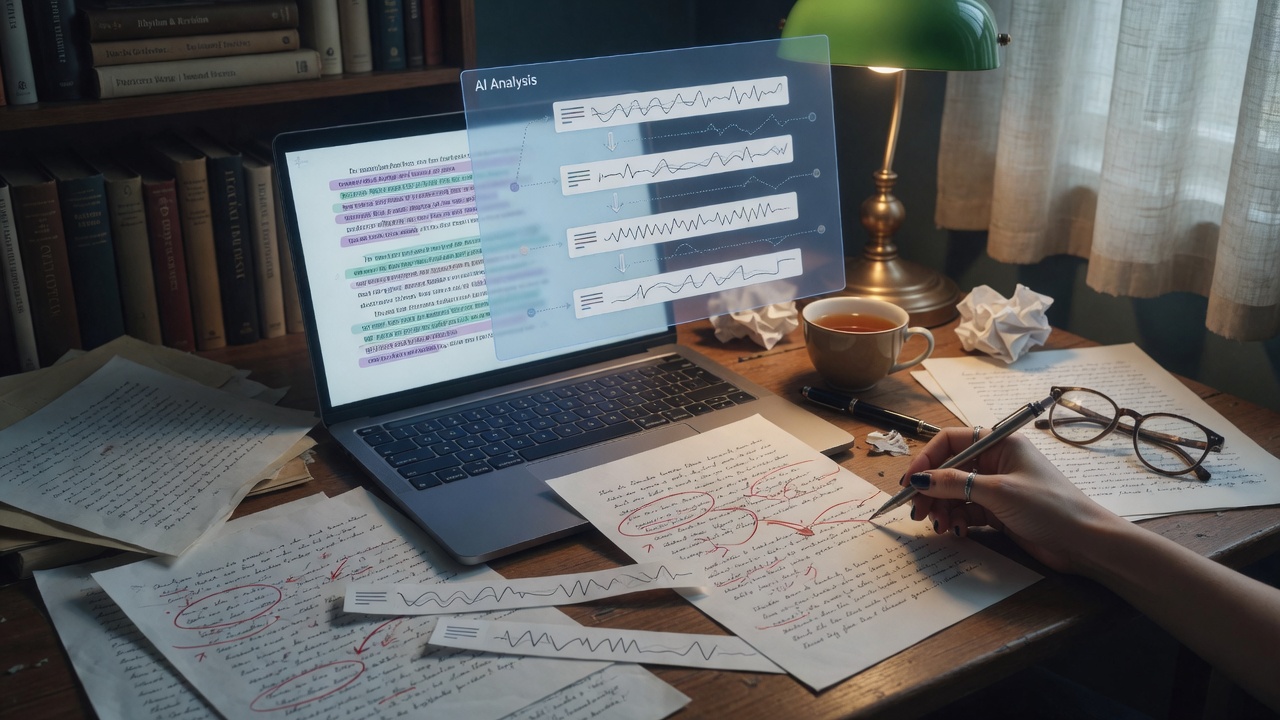
Read your own manuscript out loud and something strange happens: you stop hearing the sentences and start hearing the story. That's the whole problem. Your brain autocorrects rhythm the same way it autocorrects typos, filling in variation that isn't actually on the page because you already know what you meant to write. Monotony hides from you precisely because you're the author. It doesn't hide from a machine that has no investment in your story and no memory of what you intended — it only sees the pattern that's actually there.
Why Rhythm Monotony Hides From Human Proofreading (and Why AI Can Spot It)
Sentence-length monotony is one of those problems that's invisible until someone points it out, and then you can't unsee it. A paragraph where every sentence runs eight to twelve words, opens with the subject, and follows subject-verb-object order isn't grammatically wrong. Nothing in it will trip a spellchecker or an editor's red pen for "errors." But read three paragraphs of it back to back and the prose starts to feel like a metronome. Flat. Predictable. Exhausting in a way readers can't quite name.
The reason humans miss this during self-editing is simple: we read for meaning, not for shape. Your eyes glide over "She walked to the door. She opened it. She stepped outside." and your brain fills in urgency or hesitation based on context, because that's what good readers do. But an AI model, when asked the right way, isn't reading for meaning at all — it's counting words, tracking sentence openers, and mapping structure like a spreadsheet. That's exactly the lens you need for this particular problem, and it's a lens humans are bad at holding for more than a paragraph or two before fatigue sets in.
This is also why generic feedback like "make this flow better" doesn't work. It's too vague for a human editor to act on consistently, and it's even vaguer for an AI model, which will respond by rewriting the passage into something unrecognizable — often trading monotony for purple prose, which is arguably worse. The fix isn't a vibe. It's a diagnostic, followed by a targeted repair. If you've read The Five-Pass Revision Order for AI-Assisted Novels, this technique slots in as its own micro-pass, usually after you've locked structure and before you're polishing line-level word choice.
Monotony isn't a feeling you chase — it's a pattern you measure. Once you can see the pattern, fixing it stops being guesswork.
The Diagnostic Prompt: Getting AI to Chart Sentence Length and Opening-Word Patterns
The trick to this whole technique is asking for data before you ask for prose. Don't open with "improve this paragraph." Open with "analyze this paragraph." You want the AI to behave like a linguist running a syntax audit, not like a co-writer itching to rewrite your voice. Paste in a chapter — or even better, a scene you already suspect is dragging — and ask for a structural breakdown before anything else happens.
Analyze the following passage purely for sentence structure — do not comment on plot, character, or word choice yet. For each sentence, list: (1) word count, (2) the first word or opening phrase, (3) whether it's simple, compound, or complex, and (4) the core sentence pattern (e.g., Subject-Verb-Object, Subject-Verb-Complement, opening with a prepositional phrase, etc.). Present this as a table. Then summarize any repeating patterns you notice — for example, three or more consecutive sentences of similar length, or repeated identical sentence openers. Here is the passage: [paste 300–500 words]
Why this works: you're forcing the model to slow down and quantify instead of jumping straight to "here's a better version." That table is diagnostic gold. You'll often find things you'd never have caught by eye — like six of your last nine sentences starting with a character's name, or a run of four sentences that are all nine to eleven words with no variation in clause structure. Once you see "12, 11, 13, 10, 12" laid out in a column, the treadmill becomes obvious in a way it never was on the page.
Tweak this prompt by narrowing the scope — run it on dialogue-heavy scenes separately from action scenes, since they tend to have very different natural rhythms. You can also ask it to flag repeated sentence openers across a whole chapter rather than a single passage, which is useful for catching monotony that spans page breaks, the kind no human proofread catches because nobody rereads ten pages back while editing page eleven. If you want a faster, tool-based version of this same idea without building the prompt yourself, the Manuscript Cleanup Report runs a similar structural scan automatically across a full manuscript upload.
Fixing the 'She Did X. She Did Y.' Subject-Verb Treadmill
Once you have your diagnostic table, the most common offender you'll find is what I call the treadmill: a string of sentences that all start with the same subject, follow the same subject-verb-object shape, and run roughly the same length. It shows up constantly in AI-generated first drafts because language models are statistically drawn toward the most common, most "correct" sentence pattern in English — which happens to also be the most monotonous one when repeated. If you've used AI to write a book with AI from outline to draft, you've almost certainly seen this pattern in your own manuscript, especially in transitional or action-sequence paragraphs where the model is just moving a character from point A to point B.
The fix isn't "add more variety" as a vague instruction — that's the trap. The fix is to name the specific mechanical moves that break a treadmill, and ask the AI to apply them selectively rather than everywhere. There are really only a handful of tools here: combine two short sentences into one with a subordinate clause, invert word order so the sentence doesn't open with the subject, drop the subject entirely in favor of an implied one, or break a longer sentence into a short punch for effect. Naming these explicitly gives the model constraints instead of a blank check.
Here's a paragraph that reads like a subject-verb treadmill — nearly every sentence starts with "She" and runs 8-12 words. Rewrite it using these specific techniques, applied selectively (not to every sentence): (1) combine two adjacent short sentences using a subordinate clause or participial phrase, (2) open at least two sentences with something other than the subject — a prepositional phrase, a time marker, or an action fragment, (3) vary at least one sentence to be under 5 words for emphasis, and (4) leave the meaning, events, and character voice completely unchanged. Do not add new adjectives, adverbs, or描述ive flourishes beyond what's needed for the sentence to make grammatical sense. Passage: [paste paragraph]
The line about not adding new adjectives or adverbs matters more than it looks. Left unchecked, AI models treat "vary the rhythm" as an invitation to also add texture — extra sensory detail, extra emotional beats, extra clauses that weren't in your draft. That's scope creep, and it's how a rhythm fix quietly turns into a content rewrite you didn't ask for. Keep the prompt narrow: structure only, meaning untouched. If you're worried about voice drift creeping in during this kind of pass, it's worth cross-checking the result with the character consistency tool afterward, especially in dialogue-heavy chapters where a character's verbal tics are part of what makes them recognizable.
Prompting AI to Vary Cadence Without Flattening Your Voice or Adding Purple Prose
Here's the failure mode nobody warns you about: you ask AI to fix monotony, and it overcorrects into a thesaurus explosion. Suddenly your clean, punchy sentence about a character slamming a door has sprouted three metaphors and a semicolon you never asked for. This happens because "make it more varied" sounds, to a language model, a lot like "make it more literary" — and literary, to a model trained on a huge amount of workshop-style prose, often means ornate. That's the opposite of what you want if your voice is lean, commercial, or genre-forward.
The fix is to anchor the prompt in constraint, not inspiration. Give the AI a ceiling, not just a direction. Tell it what NOT to do as clearly as what to do, and give it a reference point for your actual voice — a paragraph elsewhere in the manuscript that already sounds like you, unedited. This matters even more if you're working in a genre with its own rhythm expectations; a Romance Beat Sheet: Where AI Drafts Usually Break reader knows that romance interiority often lives in short, breathless sentences on purpose, and "fixing" that rhythm without care can kill the exact tension a scene needs.
I want you to vary the cadence of this paragraph, but I need you to stay well within my existing voice — which is direct, uses short sentences often, and almost never uses semicolons, em-dash asides, or metaphor stacking. Here's a paragraph from earlier in the manuscript that represents my voice correctly: [paste reference paragraph]. Now revise the following paragraph for rhythm only. Do not add imagery, similes, or descriptive language that wasn't implied in the original. Do not increase the overall word count by more than 10%. Flag any sentence where you genuinely can't vary the structure without changing meaning, instead of forcing a change. Paragraph to revise: [paste paragraph]
That last instruction — "flag instead of forcing" — is doing quiet, important work. It gives the model permission to leave a sentence alone, which counters its default bias toward changing everything it touches. Not every sentence needs fixing. Sometimes three short sentences in a row is exactly right, because the scene calls for staccato tension. The goal was never "no repetition ever," it's breaking up unintentional repetition while preserving intentional rhythm. If your project leans toward genre fiction where voice consistency really carries reader trust — LitRPG stat blocks, fantasy exposition, tight first-person romance — it's worth running this same anchored-voice approach through the LitRPG writing tools or your story bible style notes so the model has a consistent reference every time, not just for this one pass.
A Before/After Case Study: One Paragraph Through Three Rhythm Passes
Theory is only useful once you've watched it work on an actual paragraph, so here's a walk-through using a fairly typical AI-drafted passage — the kind you'd get from an early outline-to-draft pass, maybe generated off an AI book outline without much rhythm coaching yet.
Original draft (the treadmill): "She walked into the kitchen. She saw the note on the counter. She picked it up and read it twice. She felt her stomach drop. She put the note down and walked to the window. She stared outside for a long moment."
Run this through the diagnostic prompt from section two, and the table comes back almost comically uniform: six sentences, all opening with "She," ranging from six to eleven words, every single one following Subject-Verb-Object. The AI's own summary line reads something like: "Six consecutive sentences share an identical subject and near-identical sentence pattern, creating a mechanical, listlike rhythm." That's not a subjective judgment — it's just what the sentences actually do.
Pass one — mechanical variation (from section three's prompt): "Walking into the kitchen, she spotted the note on the counter. She picked it up, read it twice, and felt her stomach drop. Then she set it down and moved to the window, staring outside for a long moment." This already breaks the pattern — opening word variety, one combined sentence, one shorter beat. But notice it's still a little safe. It fixed the mechanics without touching the emotional pacing.
Pass two — cadence with voice anchoring (from section four's prompt): "The note was on the counter when she walked in. She read it twice. Her stomach dropped. She set it down, crossed to the window, and just stood there." This version does something the first pass didn't: it uses sentence length itself to mirror the emotional beat. "Her stomach dropped" standing alone as its own three-word sentence lands harder than it did buried mid-sentence in pass one. That's not decoration — that's rhythm doing narrative work.
The difference between pass one and pass two is the difference between "technically varied" and "purposefully varied." Pass one would satisfy a checklist. Pass two reads like a person actually feeling something. That gap is exactly why the diagnostic-then-targeted-fix approach beats "make this flow better" — you get to choose, sentence by sentence, where variation should just break the pattern and where it should actively serve the moment.
Once you've run a few chapters through this process, it's worth doing a final structural comparison against your original draft — the Manuscript Diff tool is handy here, since it lets you see exactly how much actually changed line by line, which is reassuring when you're worried an editing pass quietly rewrote more than you intended. And if you're layering this alongside other line-edit tools, running a pass through Filter Word Finder or Show Don't Tell Hints around the same time catches adjacent issues — filter words and telling statements tend to cluster in the same monotone paragraphs that have flat rhythm, since both problems come from drafting on autopilot.
This technique works because it separates measurement from revision — two things that get blurred together every time someone says "fix the flow" and hopes for the best. Try it on one chapter this week: run the diagnostic prompt, actually read the table it produces, and only then decide where a targeted rhythm fix earns its place. You'll start noticing the treadmill pattern on your own after a few passes, which is really the point — not to outsource rhythm to AI forever, but to train your ear on exactly what to listen for the next time you draft.