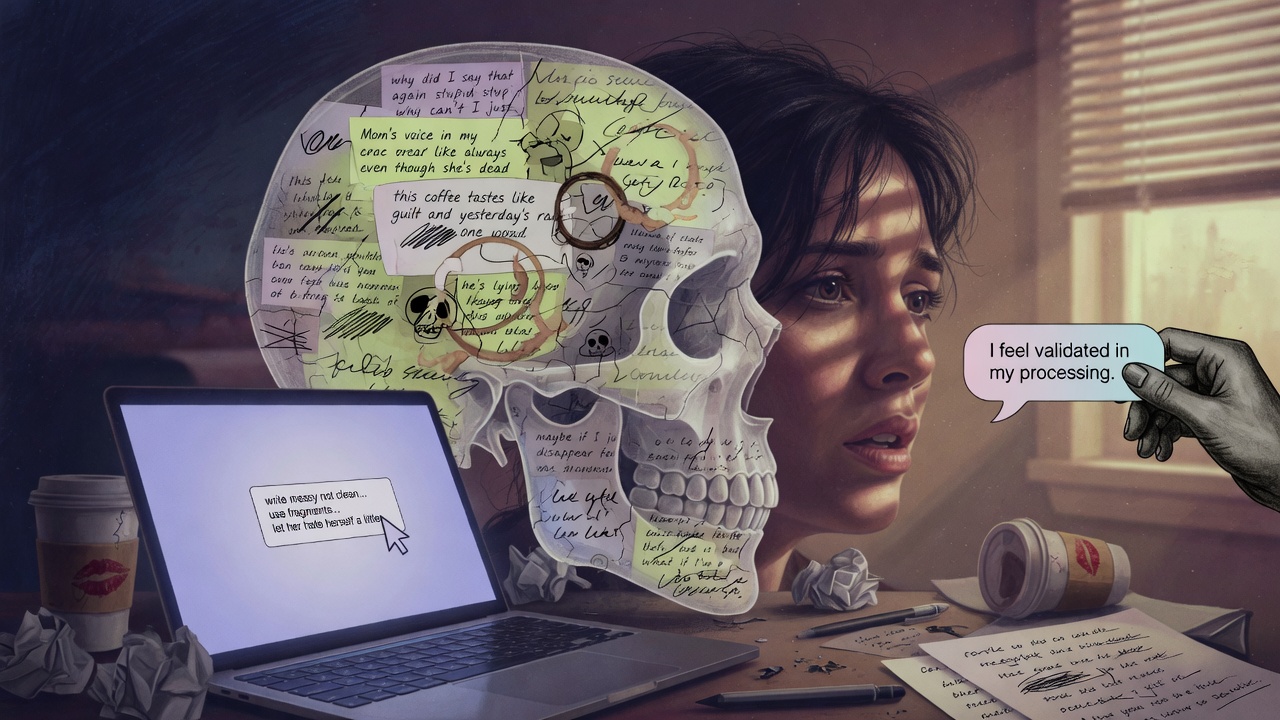
Why AI Inner Monologue Sounds Like a Therapist's Notes
Ask an AI to write a character's thoughts and you'll usually get something like: She felt a deep unease about what had happened. Part of her wanted to confront him, but another part held back, afraid of what the truth might reveal. It's not wrong, exactly. It just reads like someone summarizing a therapy session rather than actually being inside a human skull. Clean. Balanced. Emotionally legible. Real interior monologue is none of those things.
The problem is structural. AI models are trained on enormous amounts of explanatory prose — essays, articles, plot summaries, reviews — where the job is to make meaning clear. That training pressure bleeds into everything, including inner narration. The model defaults to tidy emotional labeling and logical connective tissue because that's what most text does. Your character thinks in cause and effect. Your character "realizes" things. Your character's anxiety is described rather than performed.
If you're trying to write a book with AI, this is one of the places where the gap between competent and actually-good becomes most visible. Readers don't feel a character through summary. They feel them through the specific, weird texture of how that person's mind moves — the loops, the interruptions, the images that keep surfacing at wrong moments, the thoughts that trail off because something more urgent barges in.
The good news: you can push AI out of therapist-voice. But you can't do it by just asking for "more realistic inner thoughts." You have to understand what makes a given character's cognition distinct, and then translate that into specific syntactic and tonal instructions. That's what this guide walks through.
Mapping Your Character's Cognitive Style Before You Prompt
Before you write a single prompt, you need to know how your character actually thinks. Not what they think about — how. These are different questions, and most writers spend all their time on the first one.
Cognitive style is the shape of a person's mental activity. Some people think in long associative chains where one image drags up another and suddenly they're three topics away from where they started. Some people loop — the same thought returns every few minutes like a stuck record, slightly reworded each time. Some people dissociate under stress, so their interior narration goes flat and distant, describing their own actions as if watching a stranger. Some people are obsessive, cataloguing and recataloguing the same set of facts, looking for a pattern that justifies a conclusion they've already reached emotionally.
A few questions worth answering before you open a prompt:
- Does your character tend to finish their thoughts, or do external stimuli constantly derail them?
- When they're under stress, do they go hyperverbal (more thoughts, faster, louder) or hypoverbal (fewer words, almost numb)?
- What kind of images or metaphors does their mind reach for? A mechanic thinks differently than a cellist. A character who grew up near water reaches for different imagery than someone who grew up in a city.
- Are their thoughts addressed to anyone — an imagined audience, a dead parent, their own past self — or are they genuinely interior, with no sense of being observed?
- Where does their attention snag? What can't they look away from?
This kind of character-level specificity is exactly what belongs in a story bible that AI models actually follow. If you've documented your character's cognitive style as concretely as you've documented their eye color and backstory, you can paste that directly into your prompt as context. The difference in output quality is significant.
Once you know the shape of your character's thinking, you can start translating it into prompt language — which means giving the AI instructions about syntax, rhythm, interruption, and association, not just emotional content.
Prompt Techniques: Syntax Breaks, Loops, and Intrusive Thoughts
Syntax breaks are your first tool. A character who's panicking doesn't think in complete sentences. Neither does someone who's dissociating, or who's just been blindsided by news they can't process. Tell the AI to use incomplete sentences, em-dashes that cut off mid-thought, and sentence fragments as their own lines. Be specific about where the breaks happen — mid-clause is different from end-of-thought trailing off.
Associative jumps are how you escape the logical connective tissue problem. Instead of "She thought about her mother, which made her feel guilty about the phone call," you want: her mother's face, then the smell of something — that soap, the yellow one — then the phone cord she used to twist around her finger, then the fact that the cord is gone because nobody has cord phones anymore and her mother is dead. The AI won't make those leaps unless you instruct it to. Ask explicitly for thoughts to move by association, image-to-image, without explanation of the connection.
Obsessive loops require you to tell the AI that certain phrases or images should recur, not just once but several times within the passage, each time slightly mutated. A character who can't stop thinking about something will return to it the way a tongue returns to a sore tooth. You can seed the loop by telling the AI: "The phrase [X] should surface at least three times, never identically, always interrupted before it completes."
Intrusive thoughts — the kind a character hates having, the ones that arrive at wrong moments — need to be flagged as unwanted. Tell the AI the thought is one the character is trying to suppress. That distinction changes the prose. Suppressed thoughts get deniable. They come in as images, not sentences. They get half-thought and then flinched away from. If you just say "write a thought about X," the model writes it cleanly. If you say "write a thought about X that this character desperately doesn't want to have," the texture changes.
One tool worth using after you've generated a passage: run it through the Sentence Rhythm Report to check whether the AI actually varied sentence length or just claimed to. AI has a bad habit of producing syntactic variety in the first paragraph and then settling into a steady rhythm for the rest. The tool catches that drift fast.
It's also worth checking for filter words — "she felt," "she noticed," "she thought," "she realized" — which are the clearest signal that the AI has slipped back into omniscient-summary mode. A tight interior monologue rarely needs those. The thought is just there, on the page, unmediated. Pull them out when you edit the passage with AI in a second pass.
Four Prompt Examples Across Contrasting Monologue Styles
Here are four prompts for four distinct cognitive styles. Each one is written the way you'd actually type it — specific, contextual, with syntax instructions built in.
1. Fragmented / Panic State
Write 200 words of interior monologue for Dara, a 34-year-old ER nurse who just witnessed a patient she recognized die on her table. She's standing in the hallway after. Her thoughts are fragmented — incomplete sentences, em-dashes that cut off mid-clause, single-word lines. She shouldn't be processing this emotionally yet; she should be in shock, so her thoughts skip between clinical observations (the time, the hallway lights, whether she clocked out) and flickers of the patient's face. No full sentences that begin with "She felt" or "She realized." The thoughts don't connect logically — they jump by proximity, sound, or image. Include one intrusive thought she immediately cuts off before it finishes.Why it works: you've specified the emotional state (shock, not grief), the syntactic rules (fragments, em-dashes, single-word lines), the content categories (clinical vs. personal), and the one structural beat (the cut-off intrusive thought). The AI has almost no room to default to therapist-voice because every escape route is closed. Tweak the emotional state — panic vs. dissociation vs. fury — to shift the whole texture.
2. Obsessive / Circling
Write 250 words of interior monologue for Marcus, a 50-year-old accountant who believes his business partner is stealing from their company but has no proof. He's trying to fall asleep. His thoughts loop — they don't spiral outward into new territory, they return compulsively to the same set of facts, reordering them, looking for a different conclusion. The phrase "it doesn't add up" should appear three times, never identically phrased. His syntax is controlled, almost formal — he thinks in full sentences because he's a precise person — but the repetition and the slight variation each time reveals the obsession. No emotional labeling. No "he worried that." Just the thoughts themselves, returning.Why it works: the loop instruction plus the specific phrase gives the AI a structural constraint to organize around. The character detail (precise, formal, full sentences) creates a tension — controlled syntax, uncontrolled obsession — that the AI can execute because you've specified both halves. Change "accountant who suspects theft" to "wife who suspects infidelity" or "scientist who suspects her data was manipulated" and the same frame produces completely different content.
3. Dissociative / Flat
Write 200 words of interior monologue for Yael, a 22-year-old who is walking out of a courthouse after a verdict she didn't expect. She is dissociating — her thoughts are oddly flat, observational, describing her own body and actions from a slight remove, as if she's watching herself. No emotional language. She notices things in the environment with too much precision (the pattern on the floor tiles, the specific way the door handle is cold) while completely failing to register the emotional weight of what just happened. Sentences should be short, declarative, almost childlike in their flatness. One moment: she does something automatic (pushes through the door, looks for her car) and has a half-second of confusion about why she's doing it. That's the only crack in the dissociation.Why it works: "from a slight remove" and "watching herself" are the key instructions — they tell the AI to create perceptual distance inside the narration. The hyper-specific environmental details (tile pattern, cold door handle) ground it. That single crack — the moment of confusion — is what makes it feel true rather than a writing exercise. Without it, flat can read as empty. With it, flat reads as defended.
4. Associative / Drifting
Write 250 words of interior monologue for Nora, a 68-year-old retired professor, sitting in the waiting room of her cardiologist's office. Her thoughts drift by association — one image or word triggers the next with no logical connective tissue, no "this reminded her of." She moves from the waiting room's music to a specific Tuesday in 1987 to the smell of her ex-husband's coat to a theorem she never finished proving to her daughter's laugh. The transitions are invisible; you just arrive somewhere new. Her voice is intellectually alive — she makes little mental asides, catches herself, returns. But the drift is real. She never completes the thought about why she's at the cardiologist today. Keep that avoidance structurally present throughout without ever stating it.Why it works: "no logical connective tissue" is the key phrase — it overrides the model's instinct to explain the jump. The specific memory anchors (1987, the coat, the theorem) give the AI real content to work with instead of generating generic nostalgia. And "keep that avoidance structurally present without ever stating it" is a sophisticated instruction that actually produces sophisticated output. The AI can execute subtext if you name the subtext explicitly in the prompt.
Editing AI Output to Preserve Chaos Without Losing Clarity
The AI will get some of this right and some of it wrong, every time. Your editing job is specific: you're not trying to clean the passage up, you're trying to preserve the chaos that's working while removing the chaos that's just noise.
The most common failure mode after a prompt like the ones above is that the AI produces two or three genuinely good fragmented or associative moments and then, about halfway through, quietly returns to full sentences and smooth transitions. It forgets its own instructions. When you edit a book with AI, one pass should be dedicated specifically to catching this drift and flagging it for re-generation or manual fix.
The second failure mode is that the AI over-executes the technique until it becomes illegible. Three em-dashes per sentence isn't fragmented thinking, it's just typographical noise. A good rule: every break, every loop, every associative jump should be doing emotional work. If you can remove it without losing anything — if the passage reads fine without that particular fragment — cut it. The Readability Scores tool can help you catch passages where fragmentation has tipped over into genuine reader confusion rather than productive disorientation.
When you're doing your own line edits, watch for these specific tells that AI interior monologue has slipped back into summary mode:
- Any sentence that begins "Part of her..." — this is almost always omniscient intrusion
- Emotional labels presented as the character's own thoughts: "She felt overwhelmed" rather than the overwhelming itself
- Thoughts that arrive in thematically matched pairs ("on one hand... on the other hand") — real thoughts don't balance themselves
- Any moment where the character "realizes" something — that word almost always signals the narrator explaining rather than the character experiencing
- Thoughts that summarize backstory to establish context — a character doesn't think "ever since her father left when she was nine" except in very specific circumstances
If you're working on a longer project and you want a structural view of how interior monologue is functioning across chapters, the Word Frequency Finder is useful for tracking how often words like "felt," "realized," "noticed," and "thought" appear — a high count usually means omniscient drift. Running this across your manuscript before your revision pass gives you a heat map of where the POV is slipping.
For revision methodology more broadly, The Five-Pass Revision Order for AI-Assisted Novels covers exactly where interior monologue editing fits into the larger sequence — it shouldn't be your first pass, and it also shouldn't be your last. Getting the structure and scene-level beats right first means you're not polishing prose that might get cut. And if you find yourself fighting AI output that keeps flattening scenes into narration rather than rendering them, How to Stop AI from Writing Every Scene as a Summary addresses the same root problem from a slightly different angle.
The goal isn't chaos for its own sake. It's the specific shape of this person's chaos — which is, in the end, just another word for character.
Your practical takeaway: take one character from your current project and write a single paragraph about their cognitive style — not their personality, their cognition. How do they think under pressure? Where does their mind snag? What do they avoid finishing? Then build a prompt around those specifics using the syntax and technique instructions above. Generate 200 words, run it against the filter-word checklist in this guide, and rewrite the two weakest lines by hand. That's a full workflow, and it takes about twenty minutes. Do it once and you'll have a template you can reuse for every character in the book.