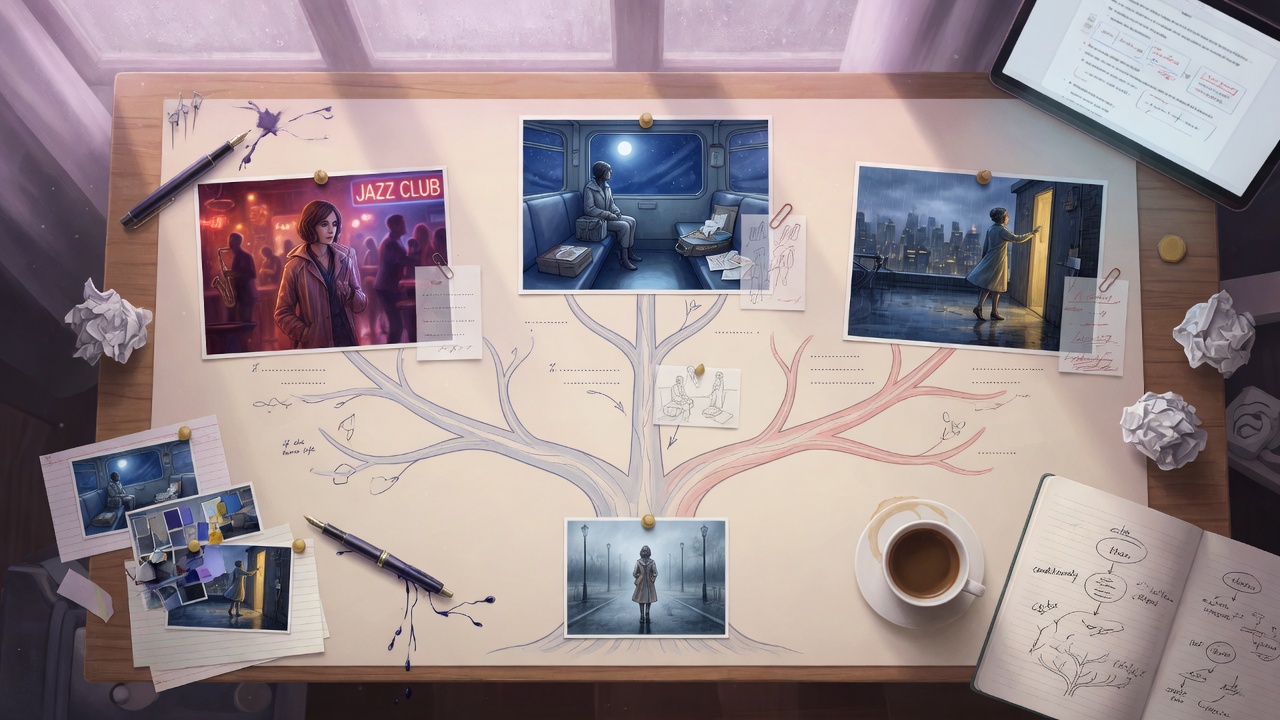
What Conditional Prompting Is (And Why Linear Prompts Miss It)
Most writers use AI the same way they'd use a typewriter with autocomplete — they describe what they want, the model writes it, and they either keep it or throw it out. That works fine for getting words on a page. But it completely ignores one of the most useful things AI can actually do for fiction: explore a decision point from multiple angles before you commit to anything.
Conditional prompting is the practice of building if/then logic directly into your prompt — you give the model a character, a situation, and two or more possible choices, then ask it to follow each branch forward. Instead of asking "write the scene where Maya confronts her brother," you ask "write the scene where Maya confronts her brother — once where she tells the truth, once where she lies." You get both. You compare them. You steal from both. You commit to one.
Linear prompts treat your story like it's already decided. Conditional prompts treat it like the living, forking thing it actually is during a first draft.
This matters more than people realize at the plot-hinge moments — the scenes where a character's choice will ripple forward for fifty pages. Get that choice wrong and you're not just fixing one bad scene; you're untangling a causality problem that runs through the whole second act. If you've ever spent an afternoon in revision wondering why a character feels weirdly passive, it's often traceable back to a decision scene where you picked the first draft version because you never explored the other options. Using AI to write a book with AI effectively means using it as a sandbox, not just a drafting engine.
The technique also pairs naturally with character work. If you're uncertain how a character would actually behave under pressure — which is the honest truth for most writers in the middle of a draft — conditional prompting lets you run the scene as a test. You're not writing the book yet. You're watching your character make a choice and seeing what that reveals. Think of it as a cheaper, faster version of the character interviews some authors do before they start drafting.
How to Structure an If/Then Prompt for a Decision Scene
The structure is simpler than it sounds, but the details matter a lot. A weak conditional prompt gives you two versions of the same bland scene. A strong one gives you genuinely different emotional trajectories — different body language, different subtext, different downstream implications.
You need four things in the prompt:
- The situation setup — where are we, who's here, what just happened in the scene before this one
- The decision point — the specific moment where the character's choice forks the story
- The branch conditions — clearly labeled IF A and IF B (or more), each with a specific, concrete action or choice
- The instruction to track consequences — you want the model to extend each branch past the choice itself, not just narrate the moment of choosing
That last one is the part most writers forget. If you ask for a conditional scene and don't specify that you want the branches to play out for a few paragraphs each, the model will often write two very similar versions that diverge only at the surface. Tell it to follow each branch through the immediate emotional and situational aftermath — what does the other character say? What does your protagonist feel thirty seconds after the choice? That's where the real difference lives.
Before you write a conditional prompt, it helps to have your scene's context organized. A Scene Planning Worksheet can clarify what your character wants, what they fear, and what's actually at stake — all of which feed directly into your if/then conditions. It's worth two minutes before you type the prompt.
You are helping me draft a scene for my psychological thriller. Here is the context:

SETUP: Detective Rena Vasquez has just found a partial fingerprint at the crime scene that matches her own partner, Cal. They're alone in the evidence room. Cal doesn't know what she found. Rena has to decide in this moment whether to confront him directly or hide what she knows and continue the investigation covertly.

CHARACTER VOICE: Rena is methodical and slow to trust, but she and Cal have eight years of history. She speaks in short sentences when stressed. She does NOT cry or show obvious emotion under pressure — she goes cold and clinical.

Write this scene TWICE:

BRANCH A (Confrontation): Rena tells Cal directly what she found. She watches his face. Write through Cal's immediate reaction and the last line of dialogue before one of them leaves the room.

BRANCH B (Concealment): Rena decides to say nothing. She pockets the evidence report. Write through her internal justification and the moment she says something mundane to Cal as a cover — show the specific mundane thing she says and what it costs her to say it.

Each branch should be 200–250 words. Keep Rena's voice consistent across both.
Why does this work? The specificity of "Cal doesn't know what she found" and "eight years of history" gives the model real tension to work with. The instruction to "write through to" a specific endpoint — Cal's reaction in Branch A, the mundane cover line in Branch B — forces the model to extend past the choice into the consequence. And the word count cap keeps both branches comparable in weight, so you're not comparing a fully developed scene against a sketch.
Tweak this template by changing the endpoint instructions for each branch. The more specific your "write through to this moment" instruction, the more useful the output will be.
Forking Prompts: Generating Two or Three Paths Simultaneously
Two branches covers most decision scenes. But sometimes a choice genuinely has three meaningful options — especially in character-driven literary fiction, or in genres where moral ambiguity is load-bearing. A character might confess, deflect, or attack. A character might stay, leave, or stay physically while emotionally checking out entirely. Don't force yourself into binary thinking just because if/then sounds like a coin flip.
Three-branch prompts take a little more care to structure, mostly because you want to avoid the model treating the third branch as an afterthought. The fix is to give Branch C its own specific beat instruction, just like you do for A and B. If you just write "and a third option," you'll get something weak. Name the third path clearly and tell the model exactly what emotional or situational note it should end on.
I'm writing a fantasy novel. Scene context:

Mira, a court mage who secretly can't cast anymore, has been asked by the king to demonstrate her power in front of the assembled court. She has three options in this moment.

WORLD CONTEXT: Magic in this world requires emotional openness — it's exhausting and exposing. Mira lost her ability six months ago after a trauma she hasn't told anyone about. She's been faking it with sleight-of-hand tricks.

BRANCH A (Performance): Mira attempts the demonstration using her hidden tricks. Write the moment of the trick working — but include one small detail that Mira notices, something that suggests someone in the court might have seen through it.

BRANCH B (Confession): Mira confesses to the king, quietly, before the demonstration begins. Write the king's face and his first three words to her.

BRANCH C (Collapse): Mira attempts to cast genuinely, hoping fear and desperation might unlock something. It doesn't work. Write her physical experience of nothing happening, and the exact sound the court makes in response.

250 words per branch. Third-person limited, close on Mira. Keep the prose register formal but emotionally precise.
Notice how Branch C has just as much mechanical specificity as A and B — "the exact sound the court makes" is a concrete endpoint, not a vague instruction. That one phrase tells the model you want sensory detail and social consequence, not just internal monologue.
If you're working on a fantasy setting and your world's rules are complex, spend time on your magic system constraints before writing conditional prompts involving powers. The guide on Fantasy Magic Systems: Constraints AI Will Respect covers how to build rules the model will actually honor — which matters when your branches hinge on what magic can and can't do.
One more practical note: three-branch prompts are longer and more cognitively demanding for the model. Not all models handle them equally well. If you're curious about which model gives you the cleanest multi-branch outputs, the best AI models for writing comparison covers this in useful detail.
How to Evaluate the Branches and Extract the Best Elements
Getting the output is the easy part. The harder skill — and the one that separates writers who improve with AI from writers who just generate more mediocre pages — is knowing what to do with two or three versions of the same scene.
Don't read the branches looking for a winner. That framing tricks you into a binary judgment that throws away useful material. Instead, read each branch looking for moments. A sentence. A physical detail. A piece of dialogue. Something that feels true to the character in a way that surprised you.
The best thing a branch can do is reveal something about your character you didn't consciously know before you ran the test.
Ask yourself these questions for each branch:
- Which choice makes the character more interesting — more complicated, more human, more specific?
- Which branch creates a better problem for the next scene to deal with?
- Is there a detail in Branch B that would actually strengthen Branch A if you transplanted it?
- Does one branch resolve tension in a way that deflates the story? (This one often disqualifies an otherwise well-written branch.)
- Which choice is harder for the character? (Often, but not always, the harder choice is the right one.)
You can also run a second-pass prompt asking the model to compare the branches analytically. This sounds strange — asking AI to critique AI — but it works well as a thinking aid when you're genuinely stuck. Keep the analysis prompt focused: ask it to identify what each branch implies about the character's core motivation, not whether the prose is better. The Beta Reader Workflow for AI-Assisted Manuscripts has a useful framework for structured critique that applies here too.
I've generated two versions of the same scene for my novel. Read both carefully.

[PASTE BRANCH A HERE]

[PASTE BRANCH B HERE]

Answer only these questions — no other commentary:

1. In Branch A, what does Mira's choice reveal about what she values more: her position or her honesty?
2. In Branch B, what does her choice reveal about the same question?
3. Which branch leaves the king as a more ambiguous figure — potentially threatening rather than simply kind?
4. Copy the single best sentence from each branch. Just the sentence, no explanation.
That last instruction — "just the sentence, no explanation" — is the most useful part of this prompt. You're harvesting specific material, not having a discussion about craft.
Collapsing Your Branches Back Into a Single Committed Scene
At some point you have to write the actual scene. Conditional prompting is a drafting tool, not a permanent state of indecision. Here's how to close the loop.
Take your chosen branch — the one whose choice you're committing to — and bring in the best specific details you harvested from the other branches. Rewrite the prompt as a synthesis instruction, telling the model which branch is the primary path, which details you're importing from the discarded paths, and what the committed scene needs to accomplish in terms of story function.
I'm now writing the final version of this scene. Here's what I've decided:

COMMITTED CHOICE: Branch B — Mira attempts to cast genuinely and fails publicly.

FROM BRANCH A, I want to import: the detail of the lord in the second row who leans forward slightly, which I'll use as the person who sees her fail most clearly.

FROM BRANCH B, I want the physical sensation Mira experiences — "her hands felt like wet paper" — which I'll adapt.

SCENE FUNCTION: This scene needs to end Mira's ability to keep hiding, and it needs to make the king's response genuinely ambiguous — we can't tell yet if he's angry or curious.

Write the committed version at 350–400 words. Third-person limited, close on Mira. Don't resolve the king's reaction — end on his face before he speaks.
This is where your characters get locked in. Whatever you've discovered about Mira through the branching process — her specific tells under stress, the way she thinks about the king — needs to be consistent from here forward. Running your committed scene through an character consistency check before moving on is smart practice, especially if you've been generating lots of exploratory drafts and your sense of the character has shifted.
After the scene is committed, update your story documentation. If you're keeping a proper story bible — and if you're writing anything longer than a short story you absolutely should be — record the choice your character made and why it matters. The guide on How to Build a Story Bible That AI Models Actually Follow explains what information actually needs to live in that document versus what you can leave out. Conditional prompting generates a lot of useful character insight, and most writers forget to capture it.
A note about revision: conditional prompts also work in the editing phase, not just first drafts. If you're revising a scene that isn't working and you can't figure out why, running the scene's central choice as an if/then prompt can reveal that the character made the wrong call — the call that resolved tension instead of deepening it. If you're working through a full edit, the The Five-Pass Revision Order for AI-Assisted Novels lays out when to deploy this technique within a structured revision process rather than just applying it ad hoc.
For writers working on romance, this technique is particularly useful at the commitment-avoidance beats that make or break a romance arc. Romance Beat Sheet: Where AI Drafts Usually Break maps exactly where those moments tend to collapse in AI-assisted drafts — and conditional prompting is one of the best tools for reinforcing them.
Here's the practical takeaway you should walk away with: pick one scene you've already written where the character's choice felt a little too convenient or a little too obvious. It's probably a scene where you took the first reasonable option and kept moving. Go back to it, extract the decision point, and run a two-branch conditional prompt — Branch A being the choice you made, Branch B being the choice that would cause more difficulty or complexity. Read both. Look for what the second branch reveals about who your character actually is. You don't have to change the scene. But nine times out of ten, you'll find at least one detail in Branch B that makes Branch A significantly better.