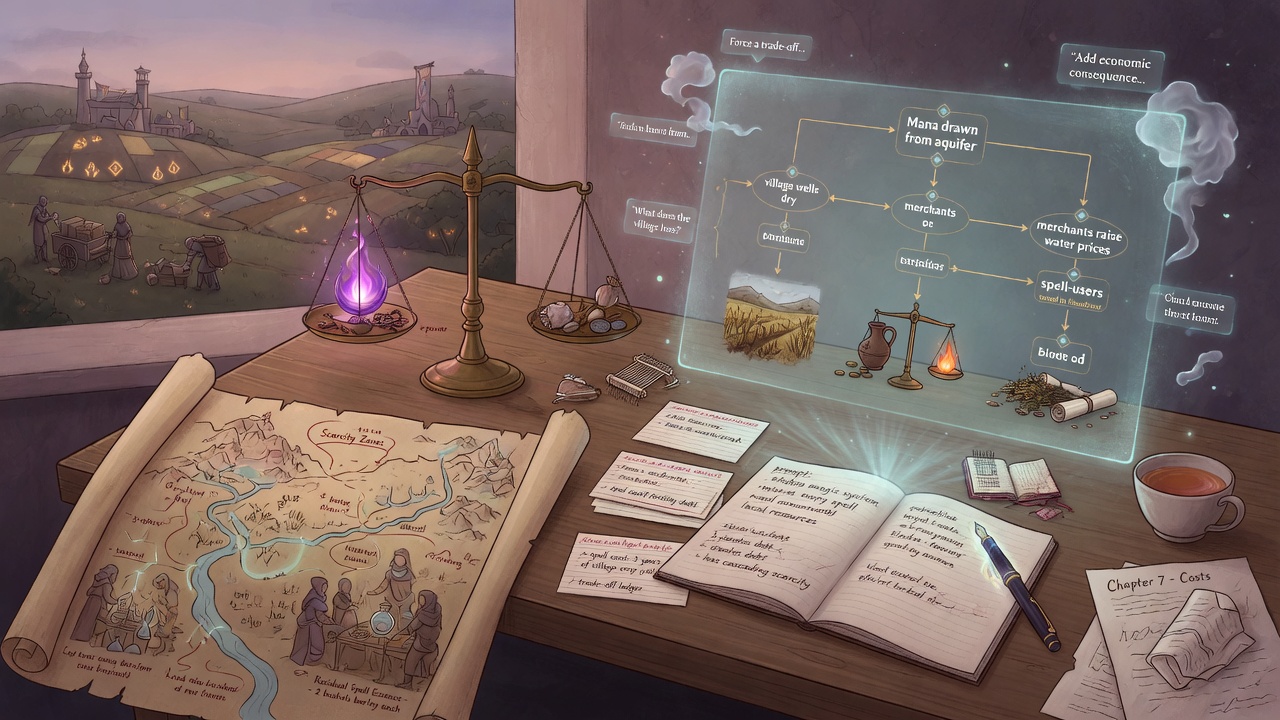
Ask most AI models to "invent a magic system" and you'll get something that sounds impressive for about thirty seconds. Elemental mages. Ancient bloodlines. A council of wizards who "guard the balance." It reads fine until you ask the one question that breaks it: what does this cost the person using it? Nine times out of ten, the answer is nothing. Magic in a lot of AI-generated fantasy behaves like an unlimited utility — turn the tap, get fire. That's not a system. That's a special effect.
Real economies have friction. Mining is dangerous. Labor is scarce. Someone controls the supply and someone else pays the markup. If you want your magic to feel load-bearing instead of decorative, you need to prompt for the friction on purpose, because the model won't volunteer it. This guide walks through how to push your AI past "cool powers" into something closer to a functioning market — raw materials, pricing, black markets, monopolies, and the loopholes that will eventually let a lazy plot cheat its way around all of it.
Why "soft magic" prompts default to vague, cost-free power
Soft magic systems — the Tolkien-and-Le-Guin style where magic is mysterious and rarely explained — work great in the hands of a writer who already knows the internal logic and is choosing not to show it. AI doesn't have that internal logic. When a model gives you vague magic, it's not being artistically restrained. It's filling space with the statistically likely fantasy tropes it's seen a thousand times: chosen ones, ancient prophecies, power that scales with emotion or willpower and nothing else.
The fix isn't asking the AI to be more creative. It's asking a narrower, harder question. Instead of "design a magic system for my world," try forcing an economic frame from the very first prompt. If you're starting a project from scratch, this is worth doing before you ever touch an AI book outline, because a magic system with real costs will shape your plot's inciting incidents, not just its set pieces.
I'm building a magic system for a low-fantasy trade-empire setting. Don't give me lore or aesthetics yet — I want the economics first. Define magic as a resource with these constraints: (1) it requires a specific, finite raw material that can be depleted, (2) using it imposes a real cost on the caster (physical, temporal, or social — pick one and be consistent), (3) it can be hoarded, stolen, or monopolized by an institution. Give me three different "fuel sources" for magic (not power types — fuel sources, like oil or grain) with a one-paragraph explanation of how each one is extracted, refined, and transported before a mage can use it.
Notice this prompt never mentions spells, wizards, or lore. It asks for infrastructure. That's the shift — you're commissioning a supply chain, not a power fantasy. For more on keeping the constraints themselves airtight once you've picked a direction, the guide on Fantasy Magic Systems: Constraints AI Will Respect goes deep on the kinds of rules models tend to forget three chapters later.
If a model can describe your magic without mentioning who pays for it, you don't have a system yet. You have a special effect.
Prompting AI to define magic's raw materials and who controls them
Every fuel source needs an origin story that isn't magical. Where does it come from in the dirt-and-labor sense? Who owns that land or that creature or that vein of ore? This is the point where your world starts resembling actual history — company towns, guild charters, colonial extraction — instead of a wiki page of spell names.
Push the AI to name specific controlling parties, not vague factions. "The Crown controls it" is a start; "the Salt Barons of the eastern delta hold a hereditary charter dating back three generations, and they set quotas twice a year" is a system. Specificity here pays off later when you need conflict — someone with a monopoly is a built-in antagonist, no extra plotting required.
My world's magic runs on "ember-glass," a mineral that only forms where lightning repeatedly strikes the same mountain range over centuries. Build out the control structure: who owns the extraction rights, how many active mining sites likely exist given the rarity, what the labor conditions are for the miners, and which single institution or family currently has the tightest grip on supply. Then tell me two ways that grip is currently being challenged — legally and illegally — as of the start of my story. Keep it grounded in logistics, not magic-plot-armor.
That last line — "keep it grounded in logistics" — matters more than it looks. Left alone, the model will want to resolve the control question with a magical solution (a prophecy, a hidden bloodline). You're explicitly asking for a mundane, structural answer: cartels, trade routes, corrupt inspectors. This is also a good moment to lean on your How to Build a Story Bible That AI Models Actually Follow setup, dropping the finalized control structure in as a hard fact so later chapters don't accidentally invent a second, contradictory supply chain.
Building a price table: what a spell costs in labor, time, or risk
Here's where a lot of writers stop short. They'll establish that magic costs something in the abstract — "it drains you" — but never pin down a number. Numbers are what make an economy feel real, even if you never print them on the page. Once you know that healing a broken leg costs three days of the healer's stamina and a fist-sized chunk of ember-glass worth roughly two months' wages for a laborer, you suddenly know things about your world you didn't before: who can afford to get magically healed, who has to set the bone the old way, and why a black-market healer operating out of the docks might charge less but leave scarring.
Ask the AI to build an actual table. Tables force consistency in a way prose descriptions don't — the model can't hand-wave a cost when it has to fill in a cell.
Build a price table for common spells in my setting, using ember-glass as currency plus labor-hours from a licensed mage. Include columns for: Spell/Effect, Raw Material Cost (in ember-glass grams), Caster's Physical Toll (recovery time), Market Price (in silver marks, assuming 1 gram of ember-glass = 40 marks), Legality (licensed / gray market / banned), and Risk of Backfire (%). Give me at least eight entries ranging from trivial household magic to battlefield-level spells. Make sure the price scales logically — nothing battlefield-tier should be cheaper than something trivial.
Run this early, before you draft scenes that involve magic changing hands. It'll surface inconsistencies fast — you'll notice if "trivial household magic" somehow costs more than "raising the dead," and you can correct the underlying logic before it's baked into forty thousand words. If you're writing something closer to progression fantasy or LitRPG writing, this table basically becomes your stat system — treat it with the same rigor you'd give character leveling, because readers of that genre will absolutely notice if the numbers don't hold.
Using AI to trace how scarcity creates black markets and monopolies
Once you know what magic costs and who controls the supply, the next question writes half your subplots for you: what happens when the supply gets squeezed? Wars disrupt trade routes. A mine collapses. A rival house buys up the harvest to corner the market. Scarcity isn't just a worldbuilding detail — it's a plot generator, and AI is genuinely good at this part if you ask it to think like an economist instead of a fantasy author.
The trick is asking for downstream effects, not just the shortage itself. A shortage is boring on its own. What's interesting is the smuggler who springs up to fill the gap, the noble house that starts stockpiling in secret, the counterfeit ember-glass flooding poorer districts and causing spells to misfire.
Three years before my story begins, a border war cut off 60% of the ember-glass supply from the eastern mines. Trace the economic ripple effects in detail: how did the licensed mage guild respond (price controls, rationing, favoritism toward wealthy clients)? What did the black market look like — who are the smugglers, what routes do they use, and what's the going rate for illegal ember-glass compared to legal? Also give me one monopolist who benefited enormously from the shortage and is now quietly working to make sure the supply never fully recovers, plus the specific method they use to suppress competition.
That last request — a monopolist actively working against recovery — is the part that turns a worldbuilding exercise into an actual villain with motive. Suddenly your antagonist isn't evil because the plot needs one; they're rational, self-interested, and protecting a revenue stream. That's a much stickier kind of conflict than "dark lord wants power." If your story spans multiple books, get this locked into a proper Series Bible Template entry — economic arcs like a slowly recovering (or worsening) shortage need to track consistently across a series in a way that's easy to lose without a reference doc. The Proper Noun Extractor is also worth running once you've named guilds, currencies, and smuggling routes — it's an easy way to catch it when the AI quietly renames "ember-glass" to "emberglass" four chapters later.
Stress-testing your system: asking AI to find the economic loophole your plot relies on
This is the step almost everyone skips, and it's the one that actually matters most. You've built the supply chain, the pricing, the black market. Now go back to your plot and ask the AI to be adversarial about it — to find the moment where a character uses magic in a way your own economy can't actually support.
This usually happens in climaxes. A character conveniently affords an expensive spell they shouldn't be able to afford, or performs three days' worth of magical toll in a single scene with no consequence, or a villain's monopoly gets undone by a heartfelt speech instead of an actual market mechanism. These are the seams readers who like systems will find immediately, and they're worth catching before a beta reader does.
Here's my climax summary: [paste 200-300 word scene summary]. Using the economic rules we established — ember-glass pricing, the caster's physical toll, the guild's rationing system, and the current black-market rates — find every place where a character uses magic in a way the economy doesn't support. Be specific: name the character, the spell, and exactly which rule they're breaking (affordability, physical recovery time, access/legality, or supply availability). Then suggest one fix for each that doesn't require rewriting the whole scene.
Treat this like an audit, not a creative brainstorm — you want the model hunting for contradictions, not generating new ideas. This pairs naturally with The Five-Pass Revision Order for AI-Assisted Novels, since economic-consistency checks fit neatly into a dedicated continuity pass rather than getting mixed in with line editing. It's also worth running your cast through an character consistency check at the same time — a character who suddenly has access to rationed materials needs a reason on the page, not just in your head.
One more place this stress-testing pays off: fight scenes and heist sequences where magic gets used under pressure. If a caster is burning through expensive, rationed materials mid-combat, the scene needs to track both the physical space and the dwindling resource at once. The guide on How to Use AI to Choreograph Fight Scenes Without Losing Track of Space is worth pairing with your price table when you're blocking out a battle where magic runs out mid-fight — that's usually where the tension actually lives.
None of this requires you to become an economist or fill your manuscript with spreadsheets readers never see. Most of this work stays invisible on the page — a reader doesn't need the ember-glass price table, they just need to feel that the healer hesitated before spending three days of her strength on a stranger. That hesitation is the whole payoff. It's the difference between magic as wallpaper and magic as a system with weight.
If you're starting a new fantasy project, don't build the map first. Build the price table first. Run the four prompts above in order — materials and control, pricing, scarcity effects, then the adversarial stress-test — before you write a single scene involving magic changing hands. You'll end up with a world where every spell has a shadow cost, and a villain whose monopoly makes sense without a single line of expository dialogue.