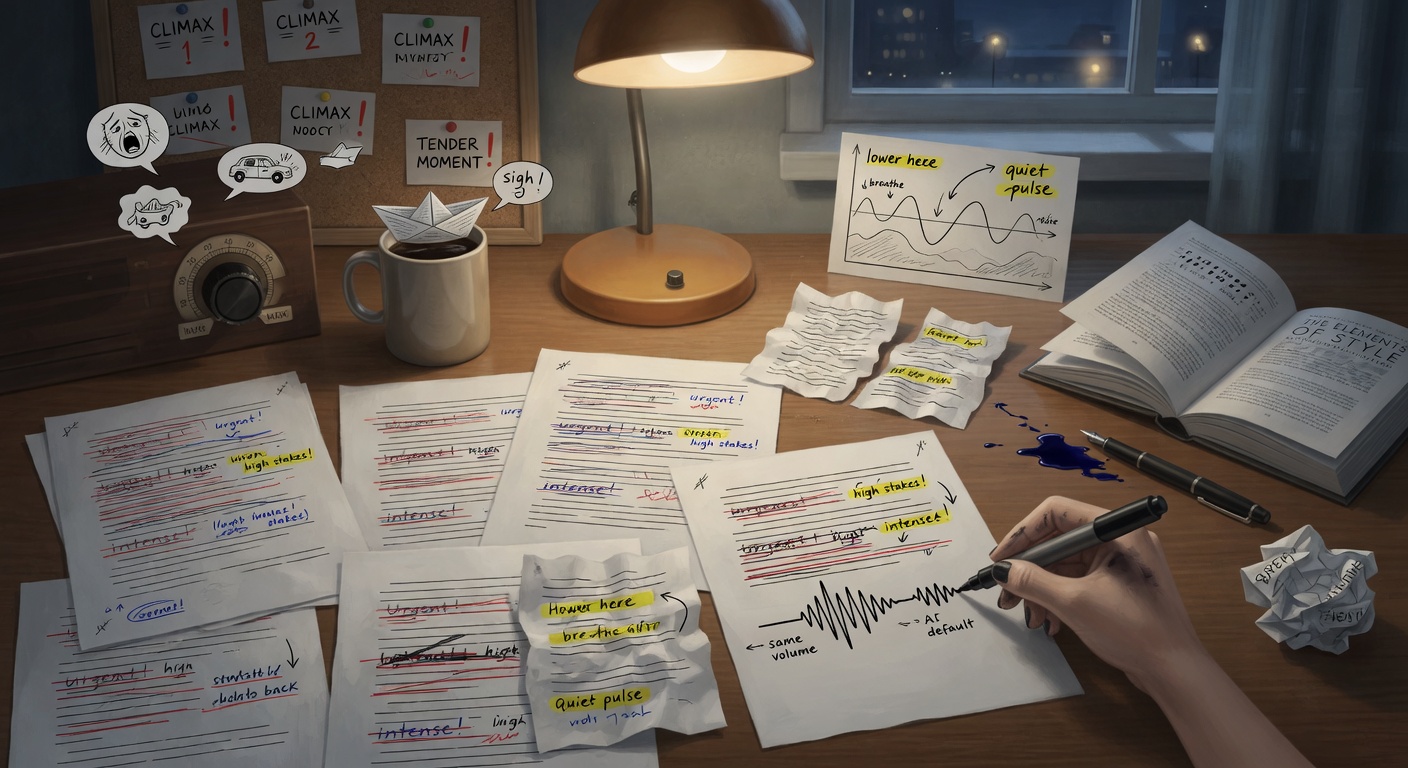
How to Stop AI from Writing Every Scene at the Same Volume
Read a few hundred pages of pure AI-generated fiction and you'll notice something uncomfortable: it never shuts up. Not literally — the words stop and start like they should — but emotionally, the prose never drops below a certain intensity. Every scene is urgent. Every conversation crackles. Every description carries this low hum of significance, like the narrative is constantly leaning forward in its seat, gripping your arm, saying this matters, this matters, this matters.
That's volume flattening. And it kills books.
Real narrative momentum isn't about sustained intensity — it's about contrast. The quiet scene before the explosion. The ordinary Tuesday morning three pages before the diagnosis. The almost-boring drive home after a first date that went perfectly. Those low-volume moments are load-bearing walls. Without them, your dramatic scenes have nothing to crash against, and readers go numb fast.
AI doesn't naturally build this contrast because it's optimized to produce engaging, well-crafted prose — and "engaging" gets interpreted as emotionally present, rhythmically alive, and narratively forward-moving at all times. The result is fiction that reads like a movie trailer stretched to feature length. You need to intervene deliberately, and this guide will show you exactly how.
Why AI Defaults to Constant High-Pitch Prose
The core problem isn't that AI writes badly. It's that AI writes consistently well in a way that human writers can't sustain — and shouldn't try to. Human writers get tired. They write transitional scenes that feel looser, more meandering. They write a chapter where nothing much happens and the prose reflects that. Those "imperfections" create the valleys that make your peaks feel like peaks.
AI has no such fatigue. Ask it to write a scene and it will produce something polished, purposeful, and emotionally textured every single time. The detective noticing a clue carries the same weight as the detective watching her mother die. The character eating breakfast gets the same careful interiority as the character deciding to leave her husband. Everything is equally observed, equally rendered, equally meaningful-feeling.
Volume flattening isn't a bug in how AI writes individual scenes — it's a feature of how AI approaches each scene in isolation, without awareness of the emotional arc it sits inside.
This is the key insight. AI doesn't hold your entire manuscript in mind the way you do. Even with good context, it's responding to the immediate prompt, not to the felt sense of where your story is in its emotional journey. It doesn't know that the reader just survived a brutal chapter and needs to breathe. It doesn't know this is the calm before the storm. You have to tell it — and more than that, you have to know what "calm before the storm" actually looks like at the sentence level.
How to Diagnose Volume Flattening in Your AI Draft
Before you can fix the problem, you need to see it clearly. The tricky part is that flattened prose doesn't feel obviously wrong when you're reading individual scenes. Each one seems fine. It's only when you step back that the sameness becomes visible.
Here's a practical diagnostic: go through your draft and mark every scene with a number from 1 to 10 based on emotional intensity. A 10 is your climax — the scene where everything breaks open. A 1 is a scene where your character makes coffee and thinks about something minor. Most of your story should live in the 3-7 range, with clear movement up and down.
If your marks cluster between 6 and 8 across fifty pages, you have a volume problem.
Look for these specific symptoms in the prose itself:
- Loaded verbs in neutral moments — "She seized her coffee mug." "He confronted the refrigerator." When ordinary actions get dramatic verbs, everything sounds urgent.
- Interiority in every beat — AI loves to give characters a thought or emotional reaction after nearly every action. In quiet scenes, this creates a sense of constant psychological pressure that shouldn't be there.
- Rhythmic consistency — Read your draft aloud. If the sentence rhythm doesn't change much between a fight scene and a walk in the park, that's a signal.
- Over-meaningful description — "The autumn leaves reminded her of endings." In a low-volume scene, leaves can just be leaves.
You might also ask the AI to help you diagnose. Paste in a ten-page stretch and ask: "Which scenes in this passage feel emotionally quiet, and which feel high-intensity? Rate each on a scale of 1-10 and explain your reasoning." The response will often reveal the flattening clearly — when everything comes back a 6 or 7, you know what you're dealing with.
The Contrast Prompt Method: Cooling Scenes Down Deliberately
Contrast prompting is the practice of explicitly naming the emotional temperature you want before asking AI to write anything. This sounds obvious, but most writers don't do it — they just describe what happens in a scene, not how loud it should be.
The difference looks like this. A standard prompt might say: "Write a scene where Marcus and his father have dinner the night before Marcus leaves for the military." A contrast prompt adds the volume instruction: "Write this as a deliberately low-key scene — subdued, almost mundane. The emotional weight should be buried under surface-level conversation about food and weather. No big speeches, no teary moments. The significance should only be visible in small physical details and what they don't say."
That second version gives AI something it doesn't generate on its own: permission to be quiet.
Write a scene where Elena cleans out her late mother's kitchen. Keep the emotional temperature deliberately low — almost flat. She's not crying, she's not having revelations. She's just sorting through Tupperware and deciding what to keep. The weight of grief should be in the mundane details themselves: the handwriting on a label, a smell, the specific brand of dish soap her mother always bought. No internal monologue about loss. No symbolic moments. Just the work of a Tuesday afternoon, written plainly.
This works because it tells the AI what not to do as much as what to do. "No internal monologue about loss" shuts down AI's default impulse to process every moment emotionally. "Just the work of a Tuesday afternoon" gives it a tonal anchor. You're essentially asking it to underwrite, which runs against its training, so you have to be explicit.
Tweak this by swapping in your character and situation, but keep the structural instructions: name what emotions to suppress, give a mundane action as the anchor, and forbid the symbolic reach.
Rewrite this scene at half the emotional volume. The current version feels too urgent — every line is carrying weight. I want this to feel like a scene where nothing important is happening, even though important things are about to happen. Flatten the prose rhythm. Use shorter, simpler sentences. Cut the loaded verbs and replace them with neutral ones. The character can notice things, but shouldn't interpret them. Show me the rewrite.
This is useful when you already have a draft you want to cool down. "Half the emotional volume" is a concrete instruction AI can actually follow. Asking it to "make this more subtle" usually just produces the same scene with slightly softer adjectives. Framing it as a volume dial gets better results.
Prompting Quiet Scenes That Do Real Narrative Work
Low-volume doesn't mean low-purpose. This is the thing writers sometimes resist — they feel like a quiet scene is wasted space, so they keep cramming in significance. But quiet scenes carry narrative weight in specific, structural ways that high-intensity scenes can't.
They establish baseline normal, so deviation reads as deviation. They let readers rest and absorb. They build character through ordinary behavior — how someone moves through a kitchen tells you things a dramatic monologue never could. And they create the contrast that makes your peaks feel like peaks.
When you're prompting these scenes, give the AI a purpose beyond "this is quiet." Be specific about what narrative function the scene serves:
Write a scene of about 400 words: Jonah's morning routine before the trial begins. The purpose of this scene isn't to show his anxiety — I have other scenes for that. The purpose is to show what "normal" looks like for him, so readers understand later what he's lost. He makes coffee badly, the same way he always does. He has a specific, slightly eccentric habit (you choose something believable for a 50-year-old defense attorney). Keep the prose observational and spare. This scene should feel like a Tuesday in March, not a day that changes everything.
Notice the instruction "the purpose of this scene isn't X — I have other scenes for that." This reorients the AI away from over-serving the obvious emotional beat. You're essentially giving it a narrow job: establish normal. Let it do that job without reaching for more.
Also worth noting: "you choose something believable" is a useful delegation. AI is actually good at inventing small, specific character details — the bad coffee habit, the particular way someone stacks dishes. These organic details often feel more alive than ones you'd laboriously invent yourself. Let it contribute that texture while you control the volume.
Building a Volume Map to Guide Your AI Scene by Scene
The most durable solution isn't fixing scenes after the fact — it's having a volume map before you start generating anything.
A volume map is exactly what it sounds like: a scene-by-scene or chapter-by-chapter outline that includes an intensity rating alongside the plot information. Most writers already have some version of a chapter outline. This just adds one column.
Your volume map might look like:
- Ch 1, Scene 1 — Maya arrives in town. Meets neighbor. [Volume: 2 — establish normal, light tone]
- Ch 1, Scene 2 — Maya finds the letter. [Volume: 7 — shock, but controlled. No hysteria.]
- Ch 2, Scene 1 — Maya at work, distracted. [Volume: 3 — low, she's suppressing]
- Ch 2, Scene 2 — Phone call with sister. [Volume: 5 — tension under the surface, neither says the real thing]
When you bring this to AI, paste the relevant context each time you generate a scene, including the volume number and what it means for that specific moment. This prevents the AI from treating every scene as if it's starting fresh at its default intensity level.
I'm writing Chapter 3, Scene 2 of my novel. Here's the context: the previous scene (volume 8) was the confrontation between Priya and her brother where she found out about the money. This scene (volume 2) takes place the next morning. She's at work. Nothing dramatic happens. Her volume rating is 2 — she's gone quiet and functional, which is how she handles shock. She's not thinking about the confrontation. She's doing her job. Write 350 words. Prose should be clean, efficient, almost affectless — matching her psychological state. No reflection on last night. No foreshadowing. Just a woman at work on a Wednesday.
The phrase "her volume rating is 2 — she's gone quiet and functional, which is how she handles shock" does something important: it connects the volume level to character psychology. AI doesn't think in terms of narrative pacing, but it does respond to character motivation. If you explain why the character is at low volume, the prose reflects that more naturally than if you just say "write this quietly."
Build your volume map before you start generating, and you'll spend dramatically less time going back to cool scenes down. The map also helps you see where you're missing contrast — if you notice five scenes in a row rated 7 or above, you know to add a quiet bridge before the next one, not after.
One Practical Thing to Do Right Now
Take whatever chapter you're currently working on — or the most recent AI-generated stretch you have — and do the rating exercise. Go scene by scene, assign a number from 1 to 10, and write it in the margin. Don't second-guess your instincts. Just mark what the scene feels like at a gut level.
If the numbers don't move around much, you've found your problem. Pick the scene that should be lowest on your map and rewrite it using the contrast prompt method: name what emotion to suppress, give a mundane anchor action, and explicitly forbid the symbolic reach. Compare the two versions.
That one rewrite will teach you more about volume control than anything else in this guide — because you'll feel the difference when a scene finally gets to be quiet, and you'll start to see everywhere else in your draft that needs the same permission.
Try it yourself
Write your own book with AI — free, no credit card required.
Free · No credit card