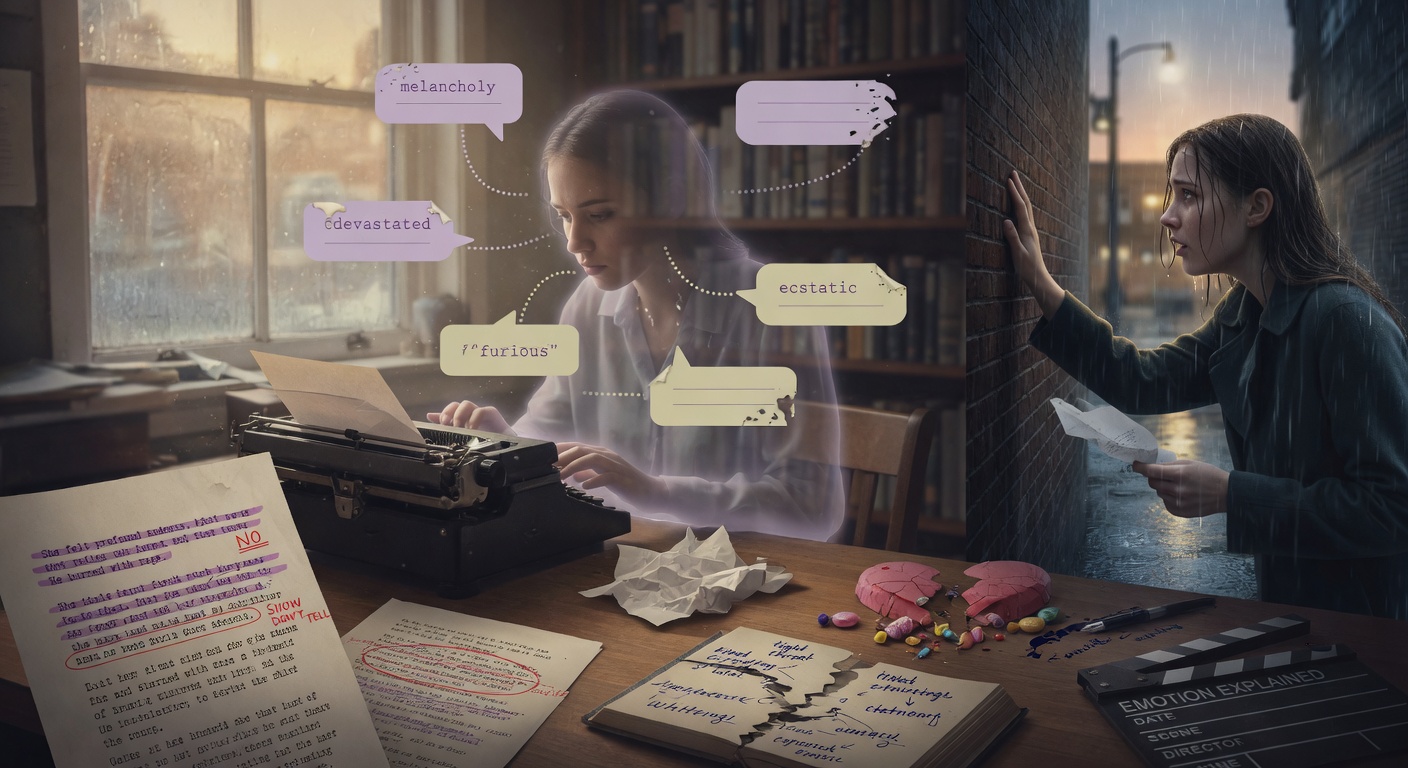
AI will tell you your character is devastated. It will tell you she's nervous, conflicted, hopeful, furious. It will hand you sentences like "He felt a wave of guilt wash over him" with the confidence of someone who thinks they've nailed it. And the maddening part? The AI isn't wrong about the emotion. It's just skipping straight to the label instead of earning it.
This is one of the most consistent problems writers run into when drafting fiction with AI — not that the AI misreads the emotional moment, but that it reports it like a journalist instead of rendering it like a novelist. Understanding why this happens is the first step to fixing it, and fixing it is surprisingly learnable once you know what to look for.
Why AI Is Hard-Wired to Tell, Not Show: The Pattern Behind the Problem
Language models are trained on enormous amounts of text — and a huge chunk of that text is non-fiction. Articles, forums, Wikipedia entries, news stories, self-help content, psychology explainers. In all of these, saying "she was anxious" is perfectly correct. Direct emotional labeling is efficient in most writing contexts. The problem is that fiction — specifically, literary fiction — operates on a completely different contract with the reader.
When a reader trusts a novel, they want to feel the character's anxiety through the drumming of fingers on a steering wheel, the third time checking the same email, the way a laugh comes out half a second too late. They don't want to be told. But AI defaults to the efficient, non-fiction approach because it dominates the training data.
The AI isn't being lazy. It's doing what most text it was trained on actually does. Your job is to redirect it toward the minority of text that does something harder.
There's also a structural reason. When AI is generating prose scene by scene, it wants to stay coherent — it wants to make sure you know what the character is feeling so the scene tracks. So it over-explains. It treats the reader like a collaborator who needs to be briefed, not an audience who needs to be moved. That instinct toward clarity produces emotional exposition almost automatically, unless you push back on it directly.
Spotting Emotional Exposition in Your AI Draft: A Self-Audit Checklist
Before you can fix the problem, you need to see it clearly. And once you know the patterns, they're everywhere. I've started doing a quick pass on every AI-generated scene before I do anything else, just hunting for these specific constructions.
The Feeling Verb
Any sentence that starts with or hinges on "felt," "felt like," "felt a surge of," "felt her heart" — these are almost always emotional exposition. "She felt relief flood through her." Cut it. What does relief look like in her body? Does she let go of something she's been gripping? Does she sit down slowly, like her legs just remembered they're tired?
The Emotion Noun Drop
Watch for sentences where the emotion is named as a noun and handed to the reader: "Guilt settled in his chest." "A wave of panic." "Sadness washed over her." These have the rhythm of showing because they use physical imagery — waves, settling, washing — but they're still labeling the emotion directly. The noun is doing the work that behavior should be doing.
The Thought Report
"He knew this was wrong." "She realized she still loved him." "He understood then that he'd made a mistake." These report on the character's internal conclusions instead of dramatizing the moment of arrival. They tell you the destination without taking you on the journey.
The Adverb-Emotion Combo
"She smiled sadly." "He laughed bitterly." "She nodded, feeling defeated." The adverb is trying to carry emotional weight that a physical detail or a line of dialogue should be carrying instead.
Run any AI-generated scene through these four filters. If you find more than two or three in a 500-word passage, the scene needs an externalization pass before anything else.
The Externalization Prompt Framework: Bodies, Objects, and Behavior
The core move here is simple to describe, harder to execute: you want to push emotion outward — into the character's body, into the physical objects they interact with, and into behavior that the reader can watch like a camera. This is what "show don't tell" actually means in practice, and it's a principle you can bake directly into your prompts.
The Body Prompt
The human body is spectacularly expressive and AI can write it well when instructed to. The key is being specific about which emotion you're externalizing and asking for involuntary physical response rather than performed gesture. A character who is scared might consciously cross their arms — that's a gesture. But their throat going dry, their peripheral vision narrowing, their sentence stopping mid-word — those are involuntary, and they hit harder on the page.
When you prompt, ask for the body's response, not the character's feelings. There's a meaningful difference between "write a scene where Marcus feels ashamed" and "write a scene where Marcus's body registers shame — focus on what happens to his posture, his voice, where his eyes go."
The Object Prompt
Object interaction is one of the most underused tools in AI-assisted fiction, and it's devastatingly effective when done right. Characters reveal emotion through how they handle things. A grieving person might rearrange objects on a shelf unnecessarily. An angry person might fold laundry with unusual force. A person avoiding a conversation might become very interested in cleaning something.
When you prompt AI to put a character in an emotionally charged scene, give them something to do with their hands. Give them a prop and ask the AI to use the character's relationship with that object to carry the scene's emotional weight.
The Behavior Prompt
Behavior is the widest category: what does the character actually do? What do they say — and what do they conspicuously not say? How do they move through the space? Do they sit when they should stand, stand when they should sit? Emotional states dictate physical behavior in ways that readers recognize instinctively. Prompt AI to dramatize the behavior and let the reader name the feeling themselves.
The reader completing the emotional equation is the whole point. "He was furious" ends the reader's engagement. A character who speaks very quietly and very precisely while something behind his eyes goes still — that starts it.
Four Prompt Examples That Replace Stated Emotion with Scene Evidence
Here's where the rubber meets the road. These are prompts you can adapt directly — they're written for specific fictional situations, which is what makes them actually useful.
Rewrite the following paragraph without using any emotion words or feeling verbs. The character, Dana, is experiencing grief after hearing about her mother's death. Instead of naming or describing her feelings, show only: what she does with her body in the next sixty seconds, one object in the room she interacts with, and one sentence she says aloud that doesn't mention grief at all. Here's the paragraph to rewrite: [paste paragraph]
This works because it gives AI three concrete lanes to work in — body, object, dialogue — and explicitly bans the shortcut (emotion words). The instruction "one sentence she says aloud that doesn't mention grief" is the key constraint: it forces oblique communication, which is how people actually talk when they're devastated. Tweak the emotion, the character name, or swap "sixty seconds" for a longer beat if you want a fuller scene.
Write a scene where two characters, Jules and Marco, have an argument that ends with Jules leaving the room. Jules is the one who is wrong and knows it, but doesn't admit it. Do not write Jules's internal thoughts or name his emotional state at any point. Show his wrongness and his awareness of it only through: the specific words he chooses (or avoids), how he physically exits — pace, what he does with the door, whether he looks back — and one physical detail about his face or hands during the argument.
This prompt is valuable because it handles a dramatically complex emotional state — knowing you're wrong but refusing to concede — without letting AI retreat into "Jules felt a surge of shame but couldn't bring himself to say so." The three specifics (word choice, physical exit, face/hands) give the AI a scaffold to work from. You can use this structure for any scene where a character is concealing something they feel.
The character Nora is sitting alone in her car outside her childhood home before going inside for the first time in eleven years. She is nervous but also wants to seem brave to herself. Write 200 words from her POV — close third person — that contains zero instances of the words: nervous, anxious, afraid, scared, brave, courage, or any synonyms for these. Focus entirely on what she notices outside the windshield, what she does before opening the door, and one involuntary physical response her body has without her permission.
The banned word list is the engine of this prompt. AI will naturally reach for the synonyms first — anxious, apprehensive, uneasy — so making those off-limits forces it into sensory and behavioral territory. "One involuntary physical response her body has without her permission" is a framing I use constantly because it signals to the AI that we want authentic physical response, not performed emotion. Try this with any emotionally loaded threshold moment: first days, returns, waiting rooms, doorways.
Rewrite this dialogue exchange so that the reader can tell Character A is in love with Character B, but Character A never says so and neither character discusses feelings directly. The subtext should live entirely in: what Character A offers to do (action, not declaration), the one moment Character A stops talking mid-sentence and why, and one small specific thing Character A notices about Character B that no one else in the room would notice. Keep the dialogue realistic — people in love don't speak in poetry. Here's the original exchange: [paste dialogue]
Love is one of the emotions AI most reliably over-explains. This prompt handles it by treating subtext as a structural problem: where does it live, specifically? The three locations (offered action, interrupted sentence, hyper-specific noticing) are borrowed from how good literary novelists actually write romantic subtext. The reminder that "people in love don't speak in poetry" keeps the AI from going lush when it should go quiet.
Building a Rewrite Habit: Catching Emotional Tells Before They Settle
The prompts above are powerful, but they're most useful when they become a habitual part of how you work with AI — not a rescue operation you run when a scene feels flat.
The best workflow I've found is to draft freely with AI first and then run a targeted rewrite pass. Don't try to prompt perfectly on the first generation. Let the AI get the emotional content down — even if it's told, not shown — because that gives you the raw material. Then go back with a specific rewrite prompt that targets the exact problem passages.
Build yourself a personal checklist for this pass. Mine has three questions:
- Is there a feeling verb in this paragraph? If yes, what's the behavior or physical response I can swap it for?
- Is the character just standing there feeling things? Give them something to do. What's in the room? What do their hands need to be doing?
- Could I film this sentence? If a camera couldn't capture it, it's probably interior telling. Translate it into something visible.
That last question — could I film it — is blunt but it works. "She felt the weight of everything she hadn't said" cannot be filmed. "She picked up her keys, put them down, and picked them up again" can be filmed, and it carries the same emotional information without explaining it.
One more thing worth building into your habit: create a personal "emotion translation" document. When you catch a good piece of externalization — either something you prompted successfully or something you found in a novel you admire — save it. Not as a template to copy, but as a reference for the type of move being made. Over time you'll develop a library of approaches: this is what avoidance looks like in behavior, this is what grief looks like in object interaction, this is what suppressed anger sounds like in dialogue. That library becomes the intuition you bring to your prompts.
The single most practical thing you can do today: take one AI-generated scene you've written recently, run it through the four-filter audit above, and pick the worst offender — the sentence most guilty of flat emotional labeling. Then write a targeted rewrite prompt for just that sentence. Not the whole scene. One sentence. Make the AI show you what that sentence could be if it trusted the reader to feel it instead of being told.
Do that enough times and you stop needing to fix it in rewrites. You start prompting for externalization from the start, because you've trained yourself — and the AI — to understand that showing is a craft problem with a craft solution, not a vague principle that sounds good in a workshop.