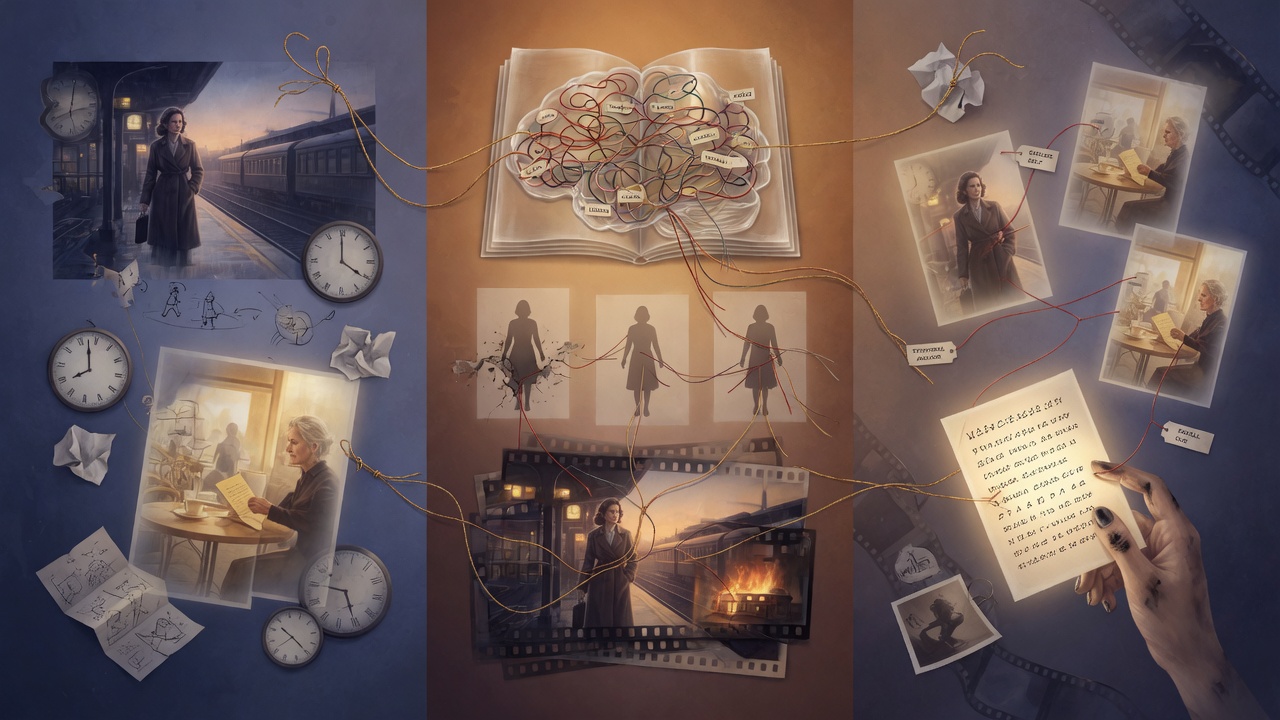
Nonlinear storytelling is one of the hardest structural challenges in fiction — and it turns out it's also one of the fastest ways to expose the limits of any AI writing model. When you're writing a story that jumps between timelines, plants a flash-forward in chapter one that pays off in chapter twenty, or braids three separate eras together through a single recurring object, you need the AI to hold a lot of complex temporal information in its head simultaneously. Most of the time, it doesn't.
I've spent weeks running structured tests across Claude, GPT-4, and Gemini, using identical prompts across three distinct nonlinear structures: flash-forward/flash-back anchoring, braided timelines, and in medias res openings. What follows is what I actually found — not marketing comparisons, but real behavioral differences that will change how you approach these models when you're trying to write a book with AI that requires serious structural complexity.
The core issue isn't whether an AI can write a flashback. It's whether it remembers what the flashback is supposed to be doing for the story — and stays anchored to that purpose three scenes later.
Why Nonlinear Structure Breaks AI Coherence (The Core Problem)
Linear narrative is forgiving. A scene happens, then another scene happens. Even if the AI drifts slightly in tone or detail, the reader's experience stays roughly coherent because the events still follow cause and effect. Nonlinear structure strips that safety net away entirely. When chapter one shows a character bleeding out on a courthouse steps, and chapter three shows that same character nervously preparing for trial, every scene in between now carries dramatic tension it wouldn't otherwise have. The AI has to track not just what happened, but what the reader already knows, what they don't yet know, and what emotional weight each scene should carry given that foreknowledge.
In practice, what breaks is temporal anchoring — the model's ability to remember which timeline layer it's currently in, and what information should (and shouldn't) be visible to the narrative voice at that point. You'll see this failure show up in three common ways: the model "leaks" future knowledge into a past-set scene (a character in a 1943 flashback references something they couldn't possibly know yet), it forgets the emotional stakes established by an earlier flash-forward and writes the present-tense scenes with generic tension, or it collapses two braided timelines into one when asked to continue a chapter.
These aren't bugs you can patch with a quick revision note. They're structural coherence failures. If you're working on a complex manuscript and haven't yet read How to Build a Story Bible That AI Models Actually Follow, that's essential groundwork — a well-structured story bible significantly reduces the frequency of these failures, though it doesn't eliminate them. The models themselves have real, different strengths here, and knowing which one to reach for is worth more than any single prompt fix.
Test 1: Flash-Forward and Flash-Back Anchoring
The test: I gave each model a brief story setup, then asked it to write a flash-forward opening scene, followed by a "return to present" scene three beats later, with the instruction that both scenes should share a specific sensory anchor (the smell of burnt coffee) without repeating the same observation.
I'm writing a psychological thriller. The story opens with a flash-forward: Mara, 38, is sitting in a police interview room. She's just given a statement. It's 2 a.m. The detective has left. She notices the smell of burnt coffee coming from a machine in the hallway. She is calm in a way that feels wrong. Write this scene in 250 words. Then skip ahead — write the scene label "THREE WEEKS EARLIER" and the first 150 words of Mara going into work on what seems like an ordinary Monday. The burnt coffee smell should appear again, but in a completely different emotional register. Do not explain the connection. Let it sit.Why this prompt works: it gives the model a clear structural task (flash-forward then anchor return), a specific sensory throughline, and an explicit instruction not to over-explain — which is where most AI prose collapses into stating the obvious. The "let it sit" instruction is crucial because it tests whether the model trusts the technique or defaults to safety.
Claude handled this best, by a noticeable margin. The flash-forward scene had the eerie stillness the setup demanded. When the coffee smell reappeared three weeks earlier, Claude placed it almost incidentally — Mara passing the break room, registering the smell as comforting, unremarkable. The emotional inversion was clean without being announced. Claude also maintained a consistent narrative voice across the temporal break, which is harder than it sounds.
GPT-4 wrote two competent scenes but committed a common failure: it made the "three weeks earlier" Mara subtly anxious, as if she already sensed something was wrong. That's a temporal leak. The present-tense Mara shouldn't be carrying the emotional weight of the flash-forward yet. GPT-4 also used slightly more explanatory language around the coffee smell, making the callback too deliberate.
Gemini struggled most here. The flash-forward was solid, but when it returned to the past-set scene, it lost the established sensory specificity entirely — the coffee smell appeared, but as a generic detail, unconnected to anything. It had essentially reset its working memory of the task.
Test 2: Braided Timelines with Shared Objects or Motifs
Braided structure — where two or three separate timelines run in alternating chapters, connected thematically rather than causally — is the structural form that breaks AI coherence fastest. The model has to track multiple protagonists, multiple time periods, and the slow convergence of their stories, all while maintaining distinct voice and stakes for each thread.
The test here was ambitious on purpose: three timelines, one recurring object (a specific pocket watch that appears in 1943, 1987, and 2024), and a request to write the opening scene of each timeline featuring the watch, with the instruction that each scene should reveal something different about the watch's history without explaining the full picture.
I'm writing a multigenerational literary novel with three braided timelines. The connecting object is a silver pocket watch with a cracked crystal and an engraving inside the lid that reads "Pour les jours difficiles" (For the hard days).

Timeline A: 1943, occupied France. Edouard, 19, a Jewish watchmaker's apprentice, is hiding the watch inside a loaf of bread before crossing a checkpoint. He hasn't wound it in three weeks because he's afraid the sound will give him away.

Timeline B: 1987, New York City. Diane, 45, a pawnshop owner, buys the watch from an estate sale lot and almost misses it among the junk. She doesn't speak French but traces the engraving with her finger.

Timeline C: 2024, Montreal. Théo, 22, finds the watch in his grandmother's jewelry box the week after her funeral. He Googles the engraving.

Write the opening scene for each timeline — 200 words each. Each scene should be emotionally complete on its own. The watch should feel different in each pair of hands without you telling the reader why. Do not connect the timelines explicitly. Let each scene breathe.
This prompt works because it gives the model everything it needs — character, context, emotional beat, and specific sensory/physical details — while withholding the connecting tissue. The instruction to "let each scene breathe" tests whether the model resists the urge to foreshadow across timelines.
Claude produced three genuinely distinct scenes with three distinct emotional temperatures. The 1943 scene was taut, sensory, almost silent. The 1987 scene had a specific mid-century clutter to it. The 2024 scene felt appropriately hollow, grief in modern bandwidth. Claude didn't connect the threads explicitly — not once.
GPT-4 did something interesting: the three scenes were well-written individually, but they shared a narrative register. All three felt like they were written by the same author in the same mood, which is technically coherent but misses the point of braided structure. Each timeline should feel like it belongs to a different world that happens to share an artifact. GPT-4 also added a small foreshadowing note in the 2024 scene that connected backward to 1943 in a way I hadn't asked for.
Gemini struggled to keep the timelines tonally separate and, in one striking failure, had Diane in 1987 think that the watch "felt like it had survived something terrible" — which is exactly the kind of cross-timeline knowledge leak the prompt was designed to catch. A character in 1987 can sense the watch is old. She cannot sense it survived a checkpoint crossing in occupied France.
If you're working through a complex braided manuscript and need help tracking these distinctions across a longer document, the character consistency checker is worth running between major structural sessions. It won't catch timeline leaks automatically, but it surfaces drift patterns you might miss during drafting.
Test 3: In Medias Res Openings That Pay Off Chronologically Later
In medias res is the oldest trick in the narrative toolbox: drop the reader into action, fill in context later. The AI challenge isn't writing a punchy opening — most models can do that. The challenge is writing the payoff scene, set earlier in chronological time, that makes the opening land with full weight. The model has to hold the opening in memory and write toward it, not away from it.
My novel opens in medias res with this paragraph (I've already written it — do not rewrite it):

"By the time Jonas understood what the other man had been asking, the ferry had already docked and the man was gone. He stood with his coffee going cold, watching the shore, and for the first time in eleven years, he felt afraid."

Now write the scene that happens eleven years earlier — the original conversation that Jonas is only now understanding. This scene should be set in a cramped shared office at a shipping company. Jonas is 26. The other man, Reuben, is a senior colleague Jonas doesn't particularly like. They're talking about something mundane on the surface (a filing error, a missing manifest) but Reuben is asking Jonas something else underneath it. Write 350 words. I should finish the scene and understand what Reuben was actually asking — but Jonas shouldn't. The irony should come from Jonas's obliviousness, not from Reuben being obviously sinister.
This is the most technically demanding of the three tests because it requires what I'd call retroactive dramatic irony — the model has to write a past scene that the reader knows more about than the character does, without making the character seem stupid and without making Reuben seem like a cartoon villain. It's a tightrope.
Claude again performed strongest. Reuben's dialogue in the past scene was plausibly professional while carrying an undercurrent that, with the opening paragraph in mind, reads as quietly menacing. Jonas's obliviousness felt authentic — he was distracted, mid-task, dismissive of Reuben in the specific way young professionals dismiss senior colleagues they find tedious. The subtext was present without being telegraphed.
GPT-4 made Reuben too clearly suspicious. He paused too long before answering. He watched Jonas carefully. By the third beat, the dramatic irony had collapsed into a straightforward scene of one sinister man and one oblivious mark. The subtext got too heavy. To be fair, GPT-4 is generally excellent at Opening Hooks for AI Drafts: Fix the First Page Fast style work — it shines on the immediate punch of a scene. It's the temporal callback work that costs it here.
Gemini wrote a technically competent scene but seemed to forget the opening paragraph existed. The scene functioned as a standalone workplace interaction with mild tension, but it didn't read as a payoff for anything. If I hadn't told it an in medias res opening existed, you'd never guess from the scene that one did. That's the core failure: Gemini wrote a scene, not the scene.
For writers who want to go deeper on structural compression techniques that help AI maintain this kind of backward-looking coherence, How to Use Constraint Stacking to Force AI Prose Compression covers the underlying method well.
Which Model to Use and When: A Decision Guide for Your Structure
After running these tests across multiple variations and prompt styles, the patterns are consistent enough to translate into practical guidance. This isn't a ranked list — each model has a genuine use case within nonlinear work.
Use Claude when:
- Your nonlinear structure depends on emotional register shifts across timelines. Claude holds tonal distinctions longer and applies them more consistently.
- You're working with retroactive dramatic irony or scenes where subtext needs to carry weight that the character doesn't recognize. Claude understands the difference between what a character knows and what a reader knows better than the other two.
- You're writing braided timelines where each thread needs to feel like it belongs to a different world. Claude maintains those separations without being asked to repeat them.
- You're deep in a complex manuscript and need the model to track instructions given earlier in a long conversation. Claude's context retention under multi-step structural prompts is notably better.
Use GPT-4 when:
- You need a strong in medias res opening on its own, before you've figured out the payoff. GPT-4 writes punchy, gripping scene-openers and is useful for generating options before you've locked the structure.
- You're using nonlinear structure primarily for pacing (chapter-level reordering, dual timelines that don't require deep subtext) rather than thematic coherence. GPT-4's structural competence is high even when its temporal tracking falters.
- You want a model that follows explicit structural instructions reliably. If you tell GPT-4 "this is timeline A, write in timeline A voice," it will comply. The issues arise when the instruction requires implicit inference rather than explicit direction.
Use Gemini when:
- You're in early planning and outlining stages. Gemini handles broad structural brainstorming well — generating possible nonlinear structures, listing motif options, suggesting how timelines might converge. You can use the AI book outline tool alongside Gemini prompts to capture those structural ideas before moving to drafting.
- You're writing single-scene flashbacks that don't need to connect to a complex web of other scenes. Gemini can write a good isolated flashback. It's the multi-scene temporal coherence that breaks down.
A note on platform and workflow
Whatever model you're using, the single biggest improvement you can make to your nonlinear drafting workflow is treating each timeline as a separate document with its own header and notes — not as prompts you fire sequentially in one long chat. When you give Claude (or any model) the full context of "here is Timeline A's established voice, here is what has already been revealed in Timeline B, now write the next Timeline A scene," the output quality jumps significantly compared to continuing a long thread where that information has scrolled far out of working range.
If you're evaluating which platform handles these kinds of structured multi-session workflows best, the Entangled Text vs ChatGPT comparison covers the practical differences in how context and session management work across platforms. And if you're wondering about the broader landscape of options available to you, the best AI models for writing overview puts these models in the context of full novel production, not just scene-level tasks.
Nonlinear structure also creates a specific revision problem: because the timeline is fractured, it's easy to lose track of what information exists when. Before you move into revision, run your manuscript through a Manuscript Cleanup Report to catch surface-level inconsistencies, and consider reading The Five-Pass Revision Order for AI-Assisted Novels — Pass Two specifically addresses structural coherence issues that are endemic to nonlinear AI-assisted drafts.
The model that writes the best individual scene is not always the model that serves your nonlinear structure best. Coherence across time is a different skill than craft within a moment.
The most practical thing you can do right now: take the in medias res prompt from Test 3 above, substitute your own opening paragraph and your own character setup, and run it across Claude and GPT-4 in the same session. Read both payoff scenes against your opening. You'll see the difference in temporal anchoring immediately — and you'll know exactly which model to trust with the rest of your structure.