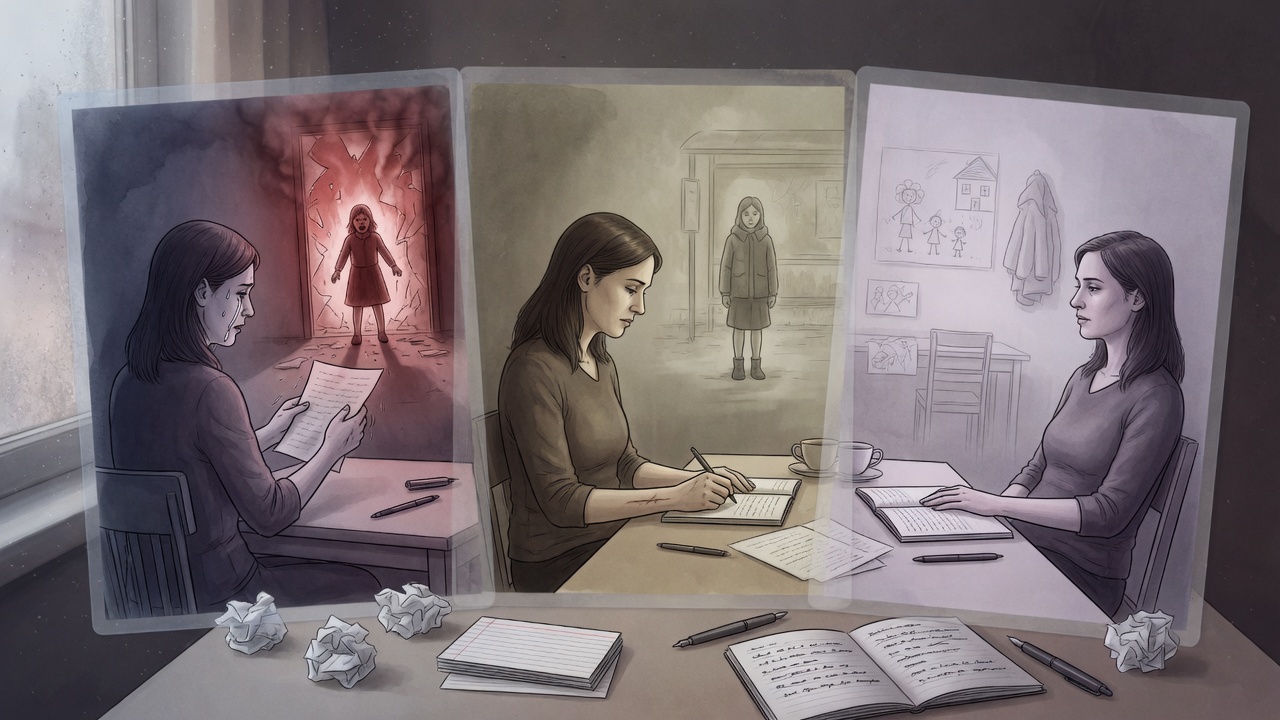
Trauma backstory is where AI writing assistants embarrass themselves most reliably. Ask any of the major models to write a scene where a character "struggles with past trauma," and you'll get tears, flashbacks, a trembling hand on a doorknob, and probably a monologue where someone explains their entire childhood in dialogue that no human being has ever actually spoken aloud. The melodrama doesn't come from malice — it comes from the fact that AI models learn from text, and published fiction has a long, rich tradition of handling trauma very badly.
The good news is that restraint is learnable, at least by the models. But you have to know how to ask, and you have to know which model is going to fight you hardest on the way there. After spending considerable time testing Claude, GPT-4, and Gemini on exactly this problem, I have some strong opinions.
Why Trauma Backstory Is a High-Failure Zone for AI Models
The failure mode has a specific shape. A character's traumatic past should leak into the present through behavioral displacement — the way she stacks her plates before a guest can clear them, the particular silence that falls when someone mentions a certain city, the joke she makes that lands three seconds too late. What AI models want to give you instead is the wound labeled and explained, usually by the character themselves, in a moment of convenient emotional access.
This happens for two reasons. First, the training data skews toward scenes where trauma is dramatically legible — the reveal, the breakdown, the cathartic confession. Those scenes are more common in published fiction and screenplays than the quieter, harder-to-write moments of behavioral residue. Second, AI models are optimized for clarity and helpfulness. A character hinting obliquely at something painful is, from a pure information-delivery standpoint, ambiguous and potentially confusing. The model's instinct is to resolve that ambiguity.
The whole craft of writing trauma with restraint is about sustaining productive ambiguity — letting the reader feel something is wrong before they understand what it is. AI models are trained to eliminate productive ambiguity. That's the core tension you're managing.
The other trap is tonal escalation. Models will frequently treat emotional scenes as opportunities to increase intensity — more adjectives, more physical sensation, more interiority. When you're trying to write a character who goes quiet at a dinner party because someone mentioned a particular year, the last thing you need is the model layering in "her heart hammered in her chest as memories flooded back." That's not restraint. That's melodrama wearing a subdued costume.
The Test Setup: Same Character, Same Wound, Three Models
To make this comparison meaningful, I used a single character across all three tests: Mara, a 40-year-old structural engineer who, at 19, was the only person to walk away from a car accident that killed her younger brother. She has never talked about it. She doesn't avoid talking about it — she just doesn't. She's competent, dry, occasionally funny. The wound shows up in control behaviors and in a very specific relationship with risk and failure.
I gave each model the same base prompt, then tested variations. The base prompt was deliberately thin:
Write a scene where Mara, a 40-year-old structural engineer, attends a colleague's birthday dinner. At some point during the evening, the conversation touches on something that connects to her past. She lost her younger brother in a car accident she survived when she was 19. She has never discussed this with anyone at work. Write the scene in close third-person limited. The scene should be about 400 words.
Then I tested a more directive restraint prompt, which I'll show in the next section. But first — what did the base prompt actually produce?
Results: How Each Model Defaults to Revealing Trauma
Claude (claude-opus-4)
Claude's default output was the most controlled of the three, but it still reached for legibility. The scene it wrote had Mara going quiet when someone mentioned a younger sibling, and the narration included a line like "something closed in her expression" — which is fine — followed by "she thought of Daniel, of the way the headlights had looked" — which is the model wanting to give you the memory even when you haven't asked for it.
What Claude does well by default: it resists the impulse to have Mara explain herself. No one at the dinner table learns what happened. The restraint is social. What it does less well: the interiority still reaches back toward the wound directly. Mara thinks about Daniel by name within two paragraphs of the trigger. The reader gets the connection served to them rather than having to feel it accumulate.
GPT-4
GPT-4's default output was more emotionally elaborate. Mara's hand "stilled on her wine glass." Her eyes "went somewhere else." Another character noticed and asked if she was okay. Mara said she was fine, "just tired." GPT-4 loves the "just tired" deflection — I've seen it use this exact beat in probably thirty different trauma-adjacent scenes. It's not wrong, exactly, but it's so common it's become a tell. The model also gave Mara a brief interiority flashback: two sentences about the rain on the windshield the night of the accident.
GPT-4 reaches for cinematic shorthand. It knows the vocabulary of restrained trauma from prestige TV and literary fiction, but it tends to apply those beats in their most recognizable form rather than finding the specific, strange way this particular character would carry this particular wound.
Gemini
Gemini's default output was the most melodramatic of the three. The scene had the conversation turn to "road safety statistics," which felt contrived as a trigger, and Mara excused herself to stand in the hallway for a moment where she "pressed her palm flat against the cool wall and breathed through the familiar weight of it." The phrase "familiar weight of it" is doing a lot of labeling work while pretending to be subtle. By the end of the scene, a close friend at the dinner had quietly touched her arm in a way that suggested she knew something had happened.
Gemini tends to want the scene to feel emotionally complete — to arrive somewhere. Trauma handled with real restraint often does the opposite. It leaves the reader in the middle of something unresolved, which is exactly where the emotional power lives.
Prompt Strategies That Pull Restraint from Each Model
The key insight, after testing this extensively, is that you can't just tell a model to "be subtle" or "avoid melodrama." Those are aesthetic instructions, and models interpret aesthetic instructions through their training data, which brings you right back to the default outputs above. You need to give the model behavioral and structural constraints that make melodrama mechanically difficult.
Here's the prompt that produced the strongest results across all three models:
Write a scene where Mara, a 40-year-old structural engineer, is at a colleague's birthday dinner. Her younger brother died in a car accident she survived at 19. She has never mentioned this to anyone at work.

Rules for this scene:
- Mara must not think about the accident directly. Her interiority should stay in the present room.
- She is not allowed to go still, go pale, or have any dramatic physical reaction.
- No other character should notice anything is wrong.
- The moment of connection to her past should happen through something Mara does or says — not through something that happens to her.
- The scene should end before any emotional resolution. Cut on a mundane action.

Write in close third-person limited, approximately 400 words.
The "rules" framing works because it converts aesthetic preferences into technical constraints. "No dramatic physical reaction" is checkable in a way that "be subtle" isn't. "Cut on a mundane action" gives the model a structural endpoint that prevents it from building toward catharsis. The constraint that the connection must happen through something Mara does rather than something that triggers her forces the model away from the stimulus-response structure that produces most melodrama.
For Claude specifically, the most useful additional constraint is around interiority. Claude will respect social restraint but still reach inward:
Continue this scene but add a restriction: Mara's internal narration cannot name her brother, cannot reference the accident, and cannot use any word in the semantic field of loss, grief, death, or memory. Her interiority in this moment should be entirely about the present — what she's holding, what she can see from where she's sitting, what she decides to do next. The wound should be implied only through what she chooses.
This sounds almost impossibly restrictive, but it produces something genuinely interesting — Mara noticing the way the birthday candles throw light on the ceiling, then offering to drive someone home even though it's out of her way. The reader feels the connection without the narration making it.
For GPT-4, the problem is cinematic shorthand. The fix is specificity:
Rewrite this scene, but replace every gesture or physical reaction that could appear in a film (the stilled hand, the faraway look, the quiet excuse) with something Mara-specific that comes from her being a structural engineer who controls her environments compulsively. Her displacement behaviors should be professional or practical in nature — not emotional in register. She should seem, to any observer, like someone who is simply being competent and organized.
Anchoring the behavioral displacement to her specific professional identity gives GPT-4 something concrete to reach for instead of the stock vocabulary. The model is good at character consistency when you give it the hook.
Choosing the Right Model Based on Your Story's Emotional Register
There isn't a single winner here. The right model depends on what kind of emotional temperature your story runs at.
If your novel is cool and observational — think Elizabeth Strout, Denis Johnson, Marilynne Robinson — Claude is going to be your closest collaborator. It has the strongest instinct for prose that earns its emotion through specificity rather than intensity, and it responds well to aesthetic direction that references literary fiction. It also tends to hold point-of-view more consistently than the other two, which matters when restraint is doing a lot of work in the narration.
If your story is structurally plotted — thriller, mystery, domestic suspense — GPT-4 is worth the investment in specific prompting. It's better at holding story logic across longer stretches, and once you give it character-specific behavioral anchors, it can deliver on them consistently across scenes. Its instinct for cinematic shorthand is actually an asset in genre fiction; you just need to redirect it toward this character's specific shorthand.
Gemini is best used for a different job in this context. I wouldn't draft primary trauma scenes in Gemini without significant constraint work. But it's genuinely useful for generating the backstory document itself — the full, melodramatic, explicit account of what happened to Mara — which you then use as your own reference while keeping it entirely off the page. Let Gemini write the scene you're never going to show anyone. Use it to understand the wound. Then go to Claude or GPT-4 to write around it.
The model that writes restraint best isn't necessarily the model that understands your character's psychology best. Use each model for what it's actually good at, and don't ask any of them to do everything.
One more practical note on workflow: whatever model you're using, the single most effective thing you can do before writing any trauma-adjacent scene is give the model what I think of as a negative space document — a short paragraph describing exactly what this character does NOT do when the wound is activated. Not "she doesn't cry in public" (too vague), but "she doesn't go quiet. She gets more verbally precise. Her sentences get shorter and more declarative. She starts cleaning up before anyone else is finished eating." Give the model the behavioral negative space and it has somewhere specific to write toward.
The first scene worth attempting with any of these models is the simplest possible version of the constraint test: take a moment where your traumatized character is triggered, and write it with the single rule that they must respond by doing something practical and competent. See what the model gives you. Then refine from there. That's where the interesting work actually starts.