The Voice That Ate Every Genre
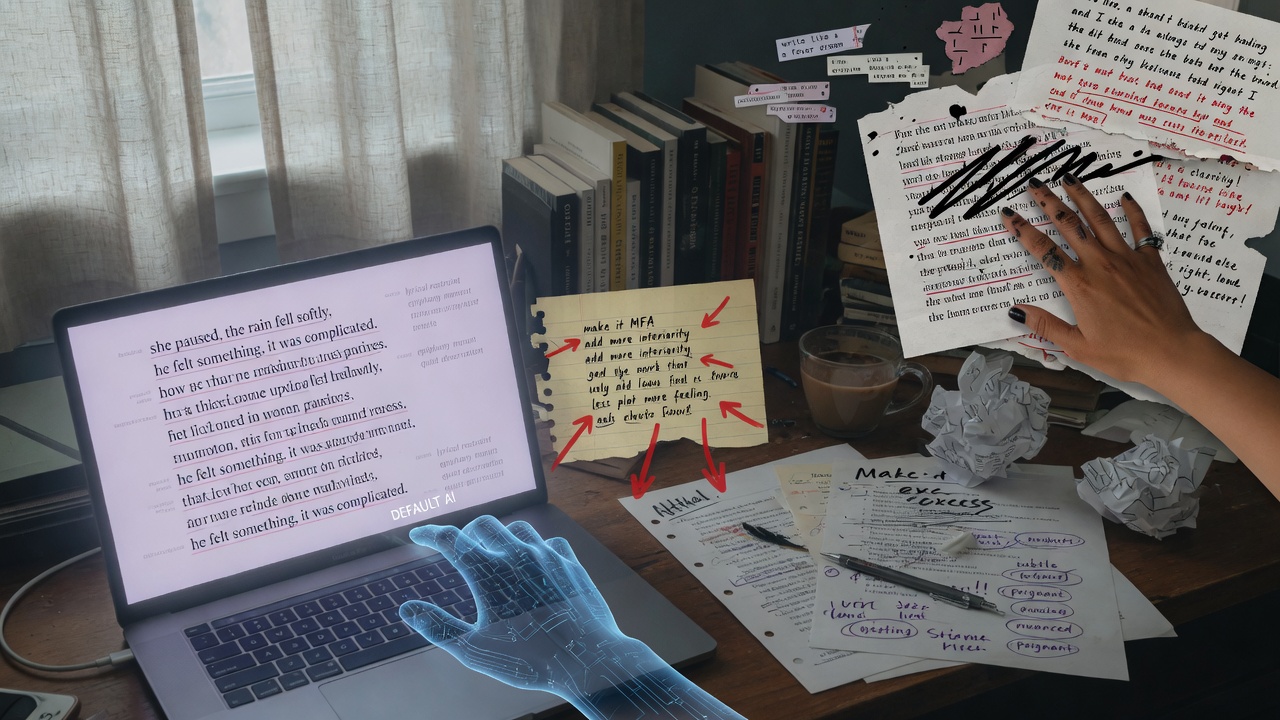
Ask an AI model to write a bar fight, a wedding, a murder confession, or a dragon attack, and you'll get sentences that all belong to the same person. That person went to a good MFA program, reads a lot of contemporary literary fiction in translation, and has been taught that restraint equals depth. Their tell is a very specific rhythm: two clauses of roughly equal weight, joined by a comma or semicolon, landing on something quiet and a little sad. "The rain fell, and somewhere in the house, a door closed." It's not bad writing. It's just the same writing, over and over, regardless of what you actually asked for.
I call it the MFA workshop voice, and once you notice it you can't unsee it. If you're trying to write a swaggering pulp thriller or a maximalist fantasy epic and your prose keeps drifting toward hushed, elegant melancholy, this guide is the fix. We'll name the tell-tale signs, figure out why the model defaults there, and build prompt techniques that actually hold a different register in place.
The Tell-Tale Signs of the Default
Before you can fix workshop voice, you need to catch yourself reading past it. It's smooth. That's the problem — it reads as "good writing" on a sentence level even when it's wrong for the scene. Here's what to look for.
- Symmetrical sentence pairs. Two balanced clauses of similar length, often split by a semicolon or "and": "She didn't cry; she just watched the water." The rhythm is pleasant but it shows up in every emotional beat, turning grief, joy, and rage into the same cadence.
- Muted verbs. Characters don't slam doors, they "let them close." Nobody screams, they "make a small sound." The verbs get sanded down until nothing in the scene has physical force.
- "Quiet devastation" phrasing. Any strong emotion gets routed through understatement — a character feels something "the way you feel a bruise you forgot you had," or grief becomes "a kind of weather." It's a specific simile factory, and it produces the same handful of shapes: weather-as-emotion, body-as-house, silence-as-character.
- Present-tense reflection dropped into past-tense narrative. Mid-scene, the prose suddenly steps back for a generalized truth: "This is what grief does. It makes liars of us all." It's the workshop essay move, and it shows up whether you're writing space opera or a cozy mystery.
- Ellipsis instead of event. Big things happen off-page, summarized in a single wistful sentence, because showing the messy, loud version would break the tone the model has locked into.
Run any AI-drafted chapter through the Sentence Rhythm Report and you'll often see this pattern as a literal statistic — sentence lengths clustering tightly around a mean, with almost no short punchy outliers and almost no long cascading ones. Workshop voice isn't just a vibe, it's measurably narrow variance.
Workshop voice isn't wrong prose. It's one register pretending to be neutral, applied to genres that need a completely different engine under the hood.
Why the Model Keeps Doing This
It's not an accident, and it's not really the model's "fault" either. Large language models learn style from whatever text is most heavily represented and most consistently rewarded in their training and fine-tuning data. A huge amount of the polished, professionally-edited English prose available online and in digitized book corpora comes from a specific band of contemporary literary fiction — the kind published by mid-size literary presses, taught in MFA programs, reviewed in a handful of magazines, and excerpted constantly. That prose shares a house style: restraint, precision, the withholding of sentiment, an allergy to melodrama.
On top of that, a lot of instruction-tuning and human-feedback ranking was done by people with similar literary training, who tend to score "elegant and understated" higher than "loud and genre-true" when judging quality in the abstract. So the model isn't just trained on more literary fiction — it's been actively rewarded for defaulting to that register whenever a prompt doesn't specify otherwise. Ask for "compelling, well-written prose" with no other constraint, and you'll get the workshop voice almost every time, because somewhere in training that phrase got strongly associated with exactly this cadence.
This matters for genre writers especially, because the pull is strongest exactly when you need it least. Write a hardboiled noir and the model will keep trying to soften your detective into someone who has quiet epiphanies. Write LitRPG and it'll want to slip in lyrical asides about the protagonist's inner life instead of tracking your stat block with the deadpan precision the genre actually rewards — a problem worth knowing about before you lean on any LitRPG writing tool. Write romance and it'll undercut every big swoony moment with restraint, when what the scene needs is unguarded excess. The fix isn't complaining about the model. It's giving it a stronger, more specific target to override the default.
Naming the Register You Actually Want
You can't fight a fog with "please don't do the fog thing." You need a named alternative, ideally one with texture the model can pattern-match against. Here are four registers that sit clearly outside workshop voice, and what makes each one work.
- Pulp urgency. Short declaratives. Present danger stated flatly. Verbs that hit like verbs: "He kicked the door in. Nobody screamed. That was the bad sign." No hedging, no generalized reflection — the sentence is doing work, not musing.
- Maximalist baroque. Long, cascading sentences stacked with clauses, sensory excess, deliberate overwriting — think Angela Carter or early Cormac McCarthy at his most operatic. The opposite instinct of restraint: more adjectives, more subordinate clauses, more sheer velocity.
- Deadpan comic. Flat affect stated about absurd events, timing carried entirely by understatement used for comedy rather than "depth" — very different from workshop restraint, even though both are quiet. The joke is in the gap between the calm delivery and the chaos described.
- Plainspoken folk voice. Colloquial, rhythmic, close to oral storytelling — contractions, run-on "and then and then," regional idiom, a narrator who sounds like a person talking to you, not a narrator performing literary control.
Name your target register explicitly in your prompt, every time, the same way you'd specify point of view or tense. If you're building out a fuller AI fiction writing guide workflow for your project, voice register deserves its own line in your prompt template, right next to genre and POV — not something you hope the model infers from context.
The Anti-Example Technique
Here's the single most effective fix, and it's underused: don't just describe what you want, show the model what you don't want, in the same prompt. Anti-examples work because they give the model a contrast to pattern-match against, rather than one target it can quietly reinterpret through its own defaults.
Rewrite this scene in a pulp-noir register — short declarative sentences, hard verbs, no lyrical reflection, no similes about weather or silence. Here's the tone I DON'T want (this is workshop-voice, too soft for this scene): "He looked at the gun on the table, and for a moment, everything in him went quiet, like a held breath." Here's the tone I DO want: "The gun sat on the table. He looked at it twice. Then he picked it up like it owed him money." Now rewrite this paragraph in that second register: [paste your paragraph]
Why this works: the model now has two data points defining a boundary, not one adjective ("pulpy") it has to interpret alone. You're triangulating the register instead of naming it and hoping.
I'm writing a maximalist baroque fantasy chapter — think overstuffed sentences, cascading clauses, sensory overload, deliberately excessive. Do NOT write like this (too restrained, this is the flat contemporary-lit voice I'm trying to avoid): "The city burned. She watched it from the hill, and something in her chest went still." Instead write closer to this model: "The city burned in three colors at once — amber where the granaries went, a sick green where the alchemist's quarter caught, and beneath it all a black smoke that seemed to eat the moonlight whole, so that the watching crowd on the hill felt not sorrow exactly but something closer to awe, the terrible awe of people watching a god unmake its own temple." Write the next three paragraphs of the siege in that register.
This is especially useful for fantasy prose where you want deliberate excess — pair it with your fantasy worldbuilding notes so the model has rich sensory material to actually cascade through, instead of padding empty description with more balanced-clause restraint.
Write my grandmother-narrator's voice for this chapter — plainspoken folk register, like someone telling a story out loud at a kitchen table, not a novelist performing control. Avoid the polished-literary tendency to balance clauses symmetrically or end paragraphs on a hushed, understated note. She talks in run-ons, corrects herself mid-sentence, uses regional idiom ("like to have died," "carried on something awful"), and never generalizes about emotion in the abstract — she tells you what happened and lets you feel it. Bad example of what to avoid: "Loss, she'd come to understand, was just another kind of arithmetic." Good example of the register I want: "Well, and then Verna went and lost the Pratt boy in the flood of '61, and I want to tell you, she never was the same after, carried that look on her like a coat she couldn't take off, not even at Christmas."
Notice each of these prompts does three things: names the register precisely, shows a concrete bad example in the exact prose style you're fighting, and shows a concrete good example at comparable length. That's the whole technique. It travels well — save a version of it in your story bible so you're not rebuilding the anti-example from scratch every session, and reuse it across chapters for consistency.
The same logic works for humor, incidentally — if you've noticed every character in your manuscript is quipping in the same register, the anti-example fix and Why AI Gives Every Character the Same Sense of Humor tackle a closely related flattening problem.
The Before/After Audit Checklist
Voice drift is sneakiest after long drafting sessions — you start a chapter in pulp mode, and by page four the model has quietly slid back toward workshop cadence because that's its gravitational center. Long context windows make this worse, not better; the more "well-written" contemporary-style prose accumulates in the conversation, the harder the model pulls toward its default the longer you go. Catch it with a dedicated pass rather than trusting your ear alone, since you've been reading the drift happen gradually and your ear adjusts with it.
- Scan for semicolon-and-comma symmetry. Search your draft for sentences with a comma or semicolon splitting two clauses of near-equal length. A few is fine. A cluster of them in an action scene is workshop leakage.
- Highlight every simile. Read them in a batch, out of context. If more than a couple involve weather, water, silence, or "a kind of," the model has been running its default simile generator. Ask for a fresh batch tied to your character's actual profession or environment instead.
- Check verb temperature. Pull ten verbs at random from an action or high-emotion scene. If most of them are quiet — "settled," "seemed," "let," "watched" — swap in verbs with actual force appropriate to the register. Run the chapter through the Word Frequency Finder to see if the same handful of muted verbs are doing all the heavy lifting.
- Find the generalized-truth sentences. Search for "This is what," "That's the thing about," "It's a strange kind of." These phrases almost always signal the model dropping into essay-mode reflection instead of staying in scene.
- Compare sentence-length variance across chapters. Run different chapters through the Readability Scores tool and the Sentence Rhythm Report side by side. If your pulp chapter and your quiet character-study chapter come back with nearly identical rhythm profiles, the register isn't actually shifting — it just looks like it is.
- Read one paragraph aloud per scene type. This sounds unscientific, but it's fast and reliable. Workshop voice has a specific breath pattern — it wants to pause and land softly. If every scene you read aloud wants to land the same way regardless of content, that's your answer.
Build this audit into wherever it naturally falls in The Five-Pass Revision Order for AI-Assisted Novels — voice consistency is really a line-level concern, so it belongs in the same pass where you're already handling prose polish, not bolted on afterward as a separate read-through. If you're using Entangled Text's iterative drafting flow, it also helps to run this check every few chapters rather than waiting for the full manuscript — catching drift early means fewer chapters to rewrite once you notice the pattern, and it keeps the fix proportional to how AI novel writing workflow tools structure a project into chapter-by-chapter passes anyway.
Where This Fits in Your Actual Workflow
None of this is a one-time fix you apply and forget. Voice register needs reinforcement the same way character continuity does — which is why it's worth treating like a checkable fact rather than a vibe. If you already run a character consistency pass to catch eye-color and backstory drift, add a voice-register line to that same pass: does this character's internal narration still sound like the register you set for them, or has it crept toward the default?
It's also worth being honest that different models resist the pull differently. Some are more heavily tuned toward that literary-restrained house style than others, and if you're comparing options, it's worth reading a rundown of best AI models for writing with an eye specifically toward which ones hold a specified register longest across a chapter rather than drifting back by paragraph three. This is also part of what separates general-purpose chatbots from tools built for long-form fiction — see Entangled Text vs ChatGPT for how persistent style instructions get handled differently across a full manuscript versus a single chat window.
If you're setting up a new project from scratch, bake your register decision into the earliest planning stage — when you generate your AI book outline, note the target voice register right alongside genre and POV, so every downstream prompt inherits it instead of you re-explaining it chapter after chapter. The same goes for romance projects specifically: if you're building a romance novel with AI, decide early whether you want unguarded maximalist swoon or something drier and wittier, because romance is a genre where workshop-voice restraint kills the exact effect the scene is supposed to deliver.
Once you're happy with the register and ready to move toward publication, the voice work is done — but it's worth one final readability pass before you finalize formatting, since register shifts can sometimes affect pacing metrics that matter for KDP Upload Checklist After an AI-Assisted First Draft or the broader Publish, Launch & Distribute Your Book: Complete Author Guide. And if line-level revision in general feels like the fuzziest part of your process, How to Edit a Book with AI and the core edit a book with AI workflow both cover the broader editing pass this fits inside. For everything else — outlining, drafting, cover generation via the AI book cover tool, even adapting a chapter into panels with the AI comic studio or AI manga generator — the full library of writing guides and the Entangled Text documentation are worth bookmarking, and the Entangled Text pricing page has current details if you're deciding whether to move your process over.
Next time you sit down to draft, don't just tell the model your genre — hand it one bad sentence in the workshop voice and one good sentence in your actual register, then ask it to write toward the second and away from the first. That single move, repeated at the start of every session, does more to keep your prose honest than any amount of adjective-stacking in your style instructions.