The Tell: Spotting Default Sarcasm Voice
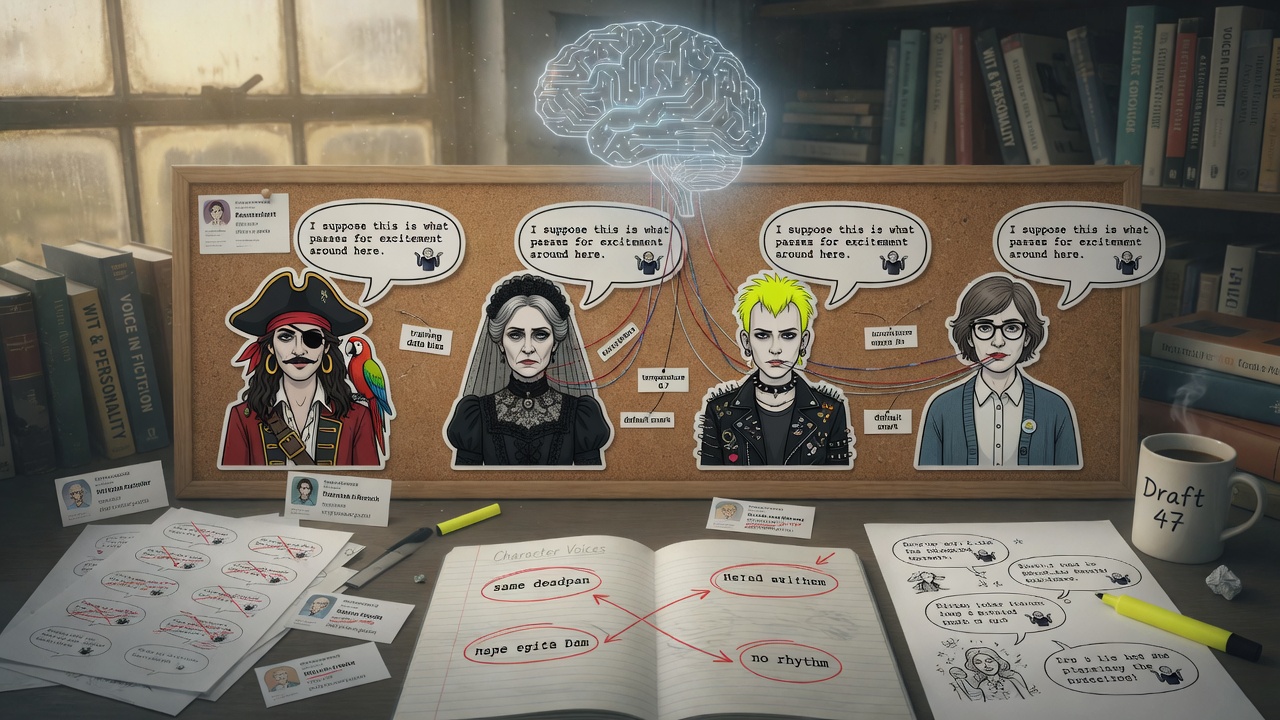
Read five pages of AI-generated dialogue with more than two characters in the room, and you'll notice something strange. The grumpy old mercenary, the anxious teenage apprentice, and the stiff-necked noblewoman all land jokes the same way. Someone says something slightly absurd. Another character deadpans a quip back. Everyone's funny in the exact same register: dry, quick, a little detached, like they all grew up watching the same sitcom. This is what I call default sarcasm voice, and once you notice it, you can't stop seeing it. The tell isn't just that characters are sarcastic — plenty of real people are. The tell is that the sarcasm has no texture. It doesn't cost the character anything to say. There's no warmth underneath it, no cruelty, no nervousness masking as wit. It's the comedic equivalent of stock photography: technically a joke, recognizably "humor-shaped," and utterly interchangeable between speakers. Try this test on your own draft. Cover up the dialogue tags and see if you can guess who's speaking based on the joke alone. If you can't, you've got default sarcasm voice running through your cast. This is one of the fastest ways to catch flattened characterization during a revision pass, and it belongs early in The Five-Pass Revision Order for AI-Assisted Novels, before you start polishing prose at the sentence level. Fixing voice after you've fixed everything else means redoing work twice.If every character's joke could be swapped with another character's joke and nothing would feel wrong, you don't have six characters. You have one narrator wearing six name tags.
Why This Happens: One Comedic Register to Rule Them All
This isn't a bug so much as a statistical inevitability. Large language models are trained on oceans of text where a certain flavor of humor dominates — the quippy, referential, slightly self-aware sarcasm that's colonized English-language internet writing for the last fifteen years. Think Whedon-esque banter, sitcom writers' room rhythms, Twitter one-liners. It's genuinely a well-built comedic tool. It's also everywhere, which means it's the statistically "safest" joke shape for a model to generate when it's asked to "make this character funny" without more specific instruction. There's also a structural reason. Humor is one of the hardest things to model probabilistically because timing and subversion of expectation matter more than word choice. Sarcasm is comparatively easy to generate because it follows a predictable template: state the obvious thing, then undercut it with a flat or exaggerated tone. That template works in almost any context, which makes it the path of least resistance for a model trying to satisfy "add some humor here" without a strong steering signal from you. The fix isn't to ban sarcasm. It's to recognize that sarcasm is a delivery style, not a personality, and every character needs their own delivery style attached to their own worldview. If you've read anything about building consistent characters with AI, you've probably run into the broader version of this problem — the same flattening tendency shows up in dialogue tags, physical descriptions, and even moral reasoning. The character consistency tool exists partly because of exactly this pattern: models regress toward a comfortable average unless you actively push them away from it.Building a Humor Profile Per Character
Here's the actual fix, and it's more granular than most advice on "character voice." You need a humor profile for every character who gets more than a few lines — not just how they talk, but how they're funny, when they're funny, and what they consider off-limits. A useful humor profile answers four questions:- What do they find funny? Absurdity, cruelty, wordplay, physical mishap, irony, taboo subjects handled lightly? A soldier who's seen combat might laugh at gallows humor that horrifies a civilian character standing next to him.
- What would they never joke about? This is often more revealing than what they find funny. A character who lost a sibling to illness might make jokes about death in general but go rigid the second someone jokes about hospitals specifically.
- How do they deliver a line? Deadpan, rambling with a long windup, self-deprecating, cruel and precise, or clumsy — landing the joke a beat too late or too early. Delivery is where most of the "sameness" problem actually lives.
- Who are they funny in front of, and who do they perform seriousness for? Real people code-switch their humor depending on audience. A character might be a rambling goofball with friends and go stone silent and clipped around authority figures.
Prompt Example
Here are four characters in my fantasy heist crew. I need a distinct humor profile for each — not just "funny" or "serious," but the specific shape of their humor. For each character, give me: (1) what genuinely makes them laugh, (2) a topic they would never joke about and why, (3) their delivery style in one sentence, (4) an example line of dialogue that could ONLY come from them, not from any other character in this group.

Rennick — ex-soldier, guilt-ridden, functions as the crew's planner
Dessa — youngest member, orphaned young, desperate to be taken seriously
Tobin — con artist, charming, terrified of being genuinely known
Yura — mute-by-choice sharpshooter who communicates mostly through notes and expressions
Prompt Example
Rewrite this scene where the crew is arguing about the plan. Keep the plot beats identical, but make sure Rennick's humor is dry and self-deprecating (he undercuts his own competence), Dessa doesn't joke at all — she reacts to other people's jokes with visible confusion or hurt because she's trying too hard to seem mature — Tobin's jokes are charming but slightly too polished, like he's rehearsed them, and Yura only "jokes" through a single written note that lands harder than anything spoken. Don't let any two characters use the same joke structure.
Prompting for Humor That Fails on Purpose
Real humor doesn't have a 100% success rate. People misjudge the room constantly — they make a joke that was funny with one friend group and lands like a dead fish with another. AI-generated banter almost never fails, because failed jokes are harder to model than successful ones, and because "make this scene funny" implicitly asks for jokes that work. This is a huge, underused lever for characterization. A joke that fails tells you more about a character than five that land, because you get to see how they handle the failure. Do they double down? Retreat into silence? Over-explain the joke, which kills it further? Get defensive and snap at whoever didn't laugh?Prompt Example
Write a scene at a family dinner where Marcus, 34, tries to lighten the tension by making a joke about his father's illness — the kind of gallows humor that works fine with his hospital coworkers but is wildly inappropriate here. I want the joke to actually fail on the page: describe the silence, his mother's expression, and Marcus's attempt to recover by making it worse with a follow-up joke before he finally just stops talking. Don't have any other character rescue him with a laugh or a kind word. Let it sit.
Prompt Example
Two characters are on a stakeout. Priya keeps making jokes to fill the silence because she's anxious, not because she's actually funny — her jokes should be a little too long, slightly unfunny, the kind where you can tell she's performing confidence she doesn't feel. Marcus doesn't laugh at any of them, not out of cruelty but because he genuinely doesn't process humor quickly — he'll laugh at the WRONG one, thirty seconds late, at something she said as a throwaway line. Write their dialogue with that mismatch as the whole engine of the scene.
Before/After: Auditing a Group Scene
Let's put this into practice with a scene structure everyone eventually writes: four people in a room, tension rising, someone cracks a joke to relieve it. Here's a typical AI-generated first pass, condensed:"Great, we're all going to die," said Wren.Every line here is interchangeable. Swap Wren's lines for Cole's and nothing breaks. That's the diagnostic in action — four names, one voice, one comedic register, and it's the flattest kind of sarcasm because it costs nobody anything. Now the audit. Go character by character and ask what their joke should reveal, not just what would be funny in the abstract.
"Cheerful as always," said Bex.
"I try," said Wren.
"Can we focus?" said Dara.
"I am focusing. On dying," said Wren.
Cole snorted. "Same energy."
- Wren — established as someone who jokes about death because she's genuinely terrified of it and can't sit in silence with the fear. Her humor should feel one notch too intense, not comfortably deadpan.
- Bex — the group's caretaker, uses humor to redirect other people's spirals rather than express his own feelings. His jokes are about other people, gently, almost like small acts of care.
- Dara — doesn't find any of this funny right now, and her interruption isn't comic timing, it's genuine frustration that reads as humorless to the others but is actually the most emotionally honest line in the exchange.
- Cole — laughs at things a beat late and slightly too loud, because he's not actually tracking the conversation's emotional temperature — he's relieved someone else spoke so he didn't have to.
"Statistically, one of us doesn't walk out of this building," Wren said, too fast, like she needed to say it before it said itself to her.Same four lines, same basic scene function, but now every joke — or non-joke — tells you something distinct. Wren's "humor" is closer to panic. Bex refuses to joke back because his role is stabilizing, not entertaining. Dara isn't being a killjoy, she's the only one being direct. Cole's laugh isn't about the joke at all; it's about relief. That's the difference between comic dialogue and character work disguised as comic dialogue. If you're revising a manuscript that's already full of default sarcasm voice, this audit is worth running as its own dedicated pass rather than folding it into a general line edit — pull it up alongside your revision order notes and go scene by scene through every multi-character conversation. The Cliché & Overused Phrase Finder can help flag repeated joke structures and stock quips that have started echoing across chapters, which is often the fastest way to locate where the sameness crept in.
Bex didn't laugh. He just put a hand on her shoulder for a second. "Nobody's dying tonight. Dara, what's the exit route look like?"
"Can we not do this right now," Dara said — not a joke, not trying to be one, just tired.
Cole laughed anyway, half a beat late, relieved the silence had broken at all. "Sorry. Sorry — yeah. Exits. Right."