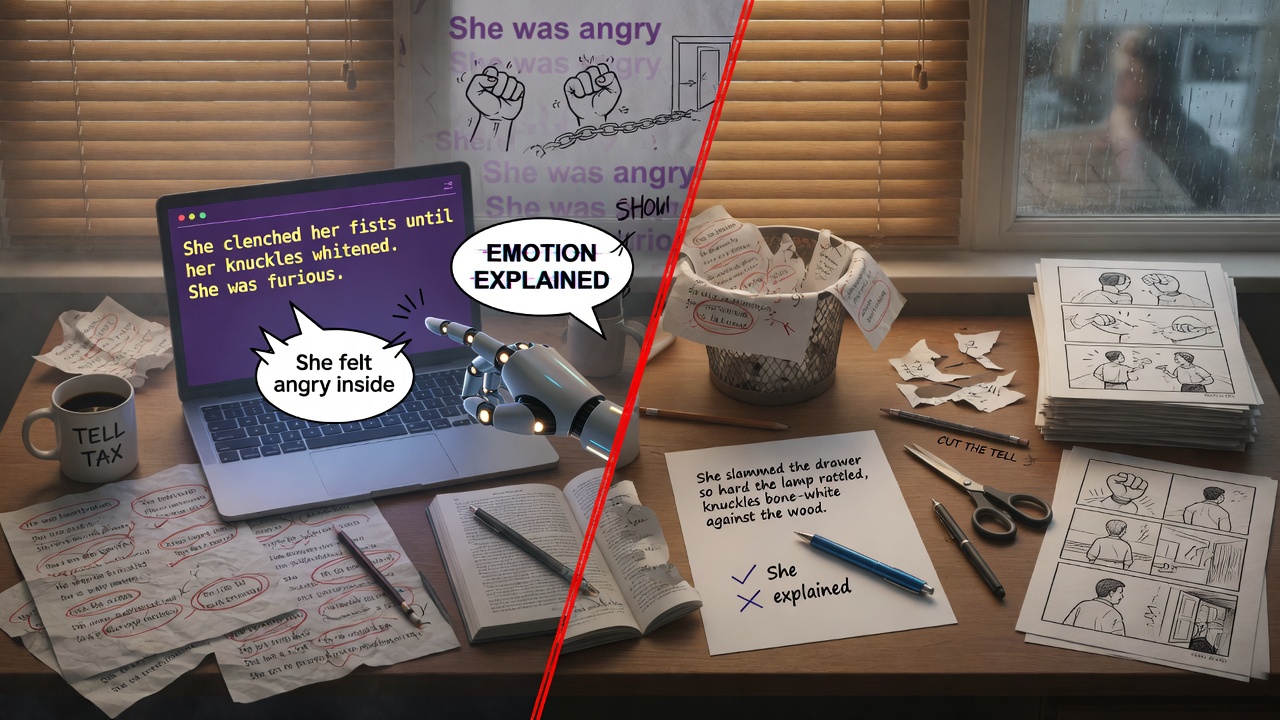
Open any AI-drafted scene and you'll find it. A character slams a door, and the next sentence tells you she's furious. A man's hands shake around his coffee cup, and the following line informs you he's nervous about the interview. The action already told the story. Then the AI turns around and tells it again, this time in plain feeling-words, like it doesn't trust you to have understood the first sentence.
I call this the tell tax — the redundant sentence you pay every time a physical beat lands. It's one of the most common patterns you'll hit when you write a book with AI, and it's sneaky because each individual sentence reads fine. It's only when you stack them up that you realize you're reading a manual for emotions instead of a scene.
The Show-Then-Tell Redundancy Pattern: Spotting the 'Tell Tax' Sentence AI Adds After Every Action
Here's what it looks like in the wild:
Maren's fork clattered against the plate. She pushed her chair back so hard it scraped the tile. She was furious.
Read that last sentence again. Did you need it? The clattering fork and the scraping chair already delivered fury to your nervous system. "She was furious" doesn't add information — it subtracts trust. It's the narrative equivalent of a comedian explaining the joke after the laugh.
The pattern usually shows up in one of three shapes:
- The direct label: "His jaw tightened. He was angry." — naming the exact emotion the action just performed.
- The internal echo: "Her stomach dropped. She felt a wave of dread wash over her." — using a physical sensation, then restating it as an abstract feeling, as if one weren't already the other.
- The causal explainer: "He looked away and cleared his throat, embarrassed by what he'd just admitted." — tacking a "because I felt X" clause onto a perfectly good gesture.
Once you know to look for it, you'll see it everywhere in AI output — sometimes once per paragraph, sometimes once per beat. It's worth running a finished chapter through something like a Filter Word Finder to catch the softer cousins of this problem too, since "felt," "seemed," and "realized" often show up riding shotgun with the tell tax, hedging the exact moments where the prose should be most confident.
Why This Happens: How Training on Explanatory Prose Makes AI Distrust Subtext
This isn't a random quirk. It's baked in.
Large language models are trained on an enormous slush pile of writing, and a huge portion of that writing isn't literary fiction — it's explanatory prose. Textbooks, articles, summaries, forum posts, product descriptions. Content whose entire job is to state things clearly and leave nothing to inference. When a model learns "good writing" from that soup, it inherits a bias toward completeness over ambiguity. Subtext, by definition, withholds information. And withholding information looks, statistically, like an incomplete sentence to a model optimizing for helpfulness. There's also a more basic mechanical reason. Models generate text one token at a time, weighing probability at each step. After a strong physical beat, the highest-probability continuation is very often a sentence that resolves the emotional register the beat just created — because that's the pattern found in the amateur and mid-tier fiction that makes up so much of the training data. Skilled published prose trusts the reader; a lot of average prose doesn't. Guess which one is more numerous in the corpus.
The result is a kind of narrative anxiety. The AI shows you the trembling hand, then immediately worries you didn't catch it, so it tells you too. It's not that the model doesn't understand subtext — ask it to analyze subtext in a passage and it'll do a fine job. It's that in the act of generation, its default instinct is to close every open loop immediately rather than let one linger for the reader to close themselves.
This matters more in some genres than others. A Romance Beat Sheet: Where AI Drafts Usually Break will tell you that romance lives and dies on withheld emotional beats — the reader needs to feel the tension before the character admits it, or the confession lands flat. The tell tax is romance's silent killer, flattening slow-burn scenes into stated-burn scenes. It's worth knowing which best AI models for writing tend to over-explain more than others, since some models are noticeably more prone to this than others — but the pattern shows up to some degree in all of them, so the fix has to live in your prompting and revision process, not in model selection alone.
The Diagnostic Prompt: Asking AI to Flag Its Own Redundant Emotion Sentences in a Draft
Before you can fix this, you need to find every instance of it — and manually scanning a 90,000-word manuscript sentence by sentence for redundant emotion tags is nobody's idea of a fun Tuesday. The trick is to use the AI's pattern-recognition against itself. It's much better at spotting this issue in someone else's paragraph (even its own, pasted back in) than it is at avoiding the habit while generating fresh.
Here is a scene from my manuscript. I want you to act as a strict developmental editor looking for exactly one pattern: sentences that state an emotion outright immediately after a physical action, gesture, or piece of dialogue already implied that emotion. For each instance, quote the redundant sentence, quote the action/beat it's redundant with, and rate how much information it actually adds on a scale of 1 (pure restatement, cut it) to 5 (adds real new information, keep it). Do not rewrite anything yet — just flag and rate. Here's the scene: [paste scene]
Why this works: you're isolating one specific failure mode instead of asking for generic "make this better" feedback, which tends to produce vague notes about pacing or voice. The 1–5 scale forces the model to actually discriminate rather than flag everything or nothing, and asking it to quote both the beat and the redundant line side by side makes the pattern impossible to miss once you're looking at the list. Run this pass before you run a broader edit — it pairs well as an early step if you're following The Five-Pass Revision Order for AI-Assisted Novels, since catching redundant tell lines early means your later prose-polish pass isn't wasting effort smoothing sentences you're about to delete anyway.
If you want a faster first sweep across a whole manuscript before you get this granular, a Manuscript Cleanup Report can surface hot spots — chapters or scenes with unusually high density of stated-emotion language — so you know where to point the diagnostic prompt first instead of running it chapter by chapter blind.
A variant for dialogue-heavy scenes
Look at this dialogue scene and flag every dialogue tag or beat that explains the emotional subtext of the line that precedes it — for example "she said, hurt" or a gesture followed by a sentence naming why the character did it. I want the line of dialogue and the physical staging to carry the emotion on their own. List each offender with the line number.
Dialogue tags are where this pattern hides in plain sight, because "she said, hurt" feels so small and harmless that writers rarely catch it on a read-through. Naming it explicitly in the prompt gets the model hunting for a subtler version of the same habit.
The Fix Prompt: Rewriting a Scene with an Explicit Ban on Naming the Feeling
Diagnosis is only half the job. Once you've got your list of offending sentences, you need a rewrite prompt that doesn't just delete the tell line but makes the show line strong enough to carry the full weight alone. Simply asking the AI to "cut the redundant sentences" often makes the action beat feel thin and underwritten, because the model compensates for the lost clarity by softening the physical detail too. You need to ban the crutch and demand the beat get stronger, not just shorter.
Rewrite this scene with one hard rule: you may never name an emotion directly. No "angry," "sad," "nervous," "relieved," "furious," or any synonym for a feeling word — not in narration, not in dialogue tags, not in internal monologue. Instead, convey every emotional beat through specific physical action, sensory detail, dialogue rhythm, or what the character notices/ignores in their environment. If a sentence currently exists only to explain a feeling, cut it entirely rather than replacing it with another physical gesture as filler — trust the beat that's already there to land. Here's the scene: [paste scene]
The instruction to cut rather than replace is the important part. Left unchecked, a model told "don't name feelings" will often just swap "she was angry" for a second, weaker gesture — which gives you two show-beats where one strong one would do. Telling it explicitly that silence is an acceptable outcome is what actually breaks the redundancy habit instead of just relocating it.
Take this paragraph and rewrite it so the reader has to infer the character's emotional state entirely from what he does with his hands, what he says versus what he doesn't say, and one small sensory detail from the room. Do not tell me how he feels anywhere in the passage. Aim for a slightly uncomfortable amount of restraint — I'd rather it feel too withheld on this pass than over-explained, since I can always add back a single clarifying beat later if a test reader is confused.
Asking for "a slightly uncomfortable amount of restraint" is a deliberate overcorrection. Models calibrate toward the middle of whatever instruction you give them, so if you ask for "less telling," you'll get moderately less telling. If you ask for maximum restraint and accept you might dial it back, you'll actually land somewhere in the zone published prose lives in. This is also a great moment to check the results against your story bible notes on a character's established tics and gestures — restraint works best when the physical vocabulary it's drawing from is already specific to that character rather than generic.
A prompt for prevention, not just cleanup
Once you've fixed a batch of scenes, feed the pattern forward into your drafting prompts so you're not stuck doing this pass forever:
When drafting new scenes for this manuscript going forward, follow this rule: after any beat of physical action, gesture, or dialogue that conveys emotion, do not follow it with a sentence that names the emotion directly. Trust the action to stand alone. If you feel the urge to add a clarifying emotional sentence, that's a signal the preceding action wasn't specific enough — go back and make the action more precise instead.
Pin this into your ongoing project instructions or the front of your outline document — whether that's a plain notes file or something generated through an AI book outline tool — so every new chapter draft inherits the rule instead of you catching it after the fact every single time.
Before/After: Three Passages Where Cutting the Tell Line Makes the Show Line Hit Harder
1. The confrontation
Before: "Daniel's knuckles went white around the steering wheel. He was trying to control his anger, but it was clearly bubbling up inside him."
After: "Daniel's knuckles went white around the steering wheel. He drove eleven miles without turning on the radio."
Notice what happened. The "after" version doesn't just delete a sentence — it replaces vague internal narration with a second, more specific physical detail that actually deepens the reader's read on the moment. Eleven miles of silence is more damning than any adjective. This is the exact move the fix prompt is designed to produce: not a shorter paragraph, but a paragraph where every remaining sentence is doing more work.
2. The reunion
Before: "She crossed the kitchen in three steps and pulled him into a hug that lasted too long to be casual. She had missed him more than she'd let herself admit, and having him here now filled her with relief."
After: "She crossed the kitchen in three steps and pulled him into a hug that lasted too long to be casual. When she finally stepped back, she kept one hand on his forearm, like she wasn't ready to test whether he'd still be there without it."
The "after" version replaces the abstract feeling-word sentence with a concrete, specific physical choice — the hand staying on the forearm — that implies the relief and the missing without ever using those words. This is the kind of beat that romance novel with AI tools and prompts should be aiming for constantly, since romance readers are extremely well-trained at reading restraint; over-explaining a reunion moment is one of the fastest ways to make a slow-burn payoff feel cheap.
3. The reveal (fantasy/LitRPG context)
Before: "The rune on the blade flared blue, and Kess stumbled back a step. She was terrified — the last time she'd seen that color, half the garrison had died."
After: "The rune on the blade flared blue, and Kess stumbled back a step. Her hand found the hilt of her own knife before her mind caught up to why."
Here the fix does double duty — it cuts the tell sentence and folds the necessary backstory context (the garrison, the history of that color) into a physical reflex instead of an explainer clause. That's a technique worth stealing whenever you're establishing rules for a fantasy worldbuilding project or working within tight Fantasy Magic Systems: Constraints AI Will Respect — dread about magic should register in the body before it registers in exposition. The same instinct — reflex before explanation — matters just as much in systems-heavy genres; check the LitRPG writing guidance if your story tracks stat panels or status effects, since those scenes are especially prone to over-explained emotional stakes sitting right next to dry numbers.
Across all three examples, the pattern is the same: cutting the tell line only works if you upgrade the show line at the same time. A weak physical beat with the tell sentence removed just reads as underwritten. A strong physical beat with the tell sentence removed reads like something a human agonized over for an extra draft. That's the gap you're closing.
Once this pass is clean, it's worth checking the same scenes against a Cliché & Overused Phrase Finder, since the physical beats you're leaning on harder now (clenched jaws, white knuckles, dropped stomachs) are exactly the gestures that turn into clichés when they're not paired with something specific to the character or scene. And before you send pages to readers, run them past a beta reader workflow — ask specifically whether any moment felt confusing without the emotion spelled out, so you know where your restraint went too far versus where it finally landed.
The next time you catch yourself deleting a redundant emotion sentence, don't just delete it and move on. Read the sentence that's left standing and ask if it's specific enough to survive alone. If it isn't, that's the actual fix — not cutting the tell line, but rewriting the show line until it doesn't need one.