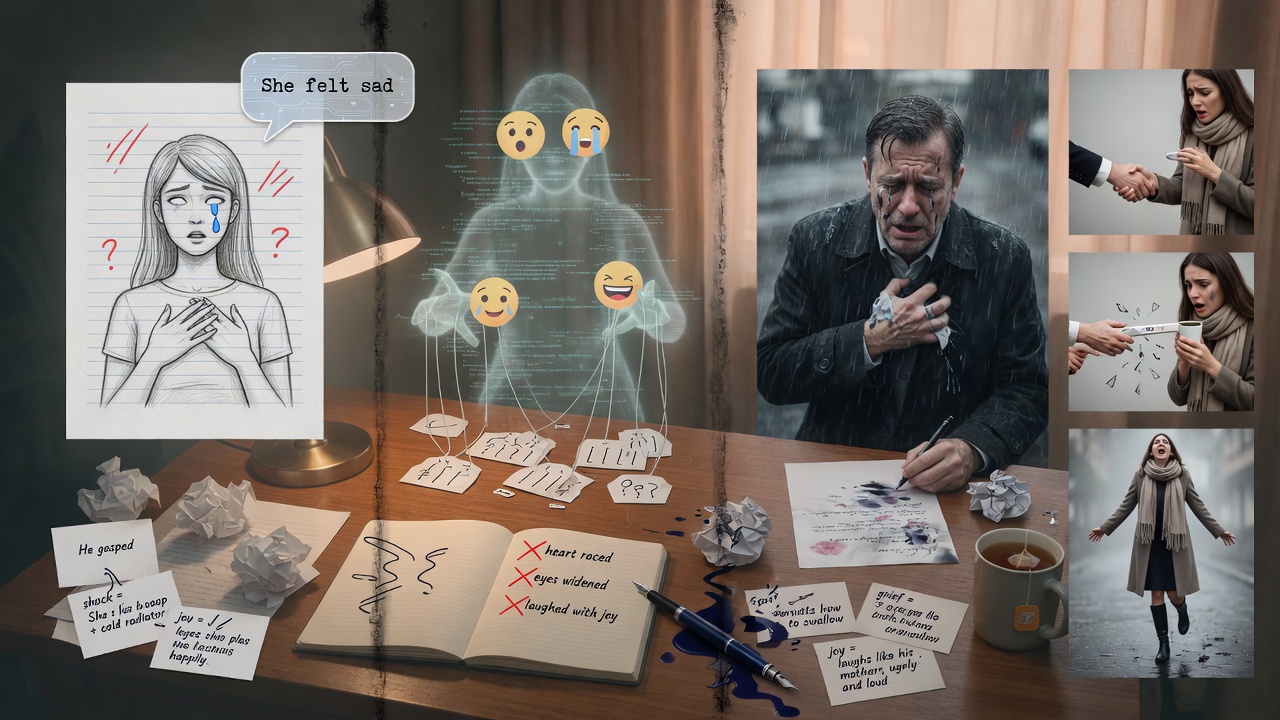
There's a moment most AI-assisted authors recognize. You've generated a solid scene — the setup works, the dialogue moves, the pacing feels right. Then your protagonist gets the news that her father is dead, and the AI writes: "She felt a wave of grief wash over her. Tears streamed down her face. She couldn't believe he was gone."
And you just... deflate. Because that's not a reaction. That's a Wikipedia summary of what grief looks like. It could belong to anyone — any character, any story, any genre. It has no weight, no specificity, no life. This is the flat reaction problem, and it's one of the most consistent weaknesses in AI-generated fiction.
The good news is it's completely fixable. Not by rewriting everything by hand, but by understanding why AI defaults to these expected beats — and learning how to prompt around that tendency in ways that pull out something real.
The Flat Reaction Problem: Why AI Defaults to Expected Emotional Beats
AI models are trained on enormous amounts of text, which means they've absorbed every conventional emotional description ever written. When something sad happens, sad things get written. When something frightening happens, the character's heart pounds and their mouth goes dry. It's not that the AI is incapable of nuance — it's that it defaults to the statistical center of how emotions are described in fiction. The most common response. The expected beat.
Think of it like asking someone to draw a bird. Most people draw a generic sparrow-shaped outline, not a cassowary or a specific heron they saw last Tuesday at the lake. The model does the same thing with emotion: it draws the average bird.
Generic reactions aren't wrong — they're just borrowed from everyone else's story instead of yours.
The deeper issue is that flat reactions erase character. A woman who grew up in a house where crying meant weakness doesn't weep when she hears devastating news — she goes very still and starts making a list of things to do. A war veteran who gets ambushed doesn't feel his "pulse quicken" — he drops to the floor and his hands start shaking because his body remembers the last time before his brain does. Those reactions tell us who these people are. The generic version tells us nothing except that the author needed to fill a beat.
When you write a book with AI, this problem compounds across an entire manuscript. Every character ends up reacting to shock with widened eyes, to fear with cold sweat, to love with a warm spreading in the chest. By chapter ten, your cast of supposedly distinct individuals all share the same emotional vocabulary. Readers feel it even when they can't name it.
Diagnosing Generic Reactions in Your AI Draft
Before you can fix the problem, you need to be able to spot it reliably. Flat reactions tend to cluster around a handful of tells.
The Anatomical Checklist
Scan your draft for these physical descriptors: heart pounded, tears streamed, stomach dropped, breath caught, hands trembled, face flushed, eyes widened. These aren't forbidden phrases — sometimes they're exactly right — but if they appear every time a character experiences strong emotion, you've found your flat reaction problem. The Cliché & Overused Phrase Finder can surface these fast across a full manuscript, which saves you from reading for them manually.
The Interchangeability Test
Copy a reaction out of context and ask yourself: could this belong to a different character in this book? Could it belong to a character in a completely different genre? If your hard-boiled detective and your teenage romance protagonist would react to danger with the same physical description, something's wrong. Good character reactions are non-transferable. They're fingerprints, not stock photos.
The "Then What" Gap
Generic reactions almost always stop at the emotion and skip the behavior. Real people do things when they feel things — sometimes the wrong things, sometimes strange things, sometimes things that contradict what they're feeling. If your character feels rage but the prose just describes the rage without showing what she does with it (snatches her keys off the counter and leaves, goes completely quiet, starts apologizing — whatever is true for her), the reaction is unfinished.
The Filter Word Finder is useful here too, because filtered reactions ("she felt that," "he noticed he was") add an extra layer of distance on top of an already-generic description. Double distance. Double flatness.
If you're working through a full revision pass and want a structured approach to catching these issues systematically, The Five-Pass Revision Order for AI-Assisted Novels puts emotional authenticity in the right sequence relative to your other edits.
The Specificity Fix: Prompting for Body, History, and Character Logic
The fix isn't to ask the AI to "write more emotionally." That makes things worse — you get florid generic prose instead of bland generic prose. The fix is to give the AI the three things it's missing when it reaches for the statistical average.
1. The Body's Specific History
Every body has a history. A character who was in a car accident at sixteen doesn't just feel fear in a moving vehicle — she feels it in a very specific place (maybe her right shoulder, where the seatbelt cut in). A character who learned to read emotion by watching a volatile parent's face goes still and watchful in conflict rather than emotional. When you tell the AI what this particular body has been through, it can generate reactions that are physically grounded in that history rather than in average-human-body templates.
2. The Character's Emotional Logic
Characters have internal rules, often ones they don't consciously know they have. Some people deflect with humor under pressure. Some go into caretaking mode when they're scared — busying themselves with others' needs to avoid their own. Some externalize; some internalize so hard you'd never know they were suffering. This is character logic, and it's the difference between a reaction that reveals personality and one that just signals an emotion label.
This is closely tied to having a detailed character document — if you haven't built one yet, How to Build a Story Bible That AI Models Actually Follow walks through exactly how to structure character notes in a way that AI can actually use when generating scenes.
3. The Specific Trigger (Not Just the Situation)
When the AI writes a grief reaction, it's usually reacting to "the situation" — someone died, therefore grief. But characters don't react to situations, they react to specific details within situations. It's not that her father is dead — it's that she finds out when she's in the cereal aisle and her phone rings. It's that the last thing she said to him was a lie. It's that she never learned how to be a daughter to him and now she never will. Tell the AI the specific trigger, not just the category of emotion.
Prompt Examples: Rewriting Flat Reactions with Character-Specific Filters
Here's where theory becomes practice. These are prompts you can adapt directly. Each one uses the three-part specificity approach.
Rewrite this reaction scene. The character is Mara, 34, a former ER nurse who left medicine after a patient she was close to died during her shift. She has trained herself to shut down emotionally in crisis — she gets very efficient, very practical, almost cold — but her hands shake when she's alone afterward. She's just been told her apartment building is on fire and everything she owns is gone. Write her immediate reaction (max 200 words) from close third person. Do NOT use: tears, heart pounding, stomach dropping, or any variation of "she felt." Show her behavior and body, not the emotion label.
Why this works: it gives the AI her professional background (shapes how she processes shock), her specific coping mechanism (efficiency over emotion), the physical tell that breaks through (shaking hands), the trigger, a word limit, POV, and a blacklist of the generic phrases she shouldn't get. The blacklist alone improves output dramatically. You can tweak the character details and the forbidden phrases for any character you're working with.
I need a reaction rewrite for this passage [paste passage]. The character is Dez, a 17-year-old boy who grew up with a mother who used silence as punishment. When he's hurt or scared, he doesn't go quiet — he does the opposite, he talks too much, deflects with jokes, gets inappropriately cheerful. He's just realized his best friend has been lying to him for months. The scene is from Dez's first-person POV. Write his internal experience and dialogue response together, making sure his behavior contradicts or masks what he's actually feeling. Keep it under 300 words.
The key element here is "behavior contradicts what he's actually feeling." That instruction alone breaks the AI's default habit of matching behavior to emotion label. Real people do this constantly — the laugh that covers devastation, the anger that covers fear. Asking for the contradiction produces reactions that feel human.
Take this scene where [character name] hears that her sister is getting married, and rewrite her reaction. Context you need: She's been in love with her sister's fiancé for three years and has never said anything. She's a professional mediator by trade — she helps people navigate difficult conversations for a living — so her default under pressure is to become extremely calm, focused, almost professionally warm. Her body: she holds her breath for a beat too long, always, before speaking. Write the scene from close third person. I want: one small physical tell, her professional mask going up, and one line of dialogue from her that sounds supportive but is doing three things at once.
This prompt introduces layered complexity through the "doing three things at once" instruction. AI is very good at generating subtext when you tell it to. If you're writing a romance novel with AI, this kind of prompting is especially valuable for charged scenes where characters can't say what they mean.
Building a Reaction Profile to Use Across Your Whole Draft
Fixing reactions scene by scene is effective but slow. The more powerful move is building a reaction profile for each major character — a short document that the AI can reference every time you generate scenes with that character.
A reaction profile is different from a general character bio. It's focused entirely on the how of emotional expression. Here's what to include:
- Default coping mode under stress — does she organize, deflect, withdraw, over-explain, go physical (cleaning, exercise, driving)?
- Specific physical tells — not "his hands shake" but "he taps his left thumb against his thigh in a specific rhythm, always the same one, and he doesn't know he does it"
- Emotional vocabulary she lacks — some characters can name fear but not grief. Some can show love only through action, never words. This limits and shapes their reactions.
- What emotion looks like from the outside vs. what it feels like inside — especially useful for close third person where you can access both
- One emotion she never shows directly — and what she shows instead
- Body memories — specific physical experiences from her past that get triggered in present situations
You keep this profile in your story bible and paste relevant sections into your prompts when generating emotionally charged scenes. If you're using character consistency tools to track whether your characters are staying true across chapters, a reaction profile feeds directly into that process.
For longer projects — especially if you're also managing fantasy worldbuilding or complex systems like in LitRPG writing — keeping the reaction profile as a named, referenceable document in your workspace means you're not rebuilding character logic from scratch every session.
The reaction profile doesn't constrain the AI — it gives it something specific to react from. There's a difference. Constraints produce generic work; specificity produces character.
One last thing worth mentioning: if you're reviewing AI-generated emotional scenes during beta reading, structuring feedback around reaction specificity is genuinely useful for your readers too. The Beta Reader Workflow for AI-Assisted Manuscripts includes ways to ask readers for this kind of targeted feedback rather than just "did this feel emotional?"
And when you reach the point of using editing passes to audit emotional authenticity across the whole manuscript, the Manuscript Cleanup Report can help you identify sections that might still carry those generic patterns before the book goes anywhere near a reader.
The most practical thing you can do right now: pick one scene from your current draft where a character reacts to something important. Paste it into your AI tool with this addition: "Rewrite this reaction. [Character name] never shows [name an emotion she would actually suppress]. Instead, under pressure, she [name her default coping behavior]. Her specific physical tell is [one concrete, non-clichéd thing her body does]. Do not use the words: tears, heart, breath, or stomach." That's your starting point. Run it once, see what comes back, then tighten the specifics until the reaction sounds like no one else in fiction but her.