The Night Before
By Murdok · 3,985 words · 17 min read
Sleep didn't come.
I'd been in the bunk for two hours with the facility's recycled air running its low, consistent push through the ceiling vents and the unit breathing in the dark around me, and nothing happened except that I became very aware of the seam in the wall panel twelve inches from my face and the way the ventilation cycle had a half-second hiccup every four minutes that nobody else seemed to notice.
The mission sheet was committed to memory. The approach geometry, the east entry, the thermal shadow, the sensor node at the forty-meter mark on the north approach that Denavi had logged this morning. Greel's 0600 brief was six hours out. There was nothing more to do with the information except let it sit, and letting it sit was not a thing I'd ever been particularly good at.
I got up quietly, pulled on my boots and vest, and went to the door.
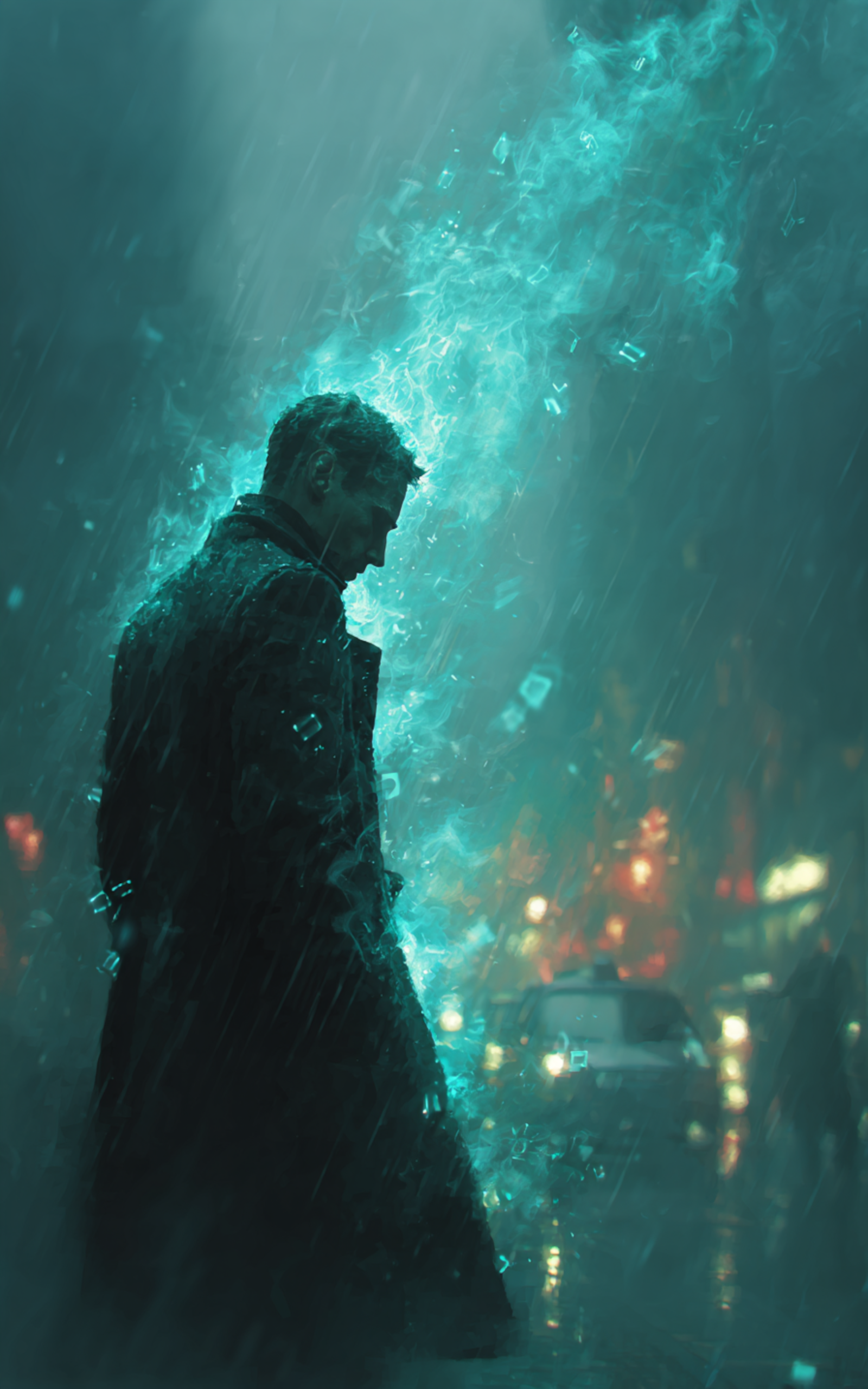
The forward position's interior was a converted materials processing facility, which meant most of the structural walls were reinforced ceramic composite that held temperature the way a root cellar held cold, and the corridors at this hour smelled like metal dust and the recycled-air sweetness that the Compact's life support systems produced, a smell I'd stopped noticing consciously about three weeks into the station but that came back as distinct in new environments. The corridor was lit at half-spectrum, the Compact's version of nighttime, which left everything in a bluish operational light that was bright enough to move through and dark enough to make you aware of your own edges.
The perimeter access was through the facility's east loading bay. I pushed through the bay door and stepped out onto the operations platform, which was about six meters of ferrocrete overhang before the ground dropped into the approach corridor's first contour.
Denavi was at the platform's far end, sitting on a supply crate with her back against a structural pillar, watching the eastern approach.
She didn't look over when I came out. "Couldn't sleep either," she said.
I pulled a second crate into a position where I could see the approach and sat down. The air outside was cold in the way industrial corridors get cold, not weather-cold but contained-cold, the temperature that settles into ferrocrete and stays. The approach corridor stretched out about two hundred meters before it bent north around a processing block. There was nothing moving in it.
"I usually sleep fine before a hunt," I said. "It was always the night before deer season closed that I'd lie there."
She looked at me. In the half-spectrum light her face was a set of planes and shadows, the cropped hair and the angular jaw that made her look younger than four months in this sector had made her act. "The last night before it ends," she said.
"Or before it starts, depending on the year."
She turned back to the approach. "I've been in this corridor since initial deployment. The first month I slept fine. After the second engagement I stopped sleeping until about two hours before dawn, every night. Now I sleep fine again." She paused. "Which either means I've adapted or I've stopped caring which, and I don't spend much time figuring out which it is."
"Probably both."
"Probably." She pulled her knees up slightly, resting her forearms across them. "You ran the east entry approach data with Greel this afternoon."
"He accepted the east entry."
"I know. He came and told me." She said this without any particular expression. "He doesn't usually do that. I've been giving him perimeter intel for four months and he runs it through his own assessment and tells me what he decided. Tonight he told me what he decided and why."
I thought about what that meant and concluded it probably meant Greel was adapting his unit's communication patterns before a mission where the person who'd contributed the most to the approach geometry needed to know the full picture. But I kept that to myself.
"He's a good unit commander," I said.
"He's kept six of us alive in a sector that's been killing Compact soldiers for eight months." She said it flat. "Yes. He's good."
The wind moved through the approach corridor and pushed something metallic and small, a fragment of processing debris, across the ferrocrete about fifty meters out. The pattern recognition tracked it automatically: small object, thermal signature minimal, trajectory consistent with wind vector, not purposeful movement. It filed and closed without me asking it to, the way you scan a tree line out of habit.
"Can I ask you something," I said.
"You're going to ask about what it's like to fight them," Denavi said. "The gifted ones."
I looked at her.
"You've been watching all of us since you arrived," she said. "But you watch me differently. You're working out what I know that isn't in the briefing." She wasn't saying this with any particular edge. Just accurately.
"What's it like," I said.
She was quiet for a moment. The approach corridor was still empty and the half-spectrum light made the ferrocrete walls look like the inside of a cave. "Faster," she said. "That's the first thing, and everyone says it, and it's true. But the fast is different from what you expect. It's not that they cross distance faster, although they do. It's that they read what you're doing and respond before you've finished doing it. Like they're watching something about you that isn't your body."
"Pattern recognition," I said. "Reading intent from movement."
"Is that what it is." She looked at me. "Is that what yours does."
"Some version of it."
She turned back to the approach. "Theirs is aggressive. It reads you and uses the read to get inside your decision loop. It's not like fighting someone faster. It's like fighting someone who already knows the conversation." She paused. "The second thing, which nobody says first because the speed gets in the way of noticing it, is that they're more predictable than unmodified soldiers."
I waited.
"With an unmodified soldier, the variance is random. You don't know what a scared person will do or a tired person or someone operating on bad information. That randomness is a tactical problem." She looked at her hands. "With a gifted soldier, the variance is systematic. The enhancement creates grooves. They move toward optimal positions by a consistent logic, and if you've seen enough of them, you start to see the grooves. Four months gives you a lot of repetitions."
"What do the grooves look like."
"They compress toward high-density cover and elevated angles. Every time. Even when a lower-angle position would give them a better engagement geometry, they take the elevation. Even when they're not taking fire, they'll move toward the most defensible local position rather than the most tactically flexible one." She considered this. "Like they're always pre-positioning for the worst case, and the worst case is always the same shape in their mind."
"The enhancement reads stress patterns and amplifies them," I said. "If their stress response is built around finding cover and holding position, that's what gets amplified."
"It makes them hard to kill and easy to predict." She shrugged. "Greel figured out the prediction part about six weeks in. The problem is we can't capitalize on it well because we don't have anything that outranges the speed advantage."
The approach corridor was still empty. Somewhere behind the north perimeter wall, the Dominion's perimeter patrol was making its eight-minute interval. Five minutes on the east. I pulled the numbers without reaching for them.
"The east entry secondary," I said. "Your read is that it's a sensor relay rather than a fire position."
"Based on the perimeter shortening after the last engagement." She nodded. "They added attention to the east side after we came in on the north. If they were adding a fire position they'd have put it where it covered both the east and the approach pad, and they'd have lengthened the north perimeter interval because they wouldn't need walkers there. The interval on the north didn't change. So they added something to the east that takes attention to maintain but doesn't free up the north coverage."
"Sensor relay that needs manual attention."
"Or something that breaks down a lot. Either way it's not a gun."
"Greel accepted the east entry analysis," I said.
"He accepted it," she said, "and you're still out here at 0200 checking it."
I didn't answer that, because she wasn't wrong.
The processing crate was cold enough to feel through the vest material. I shifted my weight and the pattern recognition did its automatic ambient survey: the approach corridor's two visible thermal signatures were both geological, the ferrocrete holding warmth from whatever processing activity had run through here hours ago. No biological heat signatures in range. The Dominion patrol was outside the current perimeter.
"The sensor node they added to the north approach," I said. "Forty-meter mark."
"New in the last four days."
"They're watching the same geometry they won on last time. Which means they either expect us to repeat the approach or they want us to see the node and avoid the approach, and the east entry is the intended redirect."
She was quiet for a moment. "Or they added the sensor because the north approach is still the objectively superior entry geometry and they want good coverage of it regardless of what we intend."
"Yes," I said. "That's also possible."
"Greel thinks the second option. He accepted the east entry because the thermal shadow and the crossfire problem with a secondary fire position outweigh the sensor coverage advantage on the north, not because he thinks they're steering us."
"The east entry is still the better call."
"Probably." She let out a breath that was visible in the cold air. "In four months I've been probably right about maybe sixty percent of my reads on their defensive geometry. The forty percent is three dead and two rotations out of theater." She said it the way Greel said names: flat, transferred, not decorated. "The east entry is probably right. Probably isn't one hundred."
"Nothing is one hundred," I said.
"No." She stood up from the crate and stretched her back, one hand pressed to the base of her spine the way you do when the cold has settled in. "I'm going to make another pass of the east perimeter before I try to sleep. The five-minute interval doesn't come up for another twenty minutes so I should have a clean look at the secondary position's approximate location."
"What are you expecting to see."
"A thermal variation in the wall composite at about thirty meters into the east approach. If it's a sensor relay the active components run warm enough to show on a direct visual sweep in these temperatures." She picked up a small thermal scope from beside the crate, the compact kind that fits in one hand. "I've been out here every night for a week and I haven't gotten a clean look yet. Wind pattern from the processing block pushes ambient heat across the east approach between 0200 and 0300 and masks it. But it's clear tonight."
She went down the platform steps toward the approach corridor. She moved the way she always moved: quietly and without looking at where her feet went, her attention ahead.
I watched her go and then turned back to the approach.
The pattern recognition was running its idle sweep, tracking the corridor's ambient data the way it always did when I wasn't actively directing it anywhere. Three months ago it had felt like a second set of senses layered over the first, distinct and identifiable. Now it was closer to the way peripheral vision works: present, continuous, available without being engaged. I noticed its absence in my pre-integration memories the same way you notice a missing tooth with your tongue, that specific shape of something that used to be there and is gone.
Sonn had said, in the calibration sessions after the second integration phase, that this was the expected progression. The system integrating into baseline function rather than running as a distinct overlay. The words had been careful and the implication had been positive. What Sonn hadn't quite said, and what I'd been sitting with for the last week, was that there wasn't really a line anymore between my perception and the system's output. It wasn't that I was using a tool. The tool was running.
I thought about Denavi's description of the gifted Dominion soldiers: the grooves, the consistent movement logic, the compression toward elevated cover. The enhancement amplifying their stress responses into systematic behavior. I thought about what my own stress responses looked like to the system. What grooves it was cutting in me.
The answer I kept coming back to was: terrain assessment, exit route planning, patience over speed. The same things Durrik had flagged in the first assessment battery as the instincts worth keeping.
My grandfather had built those grooves. Forty acres on a ridge in Cocke County and twenty years of pre-dawn walks through timber and field edge, and he'd spent most of that time not talking, just walking, and eventually I'd understood that he was teaching me to look at ground rather than at what was on it. You look at ground, you understand movement. You understand movement, you understand intent. He'd said that once, near the end, in the matter-of-fact way he said things that he'd been sitting with for fifty years.
The Aeluun system hadn't given me that. It had found it and built on it. Sonn had said so in the Chapter 5 terms: the system learns how the user solves problems and amplifies that. What I was becoming was specific to what I already was.
I didn't know whether that was a comfort. I'd been moving too fast to decide.
Denavi came back up the platform steps twenty minutes later. She had the thermal scope in her hand and an expression that had resolved into something.
"Secondary position is a sensor relay," she said. "Thermal variation at thirty-two meters into the east approach, wall composite on the right side. Active electronics running warm. The housing is integrated into the wall, not surface-mounted." She sat back down on the crate. "They put it in permanently. This isn't a portable unit they moved over after the last engagement. They built it in."
"Which means they had the east approach prioritized before the last engagement," I said. "They just hadn't activated it or we'd have seen the thermal signature earlier."
"Or they activated it when they extended the perimeter interval and we didn't have the right observation angle until tonight."
"Either way, it's been their priority approach longer than we thought."
She put the scope on her knee. "The sensor relay won't cover the approach geometry below the wall composite's thermal signature. The east entry's shadow zone is still real, it's just smaller than I thought. About twelve meters of approach before the relay's effective sweep picks us up."
"Twelve meters is enough if we use it correctly."
"We need to be below the relay's sweep angle before it picks up biological signatures. That means the drainage channel runs to the wall composite, and then we move along the wall to the entry." She looked at the approach corridor. "That's technical movement. Close to the wall, minimizing vertical profile, no light signature."
"How much of the unit can do that in the dark."
"Greel, Maret, Ollen." She considered. "You, probably. Ilden is a question mark." She paused. "Denavi can do it." The third person was flat, a self-assessment rather than a boast.
"We brief Greel at 0600."
"Yes." She put the scope in her vest. "The east entry is still the better call. It's just more specific than I initially estimated."
We sat for a while without talking. The approach corridor was empty and the half-spectrum light ran blue along the ferrocrete walls. At some point a perimeter walker passed across the north approach, visible for a second at the corridor junction before disappearing. Five-minute interval on the east. The next one would come at 0212.
I ran through the integration's current state the way I'd check a rifle before a hunt: systematically, without sentiment, looking for anything that had shifted or needed attention.
Pattern recognition: running at baseline. Ambient sweep in range, reading the approach corridor, the perimeter walker at the junction, the two geological thermal signatures in the ferrocrete. No anomalies.
Positional tracking: the unit distributed through the facility's interior, Greel in the command bay, Maret in the east bunk room, Ollen closest to the equipment staging area. Not precise, more like a general distribution map that updated when people moved. This had been the first thing the integration had produced and it was the most automatic: I always knew, approximately, where the people around me were.
Reaction time: no way to assess static. In motion it had been measurable in the training exercises, Durrik's specific observation that I was consistently faster in close-range positioning decisions than I should be at my development stage.
The predictive element was the part Sonn kept flagging in the calibration data as "emerging" and that I'd started noticing as a feeling rather than a system function: when someone moved with intent, I sometimes got a read on the intent before the movement completed. Not reliable. Not something I'd trust in a firefight yet without backup. But present.
Sonn had said, at the last calibration session before we deployed to the Caleth Corridor: "The pattern recognition is consolidating into stable channels. The emerging predictive function is the next phase's primary indicator. I want to know immediately when you have a clear instance of it in field conditions."
When, not if. Same thing Sonn always said.
The problem with the predictive element was that it wasn't something I could demonstrate or explain cleanly. It was closest to the way you learn to read a deer trail: after enough observation, you stop seeing where the deer went and start seeing where the deer was going. The trail gives you the trajectory and the trajectory gives you the destination and the destination gives you the timing. It's not a calculation, it just happens when enough pattern has been accumulated.
I didn't know how useful that was going to be against Dominion soldiers whose patterns I hadn't accumulated yet.
That was the honest answer, and I'd given it to Greel in those terms: reliable range and read quality may be lower against highly developed integration signatures. The calibration exercises had been against Compact training-grade opposition. The Dominion soldiers in this sector were at the top end of what Eshet's forces had fielded anywhere, which put them beyond anything I'd been assessed against.
The east entry perimeter walker crossed the junction at 0212, right on the five-minute interval. Denavi clocked it without moving.
"That's consistent for six days running," she said. "No variance."
"Confident in the route."
"Or automated. Some of their perimeter units are running drone walkers that mimic biological movement signatures well enough to fool standard thermal arrays." She glanced at me. "Can your read differentiate."
"Biological from mechanical?" I considered it. "In the calibration sessions, yes. The movement pattern is different enough that the read flags it. I haven't had a confirmed drone-walker in field conditions to verify."
"Worth knowing before you call contact in a live situation."
"Yes." I pulled the mission sheet from my vest, unfolded it, and read through the notation in the margin: east entry, thermal shadow twelve meters, relay at thirty-two meters wall composite right side, biological profile required for shadow approach. I added: drone-walker possible on east perimeter, verify biological signature before call.
"You carry a paper sheet," Denavi said.
"Tactical display goes down, paper doesn't."
She looked at the sheet. "Vasht's annotation at the top."
"Standard approach fails at first turn." I folded it and put it back. "She was right."
Denavi was quiet for a moment. Then: "When I came in on the north approach four months ago, we had the same quality of mission brief. Good intel, solid geometry on paper. The thermal differential on the north entry should have given us adequate cover to the drainage channel." She stopped. "Orel Tavan ran the approach correctly. He did everything the brief called for. The gap in the drainage channel's cover was eighteen inches wider than the survey data showed. Eighteen inches." She looked at the approach corridor. "Desh Maruk went back for him."
I sat with that.
"The brief is good," she said. "The east entry is good. The thermal shadow analysis is good. Twelve meters of shadow approach to the wall, relay at thirty-two meters, clean entry. That's real." She put her hands on her knees. "The gap you don't know about is always eighteen inches wide."
"Which is why we move in a way that gives us options when we find it," I said.
"Yes." She stood. "That's why."
She went back inside. The door made the soft pneumatic sound of the facility's pressure seal re-engaging and then I was alone on the platform with the approach corridor and the half-spectrum blue light and the perimeter walker making its five-minute circuit somewhere beyond the east junction.
I ran the integration through one more check, methodical and top to bottom. Pattern recognition at baseline. Positional tracking running. Predictive element quiet, which was normal outside of active engagement, it needed input to produce output and the approach corridor's stillness wasn't giving it enough to work with.
Everything was where it should be. Everything was as stable as Sonn had confirmed in the last calibration session.
I thought about the forty acres in Cocke County. I thought about the ridge in the dark before dawn, the specific way sound carries in cold November air, and the deer stand my grandfather had built from white oak planks and hung eight feet off the ground in a fork of a tulip poplar at the field edge. I thought about the morning three months ago that had been my last morning in that stand, three hours in with the rifle across my knees and the world entirely regular and then entirely not.
That morning felt like it belonged to someone else's memory. Not in a dramatic way. Just in the way that memories from before a significant change in routine feel: accurate but distant, like pulling out a photograph of a place you used to live.
I didn't spend long there. I pulled the mission sheet out again and added one more notation at the bottom, below the approach details: east entry approach: maintain wall contact, minimize vertical profile, move on point, no spread until past relay at 32m.
Clean movement, specific spacing, right sequence. The kind of problem I could solve by thinking about it clearly rather than by knowing the answers in advance.
Denavi had said the gap you don't know about is always eighteen inches wide. That was true. The response to that truth wasn't to find all the gaps before you went in. It was to move in a way that when you found one, you had room to adapt.
I folded the sheet, put it away, and stood up from the crate.
The east approach was empty and quiet. The perimeter walker would make its circuit again in three minutes. The relay at thirty-two meters in the wall composite was running warm enough to see on thermal but not warm enough to read on standard arrays in this thermal environment. Twelve meters of shadow approach if we moved correctly.
0600 brief in five hours. Thirty-six hours from now reduced to six hours now reduced to a briefing and then the ground and then the answer to every question that the data couldn't close.
I went back inside.

No comments yet. Be the first to share your thoughts!