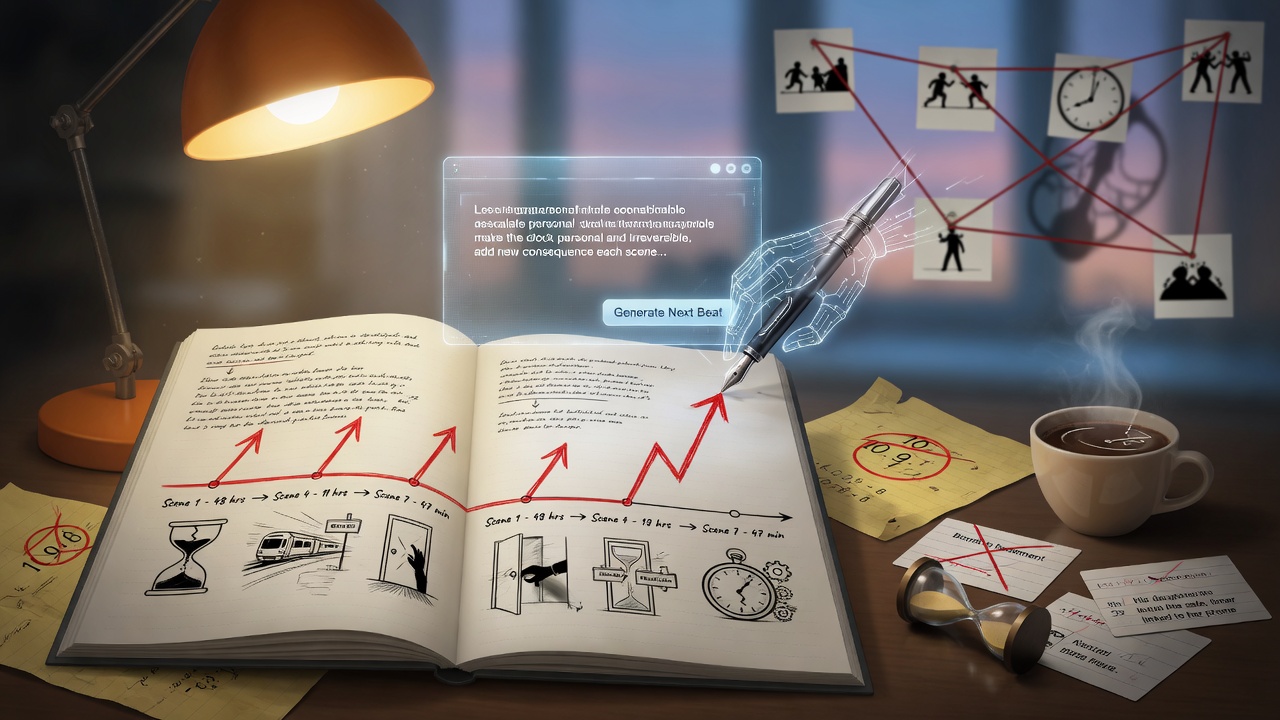
A deadline sitting in the background of your plot is just a clock on the wall. Nobody in the story acts differently because of it. That's the trap most AI-drafted thrillers, heist novels, and disaster plots fall into — the countdown gets mentioned ("only 72 hours left!") but the actual scenes don't behave like time is running out. Tension needs mechanics, not mood lighting. Here's how to get an AI model to actually build escalation into your ticking-clock plot, scene by scene, instead of just repeating the deadline like a nervous tic.
Why Most AI-Generated Deadlines Stall Out (The Flat Countdown Problem)
Ask a model to "raise the stakes" and it will almost always reach for volume, not structure. Louder threats. Bigger explosions. More people screaming the countdown out loud. What it won't do on its own is connect the passage of time to a change in what's possible for your characters. That's the actual definition of tension escalation: with each tick of the clock, options close. Doors that were open in chapter three are welded shut by chapter nine.
The flat countdown problem shows up in a specific, recognizable pattern. Chapter one: "You have 72 hours." Chapter five: "We're running out of time!" Chapter twelve: "There's only a few hours left!" Notice nothing has actually changed except the number. The stakes at hour 70 and the stakes at hour 4 read almost identically because the model never attached consequences to the delay itself — it just recycled urgency as a vibe.
A ticking clock only works if every scene answers one question: what did the delay just cost us that we can't get back?
Fixing this isn't about telling the AI to "make it more tense." It's about giving it a structure to escalate against — a framework of costs, thresholds, and reversals that it can actually execute against, scene by scene. That's what the rest of this guide walks through. If you haven't already built a story bible, this is a good moment to start one, because your ticking clock needs to be a tracked variable, not a mood. How to Build a Story Bible That AI Models Actually Follow covers how to set up that kind of tracked detail so the model doesn't lose the thread across fifteen chapters.
Mapping Your Ticking Clock to Specific Plot Beats
The single most useful thing you can do before drafting is force yourself — and the AI — to answer this: what specifically gets worse at each major beat if the characters don't act? Not "things get worse" in the abstract. A specific, nameable cost. A resource depleted. A person harmed. A door closed forever.
Start by laying your plot beats out using something like the Three-Act Beat Sheet or the Scene Planning Worksheet, then run a prompt that forces cost-mapping onto each beat before you write a single word of prose.
I'm plotting a thriller where a bomb disposal team has 6 hours to find and disarm four devices hidden across a city before a political summit. Here are my act breaks: [paste beat list]. For each beat, tell me specifically what irreversible cost occurs if the team is delayed by even 20 minutes at that point in the story — not "things get worse" but a concrete, specific loss (a location evacuated too late, a witness who dies, evidence destroyed, a device relocated). Also tell me what NEW constraint that cost creates for the next scene — something that limits the team's options going forward. Format as a table: Beat / Cost of Delay / New Constraint Created.
This works because it forces cause-and-effect logic instead of atmosphere. The model has to invent a mechanism, and mechanisms compound. Once you have that table, every scene has a built-in job: show the cost landing, and show the new constraint narrowing what your characters can do next. Tweak the "20 minutes" figure to match your actual clock granularity — hours for a heist, days for a plague outbreak, minutes for a hostage situation.
If your book leans fantasy and your ticking clock is tied to a spell, ritual, or magical deadline, this same cost-mapping trick needs to respect the rules you've already set for how magic behaves — otherwise the escalation feels arbitrary. Fantasy Magic Systems: Constraints AI Will Respect is worth reading alongside this if your clock is magical rather than mechanical, because the same discipline — specific, bounded, costly consequences — applies to both.
Using Escalation Prompts to Force Each Scene Closer to the Deadline
Once you have your cost map, the next failure mode is repetition without progression — the AI writes five scenes in a row that are all "tense" at the same pitch. What you want instead is a staircase. Each scene should be measurably tighter than the last: less time, fewer options, higher cost of failure, smaller margin for error.
The trick is to stop asking for "more tension" and start asking for a specific delta between this scene and the last one.
Here's the scene I just wrote (pasted below) where the team disarms device #2 with 3 hours 40 minutes left on the clock. Write the next scene where they're now hunting device #3 with 2 hours 10 minutes left. Make sure this scene is objectively tighter than the previous one in at least three ways: (1) they have fewer resources available than in the last scene — reference specifically what they've used up or lost, (2) at least one option that was available in the previous scene is now closed off and a character should acknowledge this out loud or in narration, (3) the cost of failure at THIS specific device is worse than the cost at the previous one — spell out why. Do not just repeat the same urgency language from the last scene; escalate the actual stakes.
This forces the model to treat scenes as a sequence with memory rather than independent set pieces. Notice the prompt asks for three concrete deltas — resources, options, cost — because vague instructions like "escalate" get you adjectives, while specific instructions get you plot mechanics.
You can also run an audit pass across a full draft once it exists, which pairs well with The Five-Pass Revision Order for AI-Assisted Novels — ticking-clock escalation is exactly the kind of structural issue that's easier to catch in a dedicated pass rather than while you're still drafting forward.
Read through these six chapters (the full "manhunt" sequence, pasted below) and build me a tension audit. For each chapter, note: the time remaining on the clock, the stakes if this chapter's goal fails, and a 1-10 tension score based on how narrow the characters' options feel. Flag any chapter where the tension score is equal to or lower than the previous chapter's score — those are places where the clock isn't actually escalating even though time is passing. For each flagged chapter, suggest one specific plot change that would tighten it.
This second prompt is diagnostic rather than generative, and it catches the flat spots you'll otherwise miss because you're too close to the draft. Running this kind of audit is also a good use case if you're working through how to edit a book with AI more broadly — pacing problems hide in plain sight until something forces you to score them scene by scene.
Building False Relief and Reversals
A clock that only ever tightens becomes numbing — readers adapt to constant pressure and stop feeling it as pressure. The fix isn't to loosen the stakes; it's to give readers a breath, then snap it shut tighter than before. This is the false relief beat: a moment where it seems like the team caught a break, bought time, or found an easier path — and then the AI needs to reverse it in a way that makes the situation worse than if the relief had never happened.
The best reversals don't just remove the relief — they charge the characters for having believed in it.
This is a beat AI models genuinely struggle with unprompted, because they tend to either keep the relief (undermining your tension) or reverse it too gently (a minor setback instead of a real gut-punch). You need to ask for the reversal explicitly and specify how much worse things need to get.
Write a scene where the team believes they've found a shortcut — a maintenance tunnel that will save them 45 minutes getting to device #4. Let them commit to this plan and feel genuine relief for a page or two. Then reveal a reversal: the tunnel is flooded/blocked/guarded (pick whichever is most consistent with the city setting established in chapter 2), which costs them not just the 45 minutes they hoped to save but an additional 20 minutes on top of that, AND removes their backup route as an option for the final device. Make sure a character explicitly registers how much worse this is than if they'd never found the tunnel at all — I want the false hope to have a cost, not just be neutral.
The instruction to make false hope cost something — rather than simply be a wash — is what separates a real reversal from a flat plot twist. Vary where you place these: early false relief resets reader expectations for the middle stretch, while a late false relief (in the final act) is often the most gutting because there's no runway left to recover.
If you're running a series or a long single novel with multiple ticking clocks stacked on top of each other, keeping track of which reversal belongs to which subplot is where a character consistency pass earns its keep — it's easy for an AI model to accidentally resolve a reversal for the wrong character or timeline when there's more than one clock running.
A Worked Example: From "Save the City in 3 Days" to a Scene-by-Scene Tension Ladder
Let's actually build one. Say your premise is the vague version every disaster-thriller draft starts as: a virus will hit critical spread in 72 hours unless the protagonist's team finds a cure. That's a countdown, not a plot. Here's the prompt sequence to turn it into a ladder.
My premise: a research team has 72 hours to synthesize a cure before a virus reaches uncontainable spread in a major city. Build me a 10-beat tension ladder from hour 72 to hour 0. For each beat, give me: the hour mark, what the team is trying to do, what specifically has gotten worse or closed off since the last beat (be concrete — a lab destroyed, a key scientist infected, a sample contaminated, political interference locking them out of a facility), and one moment of false relief to plant somewhere in beats 4-7 that I can reverse later. Make the last three beats the tightest — options should feel almost gone by beat 8.
What you get back from a prompt like this isn't prose — it's a skeleton you can hand to the AI one beat at a time for actual scene drafting, using something like an AI book outline as the backbone. The reason this works better than "write me a pandemic thriller" is that you've pre-loaded the escalation logic before a single word of narrative gets generated, so the model has something to escalate against rather than inventing tension from nothing at hour 40.
From there, draft beat by beat using the scene-tightening prompt from earlier, checking after every two or three beats that the stakes table still holds — that beat 6 really is worse than beat 5, not just louder. This is also where it helps to sanity-check pacing against your actual chapter lengths; the Chapter Word Count Planner can keep you from accidentally spending too many words on early, lower-stakes beats and rushing the tightest ones at the end, which is a common failure mode when a draft gets front-loaded with worldbuilding.
One more thing worth doing at this stage: read the ladder back and ask whether the false relief beat you planted actually gets reversed with enough cost, and whether your final beat resolves the clock in a way that feels earned rather than convenient. If you're writing genre fiction with its own escalation conventions — romance's will-they-won't-they clock, for instance — the same cost-mapping logic applies, just aimed at emotional stakes instead of physical ones; Romance Beat Sheet: Where AI Drafts Usually Break walks through the equivalent problem for that genre, and the parallel is worth studying even if you write thrillers, because escalation logic is escalation logic regardless of genre.
The Takeaway
Before you draft your next ticking-clock scene, build the cost table first: what specifically breaks, closes, or dies if this beat runs long, and what new limitation does that create for the next one. Then use the three-delta prompt — fewer resources, closed options, higher cost — every time you ask the AI to move a scene closer to zero. That's the whole method. It's not about writing "more tense" prose; it's about giving the model a ladder with real rungs, so the clock in your book does what clocks are supposed to do: make every remaining minute cost more than the one before it. If you want more structural prompting techniques like this one, the rest of the writing guides library covers similar scene-engineering problems across genre and craft.