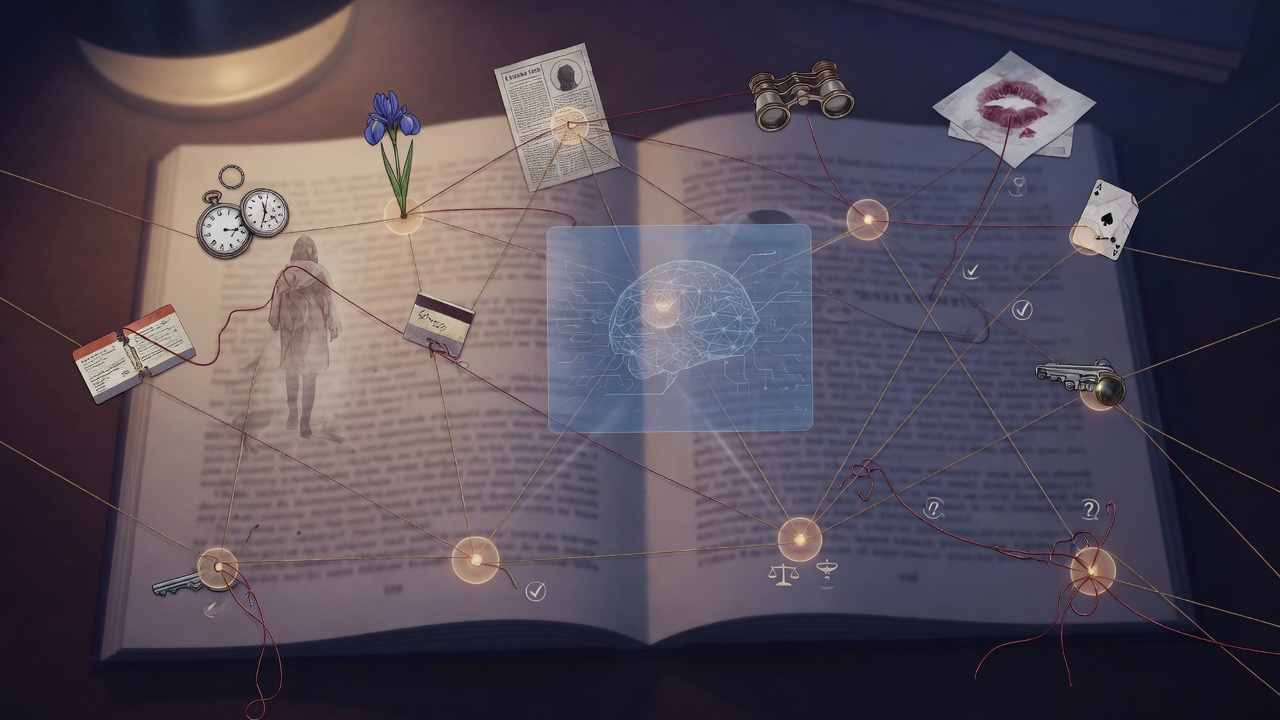
How to Use AI to Plant a Clue Network Across Your Novel
A great twist doesn't surprise the reader — it surprises the character. The reader, if you've done your job, gets that electric moment of recognition: it was there the whole time. That feeling is the whole game. And it's one of the hardest things to engineer in a novel, because you're simultaneously hiding information from a reader who's paying close attention while also making sure that same information is there to be found on a reread.
Most writers who struggle with foreshadowing aren't struggling with creativity. They know what their twist is. They know roughly what kind of clues would support it. The problem is distribution — knowing when to plant, how deeply to bury, and whether what they've already written accidentally gives too much away or leaves a gaping hole. That's a structural problem, and structure is exactly where AI can pull real weight if you know how to prompt it.
If you're already working on a longer manuscript and want a broader method for using AI across a full draft, the how to edit a book with AI framework is a good foundation. But this guide is specifically about clue architecture — designing a network of planted information that pays off without telegraphing. Here's the system I use.
Why Clue Networks Fail: The Two Mistakes Writers Make When Planting Foreshadowing
The first mistake is front-loading. You know the twist, so you write toward it from page one, and without realizing it, you've planted three strong clues in chapter two, two more in chapter four, and then basically handed the reader a signed confession by the midpoint. The twist lands, but it lands with a thud because half your readers saw it coming an hour ago.
The second mistake is the opposite: gap anxiety. You get so worried about telegraphing that you barely plant anything. You save the clues for the final act and call it "economy." Then the twist lands and readers feel cheated — not surprised. "There was no way to know that" is the death knell of mystery writing.
A clue network isn't just a list of hints. It's a rhythm — a specific distribution of information across the full story that creates the sensation of inevitability in hindsight without creating predictability in the moment.
Both mistakes share a root cause: writers are too close to the story to see what the reader actually receives. You know the answer, so you can't reliably judge which clues land as subtle versus which ones scream. AI can't fully replace a beta reader for this — nothing can — but it can simulate naive reading in a way your own brain simply won't do anymore after the twentieth revision pass. More on that in section five.
How to Prompt AI to Map Your Existing Draft for Unintentional Reveals and Gaps
Before you plant anything new, you need to know what's already in the ground. Most writers skip this step. They think in terms of what they intended to plant, not what they actually wrote. Those two things are often very different.
The audit prompt is your first tool. Feed the AI a summary of your twist (or the full chapters if your context window allows), tell it what the reader knows at each stage, and ask it to do two jobs at once: flag moments that might tip the reader off too early, and flag structural gaps where the payoff is promised but the setup is missing.
I'm writing a psychological thriller. The twist is that the detective's trusted partner, Lena, has been feeding information to the killer — not for money, but because the killer is her biological father, a fact she discovered three months before the story starts. The reader doesn't learn this until chapter 22.

Below is a chapter-by-chapter summary of chapters 1–15. Please do two things:

1. Identify any moments where Lena's behavior, dialogue, or described emotional reactions might read as suspicious to an attentive reader BEFORE I want them to be. Flag these as "premature tells."

2. Identify any chapters where Lena is absent from scenes she logically should attend, or where her motivations are unexplained in ways that create confusing gaps rather than productive mystery. Flag these as "setup gaps."

For each flag, note the chapter, describe what the specific problem is, and suggest whether I need to revise, remove, or add material.

[PASTE CHAPTER SUMMARIES HERE]
This works because you're giving the AI two different lenses simultaneously: over-exposure and under-exposure. Most prompts only ask one question. The "premature tell" list will often surprise you — things you wrote as character quirks read as blinking red arrows. The gap list will show you places where you've left the reader with nothing to anchor a later revelation to. Run this audit before you add a single new clue. You'll save yourself planting things in the wrong chapters.
If your draft is long and you're working in chunks, the The Five-Pass Revision Order for AI-Assisted Novels gives a useful sequence for how to stage this kind of structural work across multiple sessions without losing thread.
Building the Clue Inventory: Using AI to Generate a Tiered Plant-and-Payoff Matrix
Once you know what's in your draft, you need a systematic picture of what your clue network should look like when it's complete. This is where the plant-and-payoff matrix comes in.
The idea is simple: you're going to tier your clues by weight. Heavy clues are the ones a careful reader can piece together — they're real evidence. Medium clues are behavioral or atmospheric — suggestive but deniable. Light clues are almost subliminal — a character's micro-reaction, a word choice, a detail in a setting description that will only read as significant in retrospect. You need all three tiers, distributed across the full manuscript, with the heavier clues landing in the second half.
I'm building a clue network for my mystery novel. Here are the facts:

- The twist: Marcus, a grief counselor, is the arsonist. He burns houses where abuse occurred because his childhood home was never burned — his father was never caught.
- The twist is revealed in chapter 19 of 22.
- Key facts that COULD be clued: Marcus knows specific details about fire behavior that a counselor wouldn't normally know. He always steers clients away from reporting to authorities. He has scars on his forearms he explains as a car accident. He keeps a particular brand of lighter fluid in his desk drawer. His dog is named for a firefighter who died in a real historical fire.

Please generate a plant-and-payoff matrix with three tiers:

TIER 1 (Heavy / Direct Evidence): 2–3 clues a careful reader could piece together into a definitive accusation. Suggest which chapters these should appear in (second half of the book, chapters 12–19).

TIER 2 (Medium / Behavioral): 4–5 clues that are suggestive but could be explained away. Suggest placement across the full manuscript.

TIER 3 (Light / Subliminal): 5–6 clues that only register on reread. Suggest placement in early chapters (1–8).

For each clue, write: the clue itself, how it would appear on the page (a line of dialogue, a prop, a behavior, a setting detail), and what chapter range it belongs in.
The output from this prompt gives you an actual working document — your clue inventory. Save it alongside your story bible so you can track which clues you've actually written into the draft versus which ones are still planned. A matrix sitting in a doc somewhere doesn't help you if you lose track of what's been executed.
One thing to watch: AI will sometimes generate clues that are clever in isolation but tonally wrong for your book. A literary thriller and a cozy mystery both use clue networks, but the delivery mechanism is completely different. Always gut-check each generated clue against your specific narrator's voice and the chapter's point-of-view character. If your POV character wouldn't notice the detail, the clue can't land there — or you need to find a naturalistic reason they would.
Distributing Clues Without Signposting: Prompts That Bury Information in Character Behavior and Setting
This is the craft problem that trips up even experienced writers. You know what information needs to be in chapter seven. The question is: how do you put it there without putting a spotlight on it?
The answer is almost always to attach the clue to something the reader is already watching. If there's emotional tension in a scene between two characters, a behavioral clue embedded in that tension will slip past a reader's analytical brain because their emotional brain is busy. Setting descriptions work similarly — a reader in a chase sequence won't interrogate why you mentioned the window latch in the kitchen. They'll just absorb it.
The prompt below is the one I find most useful for this specific problem. You give the AI the clue you need to plant and the scene it needs to live in, and ask it to generate three versions of how that clue could be embedded:
I need to plant a clue in chapter 6 of my thriller without signposting it. Here's the scene context: Detective Rhea is interviewing a neighbor, Mrs. Calloway, about the night of the disappearance. The scene is tense because Rhea is being polite but pushy, and Mrs. Calloway is nervous and trying to be helpful without getting involved.

The clue I need to plant: Mrs. Calloway uses the past tense when referring to the missing woman — "she WAS very quiet" — before anyone has told her the woman is dead. This is a genuine slip that Rhea doesn't consciously notice but the reader might.

Please write three versions of a short passage (150–200 words each) where this clue is embedded:

Version A: Buried inside emotional/relational tension so the reader is watching the power dynamic between Rhea and Mrs. Calloway, not the language.

Version B: Buried inside a setting description — Mrs. Calloway is doing something with her hands or moving around her kitchen while she talks.

Version C: Buried inside a longer answer where Mrs. Calloway says several other things that seem more significant, making the past tense slip feel like a minor grammatical quirk.

After each version, add a one-sentence note explaining what the reader's attention is being redirected toward.
You'll usually get one version that feels right for your book's voice. Sometimes you'll want to combine elements from two versions. The key is that you're using the AI to generate options, not to write the final prose — you're going to revise whatever it produces into your own voice. Think of it as seeing three different stagings of the same moment before you pick your blocking.
This technique works for any genre. If you're writing a romance novel with AI, planted clues about a character's fear of commitment can work exactly the same way — buried in a moment of physical comedy or embedded in how they react to someone else's news. The distribution principle doesn't change. Check out How to Use AI to Write Dialogue Where Characters Talk Past Each Other for another angle on how subtext gets embedded in what characters say and don't say — useful technique that pairs well with clue distribution.
Setting is consistently underused as a clue vehicle. A detail in a room description — a specific book on a shelf, a photograph that's been turned face-down, a smell — can carry real evidential weight while reading as pure atmosphere. When you're doing your Fantasy Magic Systems: Constraints AI Will Respect-style worldbuilding for any genre, keep a running list of environmental details that could double as clues. Objects that exist in your world for thematic or atmospheric reasons often make better clue-carriers than objects invented specifically to be clues.
Running a Reader-Position Test: Asking AI to Simulate Discovery at Different Points in the Story
Here's the problem with everything above: you still know the answer. And knowing the answer means you can't reliably judge whether your clue network works from the reader's perspective. A clue that feels subtle to you might feel obvious to someone reading fresh. A clue you think is solid might register as a throwaway detail even to an attentive reader.
The reader-position test is how you pressure-check the network. You're asking the AI to role-play as a reader who has only read up to a specific point in the book, and to tell you what that reader currently suspects, what they think they know, and what the strongest narrative thread is in their mind.
I want you to simulate the reading experience of an attentive but non-analytical reader — someone who's paying attention and enjoying the story, but not trying to decode it like a puzzle.

You have only read chapters 1 through 10 of my novel. Here is a summary of those chapters, including all dialogue, character behavior, and scene details as I've written them:

[PASTE SUMMARY OR FULL CHAPTERS]

Based only on what appears in chapters 1–10:

1. What does this reader currently believe about who is responsible for the murder?
2. What three things have caught this reader's attention as potentially significant?
3. What does this reader think the story is fundamentally "about" thematically?
4. Is there any character this reader finds unexplainably suspicious or oddly written?

Then do the same exercise again, but this time simulate a more analytical reader — someone who reads mysteries regularly and is actively looking for clues. What do they think they've figured out by chapter 10?

Flag any moments where both reader types would reach the same correct conclusion. Those are my telegraphed moments.
The final question is the important one. If the casual reader and the analytical reader both correctly suspect your killer by chapter ten, you've telegraphed the twist regardless of how cleverly you think you've buried the clues. But if the analytical reader has a strong theory that's wrong — meaning your red herrings are working — and the casual reader is just following the emotional story — that's your sweet spot.
Run this test at three points: early (roughly 25% through), midpoint, and at 75%. The arc of what a simulated reader suspects across those three checkpoints tells you whether your distribution is working. If suspicion builds too fast, you have too many heavy clues in the first half. If the 75% checkpoint reader still has nothing to work with, your Tier 1 and Tier 2 clues aren't landing.
This is also the stage where real beta readers become irreplaceable — AI simulation is useful, but it's not a substitute. The Beta Reader Workflow for AI-Assisted Manuscripts has a good structure for combining AI testing with real human feedback in a sequence that doesn't waste either resource.
If you're newer to working with AI on full manuscripts, it's worth understanding the differences between tools before you commit to a workflow — the comparison at Entangled Text vs ChatGPT breaks down how general-purpose chat models compare to purpose-built fiction platforms for exactly this kind of structural editing work. The context handling matters more than most writers realize when you're feeding in chapters for structural analysis.
The most practical thing you can do right now: take your current manuscript, write a two-sentence description of your twist, then write a one-paragraph summary of each chapter and run the audit prompt from section two. Don't start planting new clues yet. Find out what you've already accidentally planted — and what's missing — before you add a single word. That audit will tell you more about the state of your clue network than six rounds of personal re-reading, because you'll finally be seeing it from the outside.
Once you have that audit in hand, build the matrix, sequence the distribution, and then pressure-test with the reader-position simulation. The whole process takes a few focused sessions. What it produces is a draft where the twist lands the way every twist should: inevitable in hindsight, invisible on the way there.
Try it yourself
Write your own book with AI — free, no credit card required.
Free · No credit card