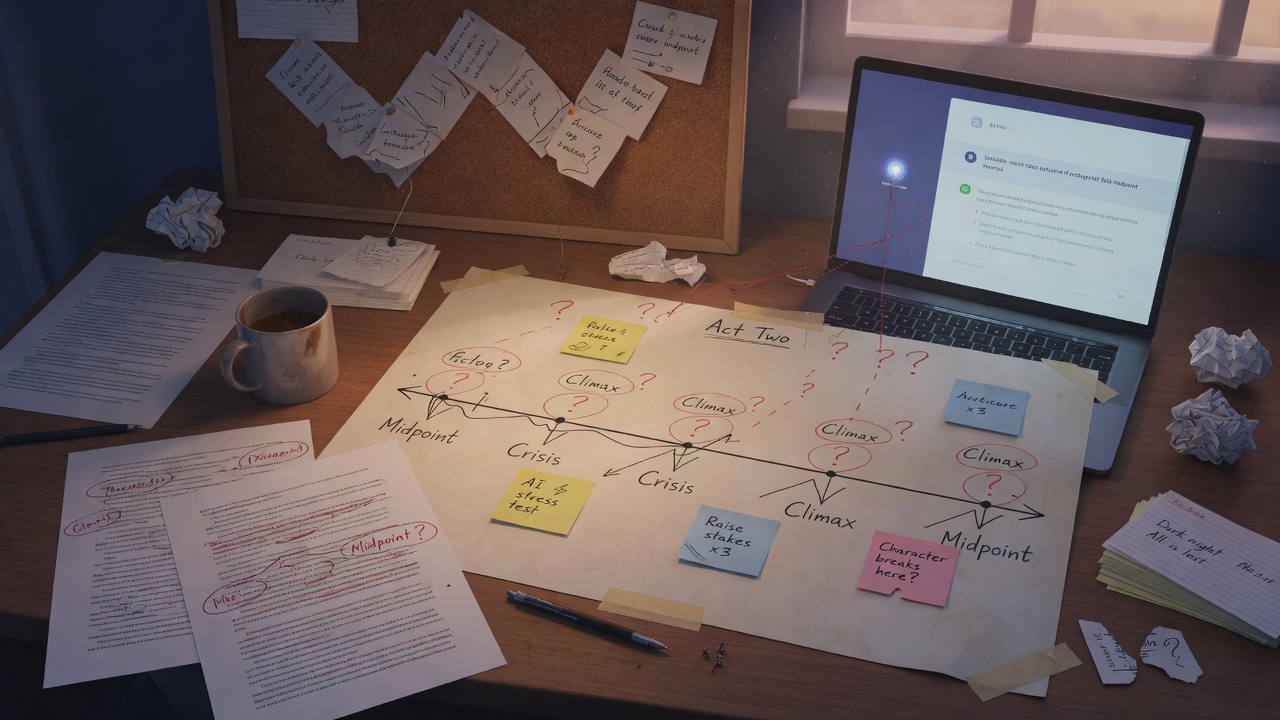
How to Use AI to Stress-Test Your Act Two Turning Points
Act Two kills more novels than bad prose ever will. You can write beautiful sentences, build a world readers want to live in, open with a hook that grabs by the throat — and still watch the whole thing go slack somewhere around the middle because the turning points don't actually turn anything. The midpoint lands with a thud instead of a shift. The crisis feels manufactured. And by the time you reach your climax, there's nothing holding the structure up.
AI is genuinely useful here, not because it has some magical structural algorithm, but because it does something a tired author struggling with their own manuscript can't easily do: it reads your turning points cold, without attachment, and asks the obvious questions you stopped asking fifty thousand words ago.
Here's how to use that to your advantage.
Why Act Two Turning Points Fail (and Why AI Can Spot It)
The two beats that matter most in Act Two are the midpoint — roughly the center of your story where something fundamentally shifts the protagonist's direction or understanding — and the crisis, sometimes called the dark night of the soul, where everything collapses before the final push. These aren't just plot waypoints. They're load-bearing walls. When they're weak, the whole structure sags.
Most midpoints fail for one of two reasons. Either they're just a plot event (something happens, but the protagonist isn't changed by it), or they're purely internal (the character has a realization, but nothing in the story's external momentum actually shifts). A strong midpoint does both simultaneously — the external and internal lines of your story cross and change direction together.
Crisis beats fail differently. They collapse under the weight of reader disbelief — we don't buy that things are truly lost — or they feel emotionally hollow because the stakes were never specific enough to hurt. A character can't lose what we don't understand they had to begin with.
Here's where AI earns its keep: it's immune to your narrative momentum. When you're deep in a draft, you feel the story. You know what you meant when you wrote the midpoint scene. You remember the eighteen scenes of setup that justified the crisis. The AI doesn't feel any of that. It reads what's on the page, and that objectivity is brutal and useful.
AI doesn't know what you intended. It only knows what you wrote. For stress-testing turning points, that's exactly the right reader.
Identifying Your Midpoint and Crisis: What AI Needs to Assess Them
Before you run any kind of structural test, you need to give the AI enough context to actually assess the beats — not just summarize them. This is where most writers go wrong. They paste in a single scene and ask "is this a good midpoint?" and get back something vague and useless.
What the AI needs is a beat brief: a compact document you write before prompting, which gives it the structural context to assess the turning point in relation to everything around it. Think of it as the briefing you'd give a developmental editor before they read a chapter.
Your beat brief should include:
- The protagonist's core wound and want — what they're running from and chasing at the start of the story
- The central dramatic question — the spine of your story in one sentence
- What happens in the beat itself — a 2-3 sentence summary of the scene or sequence
- What changes after it — how the protagonist's situation, understanding, or behavior shifts
- What doesn't change — the thing that still needs to be resolved in Act Three
For the crisis beat specifically, add one more element: what the protagonist stands to permanently lose if they don't act. Not what might go wrong in general — what specific, irreversible thing is on the table. If you can't name it concisely, that's your first diagnostic finding right there.
Write this brief before you prompt. It takes fifteen minutes and it forces you to articulate assumptions you've been carrying unconsciously. Half the time, the act of writing the brief reveals the problem before the AI says a word.
The Stress-Test Prompt Framework: Four Questions to Break Your Structure
Once you have your beat brief, you're going to put your turning points through four questions. These aren't gentle workshop questions. They're designed to find the load-bearing cracks.
Question 1: Does this beat change what the protagonist is trying to do, or just how they're trying to do it? A true turning point shifts the fundamental goal or the fundamental understanding of the goal. A false turning point just creates a new obstacle on the path to the same goal. Midpoints especially fail this test — they feel like turning points but are really just complications.
Question 2: Could this beat be removed without breaking the story? This sounds brutal, but it's the most honest structural test there is. If your story's logic, emotional arc, and character development could survive without this specific beat, it's not load-bearing enough to be a turning point. It's a scene.
Question 3: Does the protagonist earn this beat, or does the plot deliver it? Turning points that arrive from outside — from other characters' decisions, from coincidence, from external events — don't build toward climax. The protagonist's choices must drive them into the midpoint and crisis, or the climax can't feel earned either.
Question 4: After this beat, is there genuinely no going back? This is the irreversibility test. True turning points close doors. The protagonist can't un-know what they now know, can't un-do what they've done, can't return to the status quo they had before. If there's a plausible path back to before, the beat needs to be sharpened.
When you prompt the AI, you're not asking it to answer these questions for you abstractly. You're asking it to apply each question specifically to the beat you've described, with evidence from the context you've provided. The specificity of the question determines the usefulness of the response.
Prompt Examples: Running Each Turning Point Through the Test
Here's what this looks like in practice. These are the kinds of prompts that actually produce diagnostic insight rather than vague structural feedback.
For the Midpoint
I'm stress-testing the midpoint of my thriller. Here's the context:

Protagonist: Marcus, a forensic accountant. Core wound: he covered up his father's fraud when he was 22 and has built his career on being the person who exposes financial crime — he's trying to outrun his own complicity. Core want: to expose the embezzlement scheme at Holtrath Capital before the pension fund collapse ruins 4,000 retirees.

Central dramatic question: Can Marcus expose the truth when his own survival has always depended on burying it?

Midpoint beat: Marcus discovers that his contact inside Holtrath, a woman named Selin, has been feeding information not to him but to a journalist who is planning to publish a story that will blow the investigation before Marcus can secure the evidence needed for prosecution. Marcus confronts Selin. She tells him she doesn't trust him — she thinks he's working for Holtrath's legal team to find the leaks and plug them.

What changes after: Marcus realizes he can't work through intermediaries anymore. He decides to get direct access to Holtrath's internal servers himself, which means crossing a legal line he's never crossed before.

What doesn't change: He still doesn't know that his father's original fraud is connected to Holtrath's founding capital.

Apply stress-test question 1: Does this beat change what Marcus is fundamentally trying to do, or just how he's trying to do it? Give me a specific diagnosis based on the context above, and identify what would need to be true for this beat to function as a genuine midpoint rather than a complication.
This works because it gives the AI a named protagonist with a specific wound, a dramatic question with thematic weight, and a concrete scene summary — then asks for diagnosis against one specific question. You'll get a much sharper response than "here's my midpoint scene, is it working?" Notice also that the beat brief surfaces a potentially rich structural irony (the father's fraud connecting to Holtrath) that the AI can flag as underused.
For the Crisis
I need to stress-test my crisis beat. This is the low point of my literary fiction novel before the final act.

Protagonist: Dara, 38, a ceramicist. Core wound: she left her home country (Sri Lanka) at 19 to study art in London and never went back, not even when her mother was dying — she told herself it was because she couldn't afford the flight, but it was because she was terrified her mother would ask her to stay. Core want: to have her first solo exhibition succeed so she can finally feel like the sacrifice was worth something.

Central dramatic question: Can Dara build something lasting when she's spent her whole life making herself portable?

Crisis beat: The gallery calls to cancel her show three weeks before opening. A more established artist has been offered the slot. Dara has a breakdown in her studio, smashes several finished pieces, and sits alone in the wreckage for a full day.

What the protagonist stands to permanently lose: The exhibition was the last piece of her late mentor's estate — he'd promised her the show in his will, but the gallery isn't legally bound to honor it. If she doesn't fight this, she loses the last real connection to him, and she'll have no leverage to get another London show.

Apply stress-test questions 2 and 4: First, could this crisis beat be removed without breaking the story — what would be lost structurally and emotionally if it disappeared? Second, after this beat, is there genuinely no going back for Dara? Identify any ways the beat currently allows her an easy exit, and suggest what would need to close those doors.
The key move here is asking about questions 2 and 4 together for the crisis, because they test different things that often reveal the same underlying problem: the beat isn't irreversible enough to force the climax. Notice the specificity about what can be permanently lost — this is what makes crisis beats ache rather than just feel sad.
The Earn Test
I want to apply the "earn test" to my fantasy novel's midpoint. The question is: does my protagonist drive herself into this beat through her own choices, or does the plot deliver it to her?

Protagonist: Fen, a cartographer's apprentice who can see geographical anomalies in the landscape that others can't — she perceives where the land "wants" to shift or break. She's been hired to map a contested border region in a country on the edge of civil war.

Her choices in Act One and early Act Two: She deliberately maps the border to favor the ruling faction, falsifying two anomalies that would have moved the line in the rebels' favor, because she believes the ruling faction will keep the peace better. She tells herself this is pragmatic.

Midpoint beat: A rebel attack on the border outpost kills six people, including a young soldier Fen had befriended. Intelligence later reveals the rebels chose that specific location because the border map indicated the outpost was lightly defended — which was a direct consequence of Fen's falsification.

Apply stress-test question 3 only: Does Fen earn this beat through her own choices, or does the plot deliver it to her? Trace the specific causal chain from her decisions to this outcome. Then tell me: if a reader who hadn't been paying close attention read this scene, would they understand Fen's culpability, or would it read as bad luck?
This prompt zeroes in on causality, which is the most important thing for Question 3. Asking the AI to trace the causal chain forces it to identify where the chain might be broken or unclear to readers. The last sentence is doing important work — it asks the AI to consider reader experience, not just structural logic.
Using AI Feedback to Rebuild Weak Pivots Without Rewriting the Whole Draft
When the diagnosis comes back and confirms what you suspected — the midpoint isn't really a turning point, or the crisis lets your protagonist off the hook too easily — the instinct is to panic and tear open the draft. Don't.
Most weak turning points can be fixed with what I think of as pivot surgery: targeted changes to the beat itself and the two or three scenes immediately surrounding it, without restructuring the act. This is where AI helps in a second, different way — not diagnosis but reconstruction.
Once you have a specific diagnosis (say, "the midpoint changes method but not goal, so it doesn't function as a true turning point"), your next prompt should ask the AI to generate three alternative versions of what the beat could be, constrained to the same setting, characters, and general plot territory. You're not asking it to write your scene. You're asking it to show you the structural shape the scene needs to take, so you can write it yourself.
Based on the diagnosis that my midpoint changes Marcus's method but not his fundamental goal or understanding, generate three alternative structural approaches to this beat that would qualify as true midpoints. Keep the same setting (the confrontation with Selin), the same cast (Marcus and Selin), and the same general plot context (the journalist problem). Each alternative should show a different way the beat could change what Marcus is fundamentally pursuing or understanding — not just his tactics. Don't write the scene. Just describe the structural logic of each approach in 3-4 sentences, including what Marcus would now understand or want that he didn't before.
The constraint "don't write the scene" is critical. If you ask for the scene, you'll get prose you didn't write and may get attached to. Ask for the structural logic and you keep ownership of the actual writing.
After you pick the approach that fits your story, one more pass: ask the AI what the two scenes before your turning point need to establish for the new beat to land, and what the scene immediately after needs to do differently. Turning points don't work in isolation. The three scenes around them are doing half the work.
Fixing a turning point is rarely about changing the event. It's about changing what the event means — and that's often determined by what came just before and just after.
The method isn't complicated, but it requires one thing most writers resist: writing the beat brief before you prompt. That document — the protagonist's wound, the dramatic question, what changes and what doesn't — forces you to make explicit what you've been holding implicitly. Do that first, every time, and the AI's diagnostic capacity goes up dramatically.
Start with your midpoint. Write the brief tonight, run it through Question 1 and Question 3, and see what comes back. If the diagnosis stings a little, that's the stress-test working.
Try it yourself
Write your own book with AI — free, no credit card required.
Free · No credit card