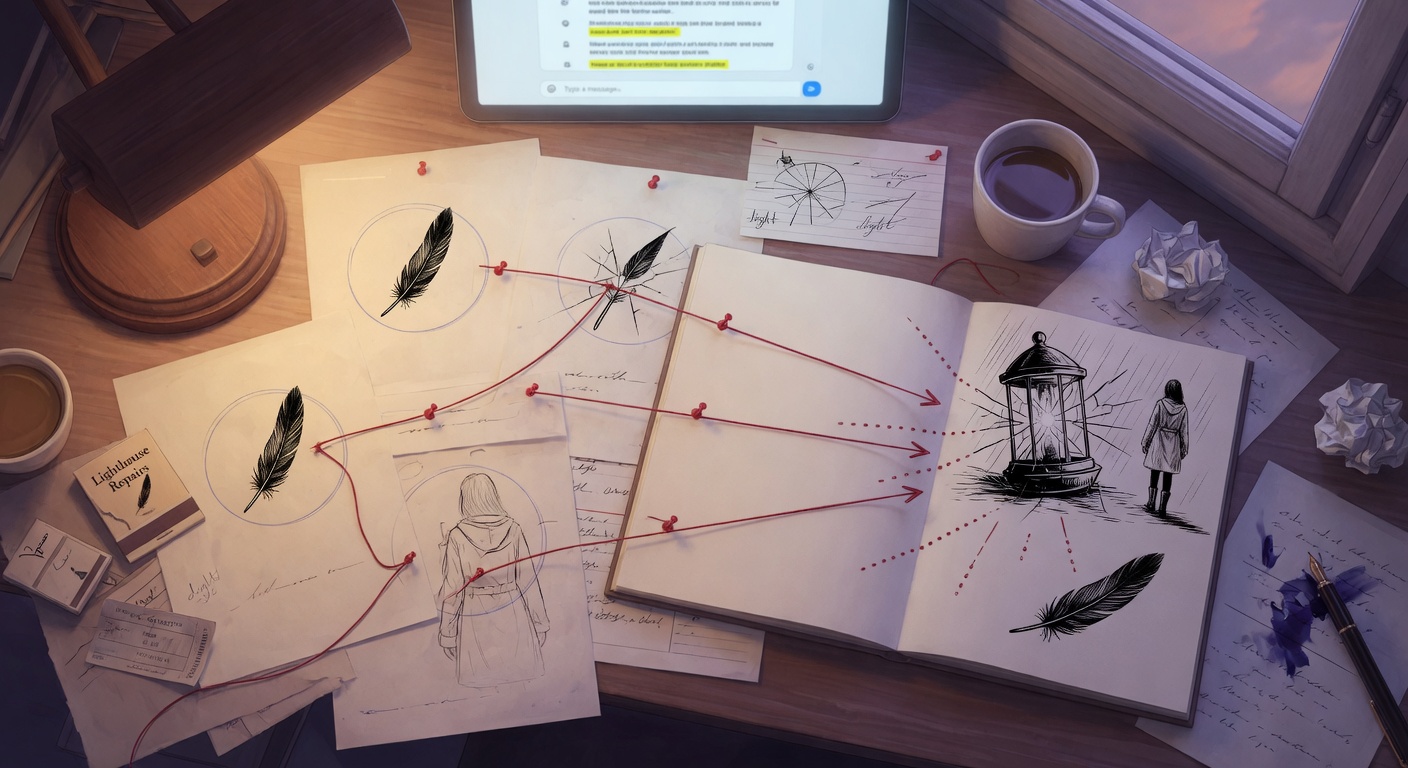
There's a specific kind of reader satisfaction that's almost physical — that moment when they hit your ending and think of course, it had to be that way. Not "I saw it coming." Not "oh, that's a nice surprise." But inevitable. Like the story couldn't have ended any other way.
Most writers try to create that feeling by planting clues as they draft forward. They're writing chapter three, they know roughly where things are headed, so they drop in a hint. Then another one in chapter seven. By chapter fifteen they've got a scattering of seeds that feel, when you read back through, like exactly what they are: a writer nervously signposting their own plot.
The problem isn't the foreshadowing itself. It's the direction you're working in.
Why Most Writers Plant Foreshadowing Forward (and Why That Fails)
Writing foreshadowing while drafting forward puts you in an impossible position. You're trying to hint at an ending you haven't fully discovered yet, which means your plants are either too vague to pay off meaningfully, or so specific they telegraph the twist to any attentive reader. You end up with one of two failure modes: the foreshadowing that lands with a limp oh yeah, I guess that was there, or the one that makes readers feel cheated because it was practically a neon sign.
The writers who do this well — who make endings feel genuinely inevitable — almost universally work backwards. They finish the story first, or at least know the ending in detail, and then they reverse-engineer the foreshadowing in revision. They ask: given what actually happens, what should a careful reader have been able to sense was coming?
Foreshadowing that feels inevitable was almost certainly written after the ending. The forward-drafted hint is educated guesswork. The backwards-planted hint is precision work.
This is where AI becomes genuinely useful, and not in the way you might expect. You're not asking it to be creative on your behalf. You're using it as a structural analyst — something with no emotional investment in your draft, that can look at your ending and your manuscript simultaneously and ask cold, systematic questions about the gap between them.
The Reverse-Engineering Method: Starting with Your Ending
Before you write a single prompt, you need to do one thing: articulate your ending clearly and specifically. Not "Marcus betrays Elena" but why Marcus betrays Elena, what it costs him, what it reveals about him, and what thematic statement it makes about the story's central question. The richer your ending summary, the better the foreshadowing AI can generate.
Think of your ending as having three layers:
- The plot layer: what physically happens in the final act
- The character layer: what this reveals or confirms about who these people are
- The thematic layer: what idea or truth the story has been arguing toward all along
Effective foreshadowing seeds all three layers simultaneously. A single well-placed detail can hint at plot, character, and theme at once — and that's exactly what makes it feel inevitable rather than planted. The reader's subconscious registers the resonance across all three tracks even if their conscious mind only notices one.
When you bring AI into this process, you're going to feed it all three layers of your ending and ask it to work backwards through your story's structure. The AI doesn't know your draft. It knows what you tell it. So the quality of your ending summary directly determines the quality of what you get back.
How to Prompt AI to Audit Your Draft for Foreshadowing Gaps
The audit step comes before generation. You want to know where your current draft is either under-seeded (no hints at all) or over-seeded (too obvious). Paste in your ending summary, your chapter-by-chapter outline or synopsis, and ask AI to analyze the structural distance between what happens and what the reader could have anticipated.
Here's a prompt that actually works for this:
I'm going to give you the ending of my novel and a chapter-by-chapter synopsis. I need you to act as a structural editor analyzing foreshadowing gaps.

ENDING SUMMARY:
In chapter 22, Diane reveals she has been deliberately sabotaging the archaeology dig for three years — not to protect the site, but because the discovery would prove her late mentor falsified his entire career. She's been protecting a dead man's reputation at the cost of her own integrity. The final image is her burying the artifact she found, alone, choosing legacy over truth.

CHAPTER SYNOPSIS: [paste your synopsis here]

For each major beat in the ending — the sabotage revelation, the mentor connection, her internal conflict between loyalty and truth, and the final burial image — identify:
1. Which chapters currently contain no groundwork for this beat at all
2. Which chapters have weak or generic setup that doesn't specifically point to THIS ending
3. Any character behaviors in chapters 1–8 that accidentally contradict the ending's logic

Don't generate foreshadowing yet. Just map the gaps.
That last instruction matters. If you don't tell it to stop before generation, AI will immediately start suggesting fixes and you'll lose the audit clarity. The gap map is its own valuable document — it shows you which sections of your manuscript need the most attention before you spend time generating specific plants.
The request to flag contradictions is particularly useful. Nothing undermines a reveal faster than a character behaving in chapter four in a way that makes their chapter twenty-two motivation incoherent. AI is good at spotting this because it's reading your synopsis without the emotional attachment you have to every scene you've written.
Prompt Templates for Generating Tiered Foreshadowing (Early, Mid, Late)
Once you have the gap map, you generate foreshadowing in tiers. Early foreshadowing (first quarter of the book) should be almost entirely deniable — atmospheric, behavioral, thematic. Middle foreshadowing can be slightly more concrete but still ambiguous. Late foreshadowing, in the final quarter before the ending, can be specific enough that readers who were paying attention feel the click of recognition.
The mistake is treating all foreshadowing the same. If you ask AI to "generate foreshadowing for Diane's betrayal," it'll give you a flat list of hints without any sense of how they should change in weight and specificity as the story progresses. You need to prompt for the tier explicitly.
Here's how to prompt for early-act foreshadowing specifically:
I'm writing foreshadowing for an ending where archaeologist Diane is revealed to have sabotaged her own dig to protect her dead mentor's fraudulent legacy. She ultimately buries the key artifact alone and walks away from her career.

Generate EARLY ACT foreshadowing only — hints appropriate for chapters 1–6 of a 22-chapter novel. These should be:
- Deniable: a reader on first pass should not flag these as suspicious
- Character-behavioral: show Diane doing something that makes complete sense in context but gains new meaning retroactively
- Thematically resonant: they should touch on the themes of legacy, loyalty, and what we bury rather than face

Specifically, I want:
1. Two moments where Diane's relationship to her mentor's work reveals something slightly off — not suspicious, just specific and strange
2. One environmental or setting detail in the dig site that will read differently after the ending
3. One line of dialogue Diane says that means something innocent in context but is quietly devastating in retrospect

For each suggestion, explain what a first-time reader will think it means versus what a rereader will understand.
That dual-reading instruction at the end — what a first-time reader thinks versus what a rereader understands — is the single most useful thing you can add to any foreshadowing prompt. It forces the AI to actually think about the gap between surface meaning and hidden meaning, which is the entire craft of foreshadowing.
For mid-act foreshadowing, adjust the prompt to ask for "behaviorally motivated" hints — things that grow organically from rising tension rather than being dropped in atmospherically. By the middle of your story, readers are tracking characters more closely, so the plants need to be embedded in active scenes:
Same novel, same ending. Now I need mid-act foreshadowing for chapters 10–15. The dig has hit a significant find and tensions in the team are rising.

At this stage, foreshadowing should:
- Be embedded inside active conflict scenes, not in quiet observational moments
- Show Diane making decisions that seem professionally motivated but are actually emotionally motivated
- Introduce one object or recurring visual that will mirror the final burial image in chapter 22

Diane's established character traits so far: meticulous, emotionally guarded, fiercely protective of the dig's academic reputation. Her flaw the reader has seen: she deflects personal questions with work-talk.

Given those traits, generate three mid-act moments where her behavior crosses from "professionally intense" into something that should make a careful reader pause. Each moment should have a reasonable surface explanation that most readers will accept.
Notice how this prompt includes established character information. The more context you give, the more the foreshadowing AI generates will feel like it belongs to your story rather than a generic archaeological thriller. Specific character traits constrain the suggestions toward authenticity.
Avoiding the Obvious: Prompting for Subtle, Deniable Foreshadowing
AI's default foreshadowing is too on the nose. Left to its own instincts, it'll suggest things like having your character pause at a graveyard or make a comment about secrets always coming out. These are technically foreshadowing, but they're the fictional equivalent of a wink at the camera. Readers feel manipulated, not satisfied.
The fix is to explicitly prompt for deniability, and to give AI constraints that force it toward indirection.
The best foreshadowing doesn't hint at the plot. It hints at the emotional truth underneath the plot. The reader's gut registers it; their brain files it as "interesting character detail."
One technique that works well: ask AI to foreshadow through what characters avoid rather than what they do. What topics does Diane never bring up? What question does she deflect so smoothly that readers don't notice she deflected it? What does she never do that her colleagues do casually? Absence foreshadows as well as presence, and absence is much harder for readers to consciously track.
I need subtle, deniable foreshadowing for Diane's secret — that she has been protecting her mentor's fraudulent legacy at great personal cost, and that she will ultimately choose his reputation over her own integrity and career.

Avoid: any foreshadowing that directly involves secrets, graves, burial, legacy, or betrayal as explicit topics.

Instead, generate foreshadowing through:
1. What Diane never talks about spontaneously, even when it would be natural to (and give me the specific scene context where this absence would land)
2. A small professional habit or ritual she has that her colleagues find slightly odd but don't question — one that makes sense as protective behavior in retrospect
3. Her reaction to a colleague's unrelated moral dilemma — not a speech about integrity, just a behavioral response that's slightly disproportionate to the situation

For each: tell me what emotional register it should play in (neutral? warm? slightly tense?) and how long it should be on the page — I don't want any of these to call attention to themselves.
The instruction to specify emotional register and page length is practical craft. Foreshadowing that gets three paragraphs is signposting. Foreshadowing that gets two sentences inside a busy scene is invisible — and invisible is exactly what you want until page 300 when everything clicks.
One more thing worth prompting for: foreshadowing that works through other characters' perceptions of your protagonist. Diane's colleagues noticing something slightly off about her — and explaining it away to themselves — can be more effective than showing Diane's internal state directly. The reader tracks the colleague's rationalization and stores the underlying wrongness without processing it consciously.
Making It Yours: The Revision Pass
Everything AI generates for foreshadowing is a first draft of an idea, not a finished line of prose. Your job after getting the suggestions is to take each one through two questions: does this sound like my story's specific language and texture, and does this fit this particular character's behavioral logic as I understand them?
AI suggestions will often be slightly generic or slightly wrong in register. A suggestion for a moment where Diane "avoids eye contact when her mentor's name comes up" is fine, but if Diane's established character is someone who uses direct eye contact as a control mechanism, that suggestion is actually backwards — and that tension, her forcing eye contact when the subject arises rather than avoiding it, is probably more interesting and more true to who she is.
Use the AI output as a structural map, not a script. It's telling you where to look in your manuscript, what kind of beat you need, and roughly what emotional work it should do. The actual words, the specific sensory detail, the precise thing Diane says or doesn't say — that's yours to write.
The most useful thing you can do this week with this method: take your ending — just the last chapter, or the last scene, whatever constitutes the real emotional and narrative resolution — and write a three-paragraph summary covering plot, character revelation, and thematic statement. Then pull up your chapter synopsis and run the gap audit prompt. Don't skip straight to generation. The audit is where you find out whether your foreshadowing problem is structural (entire sections of your book have no groundwork) or textural (the groundwork is there but vague). Those are different problems, and they need different prompts to fix.