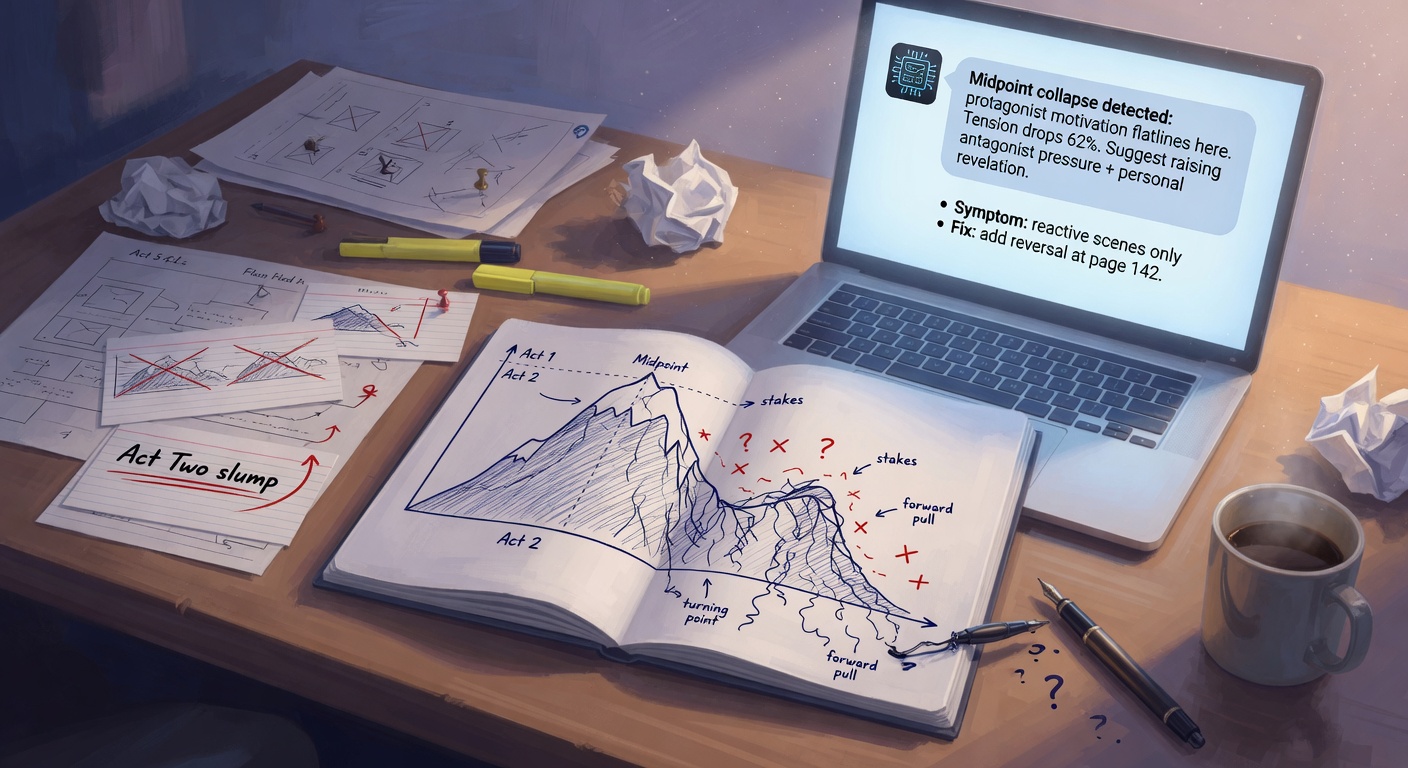
How to Use AI to Diagnose Midpoint Collapse in Your Novel
Your novel felt alive through act one. The inciting incident landed. Your protagonist made a choice that dragged them into the story's central problem, and you wrote those early act two scenes with real momentum. Then somewhere around the halfway mark, something went quiet. The scenes kept coming — dialogue, action, plot — but the forward pull just... stopped. You kept writing because that's what you do, but you could feel it. The novel had gone slack.
This is midpoint collapse, and it's one of the most common structural failures in first drafts — and the hardest to diagnose from inside the manuscript you've been living in for months. The good news is that AI is genuinely excellent at spotting this specific problem, provided you ask it the right questions. Not "does my story work?" but precise, surgical questions that force it to examine your act two the way a structural editor would.
Here's how to do that.
What Midpoint Collapse Looks Like (And Why It's Hard to Self-Diagnose)
Midpoint collapse rarely announces itself dramatically. Your manuscript doesn't suddenly become bad. What happens is more subtle: the scenes around the 50% mark stop doing the structural work they're supposed to do, and the novel starts treading water. Characters talk about things that don't change their situation. Subplots that felt connected start drifting. Your protagonist reacts instead of driving. And crucially, the stakes that felt urgent in act one seem to have gone hazy — present in theory, but not pressing against your characters with any real weight.
The reason you can't see it while you're writing is that you're tracking plot continuity, not structural momentum. You know what happened in chapter twelve and why it leads to chapter thirteen. That local logic can feel sound even when the larger architecture has lost its spine.
Midpoint collapse typically involves three interlocking failures:
- No irreversible event at the pivot — something that genuinely closes off the protagonist's old way of operating
- Stakes drift — the thing your protagonist stands to lose feels theoretical rather than immediate
- Missing directional shift — act two should change gear at the midpoint, moving from reactive survival to active pursuit (or vice versa, depending on your genre), and instead it just... continues
The midpoint isn't just the middle of your story. It's the moment your protagonist stops being someone things happen to and starts being someone who makes things happen — even if those choices lead straight toward disaster.
The tricky part is that many writers have read enough craft books to know this intellectually, so they write a scene that they think is the midpoint turn. A confrontation. A revelation. A decision. But the scene doesn't actually do the structural work — it delivers information without changing the protagonist's fundamental stance toward the story's central problem. That's what you need AI to help you see.
The Midpoint Stress Test: Prompting AI to Evaluate Your Act Two Pivot
Before you ask AI to fix anything, you need an honest assessment of what's actually happening structurally at your halfway point. This requires giving it enough context to work with — not your entire manuscript, but a focused brief that isolates the relevant information.
The most effective approach is to write what I call a structural brief: a short document describing your protagonist's core want and fear, the central dramatic question of your novel, what your protagonist believed at the start of act two, and then a summary of three to five scenes around your current midpoint. Then ask a specific diagnostic question.
I'm going to give you a structural brief for my novel and I want you to stress-test my midpoint. Don't give me general advice — I want you to tell me specifically whether my midpoint scene does three things: (1) closes off a previous option so the protagonist can't go back to their old approach, (2) raises the personal stakes beyond the external plot stakes, and (3) shifts the protagonist from reactive to active (or vice versa, if that's appropriate to the genre). Point out exactly where any of these three elements is missing or underdeveloped.

Here's the brief:

PROTAGONIST: Maya, a forensic accountant who has spent ten years keeping her head down after accidentally exposing her mentor to federal investigation.
CORE WANT: To expose financial fraud at the pharmaceutical company she's auditing without destroying her own career.
CORE FEAR: That her need to be invisible makes her complicit in the harm the fraud is causing.
CENTRAL DRAMATIC QUESTION: Will Maya act on what she knows even when it costs her everything she's rebuilt?

CURRENT MIDPOINT SCENE (chapter 16 of 32): Maya discovers a second set of accounts that proves the fraud goes all the way to the CEO. She confronts her direct supervisor, who denies knowing anything. Maya goes home and decides she needs more evidence before she can act.

What structural work is this scene doing, and what is it failing to do?
This prompt works because it doesn't ask for general feedback — it gives AI a specific rubric and forces it to evaluate against that rubric rather than offering generic story advice. The three criteria are concrete enough that the AI can point to the actual absence in your scene rather than suggesting you "raise the stakes" vaguely. Adjust the three criteria if your genre has different structural requirements — a romance midpoint works differently than a thriller's — but keep that specificity.
Using AI to Locate the Missing Irreversible Event
The single most common midpoint failure is that nothing irreversible happens. Characters discover things, argue, make tentative decisions, gather information — all reversible. The protagonist could theoretically step back from the story's central conflict and return to something like their previous life. That's a dead midpoint, structurally speaking.
The irreversible event doesn't have to be dramatic in a surface sense. It doesn't require an explosion or a death. What it requires is that after this moment, one of the protagonist's fundamental options is permanently removed. They can't unknow what they know. They can't unsay what they said. The relationship can't return to what it was. A door closed.
AI is good at identifying whether your current midpoint achieves this — and at generating specific, story-appropriate options if it doesn't. The key is feeding it enough about your story's logic so it doesn't suggest something tonally wrong.
I need help identifying what the irreversible event should be at my novel's midpoint. Here's the situation:

STORY CONTEXT: Literary thriller set in 1990s Hong Kong. Daniel, a British-Chinese translator working for a trading company, discovers his employer has been falsifying provenance documents for antiques with looted origins. He's spent the first half of the book gathering evidence while trying to appear loyal to his boss.

CURRENT MIDPOINT: Daniel photographs the documents. He has the evidence. But he hasn't acted on it, and his boss doesn't know he's suspicious.

THE PROBLEM: Nothing feels locked in. Daniel could still walk away, destroy the photos, and keep his job. The story isn't forcing him forward.

What irreversible event could happen at this midpoint that would: (a) use the specific details of this story and setting rather than generic thriller tropes, (b) remove one of Daniel's current options permanently, and (c) force the nature of his choice — between loyalty and accountability — into the open rather than letting him keep it private? Give me four options ranked by how cleanly they create structural momentum.
Notice the request asks for story-specific options, not generic ones. Without that instruction, you'll get suggestions like "someone discovers his secret" — technically a reversible event could become irreversible, but it's vague. The ranked list is useful too: it lets you quickly compare which option creates the cleanest forward pressure versus which might create interesting complications at the cost of clarity. The AI's first suggestion often isn't the best one; having four options lets you see the range.
Prompting AI to Rethread Stakes from Midpoint to Act Three
Once your midpoint has the irreversible event it needs, you face a second problem: the stakes that matter emotionally need to run like a thread from that midpoint event all the way through to your act three climax. If your midpoint changes the protagonist's situation but doesn't tighten the specific thing they stand to lose, act two will still feel diffuse.
This is where writers often make a mistake with AI prompts. They ask: "how can I raise the stakes?" That question produces generic suggestions — put someone in danger, add a ticking clock, introduce a betrayal. Fine, but not connected to your specific story. The better question asks AI to trace the existing stakes and find where the thread goes slack.
I want you to trace the stakes thread in my novel from my midpoint through to the end of act two. I'll give you summaries of the relevant scenes. I don't want suggestions for new plot elements yet — first I want you to identify exactly where the emotional stakes (what my protagonist personally stands to lose) become disconnected from the external plot stakes (what happens in the world of the story).

PROTAGONIST'S PERSONAL STAKE: Iris has spent the novel terrified that she is like her mother — someone who destroys people through carelessness. The central emotional question is whether she'll prove herself right by abandoning her found family in a crisis.

EXTERNAL STAKE: If Iris doesn't expose the conspiracy, three people will go to prison for crimes they didn't commit.

MIDPOINT: Iris discovers that exposing the conspiracy will require her to publicly contradict her mentor, the one person who treated her like she was capable of something.

SCENES 17-24 SUMMARIES: [paste your summaries here]

Where does the personal stake stop pressing against the external stake? Where do they become parallel tracks instead of one tangled problem? Be specific about which scenes lose the connection.
The framing of "parallel tracks instead of one tangled problem" is doing real work here. When external and internal stakes are running alongside each other rather than through each other, readers feel the midpoint sag even if they can't articulate why. Getting AI to name the specific scenes where that separation happens gives you a targeted revision list rather than a general sense that something's off.
Before and After: Midpoint Revision Prompts with Examples
Diagnosis is only half the job. Once you know what your midpoint is missing, you need to actually fix it — and that means either rewriting an existing scene or adding a scene that does the structural work. Both are places where AI collaboration can accelerate the process significantly, but the prompts look different depending on which problem you're solving.
When You're Rewriting an Existing Scene
The mistake writers make here is asking AI to "improve" the scene. That produces polished prose that still doesn't do the structural work. Instead, give the AI your existing scene plus a specific mandate for what the revision must accomplish at a structural level.
Here is my current midpoint scene (chapter 15). The problem is that it's informational — my protagonist learns something important but doesn't have to make a choice that costs her anything.

I need you to rewrite this scene so that by the end of it: (1) Sasha has said or done something she cannot unsay or undo with her sister, (2) the revelation about her father comes out in a way that immediately changes the dynamic between them rather than sitting as new information Sasha privately processes, and (3) the scene ends with Sasha more exposed than when it started, not more informed.

Don't change the setting (the car outside the hospital), don't change the essential information that's revealed (the financial documents), and keep Sasha's voice — she deflects with dry humor when she's frightened. Just restructure the scene so the choice and its cost are on the page, not implied.

[paste your scene here]

After the rewrite, explain in two sentences what structural change you made and where you see the irreversible moment landing.
The constraints at the end — keep the setting, keep the information, keep the voice — are crucial. Without them, AI tends to solve structural problems by changing the content dramatically, and you end up with a well-structured scene that doesn't sound like your book. The request for a two-sentence structural explanation after the rewrite helps you evaluate whether the AI actually achieved the goal or just wrote something that feels more dramatic on the surface.
When You're Adding a New Scene
Sometimes the diagnosis reveals that you don't need to revise what you have — you need a scene you never wrote. A beat that was supposed to be implied but needs to be explicit. Here, the constraint structure shifts: you're giving AI permission to invent, but anchoring it firmly in your story's established logic.
I need a new scene to insert at the midpoint of my novel. It doesn't exist yet. Here's the context:

The scene needs to come between chapter 14 (where Jonas learns his business partner has been lying to him for two years) and chapter 15 (where Jonas starts planning his response).

Right now those chapters sit next to each other and the midpoint feels like an information dump followed by a planning session. What's missing is the moment where Jonas stops being someone who handles things calmly and becomes someone capable of what he's about to do in act two.

Write a scene — no more than 800 words — in which Jonas does something in the aftermath of learning the truth that he wouldn't have done at the novel's beginning. Something small enough to be realistic, big enough to mark a before and after. He's normally methodical, contained, someone who reads the room. Show me the first crack.

Setting: his office, late at night. No other characters present.

Maintain close third person, past tense, and a fairly spare prose style — no interior monologue that explains his emotional state. Let actions carry it.
The instruction "something small enough to be realistic, big enough to mark a before and after" is probably the most useful phrase in that prompt. Midpoint scenes fail when writers go for the dramatic gesture that feels structurally loud but emotionally hollow. A contained character alone in his office doing something slightly wrong is more revealing than a confrontation written too big. The AI will take "first crack" seriously if you give it that framing.
The real power of using AI for midpoint diagnosis isn't that it finds problems you couldn't find — it's that it forces you to articulate your story's structural logic in precise enough terms that the problem becomes visible. Half the time, writing a detailed structural brief for an AI prompt is where you'll realize what's actually wrong, before you even read the response.
So start there. Write out your protagonist's core want, fear, and the central dramatic question in three sentences. Then describe your current midpoint scene. Then ask the AI to apply the three-criteria stress test from the second section of this guide. That single diagnostic prompt, done carefully, will tell you more about your midpoint problem than reading another craft book chapter about act two structure.
Try it yourself
Write your own book with AI — free, no credit card required.
Free · No credit card