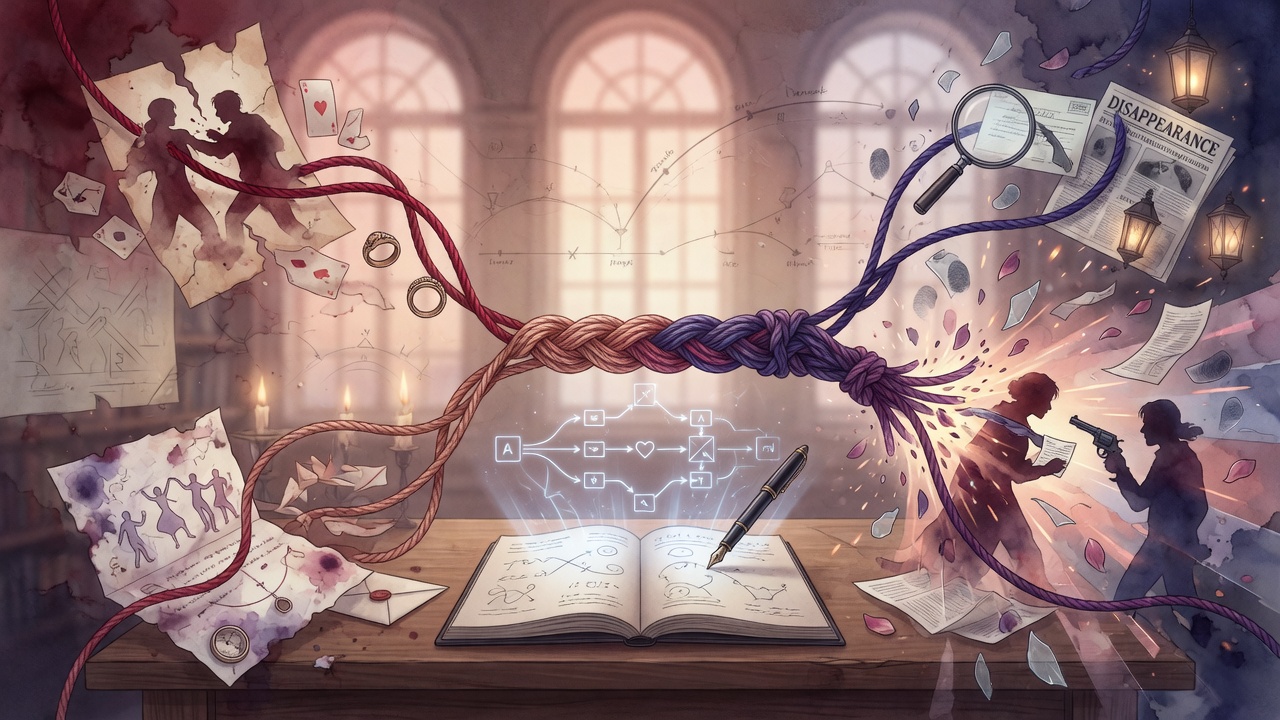
You've got three subplots humming along nicely. The betrayal thread, the romance thread, the mystery-of-the-dead-father thread. Each one is fine on its own. Then you hit the climax and... they don't talk to each other. The romance resolves in chapter 24. The betrayal gets revealed in chapter 27. The mystery wraps up in an epilogue nobody asked for. Your climax feels like three smaller endings wearing a trench coat, pretending to be one big ending.
This happens constantly in AI-assisted drafts, and honestly in human-written ones too, but AI tends to make it worse because most models resolve whatever thread is closest at hand rather than thinking about the manuscript as a woven structure. The good news: you can fix this with the right prompting sequence, and you don't need to outline your whole book from scratch to do it. You need a map, a convergence plan, and an audit pass. Let's get into it.
Why Subplots Usually Resolve in the Wrong Order (and Why It Flattens Your Climax)
Here's the thing nobody tells you about subplots: they're not decorations. They're pressure systems. Each one builds tension that's supposed to release at a specific moment, and the magic of a great climax is when two or three of those pressure systems release at the same time, in the same scene, because of the same event. Think of the reveal in a heist novel where the mole is unmasked exactly when the vault door opens and exactly when the protagonist realizes she's been lied to about her sister. One scene, three payoffs.
Most drafts don't do that. They stack payoffs end to end like dominoes falling in sequence instead of a controlled demolition. Why? Because when you're drafting scene by scene — especially with AI generating chunks of prose — each subplot gets resolved the moment it feels "ready," with no awareness of what the other threads are doing at that point in the timeline. The AI doesn't know your betrayal reveal was supposed to land in the same chapter as your romance's black moment unless you tell it, explicitly, that these two things need to occupy the same real estate.
The flattening effect is real. Readers describe these books as "fine" or "solid" but rarely as unforgettable, because the emotional peaks are spread across fifty pages instead of stacked into five. If you've worked through The Five-Pass Revision Order for AI-Assisted Novels, you know structure passes come before line passes for exactly this reason — you can't polish your way out of a climax that's structurally scattered.
A climax isn't the biggest single event in your book. It's the moment where the most threads collide at once.
Building a Subplot Thread Map: Prompting AI to Extract Every Storyline From Your Draft
Before you can braid anything, you need to see the strands. And you probably can't see them clearly yourself — not after 80,000 words of drafting where you were living inside the prose instead of looking down at it from above. This is where AI is genuinely useful: it's excellent at extraction tasks, pulling structural information out of messy narrative text, even when you as the writer have lost track of your own threads.
Don't ask for a vague "summary of the plot." Ask for a thread-by-thread extraction with chapter references.
Read through the attached manuscript and identify every distinct subplot thread, including the main plot. For each thread, give me: (1) a one-line description of what it's about, (2) every chapter where it appears or advances, (3) the current state of tension at the end of the manuscript — resolved, partially resolved, or still open, (4) which characters are load-bearing for that thread. Do not summarize the whole plot — I need threads isolated and separated, even minor ones like the recurring conflict between Mara and her mother, or the subplot about the missing shipment.
This works because you're forcing the model to categorize rather than narrate. Narration is what AI defaults to; categorization is what you actually need for structural work. Tweak the chapter-reference request depending on how your manuscript is organized — if you're working in scenes rather than chapters, ask for scene numbers instead. If you've been keeping a story bible, feed that in alongside the manuscript so the AI cross-references your intended threads against what actually made it onto the page. You'll often find threads you meant to develop and quietly dropped by chapter 10.
Once you have this map, put it somewhere you can see all of it at once — a spreadsheet, a whiteboard photo, whatever. This is your control document for the rest of the process. If you want a lighter-weight version of this exercise before you've even drafted, the AI book outline tool can generate a similar thread breakdown from a synopsis instead of a full manuscript.
The Convergence Prompt: Asking AI to Find Natural Collision Points Between Threads
Now for the actual braiding. With your thread map in hand, the next move is asking AI to hunt for places where two or more threads could plausibly collide — not just resolve near each other, but actually cause each other to resolve. This is a different kind of prompt than the extraction one. You're asking for creative structural analysis, not retrieval.
Here is my subplot thread map [paste map]. I want to converge the betrayal thread (Colm's double-dealing with the Ashford family), the romance thread (Neve and Colm), and the main plot (the siege of Dunmore) into a single climax sequence rather than resolving them separately. Suggest three different ways a single scene or short sequence could force all three threads to resolve simultaneously. For each option, tell me what new causal link needs to exist between the threads that doesn't currently exist in my draft, and flag anything in earlier chapters I'd need to plant or adjust to make that causal link feel earned rather than convenient.
Notice the last part of that prompt — asking what needs to be planted earlier. This is the piece writers skip, and it's the difference between a convergence that feels engineered-well and one that feels like a coincidence yanked out of nowhere. If the AI tells you Colm's betrayal needs to be discovered by Neve specifically during the siege, you now know you need an earlier scene establishing that Neve has access to whatever evidence reveals it. That's a plant. Go add it.
This is also where genre-specific convergence patterns matter. A romance climax converging with an external plot thread has different mechanics than a mystery thread converging with a magic-system thread — if you're working in fantasy, cross-reference this against Fantasy Magic Systems: Constraints AI Will Respect to make sure your convergence doesn't require your magic to suddenly do something it's never done before. And if romance is one of your braided threads, the Romance Beat Sheet: Where AI Drafts Usually Break guide covers exactly where convergence attempts tend to go wrong — usually by making the romantic black moment resolve too easily just because the plot needed it to.
Testing Alternate Convergence Sequences Before You Commit to a Draft
Here's a mistake I see constantly: writers get one convergence idea from AI, like it, and immediately start drafting the scene. Don't. Generate three or four alternate sequences first and stress-test them against each other, because the first idea is rarely the one with the most emotional torque.
For each of the three convergence options you gave me, write a compressed 300-word beat-by-beat outline of how the climax scene would actually play out — who says what, who learns what, in what order. Then tell me, for each version, which character ends up with the least agency in the outcome, since I want to avoid a climax where any major POV character is purely reactive. Rank the three options by how much simultaneous tension they release versus how much they release sequentially within the same scene.
That agency question is the sleeper insight here. A lot of "convergence" attempts accidentally solve the problem by making one character a passive witness to everyone else's payoff. If your romance lead just stands there while the betrayal plot resolves around her, you haven't braided the threads — you've just relocated one of them next to the others without actually connecting it.
This is also the right moment to run these alternate sequences through a Scene Planning Worksheet or check pacing against a Three-Act Beat Sheet — convergence scenes tend to run long because you're servicing multiple threads at once, and you want to know before you draft whether you're looking at one chapter or three. If word count is a concern across the whole manuscript, the Chapter Word Count Planner helps you see whether a heavier convergence chapter throws off your overall pacing.
Test at least two sequences by actually drafting a rough version of each in AI, even if you throw both away afterward. Prose reveals problems outlines hide. You'll often discover that the "cleanest" outline on paper produces a scene that feels rushed or overstuffed once it's actual dialogue and action, and the messier-looking outline turns out to breathe better.
Auditing the Final Braid: Catching Threads That Get Dropped or Resolved Too Early
You've picked your convergence sequence, drafted it, and it feels good. Now audit it — because braiding three threads into a climax often causes a fourth or fifth minor thread to quietly get orphaned. This is the single most common casualty of subplot convergence work: the B-plot that existed to serve character texture rather than driving the climax gets forgotten entirely once you're focused on the big collision.
Here's my revised manuscript with the new convergence climax in chapters 26-28 [paste or reference]. Cross-check this against my original thread map. Tell me which threads from the map do NOT appear in or lead into the new climax sequence, and for each one, tell me whether it (a) needs its own small resolution beat elsewhere in the book, (b) can be folded into the climax with a single added line or reaction, or (c) was minor enough to cut and I should now go remove its setup scenes so it doesn't read as an abandoned promise to the reader.
Option (c) is the one writers resist most, but it's often the right call. Not every thread needs to survive the braid. A subplot that doesn't connect to your climax and doesn't matter enough to earn its own resolution beat is usually a subplot you planted and forgot about — better to cut its setup scenes than leave a loose thread dangling that makes readers think they missed something.
Run a parallel check for the opposite problem: threads resolved too early. If your betrayal thread pays off in chapter 20 instead of during the climax, either move the reveal later or make sure chapter 20's resolution isn't the full resolution — leave one layer of it open specifically so it has something left to contribute to the convergence scene. This is delicate work, and it's worth running your character consistency checks alongside it, since moving reveal timing around tends to create small continuity errors in who-knows-what-when across the back half of the manuscript.
If you're working with beta readers at this stage, brief them specifically on convergence — ask them to flag any moment in the climax where they felt confused about why something was happening, since confusion at a convergence point almost always traces back to a thread that wasn't sufficiently connected earlier. The Beta Reader Workflow for AI-Assisted Manuscripts guide has a good framework for structuring that kind of targeted feedback request rather than just asking "did you like the ending?"
One last thing worth saying: this braiding process isn't a one-time pass. If you're writing a series, or even a single long novel with a lot of moving parts, you'll want to run the thread-mapping prompt again after any major revision, because moving one scene almost always shifts the timing of at least one other thread. Writers using LitRPG writing tools or building complex fantasy worldbuilding systems feel this especially hard, since those genres tend to run four or five threads simultaneously by default. If you want to see how this whole workflow compares across different AI setups, the Entangled Text vs ChatGPT comparison and the best AI models for writing breakdown both cover which models handle long-context structural extraction best, since a 100,000-word manuscript pushes context limits in ways a query for dialogue never will.
For the full picture of where this fits into your revision process, start with the AI fiction writing guide, or browse the rest of our writing guides for the passes that come before and after this one — dialect work, opening hooks, and the final KDP upload checklist are all part of the same pipeline. And once your climax is actually converging the way you want, the Publish, Launch & Distribute Your Book guide picks up right where this leaves off.
Your next concrete step: open your manuscript, run the thread-extraction prompt today, and just look at the map before you do anything else. Don't fix anything yet. Just see which threads are actually still open by chapter 20 — you may find you have more convergence material to work with than you thought.