Durrik's Opinion of Farmers
By Murdok · 4,332 words · 19 min read
The station smelled like hydraulic fluid and burnt coffee substitute, which was close enough to the shop smell back home that I spent the first thirty seconds of the docking corridor trying to place it before I gave up and followed Vasht toward the intake checkpoint.
Compound Tharrak Seven was a military staging station in the literal sense: everything about it was built for throughput, not comfort. The docking arm we walked was brushed composite paneling bolted over structural members that showed at every joint, the kind of construction that said the people who built it expected it to be expanded repeatedly and had stopped pretending the additions would look uniform. It was functional in the way a barn addition is functional. It worked. Nobody cared that you could see the seams.
Vasht moved through intake without breaking stride, which told me she'd filed paperwork before we docked. I moved through behind her. The checkpoint officer, a stocky Solvari with a facial ridge pattern I hadn't seen on anyone aboard the scout ship, held up a scanner the size and shape of a remote control and pointed it at my chest without asking.
"Caulfield, Derek," the officer said, reading from whatever came back. "Non-enrolled specialist, provisional contractor status." He looked at me over the top of the scanner. "No assigned unit."
"Correct," Vasht said.
The officer looked at me for another second, the way a TSA agent looks at someone who came up flagged without being flagged enough for a secondary. Then he stepped aside.
Past the checkpoint, the station opened up. The corridor branched three ways, each branch labeled in the Compact's script with a secondary label in something that wasn't quite the Trade Auxiliary language the translation device handled, and below that, in characters I didn't recognize at all. Vasht turned left without consulting anything.
"Training decks are in the beta arm," she said. "The assessment is scheduled for fourteen hundred station time. That gives you forty minutes to stow your kit and eat something."
"Who runs the assessment."
"Sergeant Durrik."
I'd heard the name in the briefing files Vasht had given me, and once from Sonn in passing. "Chethari?"
"Navari." She glanced back. "You read the Navari physiology file."
"Enough of it." The Navari were bipedal, roughly my height or a few centimeters taller, with a forearm structure that allowed for a secondary joint most other species didn't have. They were built for endurance over speed. Their sensory range ran heavy on low-frequency sound, which gave them a situational awareness in confined spaces that most species couldn't match. "He's been doing this a long time?"
"Fourteen years of combat instruction. Eight before that in field service." She stopped at a door that read, in Trade Auxiliary, something that translated as temporary quarters and had the translation device rendering it as bunk assignment. "His assessment will be honest. Take it as such."
"I wasn't planning to take it as anything else."
She held the door. "People say that before Durrik assesses them. Fewer of them mean it than they expect to."
I didn't have much kit to stow. The translation device. The reading queue, transferred to a compact unit Sonn had configured. A change of clothes the Compact had provided, their best guess at human sizing, which was close enough to work if I wasn't planning to impress anyone. I wasn't.
I ate at the corridor canteen thirty meters from the bunk, a nutrient block the consistency of dense cornbread and a protein packet that tasted like soy and metal. The Compact had better options for their own crew and this was what they'd flagged as palatable for my physiology and accessible at short notice. It filled the space. That was enough.
The training deck was four levels down and required a keycard Vasht had assigned at checkout. It was larger than I expected: a long rectangular space with a high ceiling, impact-resistant flooring with the look of heavy rubber over something denser, and along both walls, a mix of equipment I could partially identify and equipment I couldn't. Weight-and-resistance apparatus I could read by function if not by design. Tactical-movement markers laid out in a grid pattern that took up the rear third of the space. A target range at the far end, currently dark. In the middle of all of it, with a data tablet in one hand and his back to the door, stood the Navari.
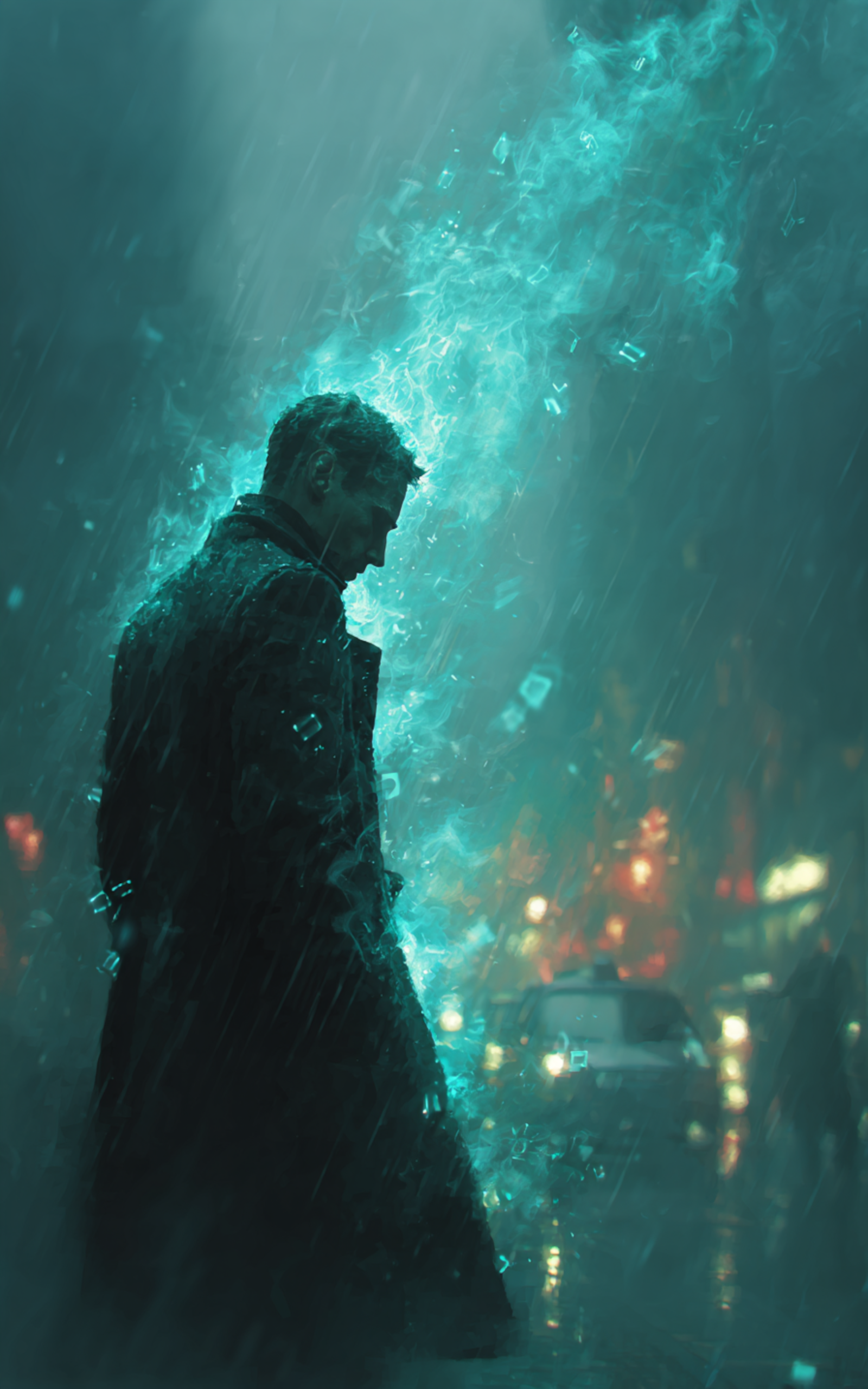
Durrik was built the way the physiology file had described: broad through the shoulders, long in the limb, with the specific posture of someone who had stopped thinking about how to carry their body and now just carried it efficiently. The secondary forearm joint was visible when he moved his tablet hand, a smooth mid-arm flex that human anatomy didn't replicate. His skin was the same warm gray-brown I'd seen in the file photos, and he was bald where the file had said Navari tended toward natural baldness after thirty. He looked about fifty, which, accounting for species variation in aging, probably meant something different than it would at home.
He turned when I came through the door, not because I'd made noise but because the door had, and he took in the full picture of me in about two seconds with the kind of assessment that didn't need to announce itself.
"Caulfield," he said. His Trade Auxiliary was cleaner than Vasht's, with less hesitation at technical terms, the way someone sounds when they've used a language as a working tool for years. "You broke a Solvari's collarbone with a rifle stock."
"He was in a corridor I didn't recognize," I said. "Seemed reasonable at the time."
Durrik looked at the tablet and made a notation. "Uncontrolled environment, confined space, improvised implement, successful incapacitation. You had no idea what the target's physiology was."
"No."
"You aimed for the shoulder."
"Clavicle is a clavicle," I said. "Most things have one."
He looked up from the tablet. His eyes were set wide, with the slightly enlarged irises that came with the Navari's low-frequency sound sensitivity, a biological trade-off that had always struck me as interesting in the files and was more interesting in person. He was measuring something, and the measurement was not unfavorable, but it wasn't finished either.
"Do you know what you're here for today," he said.
"Assessment. Physical and tactical."
"Yes." He set the tablet down on a wall-mounted bracket. "I am going to find out what you can do and what you cannot do, and I am going to tell you the truth about both of those things. Some of what I tell you will not be what Commander Vasht has told you, or what the Thuvari specialist has told you." He held my eyes. "I'm not interested in your project's success. I'm interested in whether you are usable. Those are related but not identical concerns."
"Fair," I said.
"You are also, in the current state, a farmer from a pre-Compact world who has spent his adult life managing forty acres and hunting deer." He picked up a handheld biometric scanner from the bench beside the tablet bracket. "I have trained eleven species. I have assessed more than two hundred individual soldiers. I have never begun with anyone who has had no combat training whatsoever, because the Compact does not recruit from that pool." He held out the scanner. "Hold this in your right hand, arm at your side. Don't flex."
I took the scanner. It was lighter than it looked, with a textured grip that suggested it had been designed for a hand that didn't exactly match mine.
"I'm not going to pretend this is a typical starting point," I said.
"No." He was reading the scanner's output on a small display clipped to his forearm. "But you are also not a typical case, which I have been told repeatedly and which I will assess for myself." He walked a slow circuit around me, not posturing, just looking. "Physical condition: strong for your age and species baseline. Your muscle distribution suggests labor rather than training. You have a healed fracture in your left wrist, probably four to six years ago."
"Fence post fell on it."
"Torque injury, not impact. The bone healed well." He completed the circuit and stood in front of me. "Stand with your feet at shoulder width and hold the scanner at chest height with both hands."
I did.
"Now track the light with your eyes only." A light appeared on the far wall, moving in a pattern that started slow and accelerated through about eight directional changes before stopping.
Durrik looked at his display. He made a sound that was not quite approval and not quite otherwise. "Good. Better than species baseline. The Thuvari specialist's file says your baseline pattern recognition is already elevated from the initial read."
"That's what they said."
"I'm asking you to confirm or deny through your own experience. Don't tell me what the file says."
I thought about the past two days on the ship, the way I'd started reading the crew's movement through the common area with a specificity I hadn't had before the integration conversation, except the integration hadn't happened yet. This was pre-device, all of it. "Yes," I said. "Better than I've always been. Not dramatically. Like the difference between reading a room and reading a room fast."
He nodded and made another notation. "We'll do the physical battery first."
The physical battery took an hour. Pull-based resistance work, push-based, lateral mobility across the marker grid, reaction-time drills with the tracking light at increased speed, and a confined-space navigation exercise through a segment of the training deck that was partitioned into narrow corridors with low overhead, designed to stress exactly the kind of movement I'd used in the scout ship's docking arm. I worked through all of it without stopping except when Durrik told me to stop, which he did occasionally to reset equipment or take a reading.
He didn't comment while I worked. He watched and noted. The watching was professional and complete, the kind of attention that makes you aware of it without being uncomfortable, the way a good vet watches an animal they're assessing: they're not projecting anything onto you, they're just looking.
When the physical battery was done, he had me sit on a bench along the near wall while he stood and reviewed his display.
"Physical results," he said. "Upper body strength: above human species average by approximately twelve percent, consistent with manual labor background. Lower body strength and endurance: significantly above average. The forty acres have been good for something." He said this without any particular inflection, not a joke, just an observation he was treating like data. "Spatial awareness in confined spaces: standout. The corridor navigation was cleaner than I've seen from trained soldiers who work open-terrain assignments. Reaction time: good, not exceptional. The pattern recognition elevates effective reaction time rather than the raw speed."
"What does that mean, practically."
"It means you respond faster to real things than to test stimuli. You read context, not signal." He scrolled down his display. "This is a coaching problem in most recruits: we train it out of them because test environments don't replicate the real, and then we spend months training it back in. You appear to have it natively." He looked up. "The fence posts and the deer are responsible for that, I assume."
"And my grandfather," I said, which was true and also brief.
Durrik registered this without pushing on it. He moved to the next section of his display. "Tactical knowledge. We'll do this verbally, then one live exercise." He set the display down and looked at me straight. "Fire discipline."
"I don't fire until I have positive identification."
"Why not."
"Because I might need the shot I'm holding for something I haven't seen yet, and I can't un-fire a round into the wrong target."
He wrote something. "That is correct tactical reasoning and you arrived at it through hunting."
"Through being my grandfather's hunting partner for twelve years and having him stop me from shooting twice when I would have shot wrong, and once when I would have shot into a space with a child behind it."
Durrik was quiet for a moment. "Cover selection."
"Concealment and cover are different things. Concealment keeps you unseen. Cover keeps you alive. I want both, I prefer cover, and if I can only have one I take cover."
"You learned this."
"By deduction," I said. "I never had formal instruction. But if I'm behind something that hides me and the other person can still shoot through it, I'm dead whether they can see me or not. That seemed self-evident."
Another notation. "Unit communication."
This is where it went honestly wrong, and I said so. "Weak. I've never operated as part of a coordinated group under pressure. Hunting is mostly solo or two-person with known signals. I don't have the vocabulary for tactical communication and I don't have the instinct for maintaining communication discipline under fire."
"Because you've never been under fire."
"Because I've never been under fire."
He looked at me for a moment with the expression of someone who has just confirmed a thing they already believed but needed to hear spoken out loud. "Withdrawal and positioning."
"I think in exit routes first. It's a habit. I plan around how to get out before I plan around how to go in."
"Offense orientation."
"Low," I said. "I don't have the instinct to press an advantage. I have the instinct to hold a position and wait. The deer comes to you or it doesn't, and you're either in the right spot or you're not, but burning energy running after it mostly means you get nothing and you're tired."
Durrik set his display on the bench beside me, not done with it, just setting it aside for a moment. He crossed his arms, the secondary joint on his forearms shifting slightly at the crossing, and he looked at me with the honest assessment he'd promised at the start.
"Here is what you are," he said. "You are a man with good physical conditioning, outstanding spatial awareness, genuine trigger discipline, and a systematic exit-route mentality that training programs spend months trying to build and usually cannot. You also have zero unit integration experience, low offense orientation, and no combat communication instincts at all." He did not soften any of this. "The Aeluun integration will amplify what's there. It will not add what isn't. What's there is a good base for someone who thinks, fights defensively, and reads terrain. It is a poor base for someone who needs to operate as part of a formed unit under coordinated assault conditions."
"So your assessment is that I'm half-ready for one kind of fight and not ready at all for another."
"My assessment is that you are not ready for any fight because you have never been in one." He picked up the display again. "But you are not starting from nothing, which is better than I expected based on the project file." He pulled up the final section. "We'll do one live exercise. Tactical movement across the marker grid with a single opposition. I want to see how you move when someone else is moving."
The opposition was a Solvari specialist named Harren who had a good four inches on me and moved through the grid with the efficient speed of someone who'd done this a thousand times. The exercise was simple: reach the far end of the grid, one point of contact maximum, Harren's goal was to stop me. No live equipment. Contact calls registered by sensors embedded in the flooring and the vests we both wore.
I lost the first run. Harren cut off my primary approach at the midpoint and I walked into a coverage position I should have seen before I was in it.
I took fifteen seconds before the second run and mapped the grid from the near end. Where Harren had gone the first time: left-side approach, mid-grid to right, coverage from a raised marker that gave him line on two of the four viable approach paths to the far wall. He'd taken it fast, meaning it was his practiced route, meaning he'd default to it.
On the second run I went directly at the raised marker from underneath it, which was the one approach angle it didn't cover cleanly, and drew Harren out of position reaching for a contact call on a target that was closer than his vest's sensor range was calibrated to handle. While he was recalibrating I went around his right and reached the far wall before he recovered.
Durrik stopped the exercise.
He was quiet for a moment. Then: "Explain the second approach."
"He showed me where his comfort position was on the first run. If he's been doing this a long time, he likes that position. It's a good position. But it has a gap in the close approach from below and to the left, and if you don't know about the gap, you don't know to cover it." I pulled off the sensor vest. "Once I got inside the coverage gap, the question was just whether I was faster than his recalibration. I was, barely."
Durrik took the vest from me and set it on the bench without ceremony. He picked up his display, scrolled back through the session notes, added something at the bottom.
"You didn't try to out-maneuver him," he said. "You used his own position against him."
"I can't out-maneuver someone who is faster than me and better trained. So I didn't try." I looked at Harren, who was pulling off his own vest across the grid with the flat expression of someone who had just been beaten cleanly by someone he outclassed and was deciding how he felt about it. "No offense."
Harren shrugged, which was a close enough translation.
Durrik made his final notation and set the display down for the last time. He picked up a water container from the bench, the Compact equivalent of a canteen, and held it out. I took it.
"Your gaps are real and they are significant," he said. "Communication discipline, unit integration, offense orientation. Any one of these would get you killed in a formed engagement. All three together mean you are currently a liability in any scenario where you are supposed to be part of a team and not operating alone." He held my eyes. "I am going to fix the communication problem and the unit integration problem because those are trainable. The offense orientation is a limitation of your fundamental approach, and I will work around it rather than into it, because changing how you think under pressure at twenty-two years old, after your whole pattern is already established, is harder than working with what your pattern produces."
I drank the water. It tasted mineral, different mineral than home but recognizable as the same category of thing. "How long."
"To get you to functional. Four weeks, if you work." He didn't phrase this as a question. "To get you to good: longer. We don't have longer, from what I understand of the project timeline."
"Four weeks to functional," I said.
"Three, if the device does what the Thuvari specialist says it's going to do to your pattern recognition and reaction baseline." He picked up his display one final time and folded it into a case on the bench. "You'll start tomorrow, zero eight hundred, on this deck. Communication protocols first, because that is the most dangerous gap. Terrain navigation under contact conditions second, because your instinct is there and it needs to be refined rather than built. Unit integration third, because I can get you to adequate and adequate is survivable."
"And the offense orientation."
He looked at me. His expression hadn't changed substantially in the last ninety minutes, but there was a different quality to his attention now, the kind of look that was deciding something rather than reading something. "You got through that grid by waiting for your moment and using the other person's habits against them," he said. "You are never going to be an aggressive operator. You are going to be a patient one who knows exactly when to stop being patient. That is a specific skill set that is worth having." A brief pause. "Do not mistake it for a general advantage. It has specific counters."
"What counters it."
"An opponent who is also patient and has better intelligence than you do." He picked up the equipment case and moved toward the door in the measured way of someone who has said what needed saying and considers the meeting done. "We will address that in week three. It requires you to have enough tactical vocabulary to understand the countermeasure before it applies to you."
He was three steps from the door when I said: "Durrik."
He stopped. Didn't turn fully, just enough.
"You said usable," I said. "Am I."
He was quiet for three seconds, not the hesitation of someone figuring out what to say, but the pause of someone who had already figured it out and was deciding whether to say the complete version or the shorter one. He went with the shorter one.
"The trigger discipline and the spatial awareness are the kind of things I see trained out of recruits who picked up bad habits. You haven't picked them up yet." He turned back to the door. "Come back tomorrow with whatever questions occurred to you overnight. I will answer the practical ones."
He went out. The door closed behind him with the flat click of a well-fitted mechanical latch.
Harren was pulling gear off the far rack, not watching me, giving me the specific non-attention of someone who has been assessed alongside a stranger and has no stake in how the stranger processes it. I finished the water and set the canteen on the bench.
Four weeks. Three if the integration accelerated the baseline the way Sonn thought it would. Communication discipline, unit integration, working around the offense orientation rather than into it. All of that was real information, delivered without decoration, and I'd known from the first two minutes that Durrik was the kind of person who didn't soften assessments to manage how the recipient felt about them. That was useful. People who tell you comfortable versions of true things are not the people you want assessing your survivability.
The training deck's ceiling hummed with the same recycled-air machinery that ran on the scout ship, the same forty-nine second cycling interval that the Compact seemed to use everywhere. I'd started noticing it on the ship and it was still there here, the infrastructure of an interstellar operation running on the same boring mechanical interval regardless of what was happening around it. There was something steadying about that, in the way that the forty acres going through its seasons regardless of your personal disasters had always been steadying. The world continues its functions. You work within them or you don't.
I looked at the marker grid, empty now, the floor sensors dark. On the second run I'd found the gap in Harren's coverage in fifteen seconds of observation because I'd already seen where he preferred to be. Durrik was right that it wasn't a general advantage. An opponent who was also patient, who set up in coverage positions they didn't default to, who varied their habits, who had better information than I did about the terrain before I had a chance to read it: that would counter it. That would put me back at a deficit.
So the answer was information and preparation, which were things I understood, applied to a context I was still learning.
I picked up the sensor vest from the bench and hung it back on the proper rack, the way you hang tools when they're not yours, and then I walked back toward the bunk assignment and the forty minutes before dinner that the station schedule had blocked.
The question of the training program was settled. I'd show up at zero eight hundred and work through the communication protocols and the unit integration drills and the terrain navigation under contact, and Durrik would tell me the truth about where I was and where I needed to be, and in three or four weeks I would be functional enough that the Aeluun system had something useful to work with when the real testing started.
I had, somewhere around the second run through that marker grid, stopped looking for the exit.
I wasn't sure when it had happened. But I hadn't looked for one since the moment I'd identified the gap in Harren's coverage position, and that told me something about where my attention had shifted. The thing about exit routes, which Durrik had noted and which was true, was that you planned them first. But if you were planning an exit route, you were already committed to being in the space long enough to need one.
I was committed to being in this space. For now, that was as far as I'd take it.
The corridor outside the training deck was empty. I walked back toward the bunk assignment with the low hum of the station around me, and the specific muscle fatigue in my legs from the grid work, and in the back of my awareness, that faint heightened readiness that had been there since the first integration discussions with Sonn, the system beginning to ask its questions before I'd even touched the device.
In the morning, I'd touch it. And then Durrik's four weeks would have a different baseline than the one he'd assessed today.
I was curious about that, in the flat practical way I was curious about most things. Not eager. Curious.
Which was probably as honest as I could be about where I stood.

No comments yet. Be the first to share your thoughts!