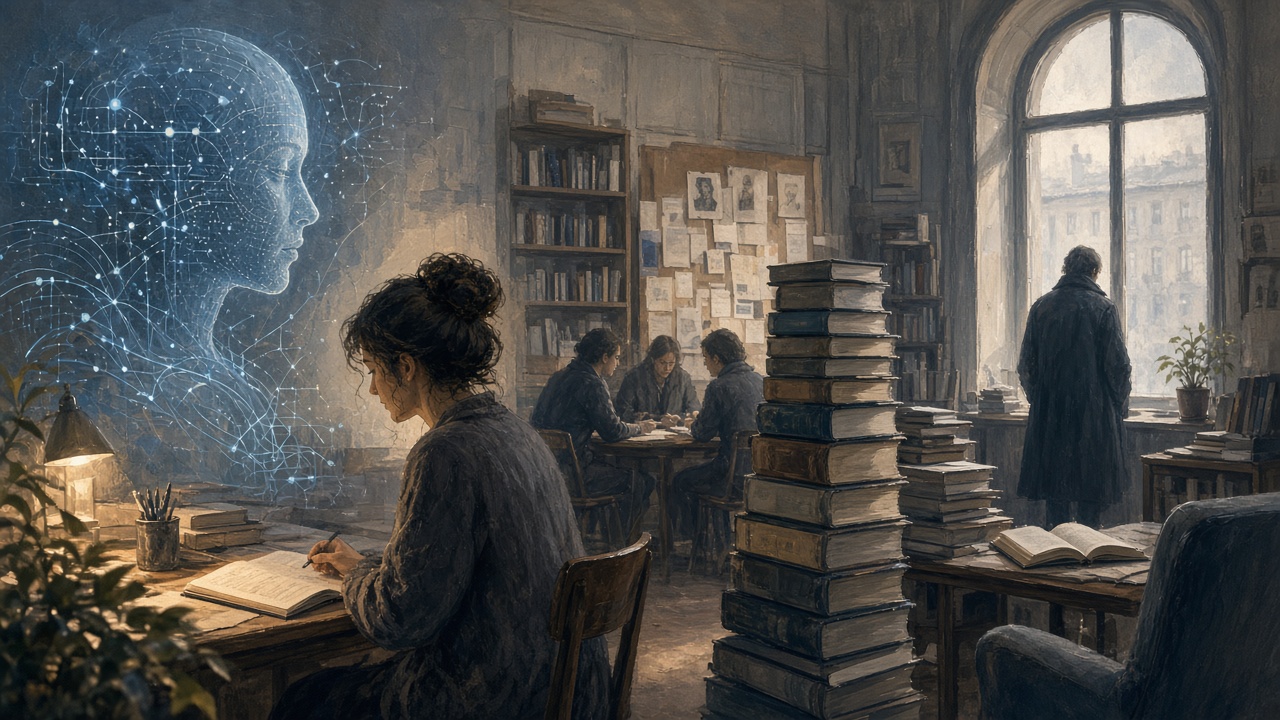
A Literary Hub essay published Monday argues that the literary world has built extensive infrastructure for craft and career development but has no comparable support for writers' spiritual lives, even as anxiety about artificial intelligence grows. The author, Charlotte Donlon, says that gap matters because the writer's soul may be the one thing AI cannot replicate.
Donlon, a spiritual director who works within a Christian framework, writes that AI "can ingest every book in a library and spit our syntax back out to us" but cannot grieve a loss it has never suffered or sit inside silence until it yields meaning. She calls that capacity the soul's domain.
Her essay points to a specific gap in how the industry currently organizes itself. MFA programs, conferences, grants and residencies exist to develop craft. Panels on publishing, money and marketing exist to support careers. Nothing comparable exists, she argues, for writers' inner lives.
She offers one data point from her own experience: at a daylong gathering of more than 120 writers from the South in Birmingham, Alabama, last May, organized around the question of what writers need, not one session touched on the soul.
Why the subject gets avoided
Donlon acknowledges why many writers and institutions steer clear of this territory. Religion has caused harm, she writes, people fear proselytizing, and "soul language can sound fuzzy or exclusionary" in a literary culture that prizes the secular and intellectual. Christian publishing and conferences do discuss the writer's soul openly, she notes, but those spaces are built around particular beliefs and aren't designed for a Buddhist poet, an agnostic novelist, or a writer who left the church but kept the longing.
She describes the resulting split in stark terms: secular literary spaces have "banned the soul from the building," while religious ones have simply shrunk the size of each room.
Donlon says she is not arguing for religious programming in secular spaces. Her own work happens largely within the Christian market, she writes, but making room for writers of any faith or none is, for her, itself a Christian act. She frames the need as human rather than doctrinal, pointing to writers like Toni Morrison, Adam Zagajewski, Kaveh Akbar and Jamie Quatro as examples of authors who explore the soul's deeper waters without requiring readers to sign onto any creed.
A shifting audience
Donlon cites survey data suggesting the audience for these conversations isn't disappearing, just changing shape. About four in ten American adults say they have become more spiritual, she writes, even as far fewer say they've become more religious. Younger adults are drifting from organized religion while holding onto practices like meditation, prayer and time in nature, and a large share of religious "Nones" still engage in explicitly spiritual activities. The share of Americans who call religion crucial to their lives, and who pray and attend services regularly, has held steady since 2020, following decades of religious decline nationwide, according to the essay.
The practical cost of ignoring all this, Donlon argues, is fragmentation. Writers stay spiritually curious in private while appearing professionally secular in public, submitting pitches and meeting deadlines during work hours while losing sleep over AI anxiety and shrinking paid opportunities at night. That split, she writes, wears the soul down and makes creative work feel less authentic over time.
Her proposed fixes are modest additions rather than an overhaul. She suggests literary conferences add sessions on the inner life and sustainable creative practices, MFA programs offer optional courses on contemplation and artistic identity, and residencies treat time away as soul-tending rather than pure productivity. "I am asking for soulful add-ons," she writes, not a replacement for existing craft and career infrastructure.
Donlon is the author of "Spiritual Direction for Writers: Everyday Rituals for Your Writing Life," published by Here Below Books.
Sources
Every quotation and figure in this article is checked against the source reporting linked above before publication. How we report