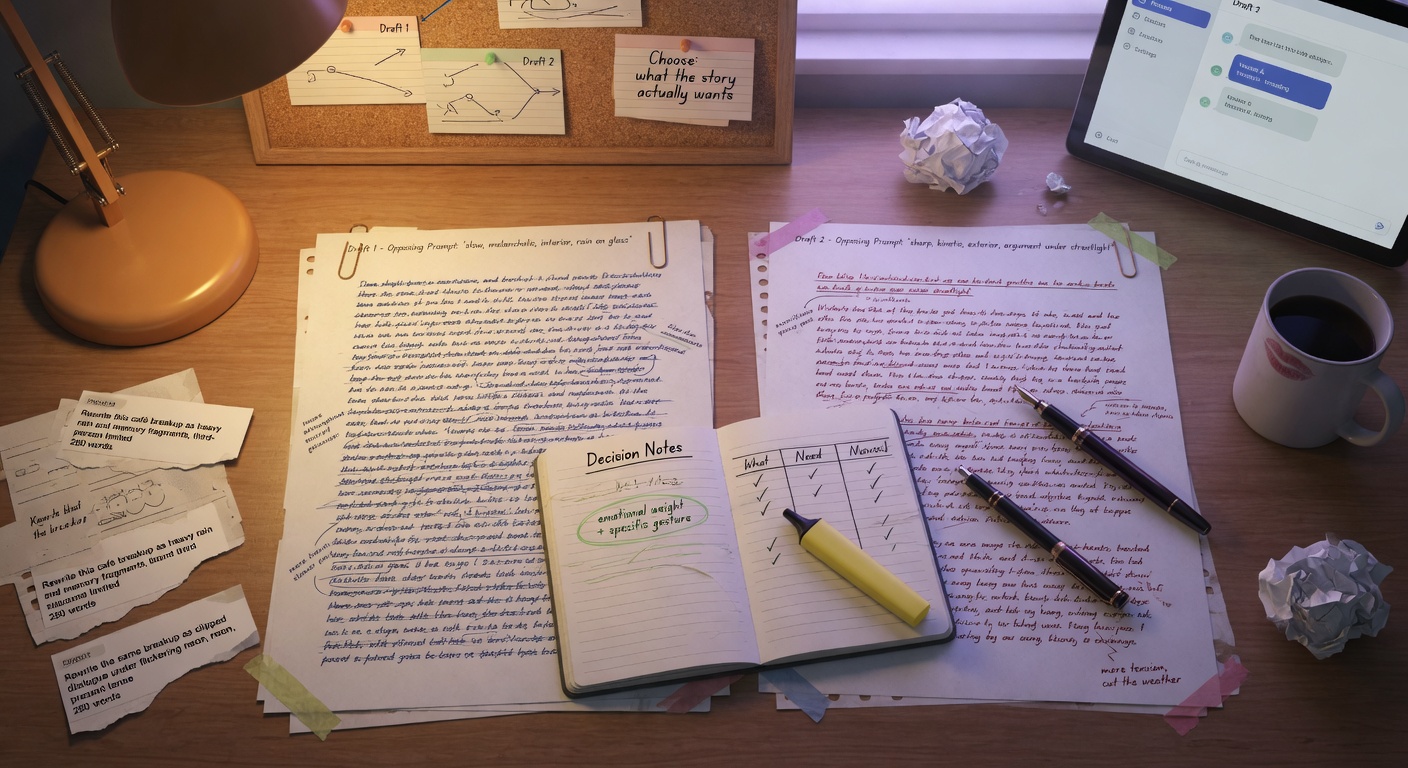
Most writers use AI to draft a scene once, feel lukewarm about it, and then spend twenty minutes nudging it with small follow-up prompts trying to fix whatever's bothering them. The problem is they don't know what's bothering them. They just know the scene isn't right yet.
Drafting the same scene twice — deliberately, with opposing creative parameters — solves this. Not because you'll love one version and hate the other, but because having two versions forces you to articulate what each one is doing. You stop reacting to a single draft and start making actual editorial decisions. That shift, from reacting to deciding, is where your real voice starts to show up.
Here's how to run the whole workflow from setup to final synthesis.
Why Drafting the Same Scene Twice Changes How You Evaluate It
When you read one draft of a scene, your brain treats it as the scene. You evaluate it against some fuzzy internal standard, find it lacking, and try to improve it. You're working in the dark. But when you read two drafts of the same scene that made different choices — one that opens on action, one that opens on interiority; one that's clipped and tense, one that lingers — suddenly you can see the shape of the decision. You're no longer asking "is this good?" You're asking "compared to what?"
The comparison forces you to name what you want. And naming what you want is most of the craft.
There's another benefit. AI has a tendency to drift toward a certain kind of competent averageness — it hedges its tonal bets, lands on a medium pacing, chooses the obvious entry point. When you ask for a single draft, you often get the middle of the road. When you explicitly demand that two drafts be different from each other, you push the AI toward the edges of the creative space, and the edges are where interesting writing lives.
The goal of this workflow isn't to have AI write your scene for you. It's to give yourself two reference points, two different solutions to the same narrative problem, so you can synthesize something better than either.
Setting Up Opposing Parameters: How to Guarantee Two Different Scenes
The most common mistake writers make when asking for two drafts is writing two nearly identical prompts and hoping the AI makes different choices. It won't. Or if it does, the differences will be superficial — a different first word, slightly shuffled sentences. You need to build the divergence in from the start.
The cleanest method is to write a shared context block and then two separate instruction blocks with explicitly opposing directions. Think of it as a brief for two different directors shooting the same scene.
Your shared context block should contain: the scene's narrative function (what it needs to accomplish in the story), the characters present, any fixed facts that can't change (she's holding the letter, it's raining, they're in a parking garage), and the emotional territory the scene needs to cover. Everything else — how you get there, what it sounds like, where it starts — is up for grabs.
Then your two instruction blocks each get a clear creative directive. Not just "make it different" but specific, opposing parameters. Version A: close third-person interiority, slow burn, bitter undercurrent. Version B: distant third, short declarative sentences, the emotional content almost entirely subtext. Those are two genuinely different scenes.
SHARED CONTEXT:
Scene function: Nadia confronts her father about the money he took. This is the moment she stops protecting him. She needs to leave the conversation feeling like she burned something down, not like she won an argument.
Characters: Nadia (32, controlled, has been rehearsing this), her father Bertrand (60s, charming deflector, doesn't take her seriously until it's too late).
Fixed facts: They're in his kitchen. He's making coffee. She doesn't sit down.

VERSION A — write this draft with:
- Close third-person, deep in Nadia's interiority
- Slow pacing with long sentences, physical sensation, the way time stretches when you're terrified
- Tone: grief underneath the anger, like she's mourning him while she's still talking to him

VERSION B — write this draft with:
- More distant third-person, mostly external action and dialogue
- Short sentences. Clipped. White space does the work.
- Tone: cold. The emotional content is entirely in what she doesn't say. The reader has to infer.
Why this works: the shared context block means both drafts solve the same narrative problem, so you can compare them fairly. The opposing instruction blocks guarantee the AI actually makes different choices rather than splitting the difference. The tonal descriptions give it something to aim for beyond mechanics.
What to tweak: adjust the "fixed facts" block to be as specific as your scene needs. If you have a piece of dialogue that has to be in there, put it in the shared context. If you want the scene to end on a specific beat, include that. The parameters you're varying go in the version blocks, not the shared block.
The Four Axes to Vary
You can't vary everything at once — if you do, the drafts become incomparable. Pick one to three axes and push them hard in opposite directions. These four are the most generative:
POV Distance
POV distance is how deep inside a character's head the narration sits. Close distance gives you unfiltered thought, sensation, the character's own metaphors. Distant gives you behavior, what other characters observe, the gap between what's shown and what's felt. Drafting one of each forces you to decide: does this scene need the reader inside Nadia's skull, or does it land harder if we're watching her from outside, unable to reach her?
Pacing
Pacing is how much time the prose spends on each beat. A slow-paced draft might spend three paragraphs on the thirty seconds between when she walks in and when she speaks. A fast-paced draft might cover the same ground in two sentences and cut to the moment everything changes. Seeing both versions reveals where the scene's actual weight is — where slowing down costs you nothing, and where it costs you everything.
Tonal Register
Tonal register is the emotional temperature and the quality of the prose's relationship to the characters. Warm register leans into feeling, uses lush language, lets the reader be in the emotion with the character. Cold register is precise, clinical, slightly removed — it observes rather than participates. You can also vary this as bitter vs. dry, elegiac vs. terse, intimate vs. reportorial. Pick the poles that serve your story's larger tonal DNA.
Entry Point
Entry point is where the scene starts. The same confrontation could open on Nadia's car pulling into the driveway (anticipation), on the moment she walks into the kitchen (arrival), in the middle of the argument once it's already heated (in medias res), or just after the worst thing has been said (aftermath). Different entry points create completely different scenes even if they contain the same core exchange. This is one of the most underrated decisions in scene writing, and seeing two different entry points side by side makes the choice suddenly very clear.
You don't need to vary all four axes. Two opposing parameters, pushed hard, will generate more useful divergence than four parameters held at half-strength.
Running the Comparison Prompt
Once you have your two drafts, resist the urge to immediately start editing one of them. That's the old workflow. Instead, run a comparison prompt. This is a separate prompt where you paste both drafts and ask the AI to analyze them as an editor would — not to pick a winner, but to identify what each version is doing well and what structural trade-offs each one made.
The key is specificity. A vague comparison prompt ("which one is better?") will get you a vague answer. You want the comparison to surface concrete, stealable insights.
Below are two drafts of the same scene. Read both, then give me an editorial breakdown structured like this:

1. WHAT VERSION A DOES WELL: Be specific. Quote a sentence or two that exemplifies it.
2. WHAT VERSION B DOES WELL: Same — quote the passage that's working.
3. WHERE VERSION A LOSES ME: One moment or passage where it drags, overdoes it, or loses tension.
4. WHERE VERSION B LOSES ME: Same.
5. THE TRADE-OFF: What does each version gain and sacrifice in its approach?
6. THE STEAL LIST: Three specific elements from one version that could be transplanted into the other without losing what makes each work.

Do not recommend which version I should develop. That's my decision.

[PASTE VERSION A]
[PASTE VERSION B]
That last line — "do not recommend which version I should develop" — is important. If you let the AI make the call, you'll be tempted to defer to it, and you'll have outsourced the creative decision. The point of the comparison is to give you the information to decide, not to have the decision made for you.
After you get the breakdown, you should be able to answer one question pretty quickly: which version feels more like my book? Not which one is more technically accomplished. Which one sounds like it belongs in the story you're writing. That version becomes the base. The other version becomes the parts bin.
Synthesizing a Final Draft Using a Frankenstein Assembly Prompt
Here's where the workflow pays off. You have your base version. You have your steal list from the comparison prompt. Now you write a synthesis prompt that is extremely explicit about what you're keeping, what you're taking from the other version, and what you want to do differently from both.
Think of it like giving a film editor two cuts of a scene and marking which moments from each cut you want in the final. The more specific you are, the better this works. Vague instructions ("blend the best of both") will produce a muddled average. Specific instructions ("keep the opening paragraph from Version A, take the dialogue rhythm from Version B, cut the flashback that appears in both") will produce something genuinely useful.
I'm drafting a final version of this scene using elements from both drafts below.

Here's exactly what I want:
- Use Version A as the base structure
- Keep Version A's opening: Nadia standing in the doorway watching him, the way she notices the small domestic normalcy of him making coffee before she speaks. That detail is doing real work.
- Replace Version A's dialogue with Version B's. Version B's dialogue is colder, more controlled, which is right for where Nadia is emotionally.
- Cut the flashback in Version A entirely. It's slowing the scene down right when I need momentum.
- Take Version B's final image — her walking out without closing the door — and use it to end this version. But write it with more interiority than Version B gave it. I want to be inside her head for those last few sentences.
- The overall tone should stay close to Version A (grief underneath the anger) but the prose should be tighter — closer to Version B's sentence length.

[PASTE VERSION A]
[PASTE VERSION B]
Why this works: you're treating the AI as a sophisticated assembly tool, not an autonomous writer. You've already done the creative thinking — you know what each version did right, you know what you want — and now you're using the AI's ability to hold multiple tonal registers simultaneously and synthesize them on demand. That's genuinely hard for a human writer to do cold; the AI is very good at it when given clear direction.
The resulting draft will almost certainly need another pass from you. Plan for that. The synthesis prompt gives you a strong raw material, not a finished scene. Your job is to read it, mark what's still off, and either make those edits yourself or run a targeted refinement prompt on the specific passages that aren't landing.
A Note on When to Run This Workflow
This isn't a workflow for every scene. It's best deployed on the scenes where the stakes are high and the path forward isn't obvious — a scene you've been circling for days, a scene that's structurally important but keeps coming out flat, a scene where you know what needs to happen but can't find the right door in. The dual-draft method is an investment that pays off when the scene genuinely matters.
For quick connective tissue scenes — the character crosses the room, makes a phone call, arrives somewhere — just write a single draft and edit it. Save the opposing-parameters approach for the scenes your reader will remember.
One thing I've noticed using this method consistently: the comparison prompt is often more valuable than either draft. Reading a clear-eyed editorial breakdown of two versions you generated, where your own creative intentions are being reflected back to you with specificity, has a way of clarifying not just what you want from this scene but what you want from the whole book. You end up with language for decisions you'd only felt before. That language is the real output of the workflow — the actual draft is just where you put it to use.
Start with a scene you've already attempted at least once and found unsatisfying. Use your existing draft as the blueprint for the shared context block — pull the fixed facts from it, identify its entry point and tonal register, and use those as the baseline for one version. Then push the second version as far in the opposite direction as you can imagine. The more you resist the urge to hedge and ask for something "similar but different," the more useful your two drafts will be.